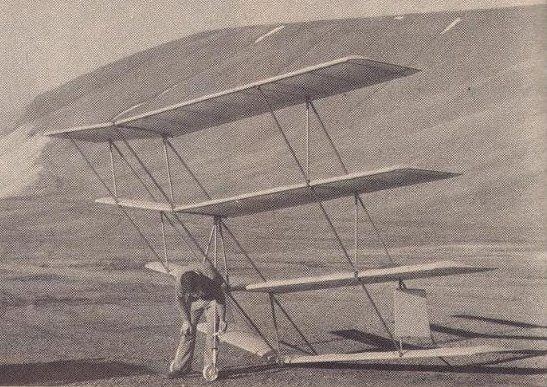
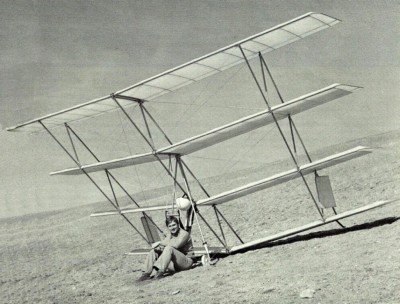
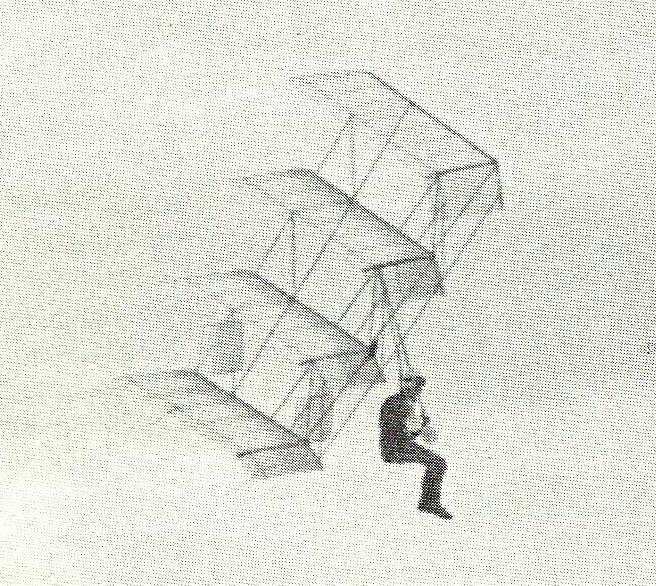
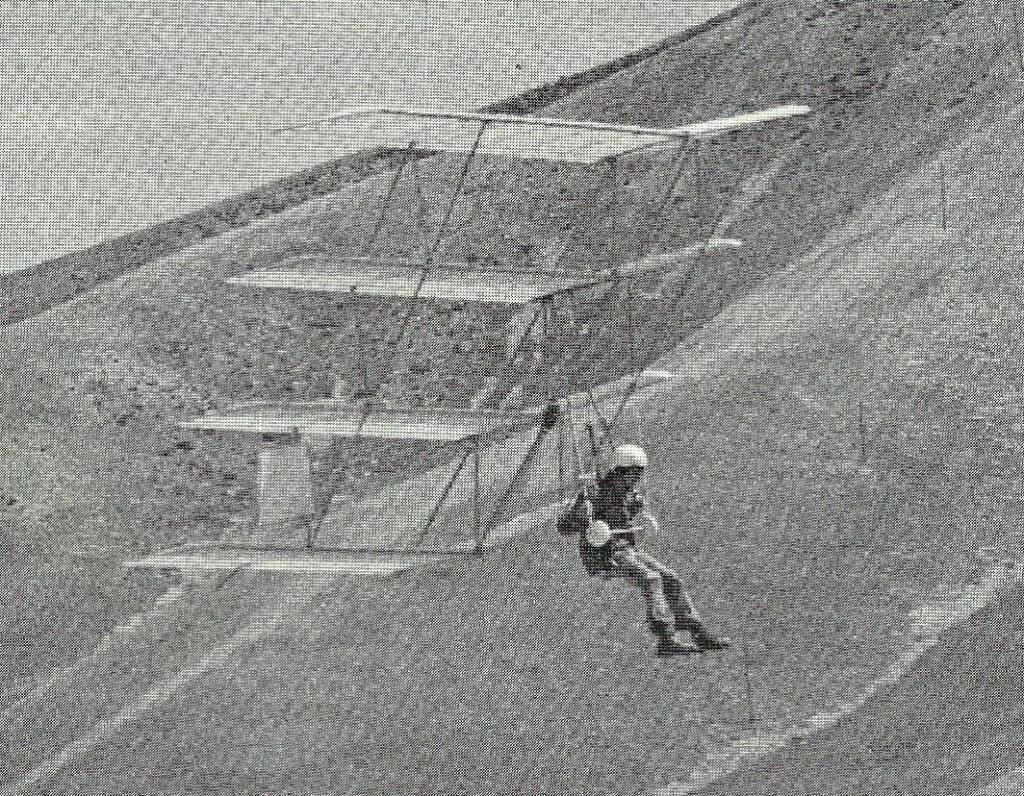
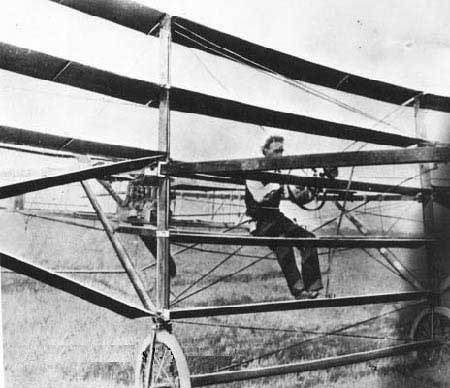
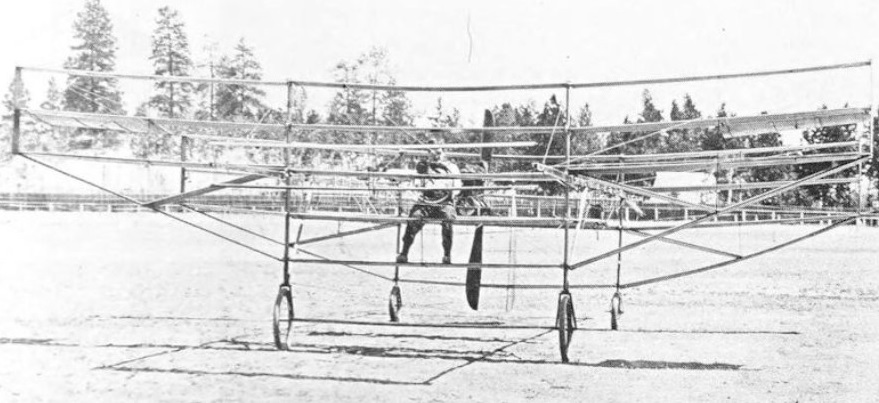
In the late 1970s, an American hang-glider enthusiast called Larry Hall used the Sellers Quadruplane as the basis for his own hang-glider design. The design goal was to fly a human pilot using super-efficient RC sailplane wings, with enough wings (stacked) to keep airspeeds low and provide good soaring ability.
Each wing panel of the QuadraPlane was separate, so setup/teardown always looked like a yard sale in progress. Each wing panel had 1.5 degrees more positive incidence than the wing below, for a total of 4.5 degrees between the top and bottom wings. This was done to provide an automatic dive recovery system, even though no reflexed airfoils were used. This increasing wing incidence, and the forward stagger of the upper wings, assured that they made more lift than the lower (rearward) wings, in a dive, and that would bring the glider back to normal flight modes, very quickly. Back in the day, a hang glider with an automatic dive recovery system was a rare bird.
The QuadraPlane had no tail surfaces. Steering was done by cables to the tip drag rudders, and they were very effective. The short wingspan meant that the QuadraPlane could turn in very small circles, and do it very well.
The pilot sat in a “swing seat” harness, with the pilot’s waist just below the triangle control-bar (where the wheels are). The glider was foot-launched, like any hang glider. In flight, the pilot had an amazing view, being far in front of the lower wings.
The QuadraPlane is now stored in the rafters of a hangar at the Morgan, Utah airstrip.
Spans from top: 20′ 10″; 19′ 10″; 18′ 10″; 17′ 10″ Chord 2′ 6″ Wing Area 185 sq.ft Dihedral 6 degrees Weight Approx. 65 lbs. Stagger 45 degrees Sweep 10 degrees Airfoil Similar to Icarus II without reflex Rudder Area 2.36 sq.ft each Overall height 10 ft
Built in the UK, this 1903 machine, which was about 80 feet in length and 60 feet in width, was to be supported on superposed planes attached to the framework both at the front and rear of the machine. It had three propellers on each side of the framework, and an extra one surmounting the whole structure. The propellers were carried on arms extending from the central driving shaft which form an axis within a rectangle, the two vertical sides of which form axes carrying the vanes of the propellers. During the driving stroke the vanes extended outside beyond the rectangle, while they returned edgewise, in a feathering position, inside it.
Hans Grade built this machine during his military service with the Magdeburg pioneers. At the end of September 1908, the first roll tests began on the Cracauer Anger outside Magdeburg. About a month later, on 2 November 1908, he made the first German powered flight. He reached by the end of the year flights at 1.5 meters altitude over 100 to 400 meters in 30 to 40 seconds, essentially straight ahead. In 1909, he decided to finish the experiments and build a new aircraft, based on the experience gained. This new monoplane won him the Lanz Prize on October 30, 1909. A replica of the machine can be found at the Technikmuseum Magdeburg.
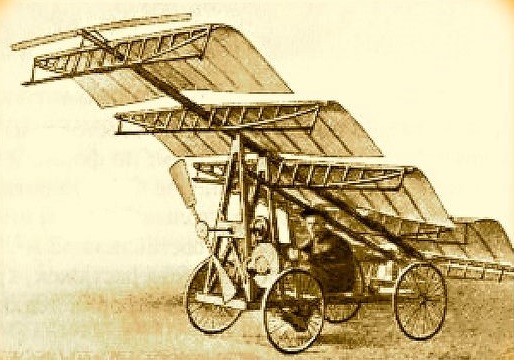
Following the crash of the Twinplane, Gibson resolved to build another aircraft. Although he used the same engine and some parts from the Twinplane, to pay for the new machine he had to sell his house.
The new design retained much of his original concept and used the four-wheel undercarriage with the engine mounted approximately centrally between the wheels but this time driving a single pusher propeller.
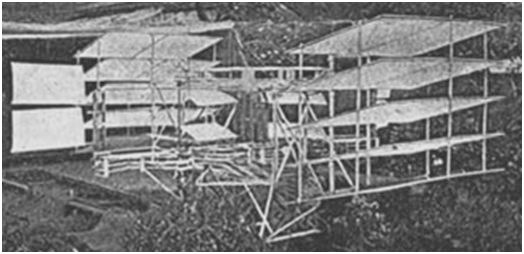
The design change was in the wings and control system. Gibson had read Sir Hiram S. Maxim’s Artificial and Natural Flight and became convinced of the value of high aspect ratio wings. So for the tandem monoplane wings of the Twinplane he substituted two sets of very narrow triplane wings (Gibson was quoted as saying ‘None of the lifting parts are over 12in (30cm) in width’), and the forward elevator was altered to a narrow-chord biplane structure. Ailerons were placed on the outer ends of the centre plane of the front set of wings. The pilot’s controls now consisted of foot pedals to operate the rudder, and a wheel to operate the ailerons when rotated and the elevators when moved fore and aft.
The Multi-plane was built at Ladner, near Victoria, on the ranch of British Columbia’s Lt-Governor Pattison, and $10,000 was reported to have been spent on its construction. It was shown at a Made-in-Canada Fair at Vancouver on 8-14 June, 1911. Its exhibition was the responsibility of Jack Woods who was associated with Gibson but whose role in the construction of the machine is not known. At the Fair, Gibson met Alexander M. Jaap of Forest, Ontario, and he joined Gibson in his experiments. The aircraft was then shipped to Kamloops, British Columbia, where it was exhibited again, and between the two exhibitions some modifications were made to the rear undercarriage.
The Multi-plane was then shipped to Calgary and taken by horse to Jack Hayes’ ranch about three miles north of the city. It was reported that, beginning early in July, the Multi-plane made a number of successful short flights, with Jaap at the controls as Gibson had promised his wife that he would not fly.
The most successful flight was the last on 11 August, 1911, and the Calgary Herald reported it as follows: ‘While attempting to make a landing from a height of over 100 feet in the air – Alex Jaap – crashed down into a swampy coulee – and narrowly escaped death. His machine was badly wrecked. Jaap, who had flown about a mile in a test flight, miscalculated the ground on which he proposed to descend, and when within 50 feet of the earth noticed that the turf was honeycombed with badger holes. He attempted to ascend – but it was tod late. His engine had stopped and refused to start again. His only chance – was to drop obliquely into the swampy ground of a nearby coulee. When the machine swooped down into the soft soil the wheels stuck in the mud and the terrific momentum literally tore the aeroplane to pieces. Had it not been for the unusual construction of the machine the motor would have fallen upon him [Jaap] and crushed his life out. As it was he escaped with a few bruises.’
After the accident Gibson announced that he would ‘rebuild my machine with pressed steel plates’ which he was going to have made in Toronto. It was also reported that when rebuilt it would be flown by P. Julien Chatel, a Calgary man who was stated to have worked with Louis Bleriot in France. The machine was never rebuilt. Thanks to the efforts of the well-known Canadian aviation historian, the late Frank H. Ellis, the Gibson engine, Canada’s first aviation engine, was located and is now in the National Aeronautical Collection at Ottawa.
Engine: One 40 hp Gibson. Empty weight: 700 lb (318 kg).
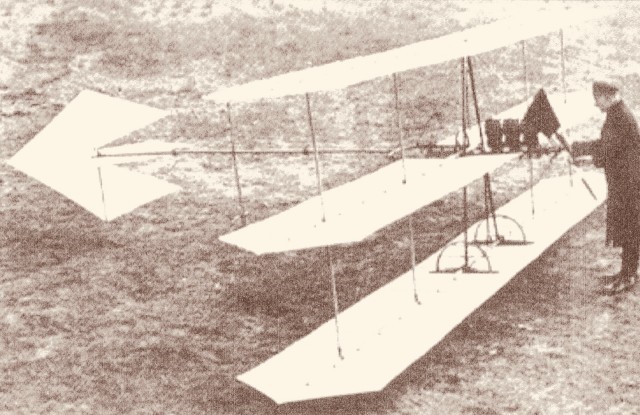
Designed and built by Yevgeny Stepanovich Fyodorov (Евгений Степанович Фёдоров) during the period 1895 until 1903. Fyodorov had a career in the military as an engineer, where in 1895 he presented a model aeroplane project with a “split-wing” (самолёта-пятиплана). This model was successfully flown behind an automobile, which towed the model. On the results of the tests with this model Fyodorov decided to build a full scale aeroplane at his own expense. According to sources it was finished, but never flight tested. The machine of Fyodorov is considered the second constructed flying machine after the one of Mozhaiski (Можа́йский).
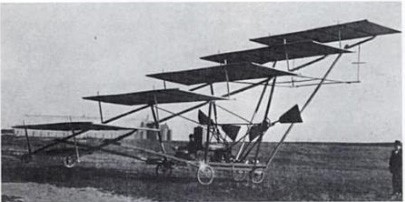
Built and demonstrated at Flugplatz Johnannisthal in 1911, but apparently did not fly. Later, the machine was modified, and it appears questionable whether the revision flew either. The secretive Merx Fünfdecker had “Himmelsleiter” (sky ladder) built and kept in its shed – hidden from prying eyes. When the first flight test was to take place, it turned out that the apparatus was higher than the door and could not be pulled out of the shed. Also known as the Mehrdecker-Versuchsflugzeug von J. Merx, (multiplane-experimental).
The 1918 Friedrichshafen FF60, a four engined triplane floatplane, was intended as a naval patrol and torpedo carrier but never fully developed due to the Armistice in November 1918.
 All Aero