Tarrant Tabor

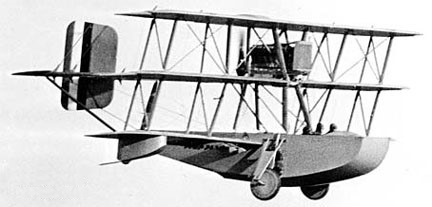
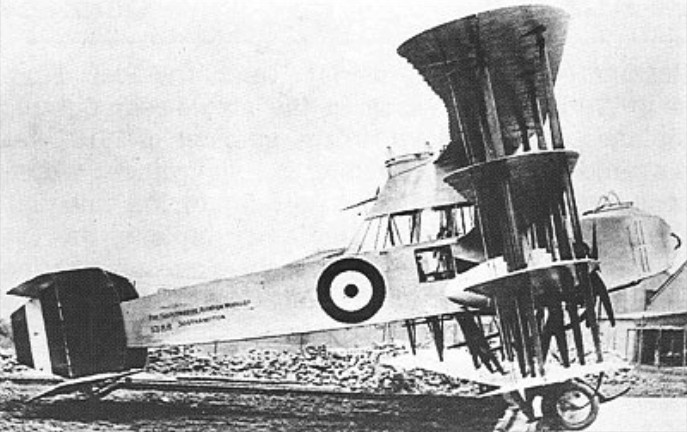
One patriot who felt he could fill this gap and strike a blow at the Kaiser was a Surrey building contractor, W. G. Tarrant, whose company had been involved in wartime contract work manufacturing wooden aircraft components. Tarrant hired Walter Henry Barling to design the aircraft, which was to be a ‘bloody paralyzer’ of a triplane made entirely of home-grown timber and constructed using a largely female work force, according to the terms of the contract issued by the Ministry of Munitions. The massive Tabor triplane was the first and last aeroplane built by W. G. Tarrant Ltd of Byfleet, Surrey. Designed in an attempt to enable Berlin to be bombed from bases in England, and assembled at RAE Farnborough, the aircraft was not completed until 1919.

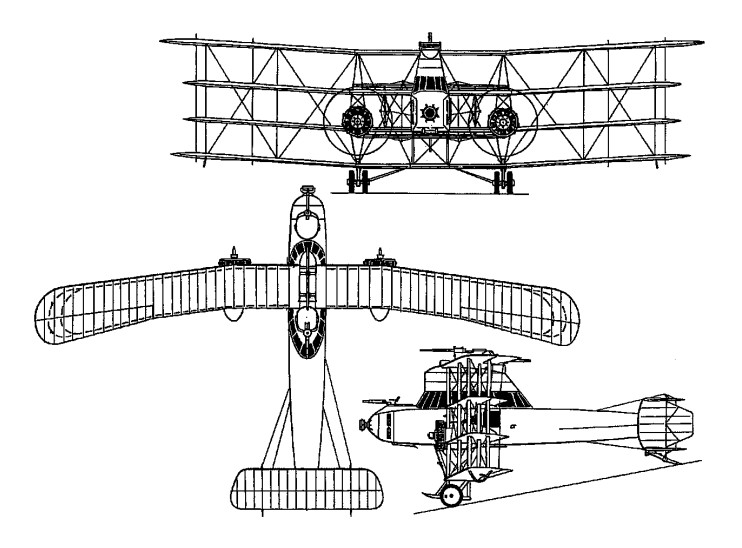
When it appeared, too late for its intended purpose, it spanned 40m (131 ft 3 in) from tip to tip of its middle wing, and had a 22.25m (131 ft 3 in) fuselage of monocoque construction formed from ply skinning over Warren-girder type circular formers. Serialled F1765, the one and only completed Tabor was powered by a total of six 450 h.p. Napier Lion engines: two pairs in push-pull tandem between lower and middle wings, and another two tractor engines between middle and top planes. The fuselage was of finely streamlined monocoque construction, while the tail consisted of a biplane unit with twin fins and rudders.

The Tabor stood as high as a four-storey house, and its height, and particularly the location of its upper engines, brought about its speedy demise. On 26 May 1919 the giant Tabor was winched out of the balloon shed at the Royal Aircraft Establishment at Farnborough along a specially built railway track. Some 508 kg (1120 lb) of lead was loaded into the nose at the last moment when some final calculations showed that the aircraft might be tail heavy, and the long, wearisome process of hand-starting the six Napier Lions began. With all engines running the pilot, Captain F. G. Dunn, and his co-pilot, Captain P. T. Rawlings, began taxi trials. Also aboard were a technical observer from Tarrant’s, a fitter, an engineer officer, and two foremen from the RAE. When Dunn opened up the top engines, which had previously been throttled back, and the sudden extra thrust so far above the aircraft’s centreline caused it to nose-over and bury its forward fuselage in the earth just as it was about to leave the ground. The two pilots died shortly afterwards of their injuries and Tarrant, perhaps fortunately for other aviators, never again dabbled with aviation.

Construction of a second Tabor was abandoned.

Engines: 6 x Napier Lion, 450 hp
Wingspan: 40m (131 ft 3 in)
Fuselage length: 22.25m (131 ft 3 in)
Weight: 45,000 lb
Tarrant, W.G.

UK
Building contractor of Byfleet, near Brooklands, Surrey, which undertook aircraft component manufacture during First World War. Only aircraft produced was Tabor long range bomber, designed with collaboration from Royal Aircraft Establishment; this six-engined triplane nosed-over and was wrecked in its first attempt to take off in May 1919.

Supermarine P.B.31 NightHawk / Pemberton-Billing P.B.31E

When Pemberton-Billing Ltd changed its name to Supermarine Aviation in December 1916, work on a further airship fighter, the P.B.31E, had reached an advanced stage and the first prototype of this quadruplane was to fly shortly afterwards, in February 1917.

Fundamentally an extrapolation of the P.B.29E, and unofficially known as Night Hawk, the P.B.31E was designed to have a maximum endurance in excess of 18 hours to enable it to lie in wait for intruding airships.

A three-bay narrow chord quadruplane powered by two 100hp Anzani nine-cylinder radials, the P.B.31E carried a searchlight in the extreme nose. The four wings had considerable sweepback of their outer sections. The intended armament comprised a one-and-a-half pounder Davis gun on a traversing mounting in a forward position level with the top wing, a 7.7mm machine gun being located in a second position immediately aft and a similar weapon occupying a forward fuselage position.

Shortly after the start of flight trials, the shortcomings of the concept were finally appreciated, and, on 23 July 1917, the first prototype was scrapped and the second incomplete prototype abandoned.

Engines: two 100hp Anzani nine-cylinder radials
Max take-off weight: 2788 kg / 6147 lb
Empty weight: 1668 kg / 3677 lb
Wingspan: 18.29 m / 60 ft 0 in
Length: 11.24 m / 37 ft 11 in
Height: 5.40 m / 18 ft 9 in
Wing area: 89.37 sq.m / 961.97 sq ft
Max. speed: 121 km/h / 75 mph
Fuel capacity: 1016 kg / 2240 lb

Pemberton-Billing (Supermarine) P.B.31E

Stebbins-Geynet Tri-Bi-plane / Model A / Model B

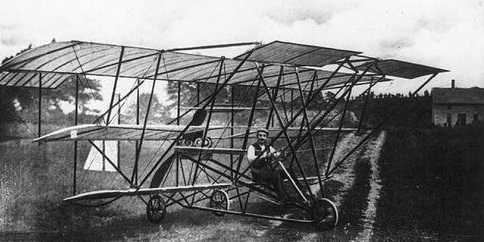
Airplane built by the Stebbins-Geynet Aeroplane Company of Norwich, Connecticut (William H. Stebbins of the USA and Louis Geynet of France), possibly the model A of 1909, which was equipped with a Cameron 25-30 hp four-cylinder, air-cooled engine. As a tri-bi-plane it had a detachable middle wing, which once removed converted the machine from a triplane into a biplane. Positive control was secured by use of the Stebbins-Geynet “auto-control” system. A pull or push movement operated the elevating rudders, while the balancing was done by means of side movements or slight turns. The rear vertical rudder was manipulated by means of a foot lever. It featured a single-place, open cockpit.

The Model B followed in 1910, same as the Model A, but with a seven-cylinder Holmes-modified Gnôme rotary, and 6sqft rudder instead of 10sqft.

Model A
Engine: 35-40hp Cameron pusher
Wingspan: 24’0″
Seats: 1

Model B
Engine: Gnôme
Wingspan: 24’0″
Seats: 1

Sorrell Triplane

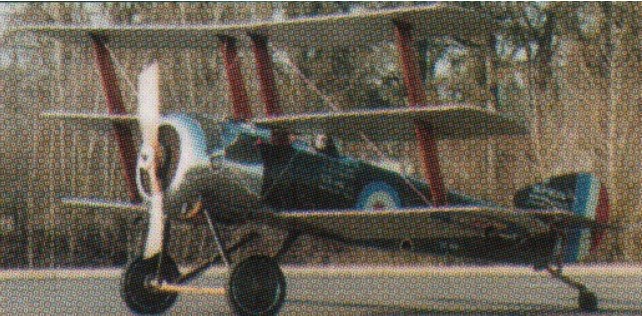
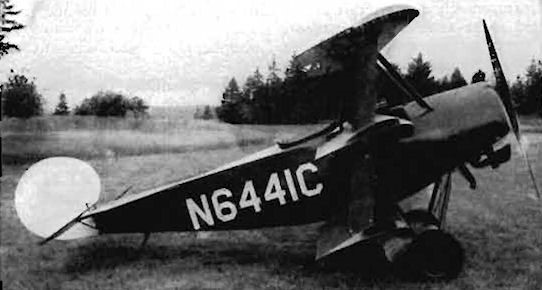
The 1957 Sorrell Triplane N6441C is a three-quarter scale replica of the WW1 Fokker triplane. Painted red, with silver rudder and white lettering, the single-seat Sorrell Triplane has a span of approximately 17 ft. 8 in., and is powered by a 65-hp Continental A65 flat-four.

The owner-constructor flew it from a private airstrip at Rochester (Washington State).

Sopwith Snark

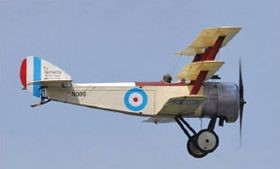
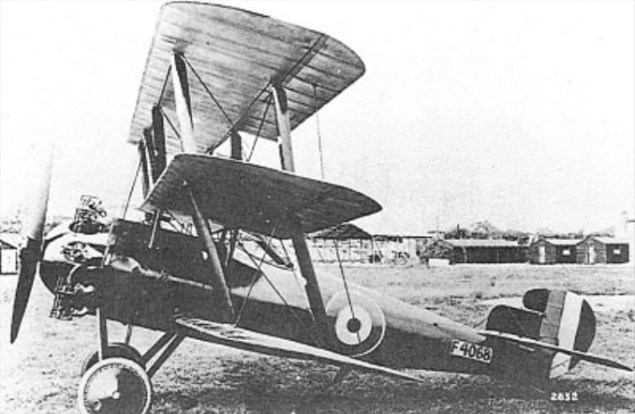
On 14 May 1918, Sopwith was awarded a contract for three prototypes of a new single-seat fighting triplane, conforming to the RAF Type I specification and named the Snark. Powered by a 320hp A.B.C. Dragonfly I nine cylinder radial and featuring a plywood monocoque fuselage, the Snark was an equi-span staggered triplane and its designed armament was two synchronised 7.7mm guns on the fuselage and four weapons of similar calibre mounted two per side under the bottom wing. The first Snark was passed for flight test in September 1918, but unavailability of a Dragonfly engine and the decision to make various minor modifications delayed manufacturer’s trials until September of the following year, the aircraft arriving at Martlesham Heath for official trials on 12 November 1919. The second prototype reached Martlesham on 17 March 1920, and the third prototype, with a 360hp Dragonfly la engine, late in the year. Apart from engine problems, the Snark triplanes suffered fuselage deterioration and all three were written off in 1921.

Engine: 320hp A.B.C. Dragonfly I
Max take-off weight: 1036 kg / 2284 lb
Wingspan: 8.08 m / 27 ft 6 in
Length: 6.25 m / 21 ft 6 in
Height: 3.30 m / 11 ft 10 in
Wing area: 29.91 sq.m / 321.95 sq ft
Max. speed: 209 km/h / 130 mph