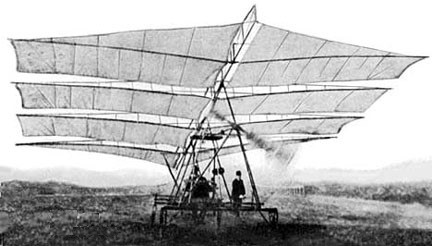
In 1908 C W Williams built a four parafoil-type wings over an A-frame. It is not recorded if it flew.
In 1908 C W Williams built a four parafoil-type wings over an A-frame. It is not recorded if it flew.

Les Wilms, of 2142 Dayton Street, Chicago, had been experimenting in airship construction and navigation since 1895. His 1910 flying machine, besides framework and a seat for the operator, consisted of a canvas sustainer overhead, flails of canvas and a rudder of like material. The hand-propelled flails, the inventor said, acted on the principle of the feathers in a bird’s wings. The aircraft, which was named “Dinosaur,” was launched into space with the aid of an incline. Trial trips conducted privately northwest of Ravenswood manor were said to have been successful.
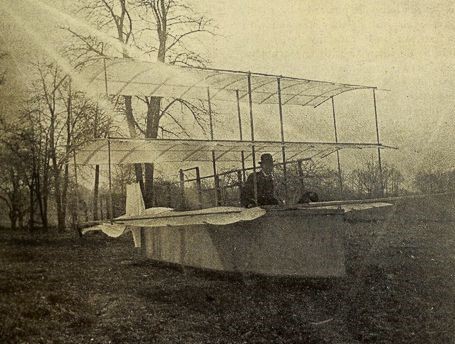
Whitehead’s airplanes are notoriously undocumented. There seems to have been a development from a triplane glider to a powered version either with a single tractor propeller or two tractor propellers running in opposite directions. The triplane could be flown without or with the body. The triplane glider with body attached, was later flown without the body. The proposed twin-propeller tractor version of the triplane with body may or may not have been built or flown.

Of 46 foot span and fitted with a 35 hp JAP radial motor, this triplane was designed by Henry Seddon Wildeblood and built by the Upper India Motor Company of Lucknow, India, in August 1911.
Reportedly at least one of the 1919 West Virginia C-3 were built. A three-place, open triplane, power was a 150hp Wright-Hispano A engine.

Designed by a collective [Аэроплан АПВ (Коллективный)] in 1909 under Alexander Petrovich Vernander (Александр Петрович ВЕРНАНДЕР – 1844-1918), professor of the Military Academy of Engineering, then second chief of the engineering bureau in Gatchina. Among the seven aircraft constructed in Gatchina one was christened „ласточку“ – swallow – a triplane that followed the Wright design but with curved wings, its propulsion consisting of a 25 hp REP engine, that drove two inward slanted propellers via bevel gear, to centre the air stream onto the rudder’s sides. Construction began in St. Petersburg in 1909, but the machine was not completed when construction ended in 1910.
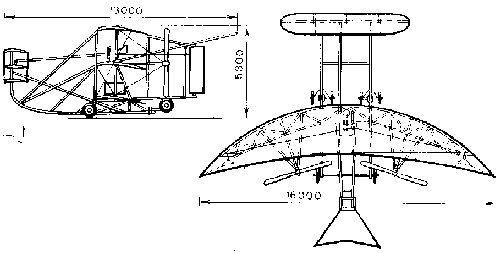
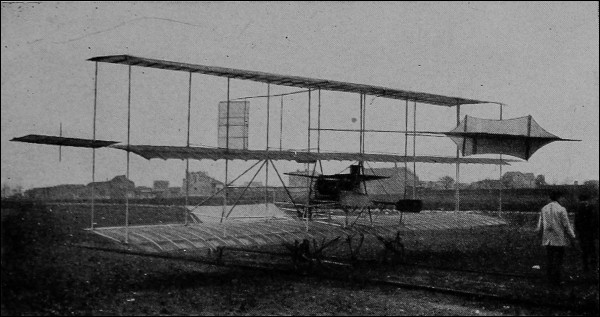
Melvin Vaniman built his own aeroplane in 1906… a triplane, in fact… the first ever triplane. Made of three arched planes, supported by a frame of steel tubes, each measuring 11 meters (36-feet) in length and 2 meters 20 cm (7.2-feet) in breadth. Total surface area: 72 (square) meters (775-square-feet). 70/80 HP Antoinette engine with 8 cylinders driving a propeller with two arms placed to the rear. The length is six meters (19.7 feet). In front, two elevators (or rudders): one horizontal and placed in the lower part, serves to control the altitude; the second, vertical, placed about 2/3 of the height of the machine, controls the direction and the turning, whether one tilts to the right or the left. The function of warping the wings is made by means of an arrangement placed on the shoulders of the aviator, and the direction to the right or the left by means of two pedals. Total weight: 500 kilograms (1,102.3-pounds).
There seems to be some discrepancy over whether or not his triplane actually flew. In 1907 Vaniman appears to have given up on aeroplanes saying: “I once had great faith in aeroplanes… I am firmly set in my belief that the aeroplane will never be a cargo carrier.”

Vaniman did not participate in the 1909 Reims air show… because he was already heavily at work on his dirigible, and therefore, there is no way anyone anywhere saw him fly at Reims some 150 meters (492 feet).
The 1911-series of 75 Aviation cards from Wills’s shows the Vaniman triplane in flight… and despite the date, it actually shows the earlier machine… perhaps more for what they hoped it actually represented… a triplane…

The two machines are basically the same: a triplane, with twin-boom outriggers, a high rectangular vertical surface, a single pusher propeller. But the two Vaniman triplanes are otherwise quite different.
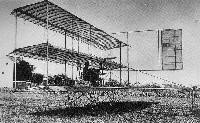


Span: 36’1″
Length: 19’8″
Weight: 1100 lb
The 1909 U.F.A. triplane was designed and built by Union Francaise Aerienne in France.
Span: 26’3″
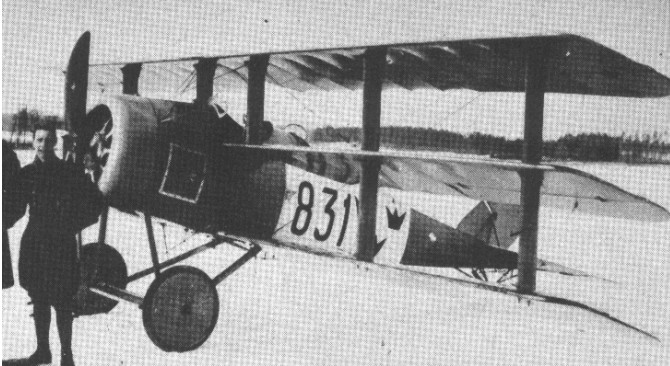
A Multiplane built in 1909. No specs or data in 1909 Jane’s, only that “the top plane is used as a horizontal rudder”.
 All Aero