Unidentified Quadruplane

Unidentified Quadruplane
The 1909 Zipfel triplane was designed by Armand Zipfel and built by Voisins in France.
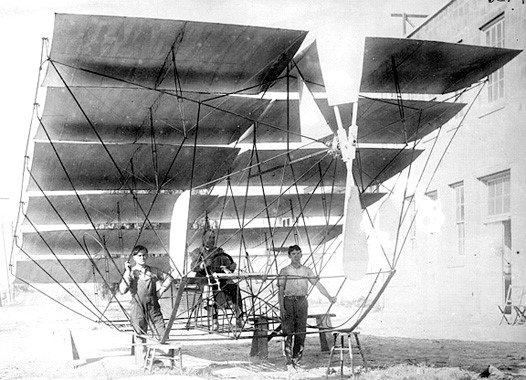
Californian Professor Jerome S. Zerbe produced a sextuplane with six 15′ wings forward-staggered over a framework bearing two tractor props, but there are no records of its success, if any.

In 1909 Californian Professor Jerome S. Zerbe built the four place cabin quadruplane Air Sedan. There were four short-span, double-cambered, forward-staggered wings, apparently with a ganged variable angle of attack. The cabin was plywood-clad.
Powered by a 100hp Gnôme or 90hp LeRhône rotary, it was flown by Tom Flannery from a field on the Washington County fairgrounds for a distance of about 1,000′ before being damaged on landing. No other flights were recorded.
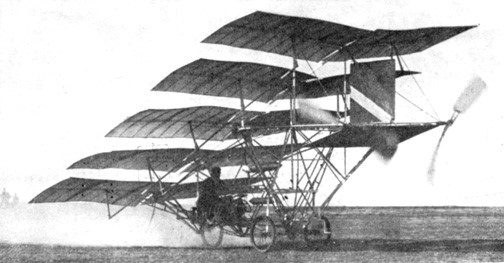
James Slough Zerbe, known as Professor Jerome S. Zerbe built three multiplanes circa 1910. The Quintaplane of 1910 had five wings attached to what appears to be a flying motorcycle.
Whether or not it ever flew is unknown, but the second five-wing multiplane built by Californian Professor Jerome S. Zerbe, came to grief on January 11, 1910 during the 1910 Los Angeles International Air Meet at Dominguez Mesa. It was reported as being “a casualty before becoming airborne.”

James Slough Zerbe, known as Professor Jerome S. Zerbe built three multiplanes circa 1910.
Multiplane of 1910.
The second five-wing multiplane built by Californian Professor Jerome S. Zerbe, came to grief on January 11, 1910 during the 1910 Los Angeles International Air Meet at Dominguez Mesa.
In September 1916 Imperial Russian Army opened a contest for a design of a three-seat army co-operation aircraft. Zalwski designed a quadruplane (which he designated WZ-V) that was to be built at Kiev, but overall situation made it impossible. The designed aircraft had a crew of three (two seating abreast in the front cockpit plus gunner behind them), a wooden construction and 220 hp Renault engine.
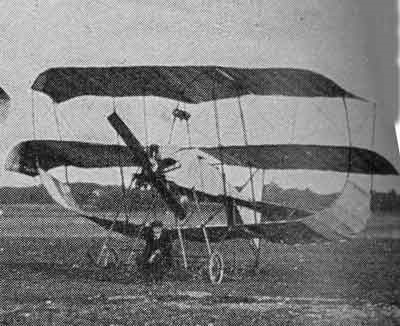
Swiss designed and built by Fritz Wullschleger and Albert Peier in 1913; their design of the triplane was uniquely implemented as the wing tips on the upper plane were folded down and on the lowest plane were folded up. The whole resulted in an almost closed-wing construction. As can be seen from other photographs of the machine, it was a two-seater, powered by a 5-cylinder Anzani air-cooled engine. Unfortunately the machine never got off the ground.
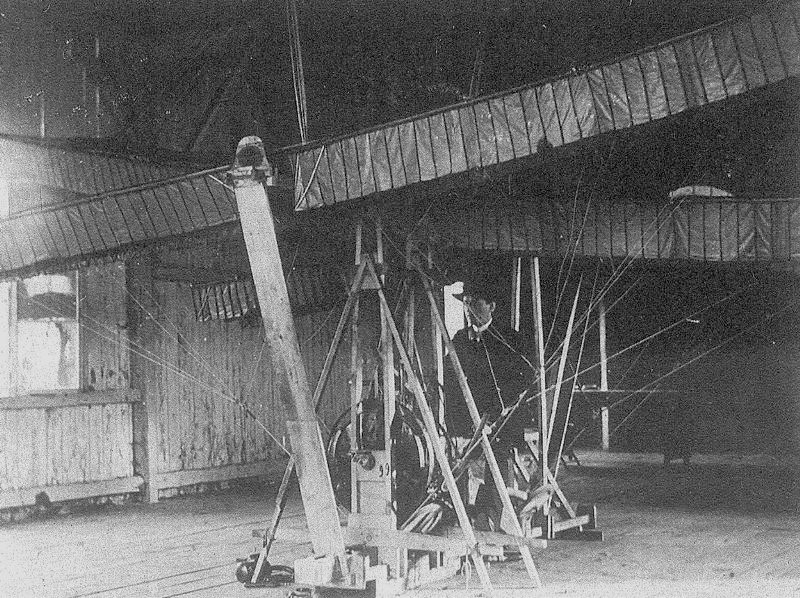
Alois Wolfmüller’s “Schlagflügelapparatur”, or “Standflugmaschine”, dated from December 1901. Powered by an 18 hp three-cylinder engine of Wolfmüller’s own design, the ornithopter with three wings in tandem arrangement was apparently able to rise 60 cm off the floor, but was very unstable. It was inspired by an 1868 test-rig of his friend Otto Lilienthal.
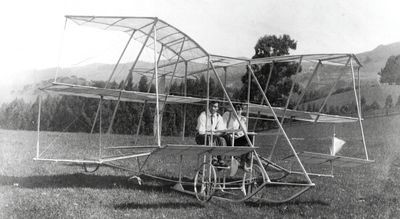
Triplane duo-seat glider designed and built in 1909 by Carl Wolf and August Becher, variously described as being from Oakland, California or Fitchberg, California. The aircraft is said to have made flights of up to 200 feet when launched from a specially built inclined ramp, 50 feet in height.
Wingspan: 19′ 8″
Wing area: 220 sq ft
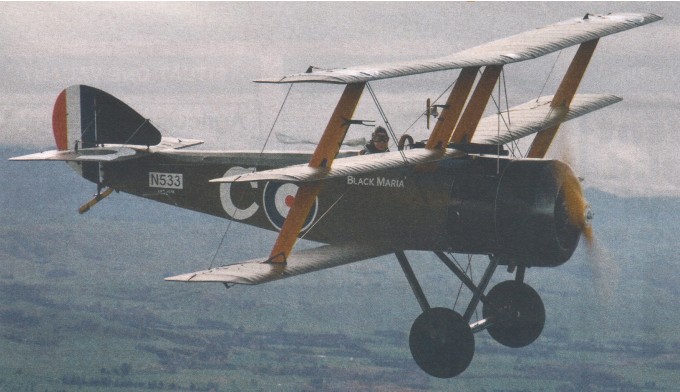
Chad Willie of Corning, Iowa, USA, has built several examples of Sopwith Triplane replicas working from original drawings and dimensions, but incorporating some modern construction techniques including steel tube fuselage, a modern engine, and simplified wing construction.
The Vintage Aviator Ltd fitted a Russian M-14P direct drive 9 cylinder 220 hp radial and one of its own replica Vickers machine guns. The top speed is about 115 mph and it lands at a comfortable 40 mph.
 All Aero