Avro IV Triplane / Bellamy Avro IV Triplane

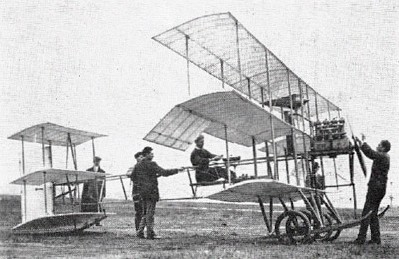
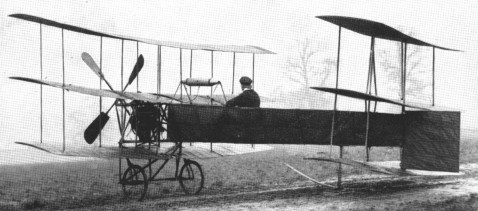
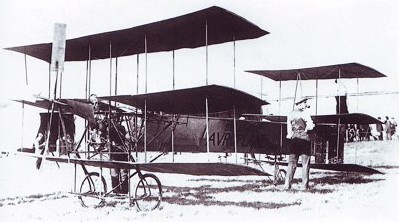
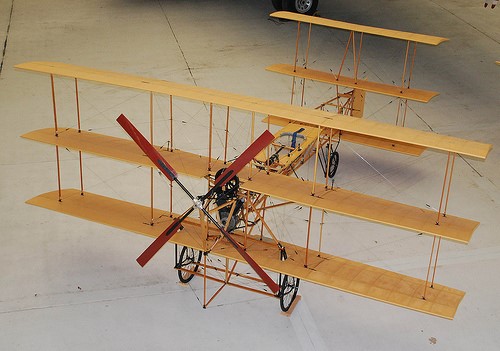
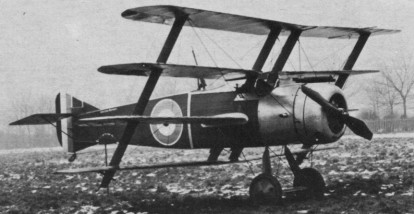
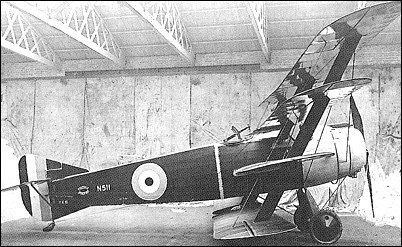
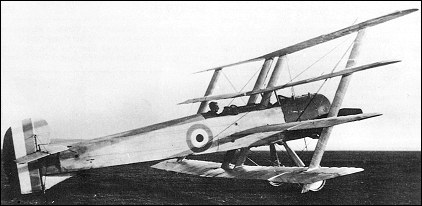
Three Avro IV Triplane (one static) were built in 1964 by the Hampshire Aero Club for the film “Those Magnificent Men in Their Flying machines”. Of all-wood construction and powered by a Cirrus II engine, they were designed by R.Hilbourne. The construction of the triplane followed A.V. Roe’s specifications and was the only replica that utilised wing-warping successfully. With a more powerful 90 hp Cirrus II replacing the 35 hp Green engine that was in the original design.

The first was flown on 9 May 1964. One passed to the Shuttleworth Trust after the film, who kept it airworthy at Old Warden as BAPC.1.

Replica

Replica:
Bianchi Avro IV Triplane

Engine: 1 x 35hp Green
Wingspan upper: 9.75 m / 32 ft 0 in
Wingspan middle: 9.75 m / 32 ft 0 in
Wingspan lower: 6.0 m / 20 ft 0 in
Length: 10.3 m / 34 ft 0 in
Height: 3.3 m / 11 ft 2 in
Wing area: 27.31 sq.m / 293.96 sq ft
Empty weight: 158 kg / 350 lb
Take-off weight: 295 kg / 650 lb
Max speed: 64 kph / 40 mph

Avro II Triplane / Mercury

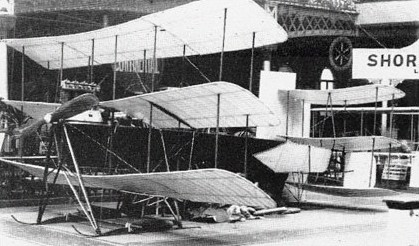
After A.V.Roe moved his entire operation back to Brooklands, he constructed the first aircraft to be built by the company; the Roe II Triplane, named Mercury. It was designed by Alliott Verdon Roe as a sturdier development of his wood-and-paper Roe I Triplane.

It was a single seat triplane powered by a 35 hp Green water-cooled, four cylinder engine. The engine’s radiators were mounted flush along the side of the front section of the triangular shaped fuselage, which was constructed from ash, with silver spruce struts and spars, all covered in Pegamoid fabric. The three wings were of equal length, as was the triplane tail section, from which control of climbing and diving by means of pivoting the entire section, which was in turn linked to the centre mainplane variable incidence gear, was carried out. Control of the mainplane was by a single cntrol stick in the pilot’s cockpit. The two wheeled undercarriage was secured to the axle by rubber shock absorber cord, which in turn was fixed to a rigid, tubular steel triangulated structure.

On 4 March 1910, the aircraft appeared in public for the first time at the Olympia Aero Show in London. A.V.Roe showed the Prince and Princess of Wales around the machine himself. Priced at £550, including instruction, an order was received while at the show, from Sir Walter Windham, MP, who also manufactured car bodies.

First flown in April 1910, the show aircraft was retained by the company for training and experimental purposes. During a flight training sessions, student pilots crashed on landing, rolled twice on take-off, resulting in a number of modifications being made. After the second crash the centre of gravity was corrected by moving the pilot’s seat forward, the wing warping control was abandoned and large, unbalanced ailerons were fitted to the upper wing. The work was completed in ten days, and tests carried out proved to be more than satisfactory.

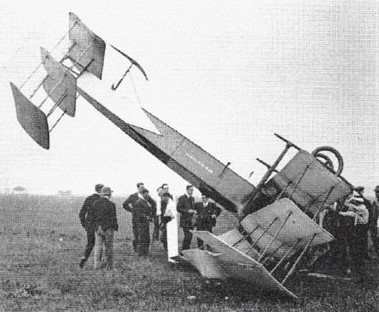
At the beginning of May, Sir Walter Windham’s aircraft was ready and after some initial instruction he took control of his aircraft. The taxying trials were successful, and Sir Walter took to the air a couple of days later. Not much is known about what happened to the aircraft, but it is known that on one of his landings the ground turned out to be too soft and the aircraft flipped on to its back.

The performance of the A.V.Roe aircraft improved and it was finally dispatched by rail to the Blackpool Flying Meeting with the Roe III but on the journey the goods train set fire due to sparks coming out of the engine and landing on the truck. Both the Roe III and Mercury were totally burnt-out.

The longest recorded flight made by the II Triplane was only 600 ft (180 m).

Engine: × Green C.4 4-cylinder inline water-cooled, 35 hp (26 kW)
Propellers: 2-bladed
Wingspan: 26 ft (7.9 m)
Wing area: 280 sq ft (26 sq.m)
Length: 23 ft (7.0 m)
Height: 9 ft (2.7 m)
Empty weight: 150 lb / 68 kg
Gross weight: 550 lb (249 kg)
Maximum speed: 45 mph (72 km/h; 39 kn)
Seats: 1

Avro Triplane I (Bull’s Eye Avroplane) 1909

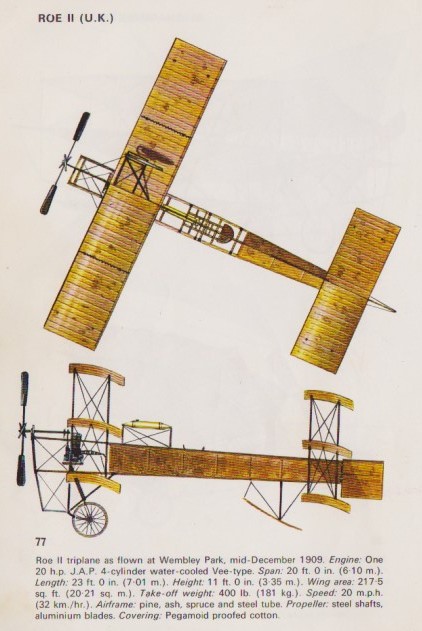
Alliot Verdon Roe transferred his experiments to Lea Marshes in 1909 and designed a triplane. Unable to afford the hire of the Antoinette engine, he built a triplane and covered its wings with brown paper in the hopes that it would be light enough to fly on 9 hp. On 13 July 1909 at Lea Marshes, with Roe at the controls, the Triplane No 1 became the first British built and piloted aeroplane to make a successful flight in England.

Testing at Wembley Park in January 1910, the 20 hp /JAP engine was sufficient to allow circuits of the airfield with few mishaps.

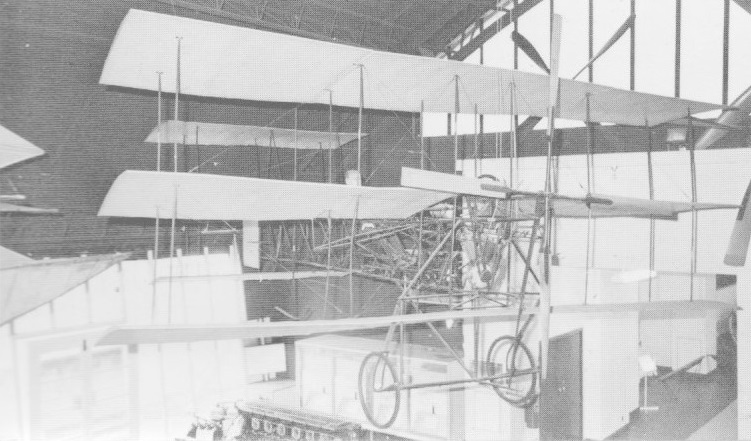
His triplane is now preserved in the National Aeronautical Collection at South Kensington.

In London movie makers needed a full-size flying reproduction of A.V.Roe’s 1909 triplane for the 1964 “Those Magnificent Men and Their Flying Machines”. Blueprints were available so Avro built one for the movie scenes.

full-scale Roe Triplane replica at the Museum of Science and Industry in Manchester, UK.

Gallery

Engine: 1 x 9hp JAP 2-cylinder / 20 hp JAP
Wingspan: 6.10 m / 20 ft 0 in
Wing chord 3 ft. 71 in.
Wing area 217.5 sq. ft.
Length: 7.01 m / 23 ft 0 in
Height: 3.35 m / 11 ft 0 in
Weight empty 136 kg / 300 lb
Take-off weight: 204 kg / 450 lb
Max. speed: 40 km/h / 25 mph
Crew: 1

Armstrong Whitworth F.K.10

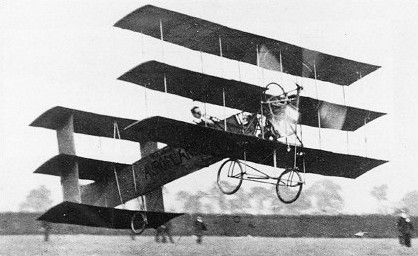
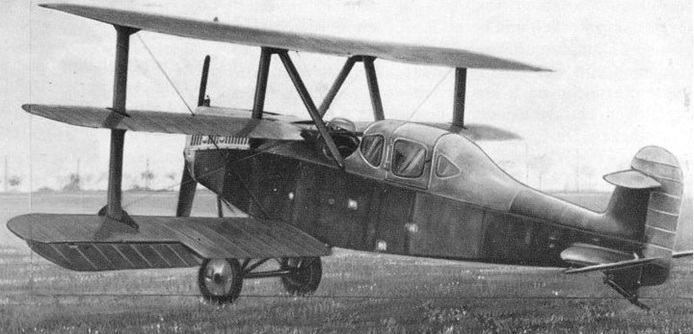
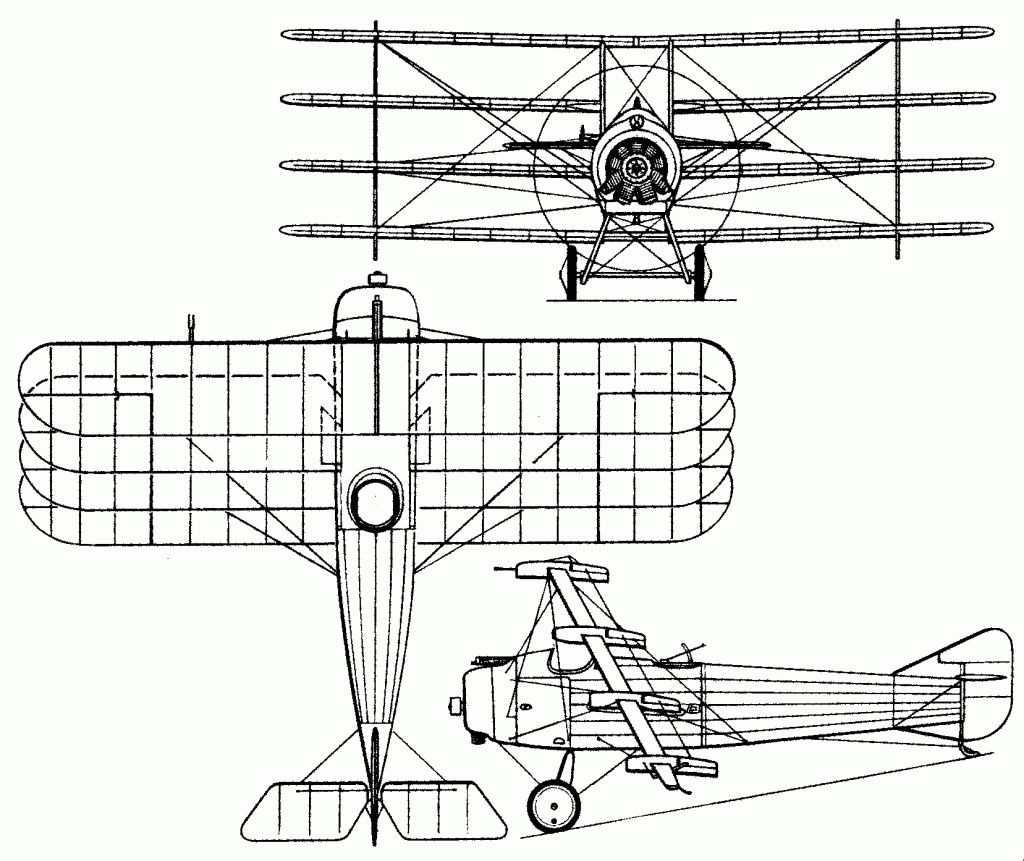
Frederik Koolhoven’s final designs for Armstrong Whitworth were several quad¬ruplhnes in early 1916. A batch of 50 improved F.K.9 versions, later designated F. K. 10, was ordered from Angus Sanderson & Company of Newcastle-on-Tyne on December 30, 1916 on behalf of the RFC.
Eleven machines received official serial identities but only five aircraft were completed before the contract was cancelled. Three were ordered for the RNAS, two of these from the Phoenix Dynamo Manufacturing Company and one from Armstrong Whitworth, these eventually being completed and tested.
After many minor modifications and part redesigning the F.K.10 still failed to reach a satisfactory performance, and the type was never put into service use operationally.

The F.K.10 was normally powered by a 130hp Clerget 9B rotary, but at least one was flown with a 110hp Le Rhone, and armament comprised one fixed 7.7mm Vickers gun and one free 7.7mm Lewis.

Engine: Clerget 9B rotary, 130hp
Wingspan: 27 ft 10 in / 8.4 m
Length: 22 ft 3 in / 6.7 m
Height: 3.5 m (11 ft 6 in)
Empty weight: 1226 lb / 556 kg
Loaded weight: 2038 lb / 924 kg
Maximum speed: 169 km/h (105 mph) at ground level
Service ceiling: Approx 3660 m (12000 ft)
Armament: 1 Lewis .303 in (7.7 mm) mg

Engine: Le Rhone 9J, 110 hp
Wingspan: 8.48 m / 27 ft 10 in
Length: 6.78 m / 22 ft 3 in
Height: 3.50 m / 11 ft 6 in
Wing area: 36.27 sq.m / 390.41 sq ft
Take-off weight: 916 kg / 2019 lb
Empty weight: 560 kg / 1235 lb
Max. speed: 135 km/h / 84 mph
Armament: 1 x fixed .303 Vickers mg, 1 x Scarff-mounted .303 Vicker mg

Armstrong Whitworth F.K.9

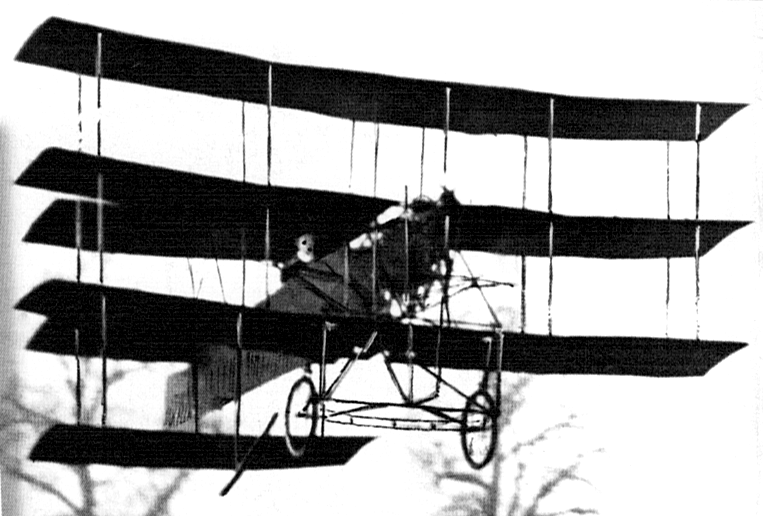
The F.K.9 two-seat fighter-reconnaissance quadruplane was built by Sir W G Armstrong Whitworth & Co Ltd as a private venture. Initially flown in the summer of 1916, trials dictated a number of modifications, including new wings with enlarged ailerons, an enlarged fin, a redesigned engine cowling and increased undercarriage track
Powered by a 110hp Clerget 9Z rotary engine, and with one fixed 7.7mm Vickers gun and one free 7.7mm Lewis gun, the F.K.9 was officially tested in November-December 1916 at the Central Flying School. A production contract for 50 examples of an improved version, the F.K.10, was awarded.

Engine: Clerget 9Z rotary, 110hp
Wingspan: 8.46 m / 27 ft 9 in
Length: 7.87 m / 25 ft 10 in
Height: 3.45 m / 11 ft 4 in
Wing area: 32.98 sq.m / 354.99 sq ft
Take-off weight: 924 kg / 2037 lb
Empty weight: 556 kg / 1226 lb
Max speed: 151 km/h / 94 mph
Armament: 1 x fixed .303 Vickers mg, 1 x Scarff-mounted .303 Vicker mg

Armstrong Whitworth F.K.5 / F.K.6

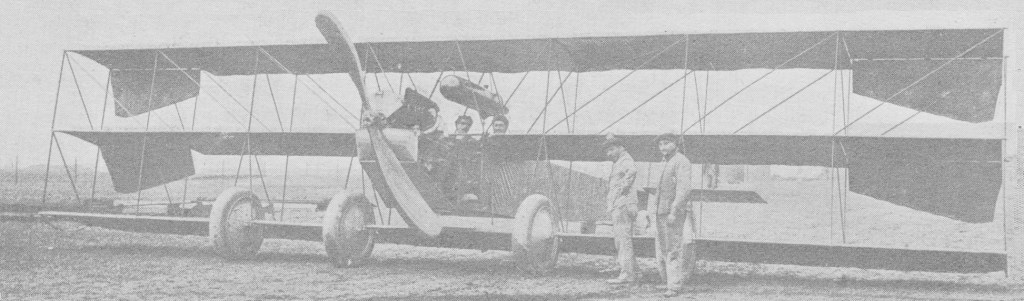
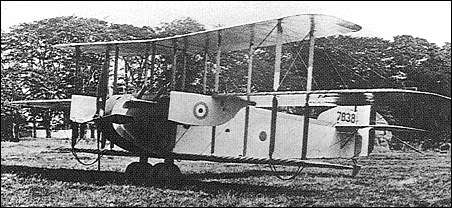
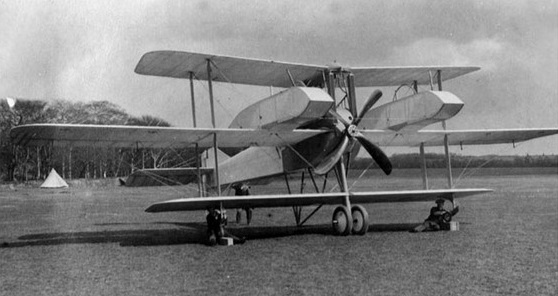
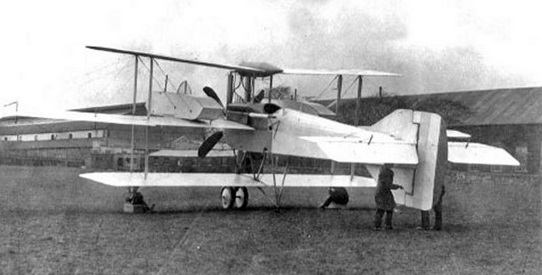
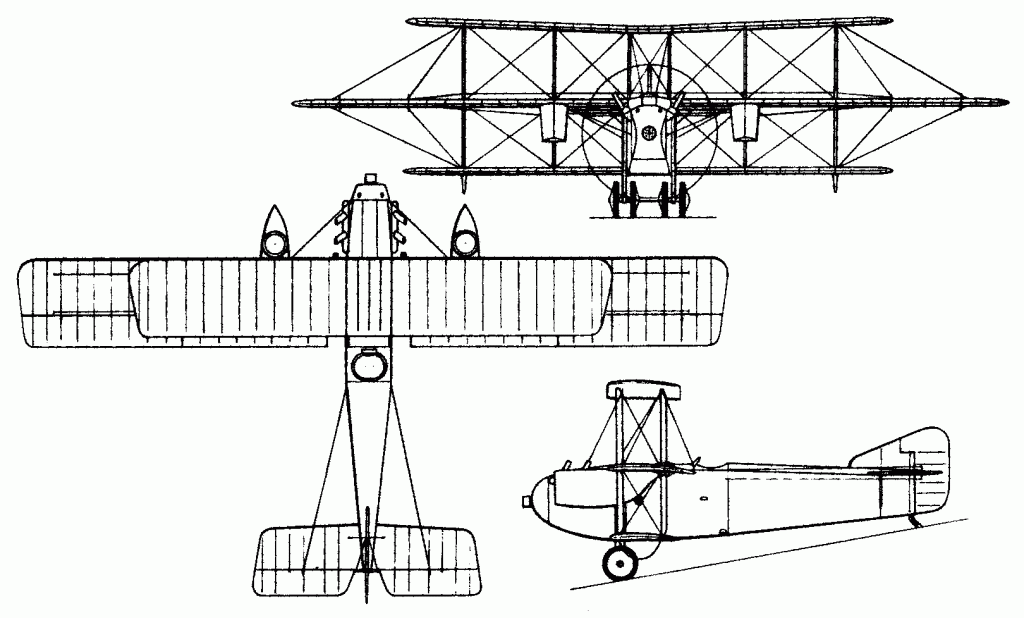
In 1915, Frederick Koolhoven, the chief designer of Sir W G Armstrong Whitworth & Co Ltd, initiated work on a three-seat triplane powered by a 250hp Rolls-Royce 12-cylinder water-cooled engine. It was intended to accommodate two gunners each with a 7.7mm machine gun in shallow nacelles mounted above the centre wing on each side of the fuselage, the gunners being seated ahead of the propeller plane of the tractor engine.

Although a prototype was completed and allegedly designated F.K.5, this was never flown, being extensively damaged as a result of a ground loop during its first take-off attempt. The design was extensively revised early in 1916 to meet an RFC requirement for an airship interceptor and long-range escort fighter. The revised design is believed to have been designated F.K.6 and four examples were ordered, two of these being intended for the RNAS. In the event, only one F.K.6 was built. The gunners’ nacelles were underslung on the central mainplane, armament remained two 7.7mm Lewis guns and the 250hp Rolls-Royce engine was retained. It is believed that relatively limited flight testing was undertaken. And no armament was actually fitted.

The middle wing was much longer than the others, but the other wings were equal span.

F.K.5

Engine: 1 x 250hp Rolls-Royce piston
Wingspan: 19.14 m / 62 ft 10 in
Length: 11.29 m / 37 ft 0 in
Height: 5.18 m / 16 ft 12 in
Max. speed: 160 km/h / 99 mph
Crew: 3

F.K.6