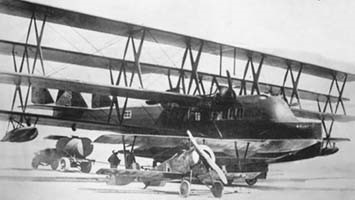
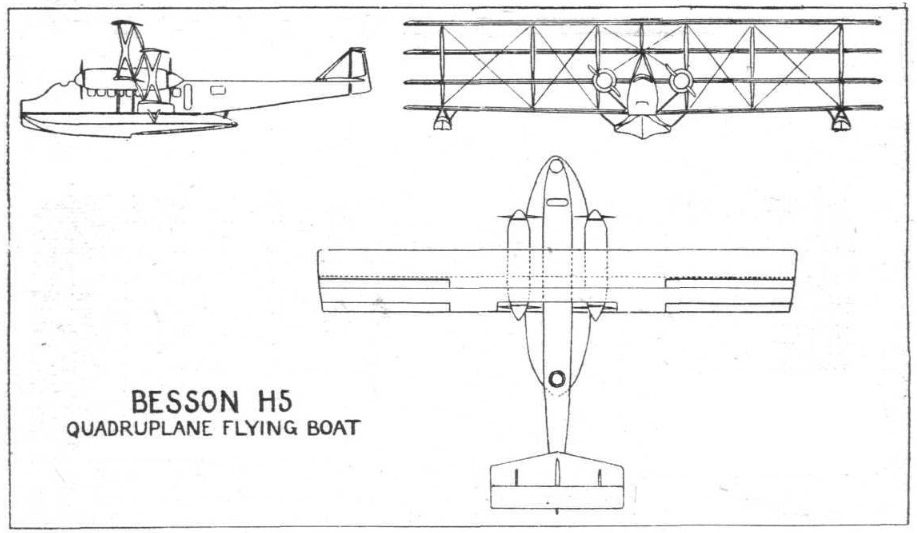
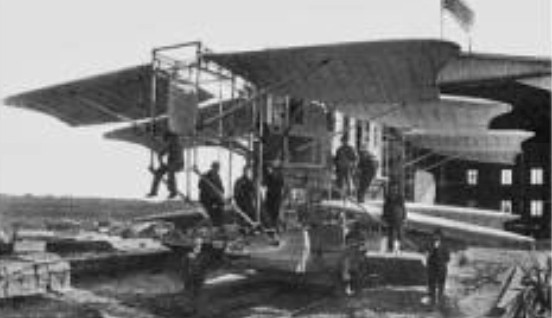
The HB.5 (MB-10) originally started development as an open-sea reconnaissance/bombing flying-boat, but it was completed as a 20-seat passenger transport flying-boat. The Besson H-5 was a quadruplane flying boat designed by the Marcel Besson company of Boulogne. On December 31, 1920 the Aviation Technical Service (Service technique de l’Aéronautique / STAé ) issued Besson No.120 contract for the construction of the prototype. A model of the aircraft, designated Marcel Besson H-5, was exhibited at the Grand Palais (Grand Palais) during the Paris Air Show was held there in 1921.
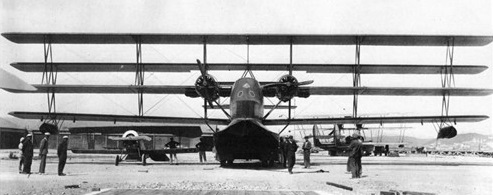
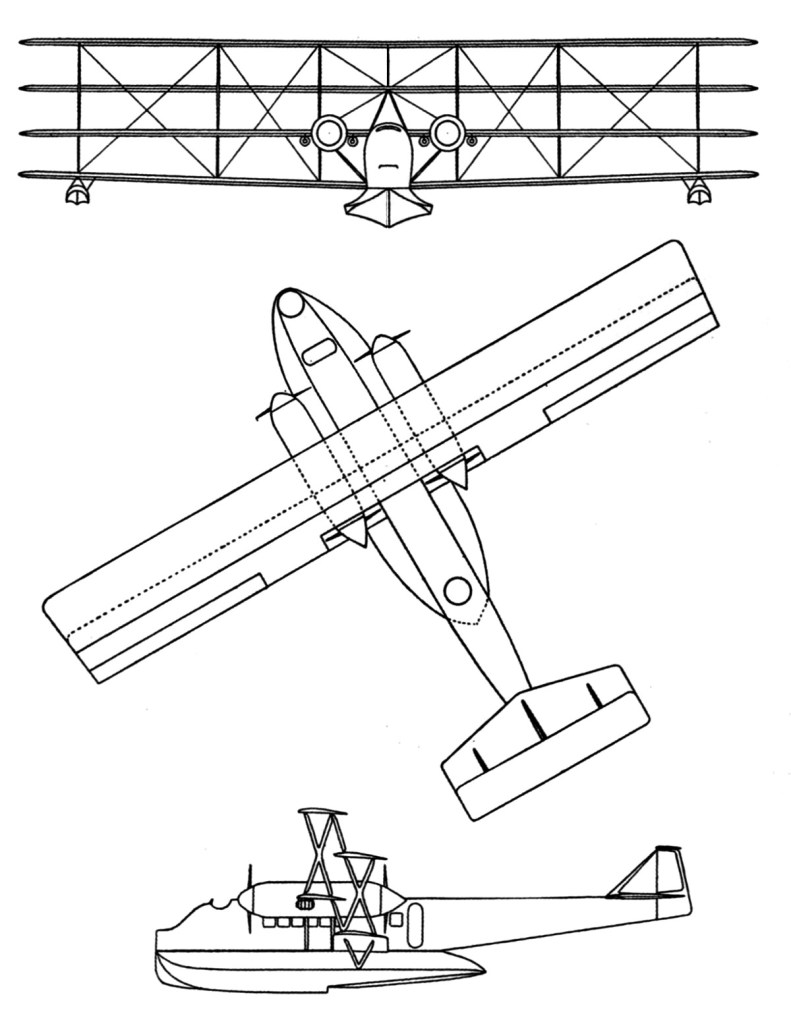
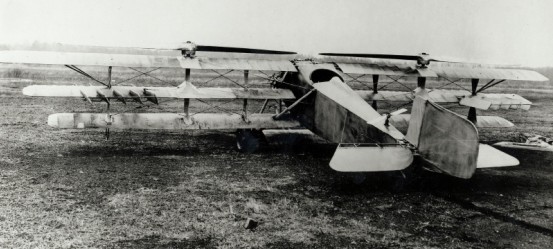
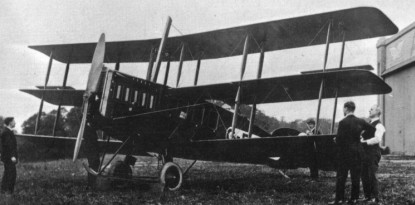
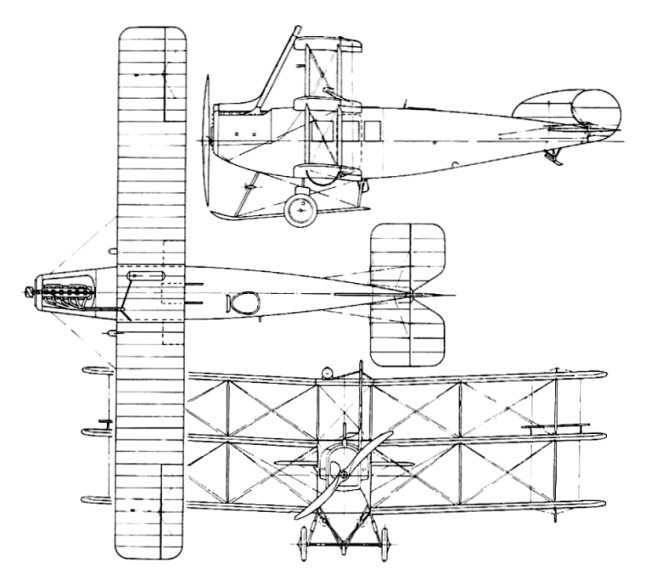
The main planes are of comparatively thick section, and have a high aspect ratio. The upper and third planes are located a little less than the chord width in advance of the second and bottom planes. Each pair of planes has an arrangement of X interplane struts, whilst struts also connect the rear spars of the forward planes to the front spars of the rear planes. The whole wing is divided into three bays each side. The lowermost plane is set at 1.5 degree dihedral. Ailerons are fitted to all four planes.
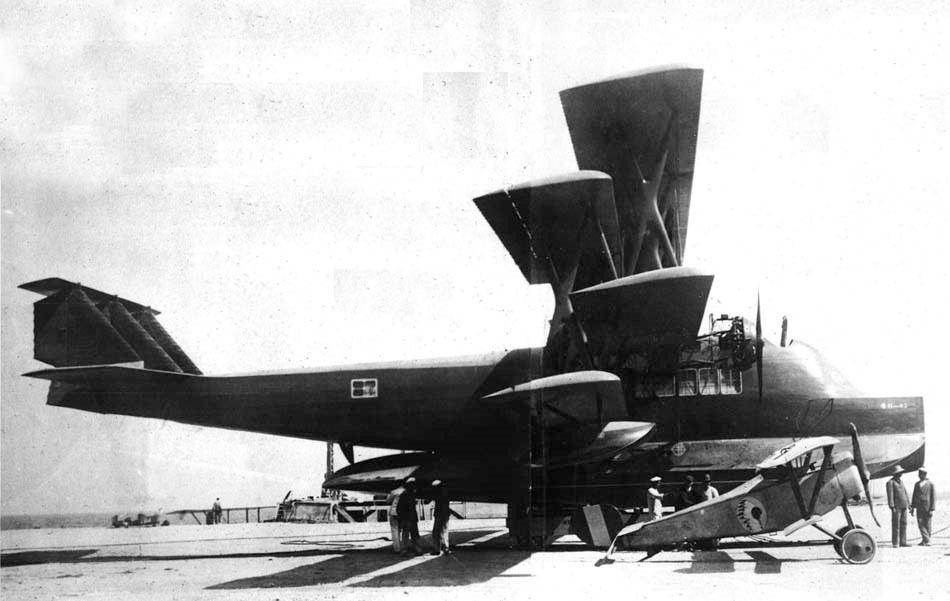
The hull of the H5 is a V-bottom single step type, 11 ft 6 in beam by 46 ft in length. It is built up of three-ply mahogany, with linen in between the layers, riveted to cross members. The whole hull is divided into 24 watertight compartments.
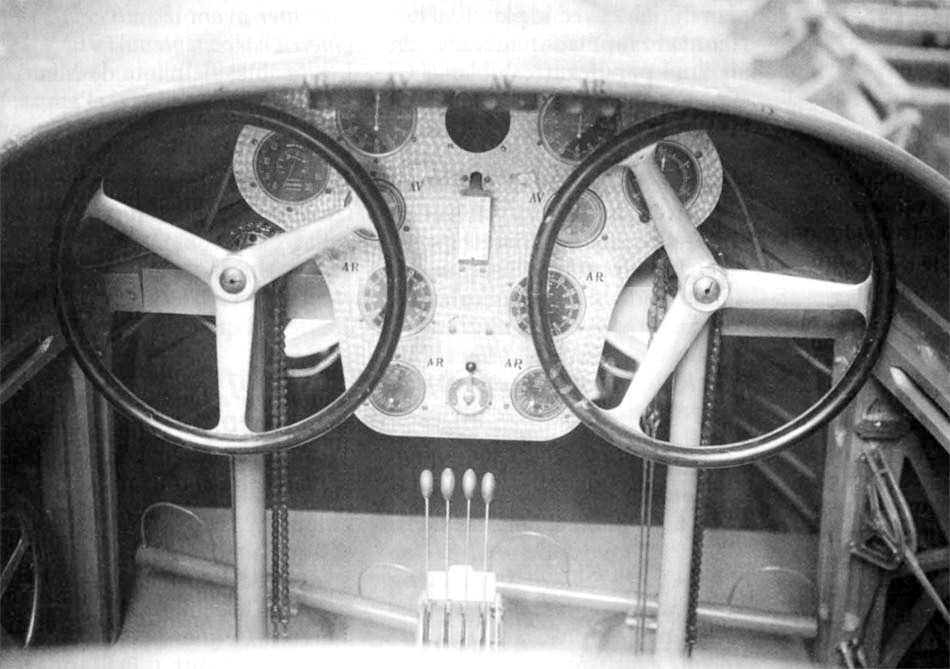
The fuselage is conventional and fabric covered. The pilot’s cockpit, with dual controls, is located high in the forward fuselage.
The engines fitted were four 250 hp Salmson 9Z radial, arranged two in tandem on each side of the fuselage and in line with the third (from top) plane. Each pair of engines is enclosed in a streamline nacelle, and the front engines, driving tractor screws, are placed well forward, whilst th rear ones driving pusher screws, are nearly in line with the trailing edges of the rear pair of planes. Four Lamblin radiators are mounted on the nacelle, one on each side under the third plane.
The design was constructed in Boulogne-sur-Seine began. 1922, then dismantled and shipped by rail to Saint Raphael on the Mediterranean. Reassembly took from April to July 1922, after which it was brought before the Commission for applied research in aviation (Commission d’études pratiques d’aviation / CEPA ) for performing tests. In those years, CEPA tests were required for both military and civilian aircraft. Lieutenant Maurice Hurel, an experienced pilot of the French Navy, was assigned to the testing. Problems with the starters led to a delay in testing for several months.
The first flight took place on September 8, 1922. Due to the failure of the first flight with the starters and the water landing was hard. The pilot managed with great difficulty to splash down the unstable flying boat; slightly damaged. During a brief examination of the balance, the aircraft weighing 7845 kg, the C of G was too far back. To restore the center 175 kg of ballast has been loaded into the nose of the aircraft in the form of sandbags.
After this procedure began a series of test flights. In the final CEPA report: “the first takeoff was very quick and the pilot immediately realized that the aircraft center of gravity has serious problems Despite the extra weight at the bow, counteracts the tendency of the pilot to keep the aircraft in the flight line at. that the angle of the height was set to its lowest position and the engines / full flow. However, due to the rapid rejection of controlled valves (approx. trimmers) pilot managed to avoid fatal pitching and landing on the water, which was performed by successive on-off engines power . In spite of the effect of trim tabs and lowering elevators aircraft nose up uncontrollably and a reduction in engine speed saved the situation. “
Splashdown on a calm sea, appeared to be acceptable to the pilot, but in spite of all the left side of the hull (where the plating thickness was 15 mm) was suddenly torn out of about a square meter of the bottom.
Marcel Besson undertook to strengthen the bottom of the hull and the long work led to an increase in weight of the empty aircraft by 440 kg. In addition, the aircraft has been improved alignment and biplane horizontal tail was replaced: instead of the original with the top horizontal fixed plane and the lower plane of the imposition of a classic forward plumage with the increased area was established. But after this decision, the empty weight of the aircraft continued to exceed its original state at 270 kg.
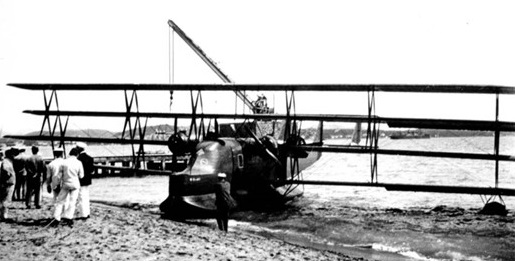
Before the second flight of the weight of H-5 was 8343 kg. In the second flight Maurice Hurel had to face a much more serious problem handling than during the first flight, as later reported commission for testing control, “March 26, 1923 the aircraft due to the housing width pulled from the water much faster: 17 seconds , reaching the angle of attack of 17º and will continue more and more to increase the pitch up, although the pilot rejected the lower stabilizers down. engine speed reduction has not led to a reduction continued to increase the angle of attack, and the pilot developed maximum engine power and rejecting the down elevators, successfully forced the aircraft . unit to dive down, however, in spite of this action, the car was irresistibly drawn to pitch up: drive, the plane again soared into the sky and began to lose speed at an altitude of 30 meters above the water plane leaned to the left, planned and hit the nose of water gathered speed.. The pilot before the plane hit the water again, was able to take control and correct the aircraft to land. “
During the third flight on April 17, 1923, the total weight of the seaplane was 8830 kg, and the extreme nose was taken by 850 kg of ballast. It was 3570 kg, more than the permissible weight specified in the contract specifications. It took three attempts to to make a flight duration of 27 seconds. After passing over the harbor at the height of 30 meters Hurel found hold the steering wheel and maintaining the aircraft in the flight line exhausting. All experts at CEPA, including Marcel Besson believed that the ballast weight at the front part has reached its maximum value (850 kg) and may not be exceeded.
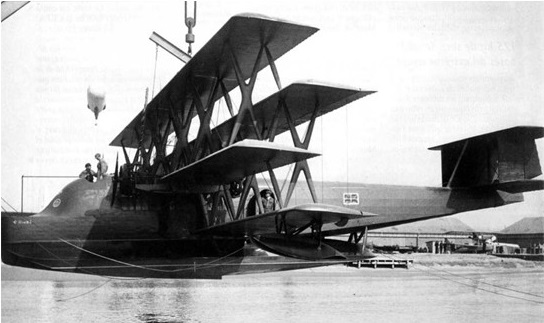
On May 9, 1923 with the same weight as in the previous test flight, the H-5 flew for 48 seconds and remained in flight without any incidents to a maximum height of 900 meters . Marcel Besson had every reason to be satisfied. There was no question of mass production of the aircraft, the H-5 met only one of the requirements of acceptance tests set out in the contract: “Flight of the no-load of one hour with a fuel capacity of two and a half hours flight flight must be performed at a height of not less than 500 meters during a flight must perform several turns airplane must.. to perform three or four take-off. “
Other awards were undelivered but Captain 3rd Rank Godfroy (Capitaine de Corvette Godfroy) in CEPA report on the test results presented astonishing manipulation which allowed to play administrative provisions solely in the interests of the manufacturer: “For operational tests giving the right to bonus payments in the contract, for example, assumed: The load 3,000 kg, including 1,500 kg of fuel that the aircraft could not be taken away during the test, under STAé instructions, the Deputy Minister intervened, and made further amendments to the contract, which allowed the aircraft to perform operational tests:
• introduced a private aircraft weight 7160 kg;
• reduced total load of up to 1840 kg;
• the base price of the aircraft increased to 120,000 francs;
• introduced premium features for compliance;
• It does not provide any penalties.
To meet these requirements, the aircraft was to have a takeoff weight of 9000 kg, which is 170 kg more than the last flight.
During tests at St. Raphael naval air station in 1922 the Besson Quadruplane, which weighs, fully loaded, just over 10 tons, took off after a run of about 500 yds, and gave a top speed of 81 mph with full load.
July 16, 1923 flights were resumed. The first attempt to take off, despite the planing length of 2 km, ended in failure. During a second attempt, 45 seconds after the start of planning, part of the body was ripped out a piece of skin, along with parts of the frames. The total area of the pulled out piece was about one square meter. Hurel managed to reach the beach in Saint-Raphael and put flying boat aground, not letting her sink.
The CEPA felt that it would not be worth recovery of the aircraft. After the tests the aircraft was stored at the base in the open. At the end of December 1923 during a heavy storm with sharp gusts of wind, the tail unit was separated from the rest of the hull.
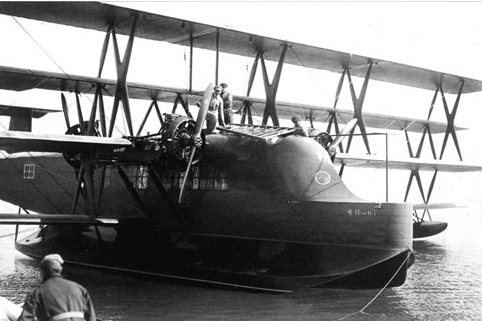
Conclusion CEPA commission was strict and did not contain any sympathy for the feelings of the aircraft designer, “four-Besson commercial seaplane design with the power plant with total capacity of 1000 hp was unfortunately built without serious preliminary studies was created in a haphazard pencil in a number of nodes. strokes without any of the details of care. in particular, it is difficult to accept as the norm is that the designer can to such an extent to make a mistake in the weight calculation, what did it, Mr. Besson (7150 kg instead of 4500 kg), created at the same time very . the fragile structure of the aircraft was presented to the test with problems centering, and only thanks to the exceptional airmanship and presence of mind of the pilot several times managed to avoid the destruction of the airframe shape makes the aircraft unfit for any service on the sea. on the other hand it is highly unlikely so he could take off with the body of another form. Commercial efficiency this aircraft seems insignificant. The aircraft can not be accepted due to imposed on him only moderate requirements. Interest is only the relative position of bearing surfaces. If the designer wished to more fully explore this location, it is more preferable to do so not on this seaplane and a small aircraft, designed to carry out technical experiments. “
Engines: 4 × Salmson 9Z water-cooled radial, 190 kW (260 hp)
Length: 22.0 m (72 ft 2 in)
Wingspan: 29.00 m (95 ft 2 in)
Wing area: 225 m2 (2,420 sq ft)
Chord: 6 ft 10 in
Gap (approx): 5 ft 6 in
Height: 6.5 m (21 ft 4 in)
Empty weight: 5,500 kg (12,125 lb)
Max takeoff weight: 10,000 kg (22,046 lb)
Max fuel capacity: 400 Imp.Gal
Oil capacity: 26 Imp.Gal
Maximum speed: 168 km/h (104 mph; 91 kn)
Cruising speed: 126 kph / 81 mph
Range: 900 km (559 mi; 486 nmi)
Service ceiling: 3,500 m (11,483 ft)
Endurance: 6 hr
Crew: 5
Capacity: 20 passengers
Aera of mainplanes: 2744 sq.ft
Area of stabiliser: 161.5 ft
Area of variable incidence: 53.8 sq.ft
Area of elevator: 86 sq.ft
Area of fins: 57 sq.ft
Area of rudder: 34.4 sq.ft
Area of aux rudders: 27 sq.ft
Power loading: 22 lb/hp
Wing loading: 8.2 lb/sq.ft

 All Aero