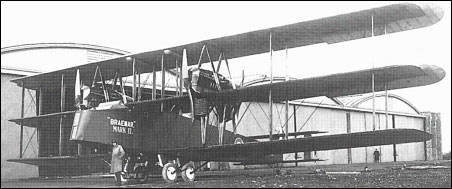
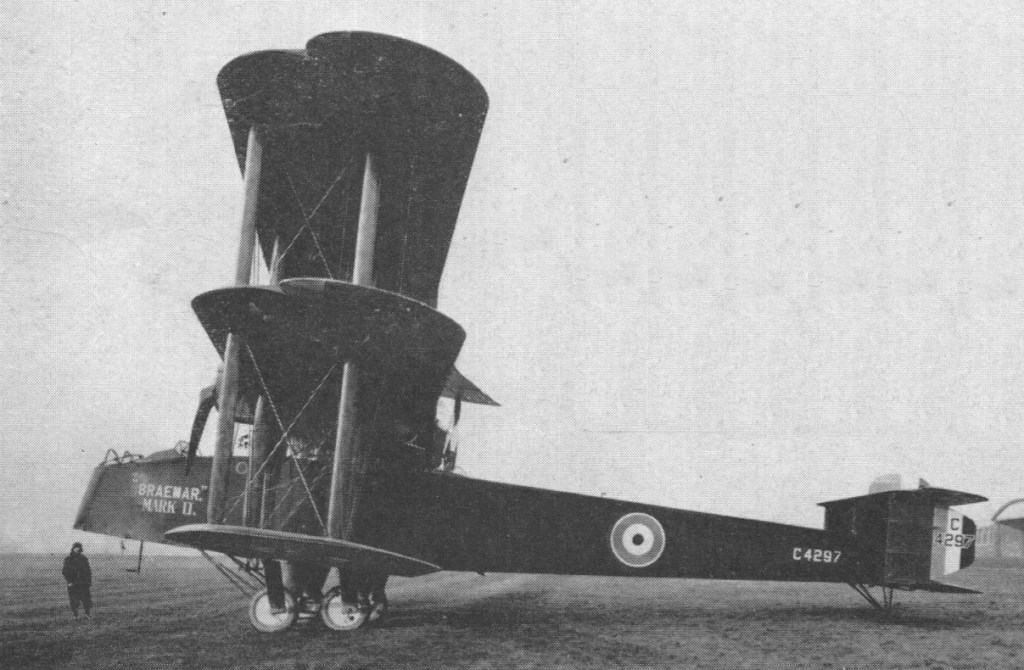
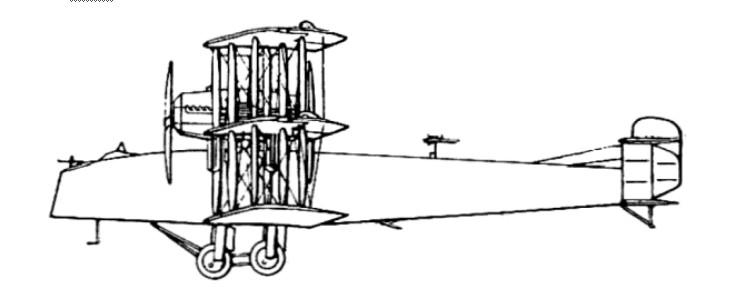
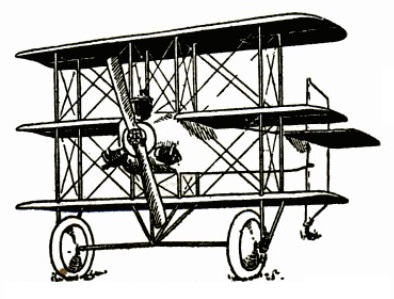
An unsuccessful contender for a 1917 large bomber requirement, the four engined triplane Bristol Braemar which did not go into production. The Braemar formed the basis of the Pullman, an equally unwanted airliner with a large cabin and enclosed cockpit. The Pullman’s crew distrusted this feature and took to carrying axes with which to hack their way out in an emergency.
Braemar Mark II Engine: 4 x 410hp Liberty 12A water-cooled in-line engines Wingspan: 24.89 m / 81 ft 8 in Length: 15.70 m / 51 ft 6 in Height: 6.30 m / 20 ft 8 in Wing area: 176.98 sq.m / 1905.00 sq ft Take-off weight: 8399 kg / 18517 lb Empty weight: 4835 kg / 10659 lb Max. speed: 201 km/h / 125 mph Ceiling: 5182 m / 17000 ft Crew: 6 Armament: 5 x 7.7mm machine-guns, 6 x 100kg bombs
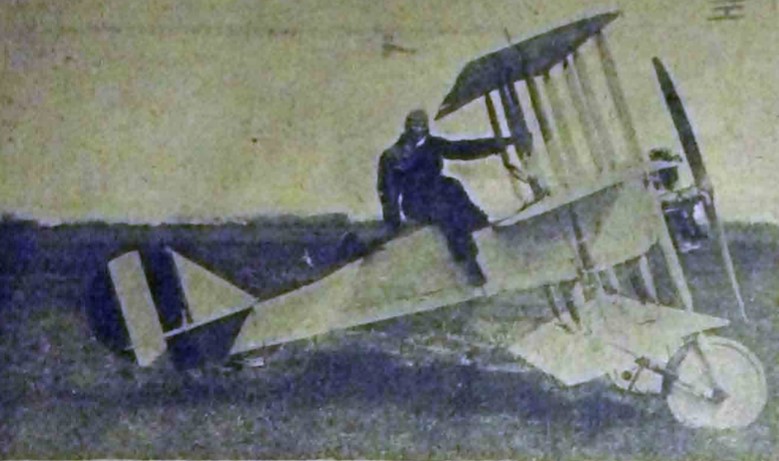
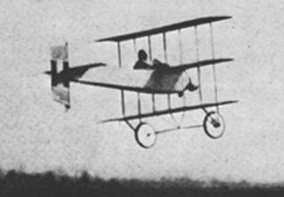
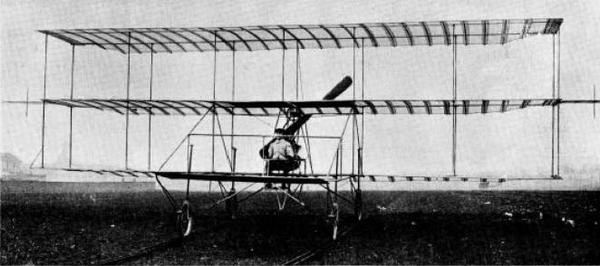
The Pensuti 2 was a very compact, low-powered triplane flown in about 1918. Its first flight, piloted by Lt. Lodovico Montegani, was delayed by the death of its designer and Caproni test pilot Emilio Pensuti in an unrelated aircraft crash. Designed to do in the air “what bicycle [sic] does for the man on the road”, it was categorised post-World War I as a small sporting aeroplane.
The single-seat triplane had unswept rectangular wings, each with a full span of only 4 m (13 ft 1 in). These were mounted without stagger, each wing braced to the one below by two pairs of vertical, parallel interplane struts, one pair out beyond mid-span and the other from the fuselage sides. The central wing was attached to the upper fuselage and the other two held well clear of it by the struts. There were ailerons on each wing.
The Pensuti had a simple rectangular cross-section fuselage, with the open cockpit at the wing trailing edge. A three cylinder, inverted Y configuration Anzani air-cooled engine of 26 kW (35 hp) in the nose drove a two-blade propeller. The triplane had a fixed undercarriage of wide track, with a single wheel at each end of a single axle with its extremities attached to extensions of the outer interplane struts. Its cruciform tail had horizontal surfaces mounted on the top of the fuselage; the vertical surface was trapezoidal and extended equally above and below the fuselage. A small tailskid was carried on its lower tip.
A second aircraft with a redesigned tail, Anzani 10-cylinder radial engine and other modifications was built at the Breda factory in Milan as the Breda-Pensuti B.2, (regn. I-BADZ). It gained the second prize at the Italian low-powered aircraft competition held in the summer of 1920 in Milan.
The Italian Air Force used them for quick recon flights for the infantry. The Pensuti 2 remained in service until 1923.
‘Ba.1’ has been applied to the B.2.
Possibly a variant with an 80 hp Breda V-8 was also built.
Powerplant: 1 × Anzani Y 3-cylinder, 26 kW (35 hp) Propeller: 2-bladed Wingspan: 4.0 m (13 ft 1 in) all wings Length: 3.80 m (12 ft 6 in) Height: 2.40 m (7 ft 10 in) Gross weight: 230 kg (507 lb) in flight with pilot Maximum speed: 95 km/h (59 mph, 51 kn) Stall speed: 40 km/h (25 mph, 22 kn) Rate of climb: 1.1 m/s (220 ft/min) Take-off and landing distances: 20 m (65 ft). Crew: one
The Borgnis-Desbordes et de Savignon Triplane, also known as the Borgnis de Savignon et de Desbordes, was named after its designers/financier, Achille and Paul Borgnis, and Desbordes de Savignon. A development of the second Bousson-Borgnis, it was of all-metal construction, built at Gennevilliers. There were no rear tail surfaces: steering was done with ailerons set on forward outriggers, and a forward elevator was set low ahead of the 4-wheel undercarriage.
The first version of the Borgnis et Desbordes de Savignon, 12 March 1909
According to reports this triplane actually left the ground several times in Gennevilliers on January 31, 1909. The first version was later modified. In the modification the elevator was brought to the rear of the machine and with new undercarriage, it was driven to Yffiniac on the northern coast of Brittany, where it flew and made a “memorable crash”. Repaired, this machine was destroyed in a collision at the end of 1910, ending the aviation related careers of the Borgnis brothers.
Engine: 6-cylinder, 28 hp Span: 14.5 m / 47′ 7″ Wing area: 80 sq.m Gross weight: 570 kg / 1250 lb
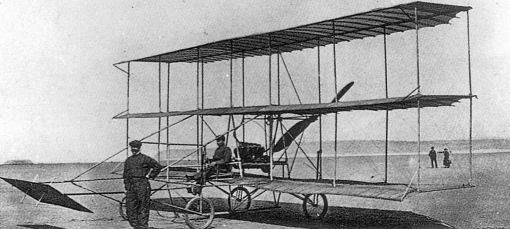
As seen at Morris Park, N.Y., winner of the first money prize in America for design and workmanship independent of performance – a $500 prize awarded by the Aeronautic Society of New York in 1909 – even though it failed to fly.
In light of the triplane’s inability to leave the earth, Morris Bokor made changes to his design and took the machine to Arlington, New Jersey, where it won the prize for excellence of construction. There – at the North Arlington Aero Carnival Week of May 25, 1909 which featured Baldwin’s airship, his newest California Arrow, and two aeroplanes, the other that of the Mexican revolutionary Victor Ochoa – the Hungarian Bokor made an attempt at flight but could only manage a top speed of 12 mph while running along an unpaved road. The triplane was subsequently taken to Westbury, Long Island, but it never did get off the ground.
The 1911 Bokor III was powered by two 30 HP 4 cylinder engines in pusher arrangement.
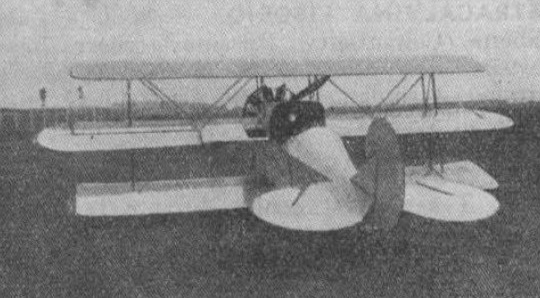
Designed by Harris Booth, the Blackburn single-seat fighter triplane was also intended to carry a single Davis two-pounder quick-fire recoilless gun firing from the nose of the nacelle and was conceived for the anti-Zeppelin role. With a fabric-covered airframe, the triplane was initially flown early in 1917 with a 100hp Clerget 9Z nine-cylinder rotary engine driving a four-bladed propeller. The Clerget was soon replaced by a Gnome Monosoupape nine-cylinder rotary of 100hp driving a two-blade propeller and the triplane was accepted by the Admiralty on 20 February 1917, but was struck off charge as unsatisfactory four weeks later, on 19 March.
Take-off weight: 680 kg / 1499 lb Empty weight: 458 kg / 1010 lb Wingspan: 7.31 m / 23 ft 12 in Length: 6.53 m / 21 ft 5 in Height: 2.59 m / 8 ft 6 in Wing area: 20.53 sq.m / 220.98 sq ft Max. speed: 145 km/h / 90 mph
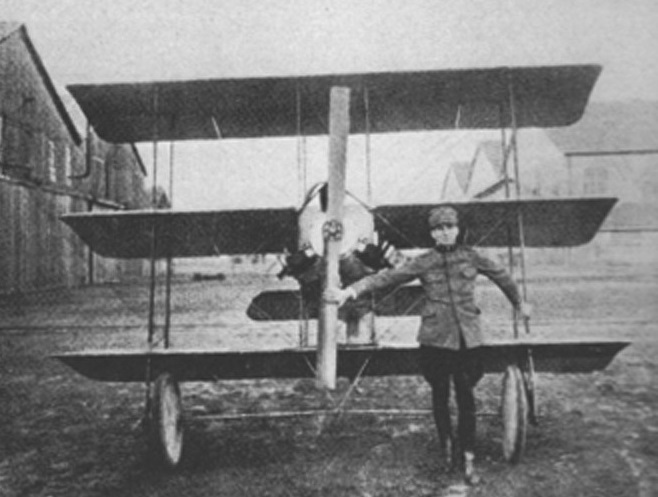
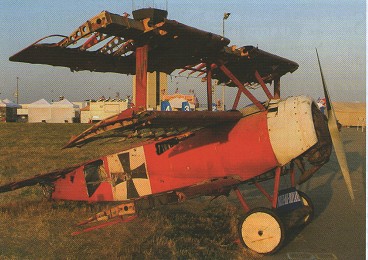
Bitz Flugzeubau in Germany built two Fokker Dr.1 triplanes in 1964 for the film industry. They featured in such films as ‘Blue Max’ and ‘Von Richthofen and Brown’.
After filming, one triplane, owned by ex-RCAF pilot Lynn Garrisin’s Blue Max Aviation, was stolen from storage Leixlip, Ireland. It resurfaced in a ‘Wing and Wheels’ auction in Florida years later however title was regained through the Courts and it was moved to Chino for restoration. From here it was stolen again. It was then abandoned at a Los Angeles A&P technician’s shop and following closure of the business, stored in the ‘owners’ back yard. After being overgrown in shrubbery, new owners of the house discovered it many years later. The legal process began again and the aircraft returned to the Garrison family.
The two were: c/n 001 G-ATIY, became EI-APW c/n 002 G-ATJM, EI-APY, N78001
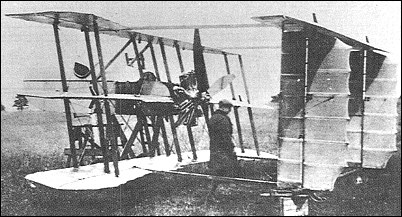
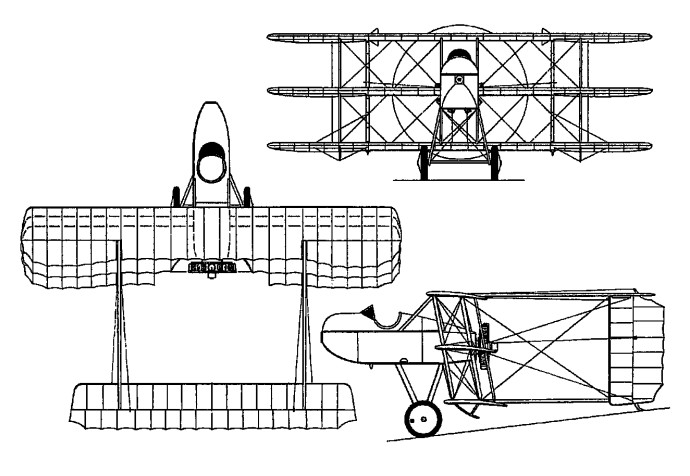
Ensign Alexander Aleksandrovich Bezobrazov (Russia) wanted to make an airplane that was to stable without a tail and proposed a three-winged tailless tandem. In February 1914, he showed his project to the Italian designer and pilot Francesco Mosca, who did a significant part of the design work. According to Bezobrazov’s original ideas, the engine should have been placed in the middle of the fuselage with a long shaft to a tractor propeller, and the cockpit behind the engine in a closed glazed cabin with a periscope, but Mosca objected and the aircraft was being built with a normal fuselage. The construction was completed by October 1914, a month after the outbreak of hostilities. The first flight by Mosca was successful, but Bezobrazov had already been sent to the front. He was wounded and spent a long time in hospital, while the machine was transferred to Crimea where Mosca continued the tests. On 6 August 1916 the pilot IA Orlov crashed it when trying to take off. Repair was completed by March 1917, but further experiments were suspended.





 All Aero