In 1907 H H Wixon of Chicago IL., USA entered an aircraft in Flying Machine events at 1907 Intl Aeronautic Tournament at St Louis MO.
Aircraft
Wixon, H H
Chicago IL.
USA
Aircraft builder circa 1907
Witzig-Liore-Dutilleul No.2
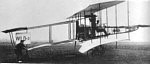
The 1909 WLD No. 2 biplane was designed and built by Witzig, Liore and Dutilleul in France.
Witzig-Liore-Dutilleul No.1
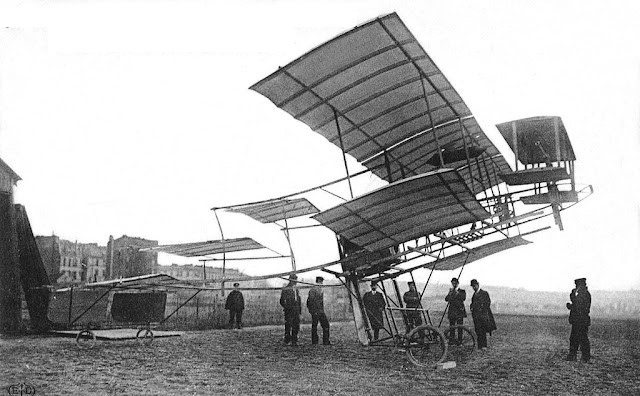
One of the first revisions of the 1909 Witzig-Liore-Dutilleul No 1, with the wheels set too far forward, resulting in the distortion of the whole airframe.
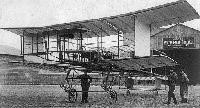
The final version of the WLD 1, with the wheels safely back supporting the engine.
A Witzig-Liore-Dutilleul biplane with a unique wing platform, and 50 horsepower engine.
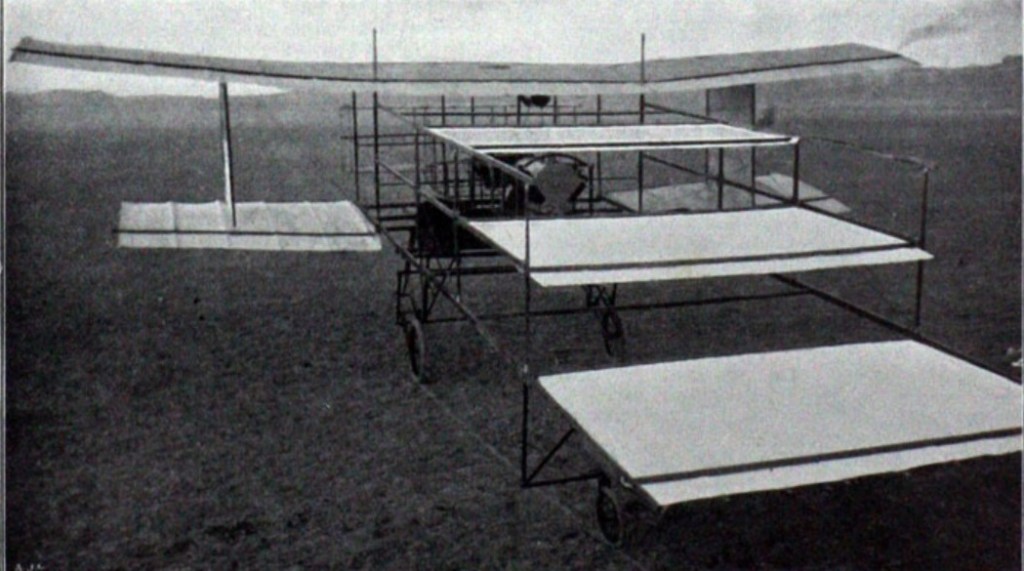
During its test flight period, it saw several modifications, sometimes even rather drastic, without much improvement to its ‘flight’ characteristics.

Engine: 50 hp Renault
Wing span: 8 m
Length: 12 m
Total wing surface: 50 sq.m
Max. weight: 550 kg
Wittman Big X
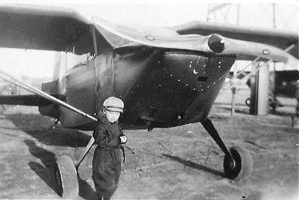
On a cross-country fuel stop at Hagerstown, Maryland with Wittman’s design, the Buttercup, Fairchild engineers expressed an interest in the design and even entered in negotiations for possible production of the aircraft. With the onset of WWII, production plans were shelved, but Fairchild contacted Wittman and proposed that a four-seat version would be marketable. Wittman designed the four-place “Big X” soon afterward, which first flew on 6 January 1945.
The Big X was steel tube fuselage with fabric covering and all-wood wings. The original Big X featured a 130 hp Franklin 6AC engine, later upgraded to a 150 hp 6A4 in 1950.
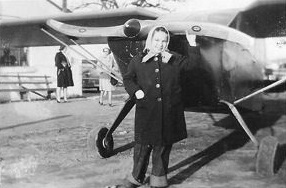
Big X was used as a companion plane and baggage hauler during Wittman’s years as an air racer. When Fairchild did not follow up on production offers, Wittman was contacted by Cessna in Wichita, Kansas, to demonstrate the lightweight and strong spring steel landing gear of the Big X. Cessna bought the plane and its production rights in order to use the gear on its new Cessna 195 taildragger. The Big X was rebuilt in 1962 with variable-camber wing and full-span flaps. Wittman later produced an updated version in a two-place configuration called the Wittman Tailwind that became a popular homebuilt aircraft.
The original aircraft (the ony Big X built) was rebuilt by Forrest Lovley in 1980.
Wittman Big X
Engine: 1 × Franklin 6A4-150-B3, 150 hp (110 kW)
Length: 24 ft 10 in (7.57 m)
Wingspan: 29 ft (8.8 m)
Empty weight: 1,150 lb (522 kg)
Gross weight: 2,200 lb (998 kg)
Fuel capacity: 36
Cruise speed: 130 kn; 241 km/h (150 mph)
Stall speed: 48 kn; 89 km/h (55 mph)
Rate of climb: 900 ft/min (4.6 m/s)
Capacity: 4
Wittman O & O Special
Built in 1986, this was a two-seat high-wing aircraft, N41SW, which appeared like an oversize Tailwind. It was specifically designed for fast cross-country travel between Wittman’s two homes in Oshkosh and Ocala, Florida (that’s where the O & O designation came from).
It was in this aircraft that crashed on 27 April 1995 and Steve and Paula were killed.
Engine: Continental, 225hp
Cruise speed: 210 mph
Stall: 52 mph
Seats: 2
Wittman DFA Little Bonzo
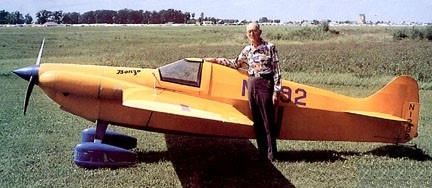
Steve Wittman designed and built two Goodyear racers, Buster and Little Bonzo, named after two comic strip characters he had enjoyed in the 1930s. Goodyear rules specified a minimum weight of 500 pounds, and Little Bonzo came out at 508 pounds. Being the stickler he always was for simplicity and lightweight, Steve begrudged the unnecessary eight pounds. Steve’s guiding principle of aircraft design was “keep it simple, stupid.”
Steve flew Little Bonzo, N1292, for the first time on July 16, 1948 and logged just under ten hours on the airplane before entering a race. Little Bonzo’s first race was the second annual Goodyear Trophy race in which Steve placed second, kicking off a 40 year racing and air show career for Little Bonzo in which the racer would win a room full of plaques and trophies, not to mention pay for itself many times over.
Some of the highlights of Little Bonzo’s career include winning the Continental Trophy races in 1949, 1950, and 1952, winning the Rebat Trophy in 1950 and 1951, and winning his own race at Oshkosh in 1956 and 1957 as well as the Lowers-Baker-Falck cross-country races. Little Bonzo won scores of small races around the country, so many in fact, that Steve lost count.
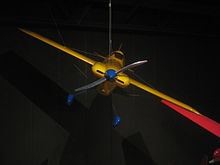
Unlike modern racers that are disassembled and towed to races, Little Bonzo flew to every event it participated in. In fact, Little Bonzo was not just a racer, but also an avid air show performer. Steve was in big demand during the postwar years as an air show performer, and he used Little Bonzo to put on demonstrations of high-speed aerobatics. With the lighter wing loading of his racer, however, Steve could do continuous loops right off the deck, with snaps on the top. Amazingly, Steve often performed his air show routine between heat races.
In 1968, the Goodyear rules were changed to allow use of the Continental O-200 engine, and in August of the following year, Steve removed the original Continental C-85 and replaced it with an O-200.
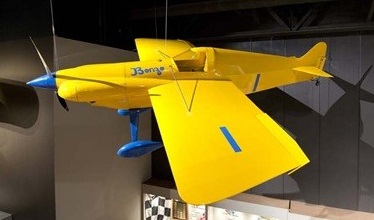
Little Bonzo participated in its last Goodyear race on July 8, 1973 at Du Page, Illinois. The racer was not flown again until Memorial Day weekend to participate in an air show. Steve flew Little Bonzo a couple of hours over Independence Day weekend and then parked the airplane for four years, though the little racer was kept in license. In 1978, Steve dusted off Little Bonzo and began winning races again.
Finally, in 1987, Little Bonzo was in need of a rebuild, its first major work since the airplane was constructed. After the rebuild, Steve flew the airplane for two fifteen-minute test flights before he decided to donate Little Bonzo. Steve restored his racer to its original configuration by installing a Continental C-85 and Little Bonzo was officially donated to EAA at a ceremony during the Oshkosh Fly-In in 1994. Little Bonzo now hangs alongside its namesake, Big Bonzo on display in the EAA AirVenture Museum Racing Gallery.
Engine: Continental C-85
Wing Span: 15 ft. 4 in.
Length: 19 ft.
Height: 4 ft. 9 in.
Empty Weight: 508 lbs.
Fuel Capacity: 15 gal.
Wittman Buster
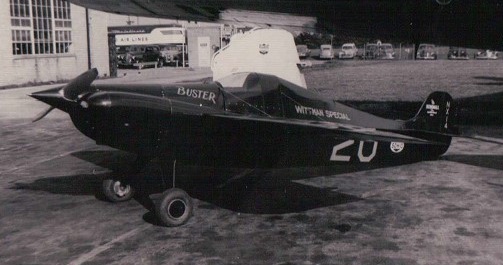
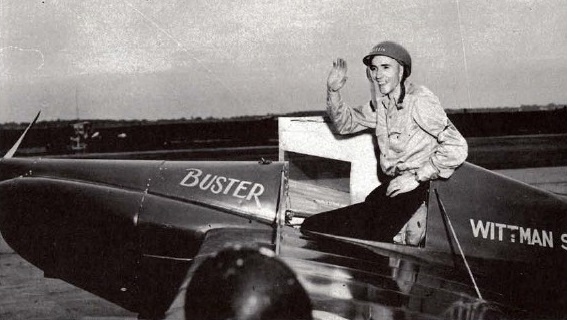
The Buster R/NX14855 (rebuilt from the fuselage of ‘Chief Oshkosh’) was Steve’s first Goodyear raceplane. Built in 1946, raced 1947-54. Piloted by Bill Brennand, Bob Porter, and others, it was retired from racing in 1954.
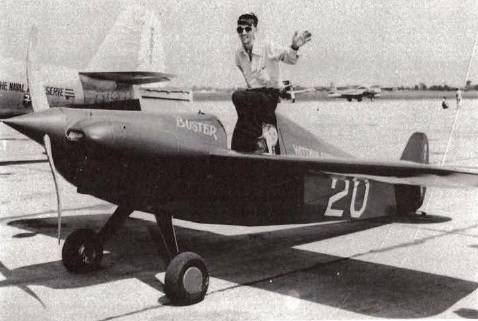
Bill Brennand won in Buster, the next year took fourth place, and the next year top prize and the Goodyear Trophy.
Engine: Continental C-85, 85hp
Wingspan: 16’0″
Length: 17’10”
Seats: 1
Wittman D-12 Bonzo
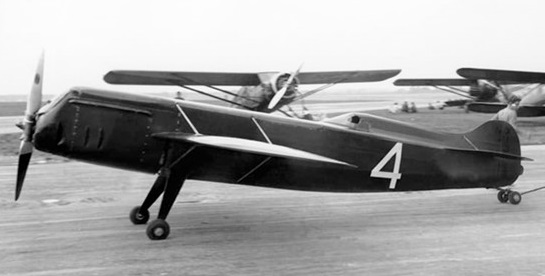
The Wittman D.12 Bonzo NX13688 was designed and built by Steve Wittman as a contender for the prestigous Thompson Trophy, built in 1934, raced 1935-39, the last to use a water-cooled engine. It was ultimately capable of over 325 mph.
The bright red Bonzo, fully restored, graces the EAA AirVenture Museum in Oshkosh.
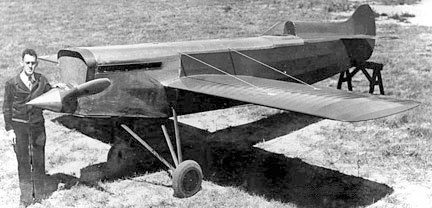
Engine: 435hp Curtiss D-12
Wingspan: 15’4″
Length: 17’6″
Seats: 1
Wittman Chief Oshkosh
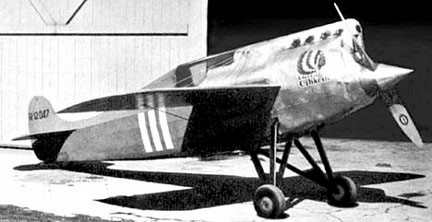
Steve Wittman’s first racing plane, Chief Oshkosh NR12047 and NR14855, was built in 1931 for the Nationals. Powered by a 90hp Cirrus, it was repowered with a 115hp Cirrus Hermes in 1932, and 125hp Menasco C-4 c.1935. Published plans shown many variations, typical of racing aircraft—1931: span: 18’9″ length: 17’9″; 1933: span: 15’6″ length: 18’4″; 1935: span: 14’6″ length: 19’4″; 1937: span: 12’6″ length: 19’6″.
It crashed in 1938 and was rebuilt in 1947 as midget racer Buster.
Engine: Cirrus, 90hp
Wingspan: 16’0″
Length: 17’10”
Seats: 1
 All Aero