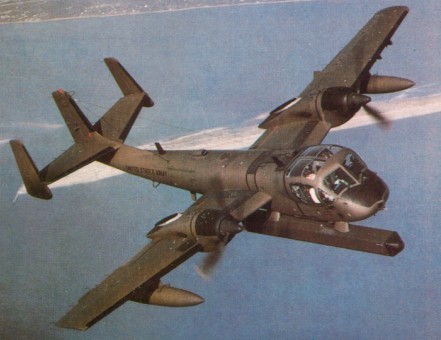
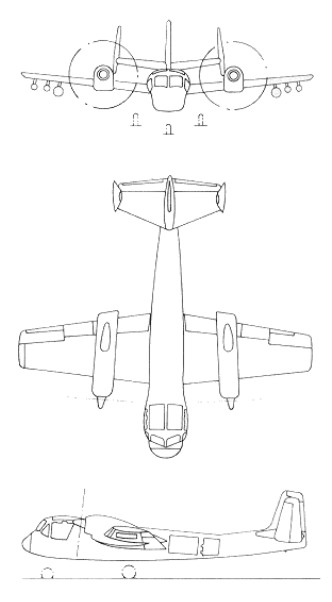
Initial variants were reasonably unsophisticated but progressive modification efforts over the years have brought about a significant improvement in its sensor systems. The first production model to see service was the OV-1A, essentially intended to fulfil photographic reconnaissance duties by day or night, being fitted with cameras, flares and advanced navigation equipment.
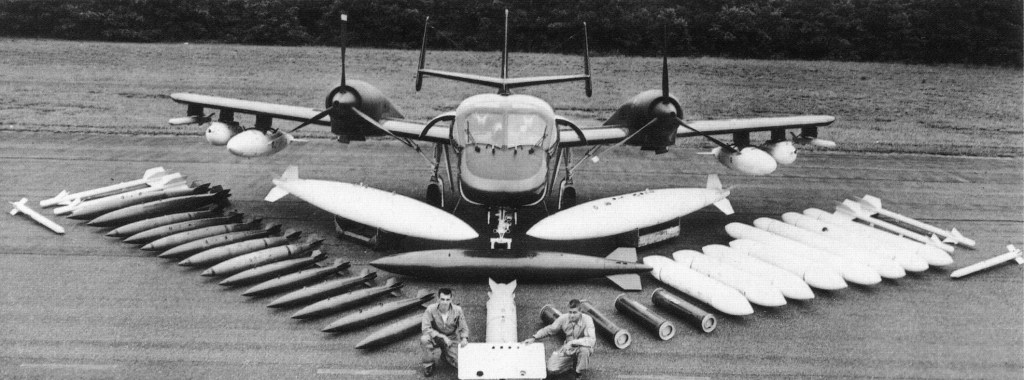
The type entered service with the US Army in February 1961 and became a stalwart of the Vietnam conflict. Six JOV-1As with additional under-wing weapon stations to take an incredible arsenal, including Sidewinder heat-seeking missiles, were evaluated in South East Asia.
It was succeeded by he OV-1B which was the first model to incorporate SLAR (Side-Looking Airborne Radar), this AN/APS-94 equipment being housed in a prominent pod carried externally under the lower starboard forward fuselage.
The next derivative was the OV-1C, which utilised the AN/AAS-24 infra-red sensor in place of the SLAR gear, while the final new-build member of the family was the OV-1D, basically a quick-change aircraft capable of operating with either infra-red or SLAR sensors. The standard OV-1D is equipped with infrared or radar sensors in addition to two panoramic cameras (horizontal and vertical) and one vertical/oblique camera, plus inertial navigation systems and full communication navigation packages. Deliveries of the OV-1D terminated in 1970, bringing total production to 375. Additional OV-1Ds were made available by the relatively simple conversion of most of the 100-plus OV-1Bs and OV-1Cs which remained.
A number of other derivatives appeared, including the RV-1D and the EV-1E, The former version is a conversion of the OV-1B specifically intended for Elint (electronic intelligence) duty, the dozen or so aircraft known to exist being fitted with a multiplicity of passive receivers, analysers and recorders to gather unknown or ‘hostile’ signals. The EV-1E, again a rebuilt OV-1B, is fitted with AN/ALQ-133 ‘Quick Look II’ surveillance radar, additional Elint equipment and electronic warfare pods. At least 16 conversions have been produced.
The latter type was also converted into the dedicated electronic intelligence gathering RV-1D. Israel received two OV-1Ds for use in the mid-1970s, with the designation EV-IE attributed to them. The only other export customer was Argentina, which still operates a small number of OV-IDs. Production ended in late 1970 after 265 were built and the US Army retired its Mohawks in 1996.
JOV-1A
Israel’s air force has received two OV-1Ds, and continued updating effort should result in updated or converted OV-1Ds for various customers, including Pakistan and the US Army.
The JOV-1B was an armed version used in Vietnam. Israel operated two EV-1Es equipped for ELINT surveillance.
The Army maintained a Mohawk fleet at 110 OV-lDs and 28 RV-1D electronic-intelligence-gathering aircraft.
Engine: 2 x Lycoming T-53-L-7, 810kW Max take-off weight: 5546-7365 kg / 12227 – 16237 lb Empty weight: 4339 kg / 9566 lb Wingspan: 12.8 m / 41 ft 12 in Length: 12.5 m / 41 ft 0 in Height: 3.9 m / 12 ft 10 in Wing area: 30.7 sq.m / 330.45 sq ft Max. speed: 558 km/h / 347 mph Cruise speed: 345 km/h / 214 mph Ceiling: 10700 m / 35100 ft Range w/max.fuel: 2770 km / 1721 miles Crew: 2
OV-1D Engines: two Avco Lycoming T53L-701 turboprops, 1,400 hp (1044 kW) Maximum speed 465 km/h (289 mph) Range 1520 km (944 miles) Empty weight 5467 kg (12,053 lb) Maximum take-off 8214 kg (18,109 lb) Wing span 14.63 m (48 ft 0 in) Height 3.86 m (12 ft 8 in) Wing area: 30.66 sq.m (330 sq ft) Length (with SLAR) 13.69 m (44 ft 11 in).
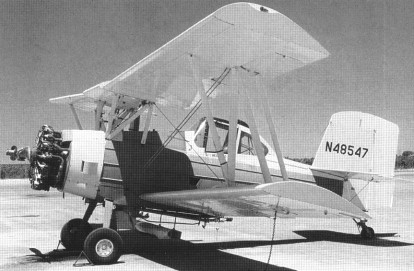
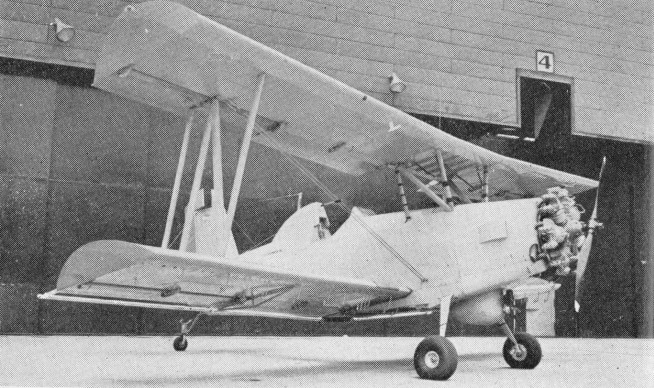
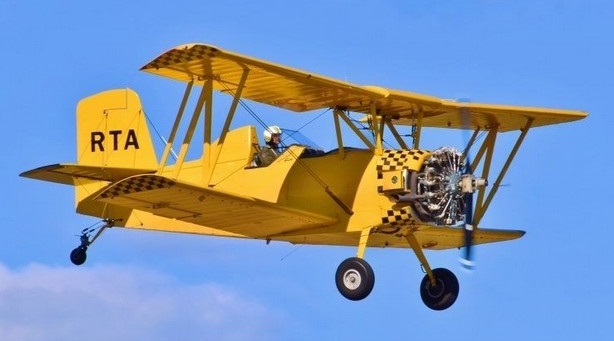
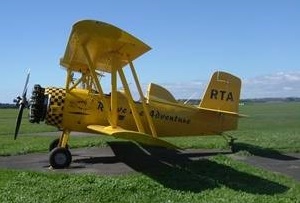
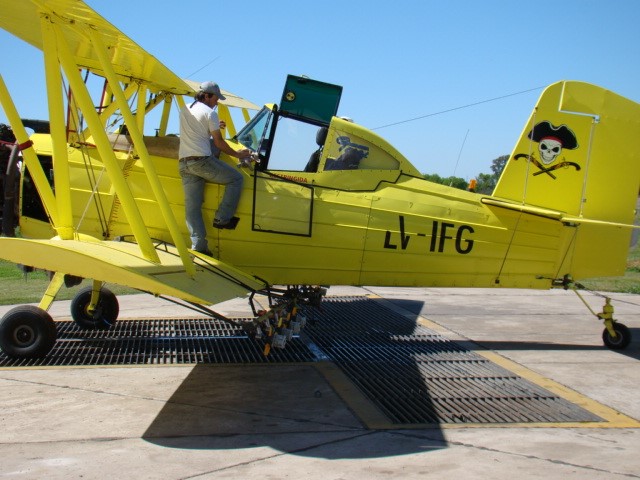
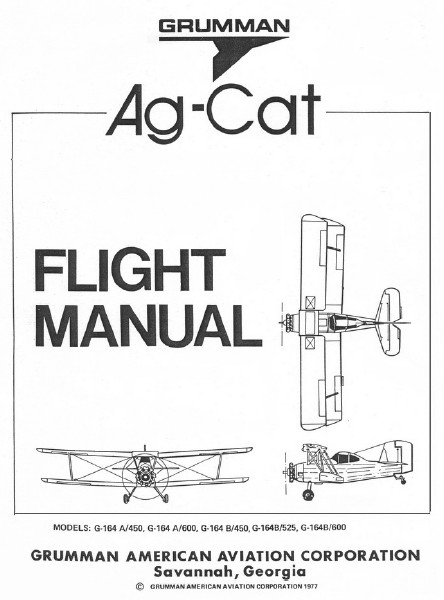
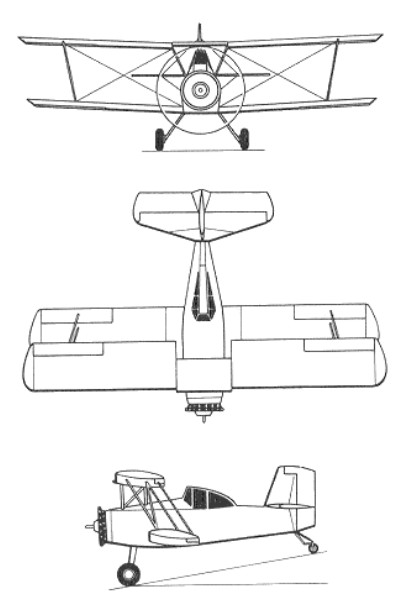
The Grumman Aircraft Corporation designed the G-164 Ag-Cat in the middle of the l950s but only built two aircraft, the first, N74054 (#X1) being flown on 27 May 1957, as later that year Grumman contracted the Schweizer Aircraft Corporation of Elmira, in New York State, to build 100 aircraft. The first of these, N10200, was flown on 17 October 1958 and the Grumman G-164 Ag-Cat was certified by the FAA in the restricted category in January 1959. The engine for the prototypes and early production aircraft was the Continental W670-6N seven-cylinder radial of 220 hp. Because of its lighter weight than other engines, the longer engine mounts were cowled and gave the Ag-Cat a length of 24 feet and six inches. The wing-span was 35 ft8 in. The first twenty-odd aircraft had flat fuselage side panels, rather than the more familiar ribbed panels. These early model aircraft were fitted with 215 US gallon hoppers.
The G-l 64 was also certified for the 220-225 hp Gulf Coast W670-240 (a modified Continental tank engine) and the 245 hp L4M or L4MB, 275-300 hp Jacobs R-755. Once with operators, some aircraft were converted to the 450 hp Pratt & Whitney R-985 or the 600 hp R-1340, the latter readily recognised by extremely short engine mounts. Aircraft in the serial range 301-400 were built new with a 300 hp Jacobs R755 and an aluminium hopper of 245 US gallons installed. Nearly all of these aircraft were fitted with an enclosed canopy, which were also retrofitted to earlier aircraft. Production of the G-164A Super Ag-Cat, with the P&W R-985 and a 300 US gallon fibreglass hopper, began in 1966 with number 401, N895X. The R-1340 engine was also fitted to these aircraft. Production of the G-164A ended at number 1730 with N6894Q.
In 1974 Grumman American announced a new model Ag-Cat. The wingspan had been increased from 36 feet to 42 feet 3 inches, but the hopper size remained at 300 US gallons and the new model was introduced with the 450 hp R-985 and, again, the R-1340 was later fitted. The recognition feature of the G-164B was the broad cord fin and rudder. With the R-985 installed the length of the G-164B is 25 feet, 7 inches. N88348 (#1B) was the first G-164B completed and over 800 were manufactured before production ended. The G 164B was certified under the A model banner. In 1976 a stretched version, the G-164C, was flown and put into production. This was followed by the many turbine conversions. Grumman American introduced in 1978 the Ag Cat C duster, powered by a 600 hp Pratt & Whitney radial. It carries a 500 galIon hopper the biggest dustbin available in any production agplane. In February 1976 the Super Ag-Cat C was flown, and in November 1977 was certificated; it has a deeper and longer fuselage accommodating a 500 US gallon hopper.
The factory PT6 turbine conversion kit weighing in some 230 kgs lighter, is around 10 to 12 knots faster and the PT6 power will enable a full load of 1500 litres to be carried for most operations. Fitted will be a three bladed Harztell prop, providing for a quieter operation and a reversing capability if ever required. Although the Grumman Aircraft Engineering Company designed the Ag-Cat, built the two prototypes and marketed the type (subsequently through its subsidiary Grumman American Aviation Company), Schweizer Aircraft Corporation manufactured all the production Ag-Cats. Schweizer built 1400 aircraft between 1959 and 1975 and, with the exception of the engine fitted, the appearance of Grumman’s Ag-Cat hardly changed. In 1978 Gulfstream American bought Grumman American, and in 1979 a dual trainer Ag-Cat was shown at the Paris Air Show, although this was apparently designed and manufactured by some other company.
By 1979 Schweizer had produced 2,455 Ag-Cats at its Elmira, New York factory: 1,730 G-164As, 659 G-164Bs, 44 G-164Cs, and 22 G-164Ds – Super Ag-Cat Cs with a PT6A turbo-prop.
Reported in March 1979 was the Gulfstream American Ag-Cat B fitted, by Page Industries, with a 600 shp Lycoming LTP 101 turboprop. First flight of the prototype was made on 22 November 1978 and the installation was notable for being 34 in / 86.4cm shorter than the PT6 in the Ag-Cat. Another installation in an Ag-Cat, flight tested late 1978, was a 650 hp liquid-cooed Vee engine developed by Stage II from the Chrysler “hemi-head” auto engine and offering less drag than the Ag-Cat’s usual radial. Mid-Continent of Hayli, Missouri fitted a 1200 hp Wright Cyclone R-1820 in an Ag-Cat to produce the King Cat, which will take off at its 9500 lb / 4313 kg gross weight from a 1000 ft / 305 m strip.
In 1981 Schweizer bought the Ag-Cat manufacturing and marketing rights from Gulfstream American, and produced an improved G-164B known as the Ag-Cat B-Plus and powered by either a 450-hp R-985 or a 600-hp R-1340 Pratt & Whitney nine-cylinder radial.
A Hershy FatCat modification widens the fuselage and raises the top wing some 8 inches. Some have been powered by a Walter 601-F-II turbine engine delivering 750 hp using a five-bladed propeller, or the 600 hp Polish PZL 3S radial, and at least one has been equipped with two Lycoming TIO-540s, in separate Piper Seneca cowlings, mounted side-by-side, in the nose.
Ethiopian Airlines sc Company’s Agro Aircraft Manufacturing division produced the Ag-Cat Corporation Ag-Cat G164B Turbine under the name Eshet for distribution and operation in Ethiopia and African countries except Algeria, South Africa, and Tunisia. Admas Air Service in Ethiopia has produced over 10 Grumman Ag-Cats under licence from Schweitzer.
G-164A Ag-Cat Engines: P&W R-985, 450 hp. Seats: 1. Wing loading: 18.52 lb/sq.ft. Pwr loading: 13.5 lb/hp. Max TO wt: 6075 lb. Empty wt: 2870 lb. Equipped useful load: 3168 lb. Payload max fuel: 2688 lb. Range max fuel/ 75% pwr: 244 nm/ 2.8 hr. Service ceiling: 13,000 ft. Hopper cap: 300 USG. 75% cruise: 89 kt. Working speed: 89 kt. Working endurance: 3.4 hr. Stall: 68 kt. ROC: 400 fpm. Min field length: 2320 ft. Fuel cap: 276/480 lb.
G-164A Super Ag-Cat Engine; 600-hp Pratt & Whitney R-1340 nine-cylinder radial. Wing span; 35 ft 11 in. Wing chord (constant); 4 ft 10 in. Length; 24 ft 3in. Height; l0 ft 9 in. Wing area; 328 sq ft. Empty, equipped; 3,159 lb. Certificated max T-O; 4,500 lb. Max TO wt: 6075 lb. Power loading; 7.5 lb/hp. Equipped useful load: 2893 lb. Payload max fuel: 2413 lb. Range max fuel/ 75% pwr: 171 nm/ 1.8 hr. Service ceiling: 16,000 ft. Hopper capacity; 33 or 40 cu ft. Fuel capacity; 46, 69 or 80 US galls. Never-exceed speed; 128 kt. 75% cruise: 98 kt. Abrupt manoeuvre speed; 102 kt. Working speed; 82-91 kt. Working endurance: 2.9 hr. Stall speed, power off; 59 kt. Stall clean: 69 kt. Rate of climb; 710 ft/min. Take-off run; 395 ft. Seats: 1. Wing loading: 18.52 lb/sq.ft. Fuel cap: 276/480 lb.
G 164B Engines: P&W R-985, 450 hp. Seats: 1. Wing loading: 15.5 lb/sq.ft. Pwr loading: 13.5 lb/hp. Max TO wt: 6075 lb. Empty wt: 3025 lb. Equipped useful load: 3023 lb. Payload max fuel: 2543 lb. Range max fuel/ 75% pwr: 283 nm/ 2.8 hr. Service ceiling: 14,000 ft. Hopper cap: 300 USG. 75% cruise: 103 kt. Working speed: 91 kt. Working endurance: 3 hr. Stall: 61 kt. ROC: 625 fpm. Min field length: 1820 ft. Fuel cap: 276/480 lb.
G-164B Engine: P&W R-1340, 600 hp.
Schweizer Super Ag-Cat 164B/600 Engine: P&W R-1340, 600 hp. TBO: 1200 hrs. Prop: Hamilton Standard 2-blade, 108-in. Seats: 1. Length: 25.9 ft. Height: 11.3 ft. Wingspan: 42.3 ft. Wing area: 392 sq.ft. Wing aspect ratio: 5.49. Maximum ramp weight: 6075 lbs. Maximum takeoff weight: 6075 lbs. Standard empty weight: 3255 lbs. Maximum useful load: 2820 lbs. Maximum landing weight: 6075 lbs. Wing loading: 15.5 lbs/sq.ft. Power loading: 10.1 lbs/hp. Maximum usable fuel: 480 lbs. Hopper capacity: 400 USG. Best rate of climb: 576 fpm. ROC @ 6000ft: 379 fpm. Service ceiling: 17,000 ft. Maximum speed: 128 kts. Working speed: 100 kts. Fuel flow @ working speed: 192 pph. Endurance at working speed: 2.4 hrs: Stalling speed clean: 50 kts. Stalling speed flaps down: 52 kts. Turbulent-air penetration speed: 102 kts. Fixed tail wheel undercarriage.
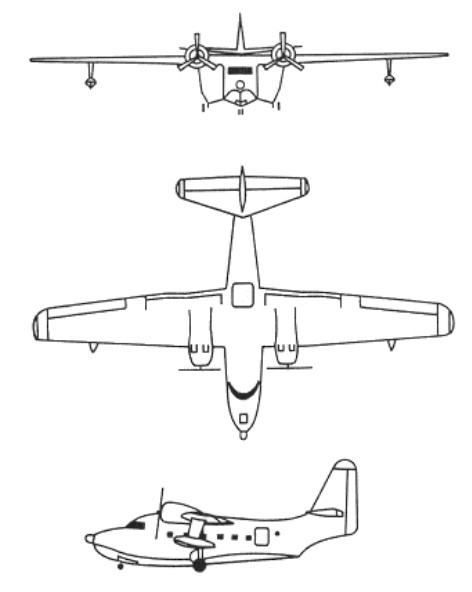
The Mallard was Grumman’s entry into the civilian/commercial use amphibian category. Based on the smaller Goose and Widgeon designs, the larger G73 featured tricycle landing gear. Only 59 Mallards were ever built, but some saw a new life as a turboprop with Pratt & Whitney PT6A out front. A supplemental type certificate was issued for the kerosene burning versions in 1960, but even the performance boost delivered by the more powerful engines was not enough to keep the Mallards in service. Only 59 were built.
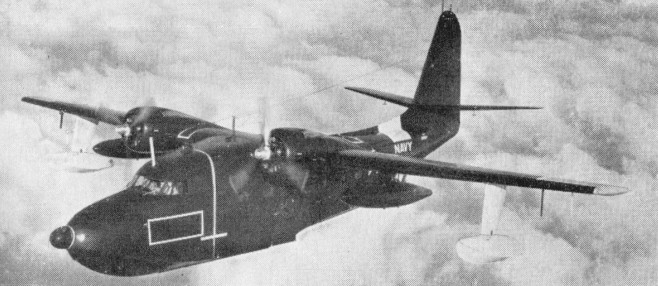
In 1944 Grumman initiated design of its Grumman G-64 aircraft, which was to be named Albatross, and which saw service with the US Air Force, US Coast Guard and US Navy. The Albatross was first ordered as the XJR2F 1 utility transport for the US Navy and the prototype was flown first on 24 October 1947, and was of generally similar configuration to its predecessor. Fixed underwing floats were retained, but these and the entire structure had been considerably refined to reduce drag. Other changes included the provision of a cantilever, instead of strut-braced, tailplane; tricycle type retractable landing gear; and pylons beneath the wing, outboard of the engines, which could carry weapons, or drop-tanks to increase range. The wings and tailplane are unswept, the tailplane with dihedral. The controls are conventional and flaps are split trailing edge type. Additional fuel could also be carried in the underwing, non-retractable, floats. Accommodation was provided for a crew of four and the cabin could accommodate 10 passengers, stretchers, or cargo, according to requirements.
Initial production was of the UF-1 model, and a modified version introduced in 1955 was the UF-2. This latter aircraft had a 16 ft 6 in increased span, a cambered wing leading edge, ailerons and tail surfaces of increased area, and more effective de-icing boots for all aerofoil leading edges.
Many SA-16A were modified to SA-16B standard.
In the tri-service rationalisation of designations in 1962, these aircraft became HU-16C and HU-16D respectively.
Winterised aircraft for Antarctic service were designated UF-1L (later LU-16C), and five UF-1T dual-control trainers were re-designated TU-16C.
The US Navy’s UF-2 general duties amphibian and Coast Guard’s UF-2G were similar to the SA-16B. In 1965 the Coast Guard operated 71 UF-2Gs.
Also operated by the US Navy as the UF-1F and UF-1L. The UF-2S was a modification of the UF-2 for anti-submarine hunter-killer duties. It utilizes much of the equipment developed for the S2F Tracker. Norway ordered 16 examples of the UF-2S. More than 450 Albatross were built.
The USAF found the G-64 attractive for rescue operations, the majority of the 305 ordered serving with the MATS Air Rescue Service under the designation SA-16A. Most of which were converted to SA 16B form with extended wings and tail for operation at greater weight. An improved version, equivalent to the US Navy’s UF-2, entered service in 1957 as the SA-16B; in 1962 these became HU-16A and HU-16B respectively. HU-16E was the designation (originally UF-1F) of Albatross aircraft operated by the US Coast Guard, and 10 supplied to Canada were designated CSR-110.
In service in 1955 with air-sea rescue units of the U.S.A.F. (SA-16A) and with the U.S.N. (UF-1) and U.S.C.G. (UF-1G) for general utility duties. One version has a sprung ski under the hull and small skis under the wing-tip floats, to permit operation from land, water or ice without modification.
An anti-submarine version with nose radome, retractable MAD gear, ECM radome and searchlight was introduced in 1961, and was equipped to carry a small number of depth charges. The versatile Albatross continues in service with a few air forces and navies, but its powerful and fuel-hungry engines have meant that surplus aircraft which became available for use were not a particularly attractive proposition to airline operators, and in consequence few were adapted for such a role.
Several nations used the Albatross, including Argentina, Brazil, Canada, Chile, Greece, Indonesia, Italy, Japan, Norway, Philippines, Portugal and Spain. Many still in service are of the anti-submarine type first flown in 1961, with nose radome, tail MAD boom, underwing searchlight, ECM installations and provision for carrying antisubmarine depth charges, torpedoes or other stores. Full all weather electronics and anti icing equipment are standard.
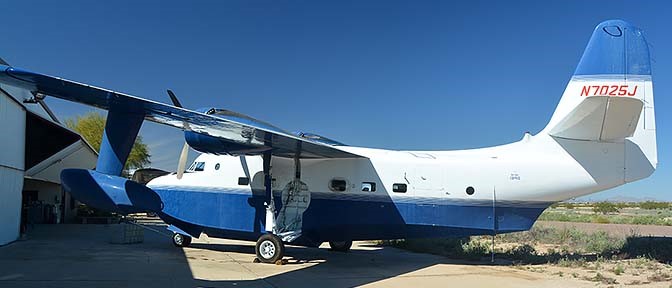
Grumman HU-16C N7025J
The unique capabilities of the big amphib have caused numerous attempts to modernize the basic hull. In the 1970s, Grumman reconfigured the military design to make room for 28 passengers, and added a galley for food and room for a fight attendant. The new airplane was designated the G111 and awarded FAA certification in 1980. Other Albatrosses have been converted to turbine power.
The Grumman G-111, civilianised version of the HU-16 Albatross, entered service on 1 July 1981 with Chalks International Airline to operate scheduled service between Fort Lauderdale and Paradise Island, Nassau. Chalks is a subsidiary of Resorts International, which has arranged the programme to convert U-16 to G-111 standard. Sub-contracted to Grumman, Chalks took two of the initial batch of five G-111. Up to 50 more were available for conversion.
Transland Aircraft modified HU-16B for civilian use with ATC A2GL.
Principal versions – UH-16A (short-span navy model), UH-16B (long-span navy model), UH-16C (short- span air force model), UH-16D (long-span air force model), and UH-16F (coast guard model).
UF-1 Air-sea rescue amphibian. Engines: 2x 1,425 h.p. Wright R1820-76B Wingspan: 80 ft Length: 62 ft. 2 in. Loaded weight: 27,025 lb. Max. speed: 247 mph Typical range: 2,700 miles at 225 mph with 2×300 USG external tanks. Armament: None. Crew: 4-6 Capacity: 10 passengers or 12 stretchers.
UF-2S Engines: 2 x Wright R-1820-76A, 1425 hp Props: 3 blade Wing span: 96 ft 8 in Length: 62 ft 10 in Height: 25 ft 10 in Wing area: 1035 sq.ft MTOW: 37,500 lb Fuel capacity centre section: 562 Gal Float fuel capacity: 2 x 166 Gal Underwing fuel capacity: 2 x 250 Gal Service ceiling: 21,500 ft Range: 2850 mi at 124 mph Wing Hardpoints: 4
HU-16C Albatross Engines: 2 x 1,425-hp (l,063-kW) Wright R-l820-76A Cyclone Max range: 2200 nm. Crew: 4-6
HU-16D Albatross Engines: 2 x 1,425-hp (l,063-kW) Wright R-l820-76 Cyclone Maximum speed 236 mph (205 kts / 380 km/h) Cruise speed: 360 km/h / 224 mph Service ceiling 21,500 ft (6,555 m) Range 2,850 nm (4,587 km) Empty wt.: 22,883 lb (10,380 kg) MTOW: 35,700 lb (16,193 kg) Wing span: 96 ft 8 in (29.46 m) Length 61 ft 3 in (18.67 m) Height 25 ft 10 in (7.87 m) Wing area 1,035.0 sq ft (96.15 sq.m). Crew: 4-6
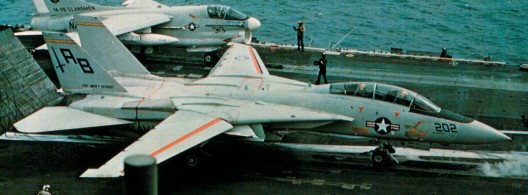
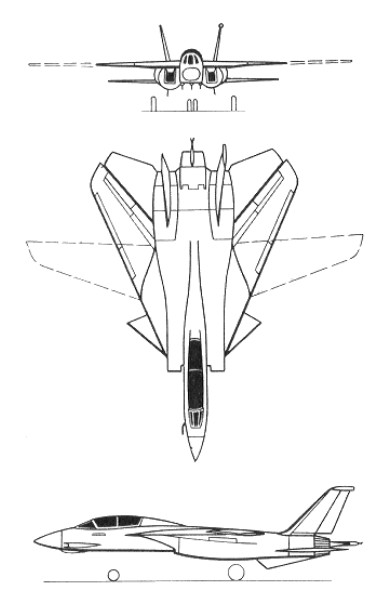
The F-14 Tomcat is a supersonic, twin-engine, variable sweep wing, two-place fighter designed to attack and destroy enemy aircraft at night and in all weather conditions.
The F-14 can track up to 24 targets simultaneously with its advanced weapons control system and attack six with Phoenix AIM-54A missiles while continuing to scan the airspace. It can also deliver free-fall or guided bombs. Unique to the F-14 is the AWG-9 doppler radar which can track 24 targets simultaneously and engage six. These six targets can then be attacked with the AIM-54 Phoenix long range missile. The Phoenix can only be fired by the F-14 and it is the only long range standoff air-air missile employed by the United States armed forces. The F-14 also features a maximum speed of over Mach 2 and automatically sweeping wings which enhance the plane’s ability to maintain control in the air. The first R&D aircraft was flown on 21 December 1970, and the production F-14A is powered by two Pratt & Whitney T1730-P-412A turbofans each having a maximum reheat rating of 20,900 lb (9 480 kg). Armament consists of an internally housed 20-mm M-61 A1 rotary cannon and (intercept mission) six AIM-7E/F Sparrow and four AIM-9G/H Sidewinder AAMs, or six AIM54A Phoenix and two Sidewinder AAMs.
US Navy F-14A
The first of 478 F-14A aircraft entered US Navy service in October 1972 and saw it’s first operational flight in September 1974. Tomcats first went to sea on board the aircraft carriers USS Enterprise and USS John F. Kennedy in 1974 75. By 1980 more than 340 of the 521 Tomcats expected to be purchased for the US Navy had been delivered. Power is provided by two 20,900 lb thrust (with afterburning) Pratt & Whitney TF30 P 412A turbofan engines, and armament can include one 20 mm General Electric M61A 1 cannon and four Sparrow or Phoenix air to air missiles under the fuselage, plus two more Sparrow or Phoenix missiles and two Sidewinders, or four Sidewinders under the fixed section of the wings. Alternatively, up to 14,500 lb (6,577 kg) of weapons can be carried for ground attack.
Delivered from September 1974, initial Pratt & Whitney TF30-P-414A-powered F-14As experienced problems from fan-blade failures and compressor stalls, the latter often at high angles-of-attack, leading to numerous irrecoverable “departures from controlled flight”. Usually in the form of flat spins, these contributed to annual losses peaking to 9-10 in the 1970s-80s, but diminishing somewhat when F110-GE-400 turbofans were introduced in F-14Ds. GEC-Marconi digital flight-control systems and Martin-Baker zero-zero ejection-seats brought further F-14 safety improvements, although compressor stalls were not entirely eliminated. A total of 377 had been delivered to service by the beginning of 1981. A total of 79 F-14 A models were exported to Iran 1976-78. The Imperial Irani Air Force during the reign of the Shah of Iran ordered 80 aircraft, but only 79 were delivered, as the last unit was embargoed and turned over to the United States Navy. The original F-14A was soon found to be slightly underpowered, and handicapped by engine reliability problems. Two prototypes were built with Pratt & Whitney F401-P-400 turbofans as F-14Bs, but the F-14B did not enter production. The F-14C was an unbuilt version with F401-P-400s and new avionics. One of the F-14Bs was later re-engined with the General Electric F101 (now F110-GE-400) as the F-14DFE to serve as the prototype F-14A (Plus). Thirty-eight of these aircraft are being newly built, and 32 F-14As are being re-engined. The F-14A+ (later designated F-14B) entered service in 1987. The F-14D Super Tomcat first took to the air on February 9, 1980. The upgrade included enhanced APG-71 radar and cockpit, a dual IRST/TV undernose pod, and increased AAM capability. The Tomcat has now been equipped for night-attack bombing duty with the use of a LANTIRN (Low Altitude Navigation and Targeting InfraRed for Night) pod. The upgrade allows the F-14 to remain in service until the arrival of the F/A-18E/F Super Hornet.
Production of the F-14A ship-borne interceptor will switch to the A(Plus) model in FY1987, and to the D version in FY1988. The F-14A(Plus)/F-14D development programme was initiated in July 1984, and consists principally of upgrades to the F-14A radar, avionics, and power plant systems, together with integration of the ALQ-165 airborne self-protection jammer, the Jtids secure datalink, an infrared search and track sensor (IRST), and the LAR-67 threat warning and recognition system. The new radar, the APG-71, based on the F-14A’s AN/AWG-9 system, includes a high-speed digital signal processor. These upgrades will be incorporated into production Tomcats in two stages. The first will involve the engine upgrade only, the F-14A’s TF30 power plant being replaced by the General Electric F110 turbofan in some FY1987/1988 procured aircraft which will be known as F-14A(Plus). The second step combines the engine upgrade with the new radar and avionics, the resulting aircraft becoming the F-14D. F-14D procurement begins in FY1988. In September 1986 the US Navy revised its F-14A(Plus)/F-14D purchase plans. Only seven production A(Plus) will now be acquired, two in FY1987 and five in FY1988, to be followed by a total of 127 Ds instead of the 304 originally planned. Seven F-l4Ds are to be funded in FY1988, and 12 per year will be procured there¬after until the planned total is reached. The first production F-14A(Plus) is scheduled for delivery in November 1987, followed by the F-14D from March 1990. Approximately 400 F-14A/A(Plus) Tomcats will be retrofitted with F110 engines and upgraded equipment to give an all-D-model F-14 fleet by 1998.
On 4 January 1989 two US Navy F-14 downed two Libyan MiG-23.
The USN lost nearly 170, mainly from accidents rather than operational attrition over Iraq and elsewhere.
F-14 retirement was accelerated by it being the USN’s most costly combat aircraft to operate, from requiring 40-60 maintenance man-hours (MMH) per flight-hour. This compares with 10-15 MMH for the latest Boeing F/A-18E
The US Navy planned to retire its Mach 2.34 multi-role Grumman F-14s, when VF-31, the last Tomcat squadron, begins conversion to Boeing F/AA8E/F Super Hornets at NAS Oceana, Virginia, in September 2009. The F-14 was formally retired from the US Navy on 22 September 2006.
F-14 Tomcat Engines: 2 x GE F110 GE400, 27,800 lb Wingspan Open: 64 ft. 0 in Wingspan Swept: 38 ft. 0 in. Length: 61 ft. 9 in Weight Empty: 40,100 lb Max. Weight: 74,350 lb Payload: 14,500 lb Range: 1,842 mi Fuel External: 4,070 lb Fuel, Internal: 17,340 lb Ceiling: 55,000 ft Climb Rate: 45,000 fpm Max. Speed: 1,585 mph Cruise Speed: 610 mph Hardpoints: six Cannons: 1x 20 mm Crew: 2
F-14A Tomcat Engines: 2 x P&W TF30-P-412A or -414A turbofan. Installed thrust (reheat): 20,900 lb st. / 92.97 kN Span (max), 64 ft 1.5 in (19,55 m), (min) 37 ft 7 in (11,45 m). Length, 61 ft 11 in (18,90 m). Height: 16 ft (4,88 m). Wing area: 565 sq ft (52,50sq.m). Tactical radius (internal fuel and four Sparrow AAMs), 450 mls (725 km). Empty wt: 18,290 kg. MTOW: 68,567 lb (31 101 kg). Empty equipped wt: 40,070 lb (18 176 kg). Warload: 8618 kg. Max level speed at 10.975m (36,000 ft) Mach 2.37 or 2.517 km/h (1,564 mph) Service ceiling: 17,070+m (56,000+ ft) TO run: 427 m. Ldg run: 884 m. Fuel internal (external): 7174 kg (1720 kg ). Air refuel: Yes. Armament: 8 x AAM / 14225kg, 1 x 20 mm M61A1 Vulcan six-barrel cannon with 675 rounds. Crew: 2
F-14A+ Tomcat Engine: 2 x General Electric F110-GE-400 turbofan, 23,100 lb st.
F-14B Tomcat Engine: 2 x Pratt & Whitney F404-P-400 turbofan
F-14D Tomcat Engine: 2 x General Electric F110-GE-400 turbofan, 23,100 lb st.
F-14DFE Tomcat Engine: 2 x General Electric F101 turbofan
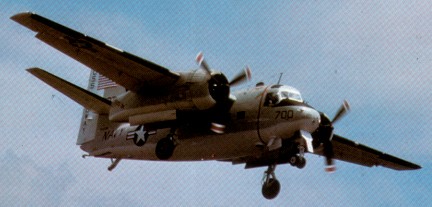
Requiring a transport able to support aircraft carriers at sea with high-priority freight and personnel, the US Navy contracted with Grumman for a derivative of its S2F (later S-2) Tracker carrierborne anti-submarine plane for the COD (Carrier Onboard Delivery) role in succession to considerably more limited types such as the 12-passenger version of the Douglas AD-5 Skyraider. The G-96 design was based closely on the S2F with its fuselage remodelled for the transport role, and as such was fully compatible with 52F support equipment on board American carriers. The type appeared in 1955 as the TF-l Trader, and 87 aircraft were produced. In 1962 these were redesignated C-lA, and the machines were eventually supplemented and finally supplanted by the same company’s C-2A Greyhound.
Principal versions -TF-l (COD plane later redesignated C-1A) and TF-1Q (four aircraft modified for electronic countermeasures training, later redesignated EC-1A). Generally one C-lA Trader was permanently attached to each American carrier, and others were allocated at strategically placed naval air stations to support carriers operating round the USA, Europe, and the Far East. The C 1A is run with a three man crew. All seats in the cabin face the rear, and the accommodations are far from plush. Double strap shoulder harnesses are standard. The C 1A is a relatively slow airplane indicating 150 knot cruise. The C 1A can make a deck run takeoff, but the catapult is preferable, because after a deck run the airplane goes off the end below its engine out minimum control speed. The C-1A leaves the cat at 112 knots, the best single engine rate of climb speed with one third flaps.
C-lA Trader Two/three-crew carrier onboard delivery plane. Engines: 2 x 1,525-hp (1,137-kW) Wright R-l820-82 Cyclone radial. Maximum speed 290 mph (467 km/h) at 4,500 ft (1,370 m) Initial climb rate about 1,800 ft (549 m) per minute Service ceiling 22,000 ft (6,705 m) Range about 800 miles (1,288 km) MTOW: 27,000 lb (12,247 kg). Wing span 72 ft 7 in (22.12 m) Length 43 ft 6 in (13.26 m) Height 16 ft 7 in (5.05 m) Wing area 499.0 sq ft (46.36 sq.m). Payload: nine passengers or freight.
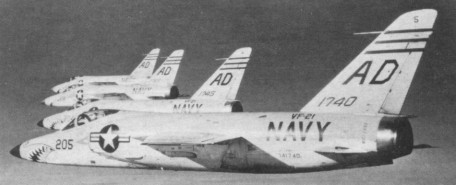
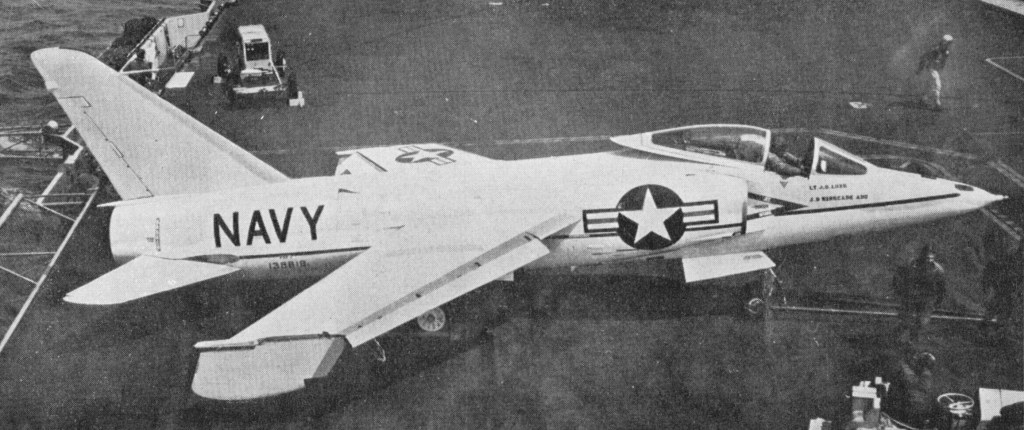
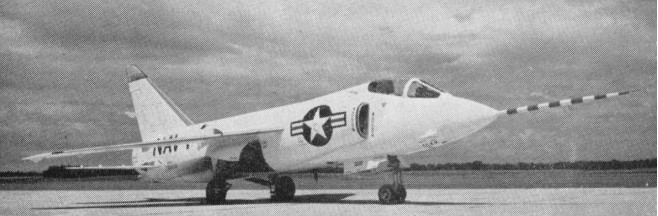
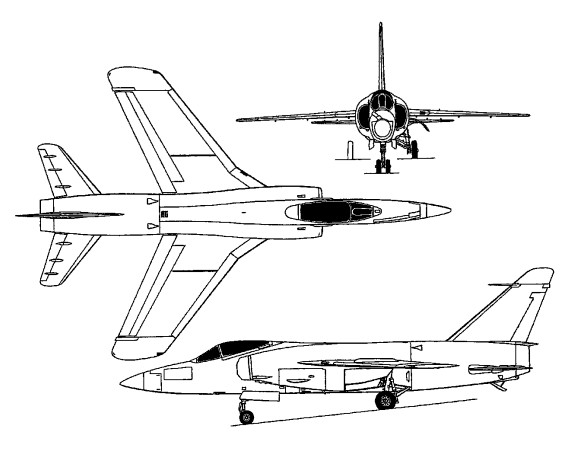
The US Navy’s first transonic shipboard warplane, development of the G-98 was ordered on 27 April 1953 as a revised and improved F9F-6. In the event, there was no commonality with the earlier fighter, but nevertheless, when the first example was flown on 30 July 1954, it was designated YF9F-9, this being changed to F11F-1 in April 1955.
The airframe had mid-set wings sweptback at 30 degrees. There are swept-back tail surfaces, with an all-moving tailplane mid-set on the fuselage. No ailerons are fitted. Lateral control being by spoilers. Leading edge slats are fitted. Trailing-edge flaps are over the full span except for the folding tip portions. Finger type air-brakes are under the fuselage. Two underwing jettisonable fuel tanks may be fitted.
The tricycle under-carriage has a single wheel on each main unit and twin-wheel nose unit. The main wheels retract forward and into the fuselage, and the nose wheels retract rearward.
Able to fly supersonic in level flight, the F11F-9 Tiger was in production for the U.S. Navy in 1955. Six prototypes and 39 F9F-9 were ordered initially. Difficulties with the intended afterburning Wright J65-W-6 engine dictated installation of the derated J65-W-18 in the production F11F-1 with a maximum military thrust of 7,450 lb (3379 kg) and 10,500 lb (4 763 kg) with full reheat. In consequence, the F11F-1 failed to meet contractual performance guarantees.
F11F-1 Tiger
A small number of pre-production aircraft, each with a Wright J65-W-6 turbojet engine with afterburner, were followed by 39 production aircraft (ordered with J65-W-4 afterburning engines).
Grumman F11F-1
The last two Tigers of the initial production batch were fitted with the General Electric YJ79-GE-7 turbojet rated at 9,600 lb (4 355 kg) military thrust and 15,000 lb (6 804 kg) with reheat as F11F-1Fs. One of the F11F-1Fs attained a speed of 1,963km/h and set a short-lived height record on 18 April 1958 of 23,449m.
A further contract for J65-W-18-engined Tigers placed for the US Navy brought the total number of F11F-1s built to 201, but these were gradually phased out of first-line service from 1959. Those which remained in second-line service when the tri-service designations became rationalised in 1962 were redesignated F-11A.
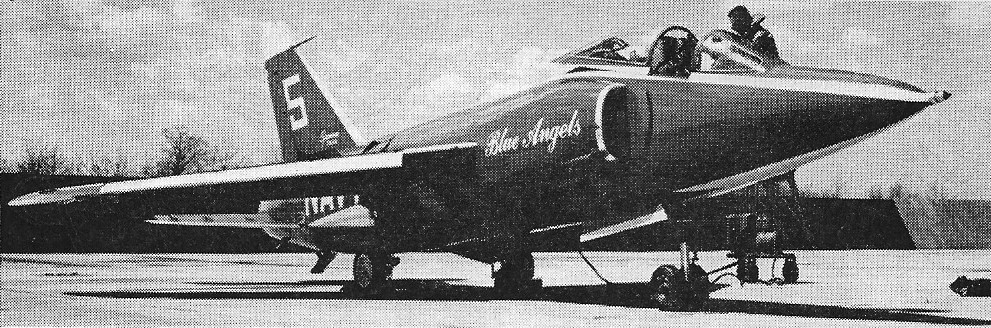
F-11A Tigers of Blue Angels 1965
Production was limited to 201 aeroplanes, the last being delivered in March 1957, service phase-out commencing in 1959.
F11F-1 Engine: 1 x Wright J-65-W-6, 33.8kN Max speed, 753 mph (1212 km/h) at sea level. Initial climb, 16,300 ft/min (82,8 m/sec). Range, 1,108 mls (1783 km). Service ceiling: 16700 m / 54800 ft Empty weight, 13,307 lb (6 036 kg). Max loaded weight, 23,459 lb (10 641 kg). Span, 31 ft 8 in (9,65 m). Length, 44 ft 10.75 in (13,68 m). Height, 13 ft 2.75 in (4,03 m). Wing area, 250 sq ft (23,22 sq.m). Armament: four 20-mm cannon. Crew: 1
F11F-1 Engine: 1 x Wright J-65-W-18, 10,500 lb Span, 31 ft 8 in (9,65 m). Wing area, 250 sq ft (23,22 sq.m). Length, 44 ft 10.75 in (13,68 m). Height, 13 ft 2.75 in (4,03 m). Empty weight, 13,307 lb (6 036 kg). Max loaded weight, 24,078 lb Max speed, 740 mph / M1.12 at 35,000 ft Service ceiling: 50,500 ft Range, 600 mls Armament: four 20-mm cannon. Hardpoints: 4 Crew: 1
F11F-9 Tiger Naval fighter Crew: 1 Engine: Wright J65-W-7 Sapphire turbojet, with afterburner, 7500 lb. thrust. Wingspan: 31 ft. 5 in Length: 39 ft. Loaded weight: approx. 14,000 lb.
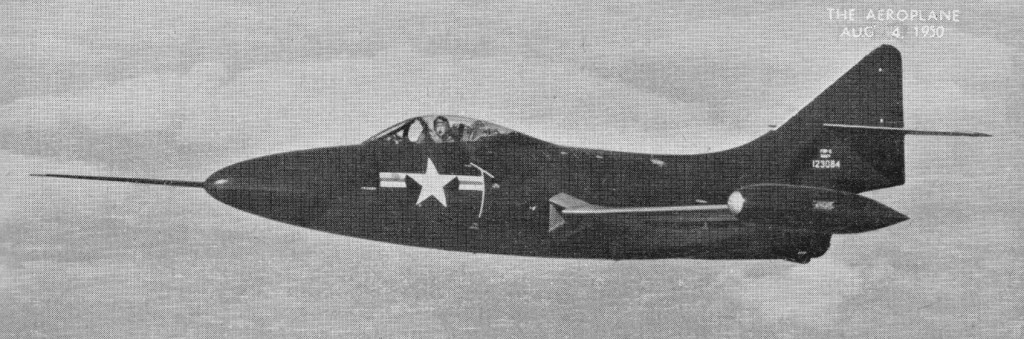
The first jet-powered ‘cat’ to be produced by Grumman and the first carrier borne jet to get into combat, the F9F Panther performed Korea where it constituted the backbone of US Navy and US Marine Corps air power, and by the time production ceased in late 1952 close to 1,400 had been built.
The Cougar was a swept-wing development of the earlier G-79 Panther. The fuselage was similar but the wings and tailplane were swept at 35 deg. The original layout of this single-seat carrier-based fighter provided for the installation of four wing-mounted Westinghouse 19XB-2B (Navy J30) axial-flow jets. But this arrangement was abandoned in favour of one fuselage-mounted high-powered turbojet engine before prototype construction began, a change prompted by the successful tests conducted by the Navy in December 1946 with two imported Rolls-Royce Nene engines. Grumman then turned its attentions to a single-seat single engine jet day fighter, two prototypes duly being ordered with the designation XF9F-2. Powered by an imported Rolls-Royce Nene engine, the first of these made its maiden flight on 24 November 1947 and such was the promise shown that substantial orders were soon forth¬coming for production-configured F9F-2 aircraft fitted with the licence-built Pratt & Whitney J42 copy of the Nene turbojet and British made Stanley Model 22G ejection seat.
The second prototype was similarly fitted, but the third (the XF9F-3) had an Allison J33 engine. Production aircraft were divided between Nene and Allison-powered models, the former engines licence-built by Pratt & Whitney as J42s.
The first production F9F-2, powered by a 22.24kN J42-P-6, flew for the first time on 24 November 1948. The 20.46kN J33-A-8-powered prototype flew for the first time on 15 August 1948 and a total of 418 of both versions were built. However the F9F-2 proved to be the better version and the F9F-3s were re-engined to F9F-2 standard.
Although the F9F-2 was the initial production model, the honour of being the first variant to enter service fell to the F9F-3, which used the slightly less powerful Allison J33 engine. This joined US Navy Fighter Squadron VF-51 during May 1949 but in the event only 54 F9F-3s were completed, most being modified later to F9F-2 standard. The next version to appear was the F9F-4 (73 of which were ordered originally) with the Allison J33-A-16, but none was completed and the contracts were combined with those for more than 580 27.80kN Pratt & Whitney J48-P-4/6A-engined F9F-5s (which flew for the first time on 21 December 1949). The F9F-2, -3, -4 and -5 were in service in 1955.
The most prolific variant was the F9F-5 which was powered by the Pratt & Whitney J48, a licence-built Rolls-Royce Tay, and redesigned fin and rudder. Over 600 were completed by the time production ceased at the end of 1952, this total including a small number of F9F-5P aircraft for photo reconnaissance duties. F9F-5P is long-nosed photo-reconnaissance version. Later machines can be seen with flight refuelling nose-probe.
F9F-5 Panther
The F9F-5 was the last version to see squadron service, being finally retired by VAH-7 in October 1958, although many Panthers continued to fly after that date with training units, and as F9F-5KD (from 1962 DF-9E) drone targets and controllers for missile trials. The F9F-4 was powered by an Allison J33-A-16 engine. The F9F-5P was a photographic-reconnaissance version with a longer camera nose.
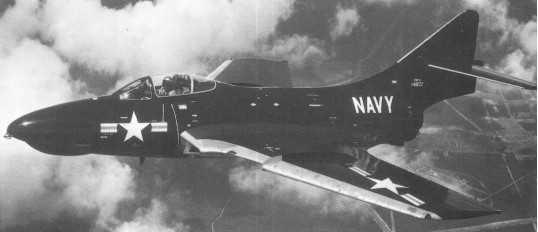
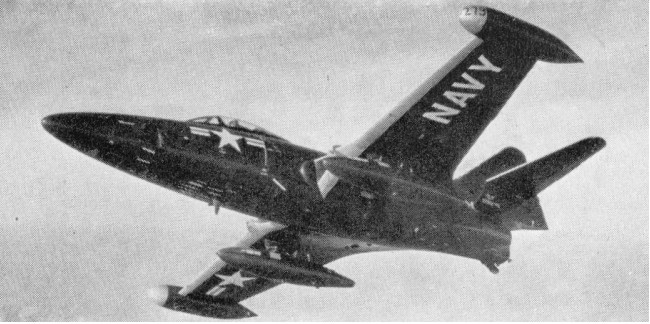
First flown in prototype form as the XF9F-6 on 20 September 1951, the Grumman F9F Cougar evolved from the earlier F9F Panther series of fighter aircraft. It differed mainly from its predecessors by virtue of posses¬sing swept wings and tailplane, thus earning the distinction of being the first swept-wing carrierborne type to enter service. Apart from this, changes were kept to a minimum to facilitate rapid production. Indeed, the new Cougar entered service just 14 months after its maiden flight took place, initial exam¬ples of the 32.25kN Pratt & Whitney J48-P-8-engined F9F-6 (later designated F-9F) joining VF-32 of the Atlantic Fleet naval air force during November 1951.
F9F-5 Cougar
Shortly after this, deliveries to Pacific Fleet units got under way, and the type was very soon introduced to combat in Korea. Production of the F9F-6 totalled 706 aircraft, 60 of which were completed as unarmed F9F-6P machines for reconnaiss¬ance duties with a longer nose to accommodate K-17 and tri-metrogon cameras, and these were followed by the F9F-7 (F-9H) which was pow¬ered by an Allison J33-A-16A turbojet. This proved to be only a temporary change, and after completing 168 F9F-7s Grum¬man reverted to the Pratt & Whitney J48 engine for the F9F-8 (which bore the Grumman design designation G-99) (F-9J), which became the definitive Cougar, well over 1,000 being completed in three basic variants. First to appear was the F9F-8 (601 built). Movable leading-edge slats were replaced by fixed cambered leading-edge extensions outboard of the wing fences. Total internal fuel capacity was increased by 530 litres. Large numbers were later modified to F9F-8B (AF-9J) standard with provision for air-to-surface guided missiles. The first production F9F-8 flew on 18 January 1954.
Some 110 of a photo-reconnaissance version designated F9F-8P (RF-9J) flew for the first time on 21 August 1955 and had an extended nose for the cameras.
F9F-5P
The Cougar also lent itself to the training of future naval aviators; a prototype two-seat YF9F-8T first flown on 4 April 1956 was followed by 399 F9F-8T (TF-9J) production examples, some of which remained in use with Naval Air Training Command until well into the 1970s. The F8F-8T was armed with two 20mm cannon and was 23 inch longer than the original cougar. Production of this version ended on the last day of 1959.
As far as front-line units were concerned, the Cougar disappeared from the scene early in 1960, the last operational version being the F9F-8P, but many continued to fly long after that date with the Reserve Force and with Air Training Command. Surplus aircraft became F9F-6K (QF-9F) and F9F-6K2 (QF-9G) target drones or F9F-6D (DF-9F) drone directors.
F9F-8T Cougar
Panthers are remembered for recording a victory against an enemy jet aircraft, a MiG-15, on 9 November 1950.
F9F-5 Panther Engine: one 3175-kg (7,000-lb) thrust Pratt & Whitney 148-P-6A turbojet Maximum speed 932 km/h (579 mph) at 1525 m (5,000 ft) Cruise speed: 774 km/h / 481 mph Service ceiling 13380 m (43,900 ft) Range 2092 km (1,300 miles) Empty weight 4603 kg (10,147 lb) Maximum take-off 8492 kg (18,721 lb) Wingspan 11.58 m (38 ft 0 in) Length 11.58 m(38 ft 0 in) Height 3.73 m (12 ft 3 in) Wing area 23.23 sq.m (250 sq ft). Armament: four 20-mm cannon, plus up to 1361 kg (3,000 lb) of external ordnance. Crew: 1
F9F-5 Cougar Naval fighter Engine: Pratt & Whitney J48-P-8 turbojet with afterburner, 7200 lb. thrust Wingspan: 36 ft. 5 in Length: 42 ft. 3 in Loaded weight: approx. 20,000 lb. Max. speed: 690 m.p.h. Ceiling. 50,000 ft. Range: approx. 1,000 miles. Crew: 1 Armament: 4×20 mm. Cannon
F9F-8 Cougar Engine: one 3289-kg (7, 250-lb) thrust Pratt & Whitney J48-P-8A turbojet. Maximum speed 1033 km/h (642 mph) at sea level Service ceiling 12800 m (42,000 ft) Range 1690 km(l,050 miles) Empty weight 5382 kg (11,866 lb) Maximum take-off 11232 kg (24,763 lb) Wingspan 10.52 m (34 ft 6 in) Length 12.73 m(41 ft 9 in) Height 3.72 m (12 ft 2.5 in) Wing area 31.31 sq.m (337 sq.ft). Armament: four 20-mm cannon, plus up to 1814 kg (4,000 lb) external ordnance
F9F-8P
TF-9J Engine: 1 x Pratt & Whitney J48-P-8A turbojet, 32.0kN Max take-off weight: 9344 kg / 20600 lb Wingspan: 10.52 m / 34 ft 6 in Length: 13.54 m / 44 ft 5 in Height: 3.73 m / 12 ft 3 in Service ceiling: 15240 m / 50000 ft Range: 966 km / 600 miles Armament: 2 x 20mm cannon, 907kg external
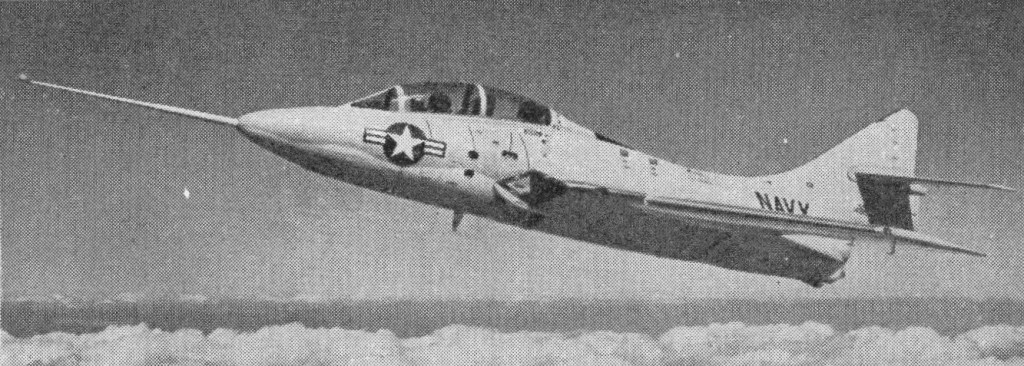
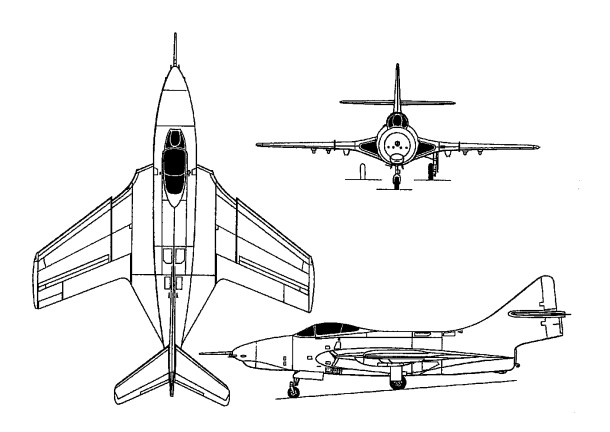
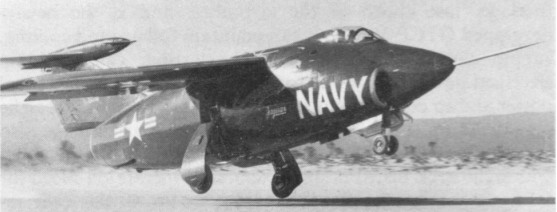
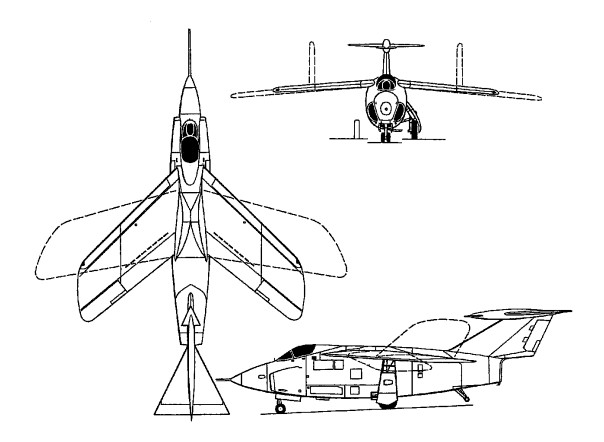
Greater success attended the development of variable-geometry wings, which allow the use of a minimum-sweep position for take-off and landing, an intermediate-sweep position for fuel-economical cruise, and a maximum-sweep position for high dash performance. The navy’s first essay in this field was the Grumman XF10F Jaguar, which was conceived in 1948 as a possible successor to the F9F Panther. The aerodynamic features of a variable-geometry type had already been explored in a number of aircraft, most notably the Westland Pterodactyl IV developed in the UK during the early 1930s, the Messerschmitt P.1011 designed in Germany during World War II, and the experimental Bell X-5 sponsored by NACA and the LTSAF with the ultimate purpose of validating a fighter-type wing with sweep variable between 20 deg and 60 deg. The X-5 had not flown when Grumman set to work on the Jaguar, but a considerable quantity of engineering data was available and this proved valuable to the Grumman engineers, who were faced with a host of problems. Originally the XF10F had been planned as a development of the Panther with clipped delta flying surfaces. Designed as a transonic single-seat shipboard fighter with an internal armament of four 20-mm cannon and provision for an external bomb load of up to 4,000 lb (1814 kg). The sweep angle of the wings could be varied hydraulically between 13.5 and 42.5 deg, and high-lift devices consisted of full-span slats and an 80 per cent Fowler flap. The concept was then refined to the point at which a tilting variable-incidence wing was in adopted for reduction of the take-off and landing speeds. The navy then added additional responsibilities to the basic fighter-role, and these so increased the structure weight that the company came up with the notion of providing a variable-geometry wing. Further refinement was added after this when it was decided to allow the wing to be swept at any angle between the minimum- and maximum-sweep angles. The provision of such wings increased the type’s weight by 2200 lb (998 kg) but reduced landing speed from 132.5 mph (213 km/h) to 109 mph (175 km/h). The Jaguar was also provided with an advanced control system that included a delta surface forward of the fin to act as a servo for the all-moving tailplane and so improve control response at transonic speed. The tailplane was operated by a novel arrangement where the pilot controlled a small delta-wing airfoil at the tip of the tail bullet. This in turn moved the main elevator Unfortunately, a lag in the response between stick and surface usually resulted in a Pilot Induced Oscillation (PIO) and the Jaguar was virtually uncontrollable much of the time.
The engineering of so complex an aeroplane took considerably longer than expected, and it was May 1953 before the XF10F prototype flew, three years behind schedule. The Jaguar was intended to be powered by a Westinghouse XJ40-WE-8 turbojet rated at 7,400 lb (3 357 kg) military thrust and 10,900 lb (4 944 kg) with full reheat, but when flight trials were initiated on 19 May 1952, a J40-WE-6 rated at 6,800 lb (3 084 kg) was fitted. The novel servo-control system for the tailplane proved far too slow in operation, and was replaced by a conventional powered tailplane, but it soon became clear that considerable revision of the basic design would have to be undertaken before production aircraft could be considered. Numerous problems arose during the test programme and as some of these could not be resolved, trials terminated with the 32nd flight on 25 April 1953. Orders had been placed for 112 production F10F-1s, but 100 of these were cancelled on 1 April 1953 and the remaining 12 on the following 12 June.
Empty weight, 20,426 lb (9 265kg). Max loaded weight, 35,450 lb (16080 kg). Span (min sweep), 50 ft 7 in (15,42 m), (max sweep), 36 ft 8 in (11, 17 m). Length, 54 ft 5 in (16,59 m). Height, 16 ft 3 in (4,95 m). Wing area (min sweep), 467 sq ft (43,38sq.m), (max sweep), 450 sq ft (41,81sq.m). Max. speed: 1143 km/h / 710 mph Range: 2687 km / 1670 miles
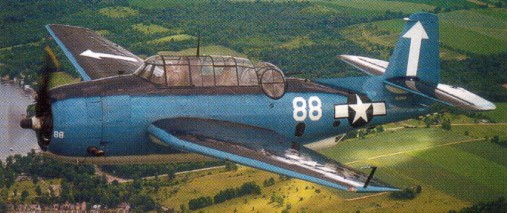
Two prototypes designated XTBF-1 were ordered on 8 April 1940, the first flying on 1 August 1941. The engine was a Wright R-2600-8 Cyclone 14-cylinder two-row radial rated at 1700 hp driving a Hamilton Hydromatic propellor. The extremely large wings folded to the rear about skewed hinges so that they lay along the sides of the fuselage, upper surfaces outwards. The main landing gear had a wide track yet retracted outwards into the wings. The fuselage accommodated a crew of three and an internal weapons bay, and the defensive and offensive armament was well planned. The pilot dropped the short 55.9 cm (22 in) torpedo, 907 kg (2000 lb) bomb or other internal load, fired the fixed guns (one 7.7 mm Browning in the upper right of the nose, and in the TBF 1C and nearly all subsequent versions two 12.7 mm in the outer wings) and rockets (eight 27.2 kg in the TBM 3). The bomb aimer sat in the lower fuselage behind the weapon bay, helped with navigation, sighted the torpedo or bombs in level bombing and manned the 7.7 mm machine gun in the rear ventral position. In the electrically operated turret with its 12.7¬mm gun sat the radio operator and turret gunner.
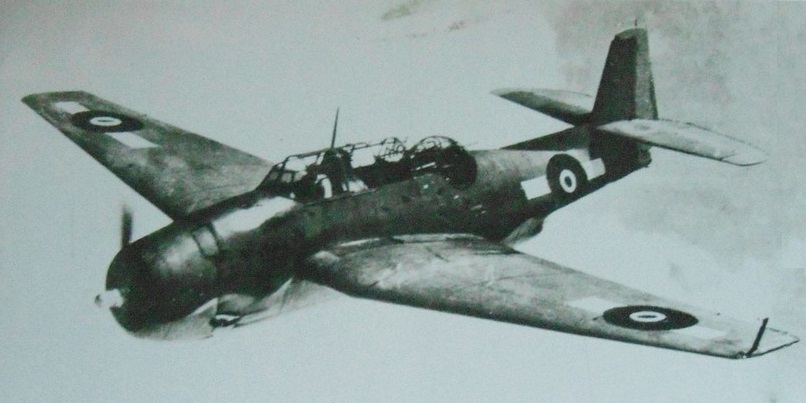
In December 1940 the US Navy placed an initial order for 286, subsequently multiplied, and deliveries began in January 1942 to VT 8. The same squadron took their TBF 1 Avengers into action for the first time during the Battle of Midway, where they did great damage for little loss, while 35 of the 41 old TBDs were shot down in a single engagement. By December 1943 Grumman had delivered 2293 Avengers, most of them being TBF 1Cs with the wing guns and provision for two underwing drop tanks. The Royal Navy received 402 of these Grumman built aircraft (for the first six months calling them Grumman Tarpons), with the US Lend/Lease designation of TBF 1B and the British name Avenger I. The first squadron, Fleet Air Arm No 832, was in action at the Battle of the Solomon Islands in June 1943, aboard the US carrier Saratoga. A further 63 TBF IBs were supplied to the RNZAF.
Grumman TBF-1C Avenger
Avenger NZ2505 was the first Avenger to arrive in NZ in 1943 and flew with RNZAF 30 Sqn. It was retired in 1959.
So important was the Avenger that a second source was arranged, to boost rate of output. As with the Wildcat fighter this second manufacturer was Eastern Aircraft division of General Motors. Between September 1942 and April 1944 Eastern delivered 2882 TBM 1 and 1C Avengers, almost identical to the Grumman 1 and 1C, and 334 TBM 1 were designated Avenger II when supplied to the Royal Navy.
In early 1943 Grumman built an XTBF 3 prototype with 1900 hp R 2600 20 engine. This version subsequently became the standard production Avenger, all made by East¬ern Aircraft (Grumman concentrating on the F6F Hellcat fighter). Between April 1944 and August 1945 Eastern delivered 4664 of this more powerful TBM 3 model, which also carried more fuel, had stronger wings equip¬ped to carry drop tanks, radar or rocket projectiles, and in most aircraft had the turret removed. The Royal Navy received 222 designated Avenger III. The TBM-3E, almost the same as the earlier TBF, had a fuselage stretch of around one foot and a more powerful engine.
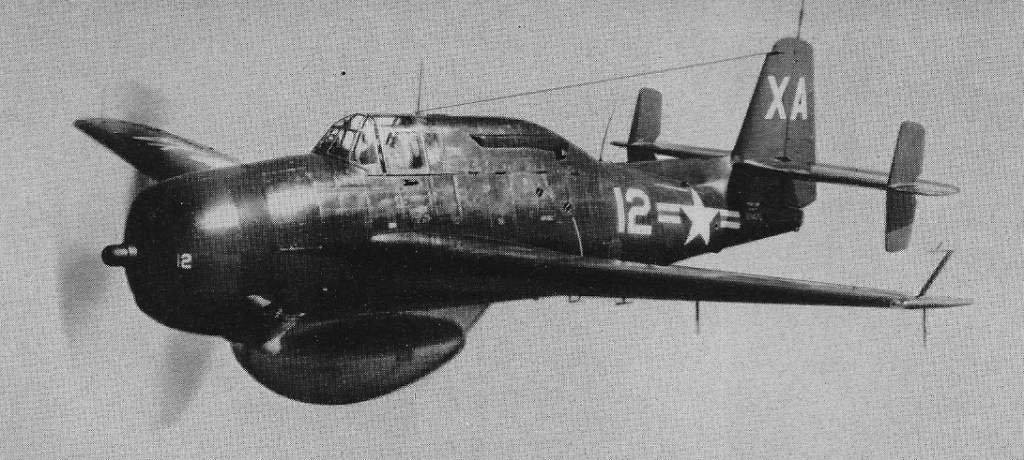
In 1946 the Avenger was the first aircraft ever to carry early warning (AEW) radar, the Project Cadillac set that became APS 20. This became a standard interim service type, designated TBM-3W and 3W2, with no turret and rearranged interior.
TBF-3W
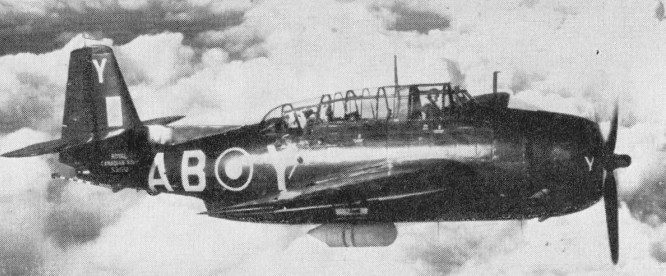
The TBM 3E was a post war rebuild which was put back into ‘remanufacture production’ during the Korean war, for the Royal Navy (100 Avenger AS.4), Royal Canadian Navy (115) and Aeronavale (96). The TBM 3S and 3S2 were antisubmarine strike versions for the Netherlands and Japan. The TBM-3U was a target towing version, and the TBM 3R was a seven seat COD (Carrier On Board Delivery) transport. 958 served with the Royal Navy. All models were powered by Wright R-2600 Cyclone engine. A total of 9839 aircraft were built.
Avengers in service with the Royal Canadian Navy in 1955 were ex-U.S.N. aircraft, modified by Fairey Aviation of Canada. Some retain original ballshape gun turret at rear of glasshouse. Others are unarmed. All carry a radome cannister under starboard wing.
TBF-1 Engine: 1 x Wright R-2600-8 Cyclone 1700 hp. Max speed: 278 mph / 445 kph. Service ceiling: 22,600 ft / 6890 m. Wing span: 54 ft 2 in / 16.5m Width folded: 19 ft / 5.8 m. Length: 40 ft / 12.2 m. Height: 15 ft 5 in / 5 m. Wing area: 490 sq.ft. Empty wt: 10,600 lb. MTOW: 7053 kg / 17,600 lb. ROC: 1075 fpm / 376 m/min. Range: 1450 km / 905 sm. Crew: 3 Armament: One .30 mg in cowling, one fixed .50 mg in each outer wing, one .50 mg in power-operated turret, one .30 mg in ventral hatch, bomb bay / one torpedo, one 2000 lb bomb or four 500 lb bombs
TBF-1C Avenger Engine: 1 × Wright R-2600-20 Twin Cyclone , 1,900 hp (1,420 kW) Wingspan: 54 ft 2 in (16.51 m) Length: 40 ft 11 in (12.48 m) Maximum speed: 275mph (442 kph) Maximum range: 1000 miles (1610 km) Service Ceiling: 30,100 ft (9,170 m)
TBM 3 / TBF Engine: Wright R-2600-20 Cyclone 14, 1726 hp / 1305kW Span: 16.51 m (54 ft 2 in) Length: 12.2 m (40 ft 0 in) Height: 16 ft 5 in / 5.0 m Wing area: 489.977 sq.ft / 45.52 sqm Weight empty: 10105.5 lb / 4583.0 kg Gross weight: 8278 kg (18 250 lb) Max speed: 232 kts / 430 km/h (267 mph) Cruising speed: 128 kts / 237 km/h / 147 mph Service ceiling: 23392 ft / 7130 m Wing loading: 37.31 lb/sq.ft / 182.00 kg/sq.m Range: 982 nm / 1819 km Crew: 3 Armament: 3x MG cal.50 (12,7mm), 1x MG cal.30 (7,62mm), 907kg ord.
TBM-3 Engine: 1,750 h.p. Wright R2600-20 Wingspan: 54 ft. 2 in Length: 40 ft. 11.5 in Loaded weight: 16,761 lb Max. speed: 261 mph Ceiling: 22,600 ft. Typical range: 1,130 miles at 151 mph Crew: 2-3.