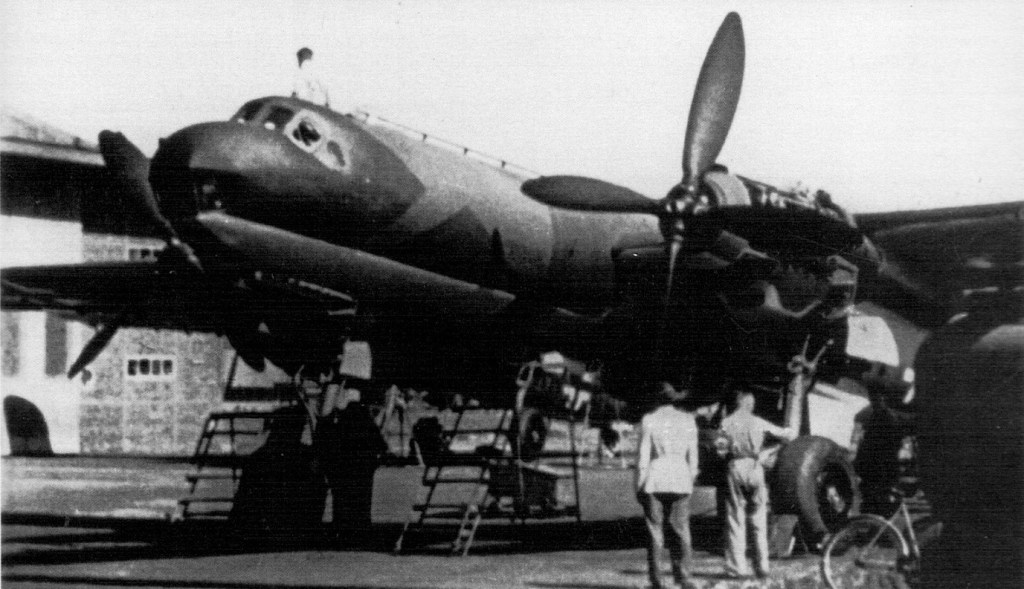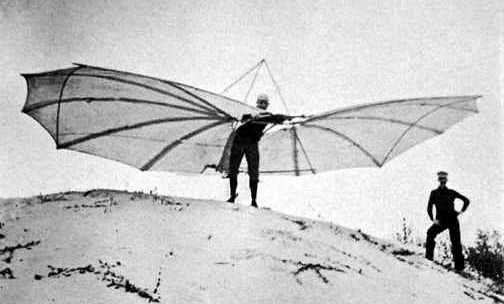
Herring Lilienthal monoplane

Herring preparatory to making a glide

In December, 1895, Mr. Chanute secured the services of Mr. A. M. Herring, a civil and mechanical engineer, who had for some years been making experiments in Aviation, this being the recent name given to attempts to imitate the birds.

Chanute selected the sand dunes along the southern shore of Lake Michigan as the perfect place to test his creations. The area was close to Chicago. The little train station at Miller, Indiana served as an entry point into Dune country. The area offered a number of other important advantages, including steady winds, dunes from which a glider could be launched in any direction, an abundance of sand for soft landings, and, Chanute hoped, relative isolation.

Chanute and his four assistants pitched their tents on a spot within the present city limits of Gary, Indiana, on June 22, 1896. Augustus Herring, the most experienced member of the group, had brought a glider based on the standard Lilienthal monoplane design. William Avery, a Chicago carpenter, had constructed a multi-wing glider designed by Chanute, while William Butusov would attempt to launch his own glider, the Albatross, down a wooden ramp. Dr. James Ricketts, a Chicago physician with “a slack practice and a taste for aeronautics,” would cook for the group and provide emergency medical service as required. Chanute’s dogs, Rags and Tatters, rounded out the party.
Herring and Avery did most of the flying.

Herring rebuilt a machine, previously tested by him in New York, somewhat similar to that of Lilienthal, so that the known should be tested before passing to the unknown. With these two machines Mr. Chanute and Mr. Herring, and two assistants (Mr. Avery and Mr. Butusov), went in June, 1896, to the desert sand dunes at the south end of Lake Michigan, north of Miller Station, about thirty miles from Chicago. The Lilienthal-like machine was the first tested.

The machine spread 168 square feet of sustaining surface, was equipped with a double rudder, and weighed thirty-six pounds. With this about 100 glides were made, the longest being 116 feet. It proved from the outset an awkward machine to handle. Lilienthal, whose skill had been developed by four or five years of practice, obtained valuable and safe results with it, but it was otherwise with novices. Its operation involved a struggle with the wind before it could be brought under control, and this continued after the flight had begun.

Gliding a short height over the ground was practiced to avoid untoward accidents, for the winds experimented in, of 12 to 17 miles per hour, constantly varied the position of the center of pressure so far and so rapidly through their fluctuations, that the operator had to shift his position as actively as a tight-rope dancer, but to greater distances, to avoid being overturned. The body had to be moved at times some 15 or 18 inches, and not infrequently in landing the apparatus was broken. This involved less personal risk than might be supposed because the radiating ribs curve downward, so that they first come into contact with the ground when an awkward landing is made, and save the operator from harm.

The Lilienthal glider proved to be a disappointment. At last, after having been broken and mended a number of times, was finally discarded altogether. After abandoning this first form of machine, the experimenters in the sand dunes next tested the machine built after the fashion of the ladder kite which had proven so steady in the air.
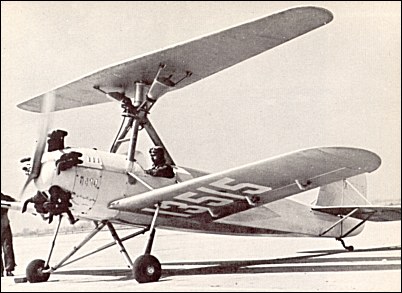
Herrick Convertoplane

The Convertoplane, cross between an airplane and a rotorplane, was developed in the United States in the 1930s by the Gerard P. Herrick, aided by Ralph H. McClarren of Philadelphia’s Franklin Institute. Basically, the design was a biplane with an upper wing that could function either as a lifting surface or as a two-bladed teetering rotor.
Flown by test pilot George Townsend in 1937, the aircraft demonstrated successful conversions in flight from a biplane to a rotorplane. Herrick was striving for an aircraft that could achieve speed as an airplane while possessing ability to convert to rotating-wing configuration for landing and take-off in tight areas.

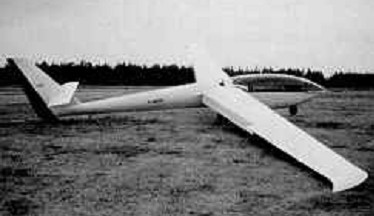
Hermanspann Chinook

Chinook S

The Chinook S, designed by Fred Hermanspann and Art Penz, first flew in 1996, as an improved version of the original Chinook of 1993. Approach control is by full deflection trailing edge flaps. Both the flaps and main wheel are hydraulically actuated. The sailplane has been used to study the effect of rain on airfoils, and dynamics at the stall.

Wing span: 17.37m / 57ft
Wing area: 13.29sq.m / 143sq.ft
Empty Weight: 286kg / 630lb
Payload: 190kg / 420lb
Gross Weight: 476kg / 1050lb
Wing Load: 35.82kg/sq.m / 7.34lb/sq.ft
Water Ballast: 0
L/DMax: 40 98 kph / 53 kt / 61 mph
MinSink: 0.73 m/s / 2.17 fps / 1.42 kt
Aspect ratio: 22.7
Airfoil: Wortmann FX67-K-170/17
Structure: aluminum, GFRP front fuselage
Seats: 2
No. Built: 1

Hergt Monoplane

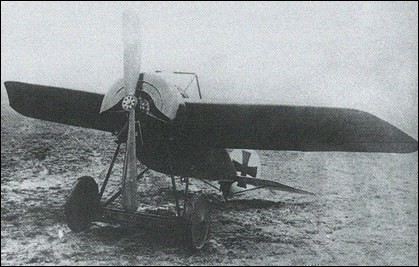
The Hergt Monoplane was designed and built at F.E.A. 1 Altenburg as a private venture by F. D. Hergt during 1918 and flown by Mario Scherff.

The prototype had room for one pilot, and ply-skinned wings and fuselage.

Engine: Gnome 80 h.p.
Wingspan: 6.0 m. (19 ft. 8 1/4 in.)
Length: 5.2 m. (17 ft. 0 3/4 in.)
Speed: 125 km.hr. (78 m.p.h.)
Armament: none

Herdler 1911 Hochdecker

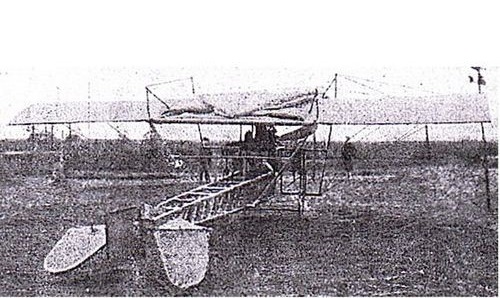
The 1911 Herdler Hochdecker high-wing eindecker designed by Carl Herdler, had an “Absturzsicherung auf dem Flügel (ein sammengefalteter Luftsack) der bei Gefahr gespreizt werden konnte” – a security device, where the idea was to blow up the bag with air, to remain longer in the air whereas to lessen the force of impact in the event of a crash on the ground. The “air bag” may have also been somewhat based on the parachute.

The machine made short hops in 1911.

Henson & Stringfellow Aerial Steam Carriage

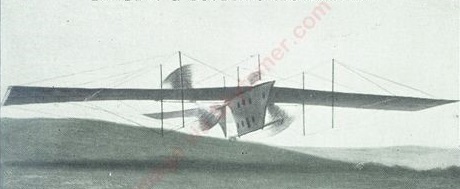
In 1843 William Samuel Henson patented about a proposed “Aerial Steam Carriage”. It seems more like a practical flying machine than anything hitherto suggested. Lacemaking industry engineer Henson, based in Somerset, has had a number of bright aviation ideas. This remarkable flying machine would be a monoplane, with two pusher propellers to be driven by a light steam engine of 25 to 30 hp. Henson actually ordered this engine from colleague John Stringfellow. Even if the Aerial Steam Carriage never flies, its impact has already been tremendous. Pictures of it appeared in magazines and newspapers, and is much talk about.

Also in 1843 William Samuel Henson and John Stringfellow filed articles of incorporation for the world’s first air transport company, the Aerial Transit Company.

Hensley 1909 biplane

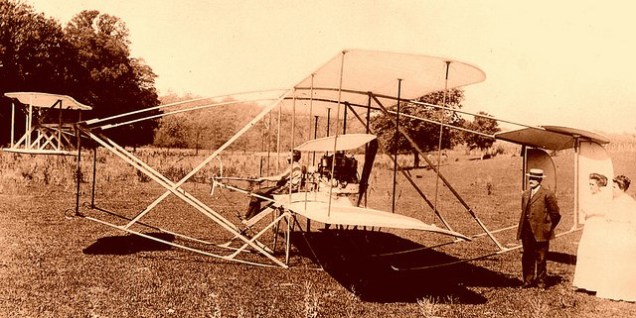
This somewhat Wright-like machine was constructed in Anderson, Indiana, USA, by Charles H. Hensley, a 40-year-old man who enjoyed building and flying box kites, and Levi Calvin Lambert, who was a 33-year-old plant manager and a member of the family that owned the Lambert Gas and Gasoline Engine Co., also of Anderson, which probably provided the engine. A grandson of Hensley stated that the plane flew around in a circle, for how long or at what height is unknown. He was told the plane was dismantled after its only flight.

Henschel Hs P.75

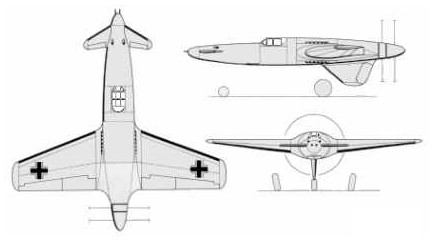
This 1941 aircraft design was to be a possible successor to the Messerschmitt Bf 110 heavy fighter. Although of a unusual configuration for that time, there were advantages (and disadvantages) to its rear wing/forward canard construction.
The Hs P.75 featured a tapered fuselage, with the slightly swept-back wings being mounted mid-fuselage and set back to the rear of the aircraft. The widened fuselage was designed to house the Daimler Benz DB 610 engine, which were two DB 605 engines joined side-by-side, just aft of the cockpit. These were the same engines that the Heinkel He 177 used, and were found to be prone to overheating and catching fire.Due to this development, they were changed in 1942 to the liquid-cooled, 24 cylinder Daimler Benz DB 613 engines (two coupled DB 603s) that produced 3500 horsepower. Both engine configurations were to drive contrarotating propellers (to offset tourque) of a 3.2m (10′ 6″) diameter via an extension shaft. There were a pair of swept-back canards located on the nose of the aircraft, that were to serve the purpose of elevators. The vertical tail unit was mounted beneath the fuselage, so that it could act as a tail bumper upon takeoff so that the propellers would not strike the ground. Since the propellers were located at the rear in a pusher configuration, a tricycle landing gear arrangement was chosen. Fuel was contained in three tanks, one in each wing and one behind the cockpit. A single pilot sat in the cockpit which was located about midway along the fuselage, and four Mk 108 30mm cannons were mounted in the nose.
The advantages of the pusher propeller/forward canard design was that it opened up the pilot’s view, plus the weapons installation was much simplified and could be concentrated. The disadvantages would be engine cooling plus an ejection system or propeller jettison would have to be designed for the pilot to safely exit the plane in case of an emergency.

Henschel Hs P.75 Data
Span: 11.3 m / 37 ft 1 in
Length: 12.2 m / 40 ft 0 in
Height: 4.3 m / 14 ft 1 in
Wing Area: 28.4 sq.m / 305.7 sq.ft
Max Weight 7500 kg / 16535 lb
Wing Loading: 264 kg/sq.m / 54 lbs/sq.ft
Ceiling: 12000 m / 39370′
Max. Speed: 790 km/h / 491 mph

Henschel Hs 132

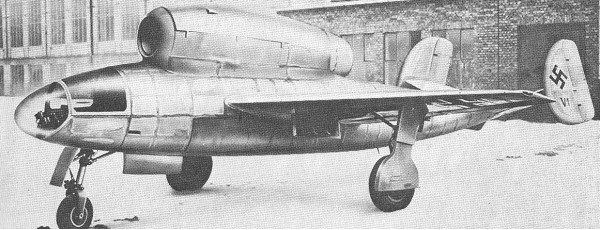
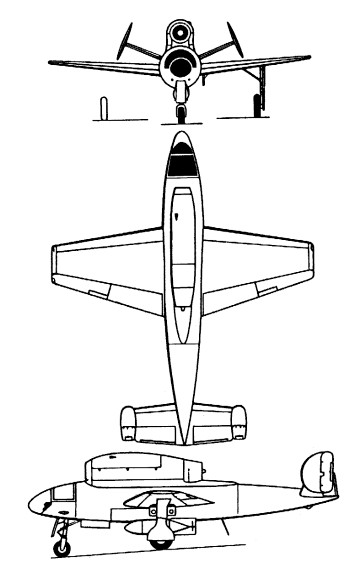
During the last half of 1943 experience showed that losses during convention¬al dive bombing with the Junkers Ju 87 were becoming prohibi¬tive without heavy fighter escort, parti¬cularly in the face of Soviet air presence on the Eastern Front. The Henschel company, with considerable experience in produc¬ing ground support aircraft, put for¬ward late in 1944 proposals for an essentially simple single jet attack bomber with a BMW 109 003E 2 tur¬bojet mounted above the fuselage. In essence the aircraft resembled the Heinkel He 162 with twin fins and rud¬ders, although the sharply tapered wing was mounted at mid fuselage depth; more significant, the pilot occu¬pied a prone position in the extreme nose so as to withstand the likely 12g forces expected to accompany shal¬low dive recovery. Simplified con¬struction with widespread use of wood in the structure was welcomed by the RLM and three prototypes were ordered, and commenced building in March 1945.

Only the Henschel Hs 132 VI powered by a 1,760 lb thrust BMW 003 engine had been completed (but not flown) by the war’s end, and all three aircraft were taken over by the Soviet forces in their advance from the east.

The first aircraft was to have carried a single 500 kg (1,102 1b) bomb recessed into the under-fuselage; the second, with Jumo 004 900 kg (1,984 1b) thrust engine com¬bined this load with two nose mounted 20 mm MG 151 cannon; and the third, with 1300 kg (2,866 1b) thrust Heinkel¬-Hirth 109 011A turbojet would carry a 1000 kg (2,205 1b) bomb, two 30 mm MK 103 and two 20 mm MG 151 guns. It was intended that the PC 1000RS Pol rocket assisted armour piercing bomb would be used for battlefield support attacks.

Hs 132 V1
Engine: one 800 kg (1,764 1b) thrust BMW 109 003E 2 turbojet.
Wingspan 7.20 m (23 ft 7.5 in)
Wing area 14.82 sq.m (159.4 sq.ft)
Length 8.90 m (29 ft 2.5 in)
Height 9ft 10 in
Maximum speed 780 kph (485 mph) at 6000 m (19,685 ft);
Service ceiling 10250 m (33,630 ft)
Range 680 km (423 miles)
Maximum take off weight 3400 kg (7,496 lb)
Armament: one 500 kg (1,102 lb) bomb under the fuselage.

Henschel Hs 130

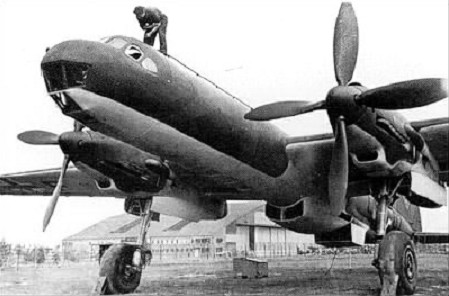
A high-altitude reconnaissance bomber, developed from the Hs 128, the A-06 and A-07 pre-series aircraft had a wing span of 29m, and turbosupercharged DB 605 engines. They could reach 15500m.

The Hs 130E-0 was powered by two 1750 hp Daimler-Benz DB 603A engines, which were supplied with air by a compressor, driven by a 1475 hp DB 605T. This configuration was known as ‘HZ Anlage’. This aircraft was capable of attaining 16,500 m / 54,000 ft.

Five HS 130 pre-production E-0s and probably three E-1 production aircraft were completed before 1944 when the programme was cancelled.

One E-1, W.Nr.130082 BD+KA, was tested by a crew from the Versuchsverband at the Henschel plant at Berlin-Schonefeld late in 1944, but crashed on 17 December 1944 killing all on board.