Hills & Sons / Hillson

UK
F.Hills & Sons Ltd was formed by Francis Hills in 1849 as a one-man joinery company in Yarm on Tees. Cooper and Walter Hills (grandsons of Francis) took over in 1907, and during the First World War, the company made ammunition boxes and joinery for the Forces. In 1921, Hills became a limited company, and in 1923, moved to larger premises in Stocton. The company began making aeroplanes after Managing Director W.R.Chown, who was interested in aircraft development, visited Prague, Czechoslovakia to obtain a license to produce the Praga E.114 Air Baby two-seat lightplane. Thirty were manufactured from 1936, known as Hillson Pragas. Following this, he purchased the old Ford Motor Company premisis in Trafford Park, Manchester, for joinery and aircraft production.

The first aircraft built by Hills was a Pou du Ciel, an HM.14 Flying Flea. The aircraft was registered G-ADOU in October 1935, and test flown at Barton Aerodrome.

The first licence-built Praga E.114 was sold to Australia, and the second registered G-AEEU became the company’s demonstrator in April 1936. Total production by Hills amounted to twenty-eight aircraft, plus seven uncompleted.

There followed two-one-off Hillson light aircraft, both designed by Norman ykes: the Pennine, a two seat, side by side, high wing monoplane, registered G-AFBX but not flown before the outbreak of war; the Helvellyn G-AFKT, an open cockpit, tandem, two seater, low wing monoplane was built and flown in 1939.

During 1938-39, Hills built Anson wings and laminated spars for Airspeed Oxfords. During the war, the company produced no less than 480.000 JABLO propeller blades and 10 million square feet of aeronautical plywood for Mosquito and other aircraft.

In addition the company produced more than 800 Percival Proctors and the slip-wing Hawker Hurricane I, after first buillding and testing a research aircraft called the Hillson Bi-mono. An expendable slip-wing was mounted above the fuselage in order to obtain more lift for operating out of small fields and to enable the aircraft to take off at greater than normal gross weight. Once airborne, the wing could be released by the pilot.
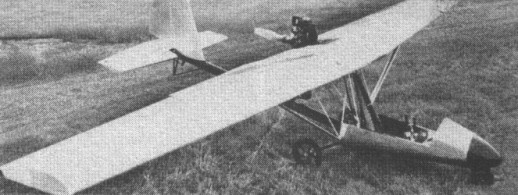
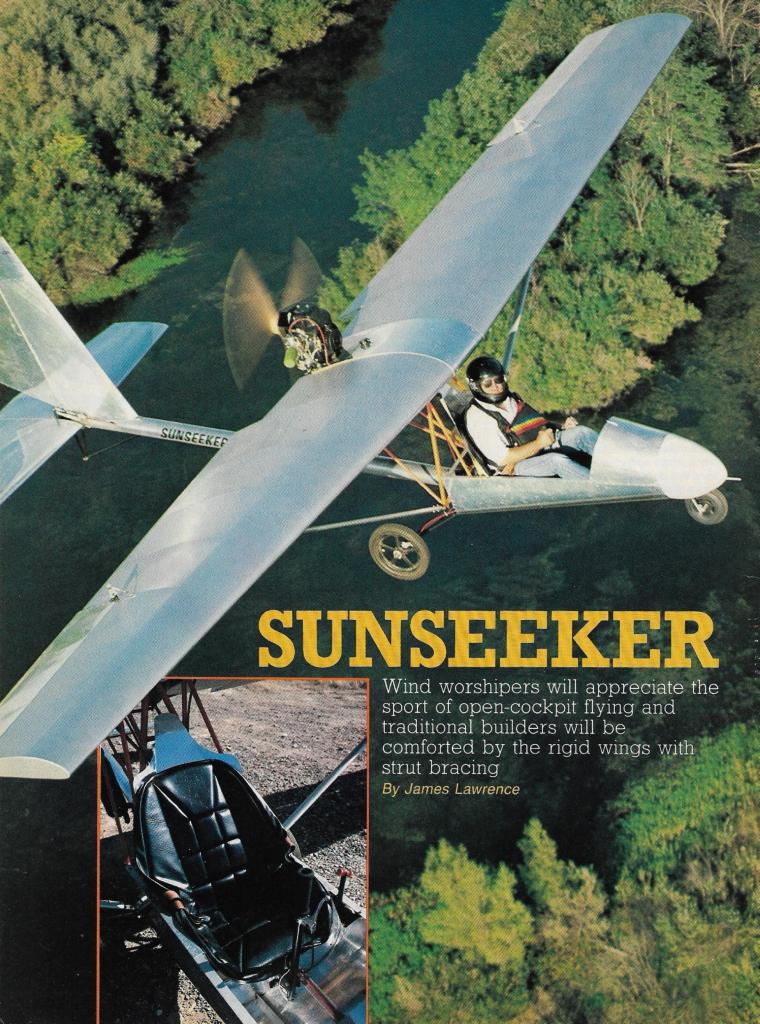
Hillside Sunseeker

High monowing, strut-braced, Kevlar/foam construction. Full three-axis control system. Powered by a WAE two-cylinder horizontally opposed British microlight engine. The landing gear was Chrome-moly steel, trike type.

After spending something like $200k developing the aircraft and all the tooling, the original designers found they couldn’t obtain product liability insurance and they decided to sell the project to someone who was going to manufacture it in Mexico. That never came to.

Only 10 came out of the factory.

Engine: WAE 2 cyl, 30 hp
Wingspan 31 ft
Wing area 112 sq.ft
Length 18 ft
Empty weight 245 lb
Payload 245 lb
Gross 600 lb
Wing loading 4 lbs/sq.ft
L/D 22:1
Cruise speed 60 mph
Stall speed 19 mph
Vmax 63 mph
Climb rate 1000 fpm
Takeoff run 150-200 ft
Landing roll 150-200 ft
Fuel capacity 5 USG

Hiller X-18

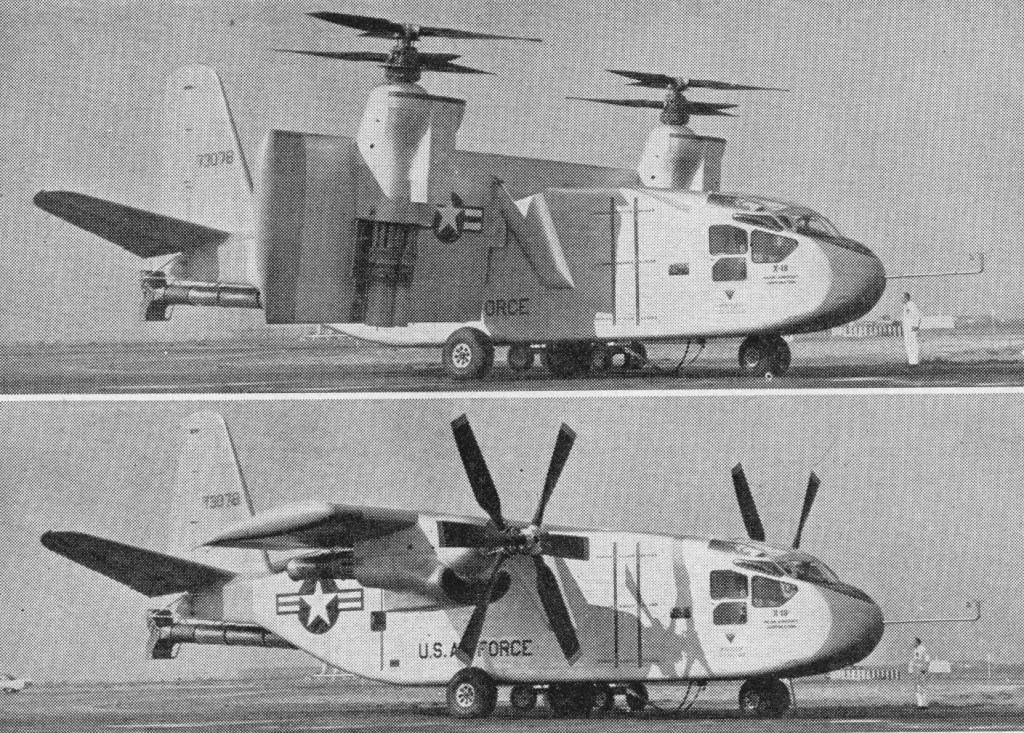
A prototype in the VTOL arena was the 33,000 lb Hiller X-18 tilt-wing convertiplane. The X-18 took to the air for the first time in November 1959, and in overall concept was configured as a transport type. Power was provided by two 5850-shp (4362-kW) Allison T40-A-14 turboshafts driving the two contra-rotating propeller/rotor units located one on each wing, and a 3400-lb (1542-kg) thrust J34 turbojet providing exhaust gases to a tail-mounted thrust diverter used for longitudinal control in vertical flight.

Hiller VZ-1 / W-1

VZ-1

The first of the Army’s designated VTOL research aircraft was a continuation of the work to develop a ‘flying platform’. The idea for a machine of this kind, making use of kinesthetic control (in which the pilot leans in the direction he wishes to go) is attributed to Charles H. Zimmerman and dates back to 1940.

In the early 1950s, N.A.C.A. (the forerunner of N.A.S.A.) undertook a research programme at Langley Laboratory to prove the idea. Three types of aircraft were studied, each capable of carrying one man who stood on a platform, and supported, respectively, by a rotor, a ducted fan and compressed air. Subsequently, the Army placed contracts for further development of a rotor type flying platform by de Lackner (the Aerocycle) and of the ducted fan type by Hiller.
The Hiller Helicopter Company had by this time already completed some studies in conjunction with Charles Zimmerman, in 1947, but no free flights were then achieved. A contract was placed with the company in 1953 for the construction of a prototype under Office of Naval Research supervision and this flying platform achieved its first successful untethered flight in February 1955.

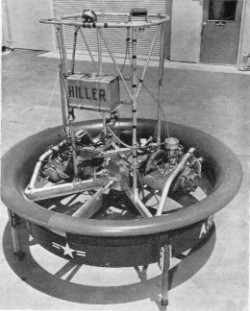
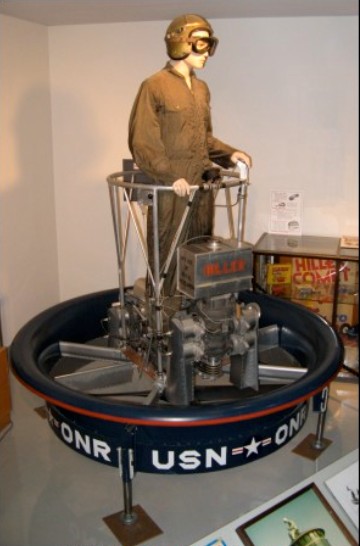
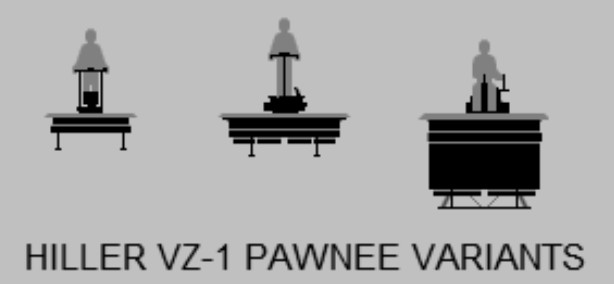
The Pawnee featured a pair of contra-rotating rotors spinning inside a duct with a diameter of 1.5 meters (5 feet). Each rotor was driven by its own 30 kW (40 HP) two-stroke engine. The pilot stood above the duct, surrounded by a circular handrail and protected by a safety harness. He controlled the engines with a twist-grip throttle and leaned to guide the aircraft. The duct improved safety during takeoff and landing. The duct also provided additional lift, since there was a horizontal “lip” around its top edge that curved down into the duct. The airflow into the duct resulted in low air pressure above the lip, and the pressure difference between the top and bottom of the lip generated a net upward force, providing as much as 40% of the total lift of the aircraft.

In practice, speeds of up to 15 m.p.h. were achieved. Hand controls included the throttles to control vertical movement and a control to apply power deferentially to the two propellers in order to keep the platform headed in the right direction.

The Pawnee handled very well in flight tests. The machine was then modified with longer landing gear legs to increase ground clearance, and eight vanes were mounted underneath the duct to improve flight control.

Results of the trials with their early platform were sufficiently promising for the Army to award Hiller a second contract, in 1956, for two larger examples of the flying platform. These were designated W‑ I E (serials 56‑6944 and 56‑6945).

VZ-1E

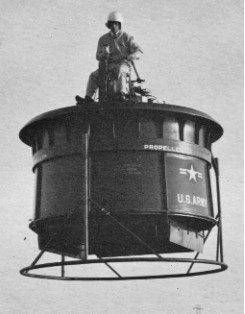
In the W 1E, the diameter of the duct was increased to 8 ft. and the chord was more than doubled. Three interconnected 30 kW (40 HP) Nelson H 56 engines supplied power to the counter rotating propellers. Controls were modified to be similar to those in a helicopter and the pilot had a rudimentary seat.

First flight of the W 1E (56 6944) was made on February 4th, 1955. It was delivered to the Army in 1959 but no further development occurred.

Gallery

Hiller

Hiller Industries
Hiller Helicopters
Hiller Aviation
Rogerson Hiller Corporation
Hiller Aircraft Corporation

Hiller Helicopters Inc. was formed in 1942 for the development and production of rotary-wing aircraft. Early work on the Hiller Model XH-44, UH-4 Commuter and the UH-5, which introduced a newly-developed ‘Rotor-Matic’ rotor control system, led to the Hiller Model 360 prototype.
Stanley Hiller flew the first successful American co-axial helicopter, the XH-44, in July 1944, when he was only 19 years old. It also featured the world’s first successful all-metal rigid-rotor blades. Hiller had learned to fly from his father at an early age, and at 16, Hiller had started a business building small gasoline engine model cars; revenue eventually grew to $100,000. Hiller became interested in helicopters in 1937 when he saw pictures of the Focke Wulf Fw 61 and Sikorsky’s VS-300 in 1939. Hiller felt the tail rotors used on the VS-300 and the outriggers on the Fw 61 were wasteful and possibly unnecessary.
Formed 1942 as a division of Hiller Industries. Name changed to Hiller Helicopters in 1948.

In 1948 Hiller Helicopters produced the Hiller UH-12, subsequently supplying it to civilian operators and, as the H- 23B and OH-23C/D Raven, to the U.S. Army and to foreign air arms under the MDAP program . Three-seat UH-12E (first flown 1958) and four-seat UH-12E4 variants also developed. The Hiller HOE-1 Hornet ramjet ultralight helicopter and “Flying Platform” were two military experimental types devised by the company.

In 1964 Fairchild-Stratos Corp purchased Hiller Aircraft with cash, not stock transactions. Hiller capabilities fitted into one of Fairchild’s primary goals – vertical takeoff and landing aircraft. The Hiller plant was to remain in Palo Alto.

Fairchild Stratos Corporation acquired Hiller in 1964, hence the FH designations, believing they were about to secure a large military contract as the OH-5A stood out the preferred winner. Leaked production data of the OH-5A resulted in Howard Hughes successfully under bidding with the OH-6A. Fairchild meanwhile announced they would begin civilian helicopter production of a refined OH-5A, designated the FH1100.
Hiller Aviation Inc was formed in 1973 after acquiring the design rights, tooling and spares for Hiller 12E light helicopters from Fairchild Industries. The company provided support for operators of Hiller helicopters and produced three-seat UH- 12E and four-seat UH-12E-4 turbine conversions of the UH-12E, developed in conjunction with Soloy Conversions. Also introduced former Fairchild Hiller FH-1100 in 1984 (later as RH-1100). Became subsidiary of Rogerson Aircraft in 1984, reviving first the name Hiller Helicopters and later becoming Rogerson Hiller Corporation.

Hiller Aircraft Corporation was founded 1994 by Jeffrey Hiller (son of the founder of the original Hiller Aircraft company) and a consortium, to repurchase assets from Rogerson Hiller Corporation. First flight January 1995 of the UH-12E5 five-seat helicopter, and June 1995 for first newly built UH-12E3.

1995: 2140 West 18th St, Port Angeles, Washington 98362, USA.

Hill Pterodactyl

A series of tailless aircraft was designed by Professor Geoffrey Hill to demonstrate the concept of aircraft that could fly safely at low speed. The first machine was a glider which he built in 1924 and flew from the South Downs, UK. From this a powered version was constructed.