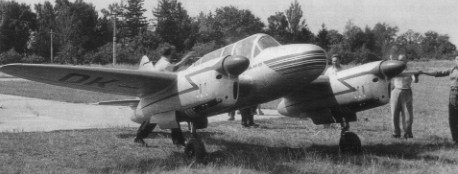
One of three new Czechoslovak prototypes unveiled at an international airshow held at Prague-Ruzyne airport on September 7, 1947, was the civil HK-101 light twin.
Engines: 2 x Walter Minor 4-III.
One of three new Czechoslovak prototypes unveiled at an international airshow held at Prague-Ruzyne airport on September 7, 1947, was the civil HK-101 light twin.
Engines: 2 x Walter Minor 4-III.
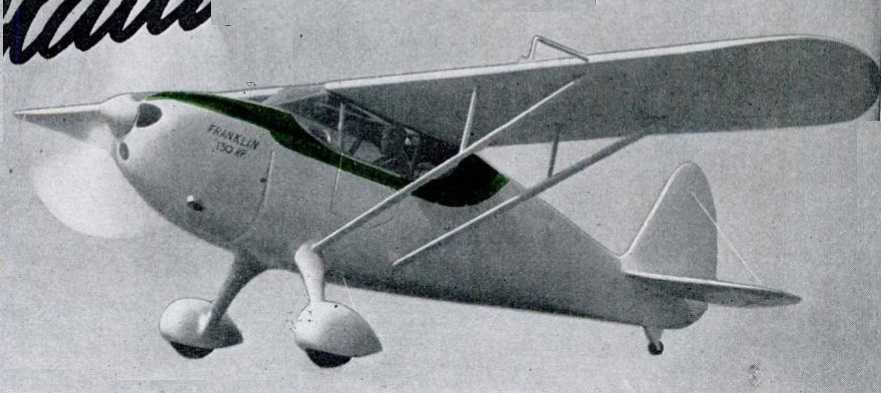
Design work on the CV-139 Comet two-seat high-wing cabin monoplane, but was suspended in 1940 to make way for military contract work for other aircraft companies. The project was resumed in 1944, when the sole prototype was test flown.
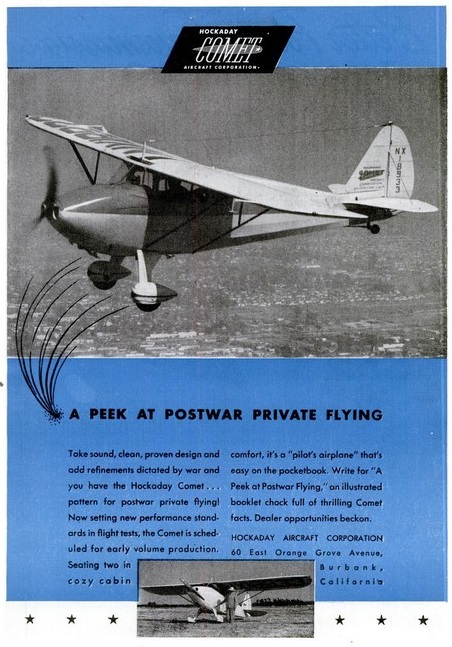
USA
Formed in 1937. Design work on the CV-139 Comet two-seat high-wing cabin monoplane, but was suspended in 1940 to make way for military contract work for other aircraft companies. The project was resumed in 1944, when the sole prototype was test flown.
The Mozzi microlight is a New Zealand design with a high-lift wing of 30 feet span, strut braced for easy removal. Built by J.L. Hobson, it features a tricycle undercarriage, pod and windscreen of a B20. Power comes from a Rotax 447 and top speed so far is 65 mph, with an economical cruise speed in the low 40s. Most of the fittings are of the builder’s own design.
A two-seat sesquiplane trainer of wood and metal construction.
Founded in 1939, this company produced the Hitachi T-2 two-seat sesquiplane trainer of wood and metal construction.
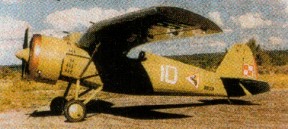
Historical Aircraft Corp offers kits to build a range of 60 percent scale single-seat fighter representations, including P-51D, Corsair, PZL P.11 c and, P-40 Tomahawk, plus an 85 percent scale representation of Ryan STA.
First flown in 1990, the kit included engine, prop and instruments, with a 1997 price of US$25,500.
Historical Aircraft Corp P.11c
Top speed: 105 mph
Cruise: 90 mph
Stall: 55 mph
Range: 300 sm
Rate of climb: 900 fpm
Takeoff dist: 900 ft
Landing dist: 900 ft
Service ceiling: 12,500 ft
Engine: 100 hp
Fuel capacity: 11 USG
Empty weight: 850 lb
Gross weight: 1100 lb
Height: 7.5 ft
Length: 18.3 ft
Wing span: 27.8 ft
Wing area: 97.3 sq.ft
Seats: 1
Landing gear: tailwheel
1997: PO Box 888, Nucla, CO 81424, USA.
Historical Aircraft Corp offers kits to build a range of 60 percent scale single-seat fighter representations, including P-51D, Corsair, PZL P.11 c and, P-40 Tomahawk, plus an 85 percent scale representation of Ryan STA.

During World War I, the Spanish Air Arm was unable to obtain combat aircraft from abroad to modernise its operational units. Hispano enlisted the services of French designed Emile Dewoitine who designed a fighter monoplane, the HS-50, which was to be powered by the Hispano-Suiza HS-12-Z-89 engine.
The design reached full-scale mock-up stage when the decision was made to build the Messerschmitt Bf109G-2 under licence.
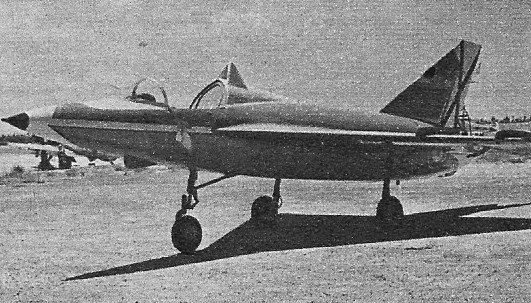
The HA-300P research glider was to provide advance information on the probable flight characteristics of the powered aircraft.
Rolled out of Military Factory No. 36 at Helouan for the first time in 1963, the Messerschmitt designed supersonic interceptor was expected to commence flight trials with an Indian test pilot. Development on the Hispano HA 300, or, XC 6, began in Spain and was subsequently shelved. The fighter is powered by two 4,850 lb.s.t. (2 200 kgp) Bristol Siddeley Orpheus 703 turbojets for initial flight trials, but the definitive version is expected to be powered by a pair of 7,000 lb.s.t. (3 175 kgp) turbojets of a type developed in Egypt by Ferdinand Brandner. Whereas the fighter is only likely to attain about Mach 1.2 with Orpheus engines, a maximum speed of the order of Mach 2.2 is anticipated with the Brandner designed engine which, if successful, may also power the Hindustan HF 24. Basically of clipped delta planform, and featuring a long, needle nose, the fighter has side by side mounted engines, a narrow track, fuselage housed undercarriage, and a Martin Baker zero altitude ejection seat.
HA-300P
Wingspan: 20 ft 2 in
Length: 33 ft 5.5 in
Wing area: 215.278 sq.ft

