Honda HA-420 HondaJet

Honda HA-420 HondaJet

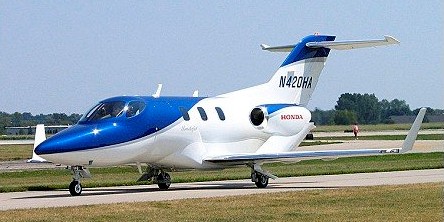
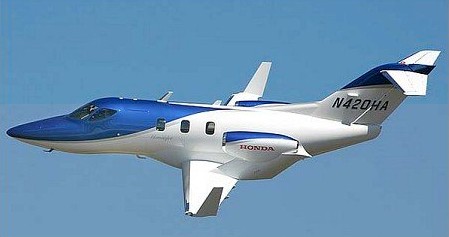
The HondaJet made its maiden flight in North Carolina in December 2003. Honda’s six seat business jet is powered by a lightweight low-emission turbine engine that has been in development since 1988.

It features a graphite composite fuselage, laminar flow wing and two Honda HF118 turbofans mounted on overwing pylons.
Delivery of the first plane is planned for the third quarter of 2012.

Gallery

Engines: 2 x 820kg GE-Honda HF118 turbofans
Max take-off weight: 4173 kg / 9200 lb
Wingspan: 12.20 m / 40 ft 0 in
Length: 12.52 m / 41 ft 1 in
Height: 4.01 m / 13 ft 2 in
Max. speed: 800 km/h / 497 mph
Cruise speed: 778 km/h / 483 mph
Ceiling: 12497 m / 41000 ft
Range: 2037 km / 1266 miles
Crew: 2
Passengers: 5-6

Honda MH02

At the Atlantic Aero FBO at Greensboro, North Carolina’s Piedmont Triad International Airport (KGSO), a team of engineers and technicians assembled a twin-engine very light business jet. This was the proof-of-concept (POC) prototype of what would become the HondaJet very light jet. The team’s work culminated on Dec. 3, 2003, when the POC took flight.

This was a relatively small team of engineers and technicians that had been working furiously for at least the last 10 months—and some much longer—in preparation for that day.

There were no electrical system drawings, only conceptual schematics, and they had to create them from scratch.

They had a very small group in the early days of the project in Greensboro and a larger team in Japan supporting them. Work hours during the design phase started early and extended into the evening, day after day. In three years, they accomplished a tremendous amount of work and overcame huge challenges with the limited staff getting the aircraft ready for its inaugural flight.

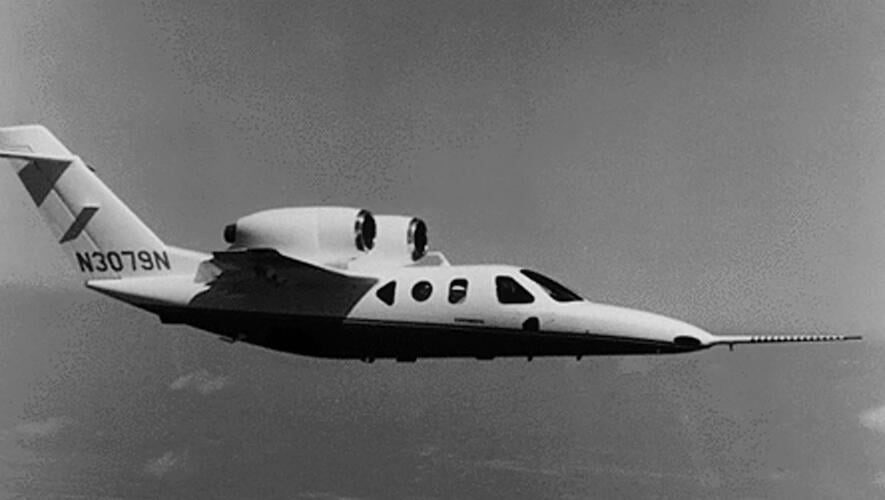
The second production jet to feature over-the-wing-mounted (OTWEM) turbofan engines, the HondaJet was the brainchild of Honda’s Michimasa Fujino. Fujino spent years exploring aircraft design, culminating in flight testing of the composite twin-engine MH02, which had two engines mounted directly on top of a wing attached to the top of the fuselage.

He eventually settled on the HondaJet OTWEM design because of its efficiency and the extra space it afforded in the aft cabin, but persuading the head office that this was the best configuration proved to be a huge challenge. It took more than two years to reach the point and finally the OTWEM configuration for HondaJet was fixed.

At midnight and, with the flight scheduled for 8 a.m., the aircraft was prepped and ready to go. However, back in at 5:30 a.m., firing up the aircraft to make sure everything was still okay before the preflight.

Michimasa Fujino’s first design was the MH02, which didn’t go into production.
Homebuilt Aviation Typhoon

Designed by Willy Andiel, the Typhoon was designed around the 90 to 100 knot capability, 44 inch cockpit, and dual disc brakes on 6 inch wheels.
Most of the components and material were supplied. An all metal aircraft, available as Tri or Tail Dragger. 2009 Price: 30000 US$

Stall: 38 kt / 44 mph / 70 kmh
Cruise: 95 kt / 109 mph / 176 kmh
VNE: 130 kt / 150 mph / 241 kmh
Empty Weight: 300 kg / 661 lbs
MTOW Weight: 544 kg / 1199 lbs
Climb Ratio: 1100 ft/min / 6 m/s
Take-off distance (50ft obstacle): 250 ft / 76 m
Landing distance (50ft obstacle): 400 ft / 122 m

Holmes KH-1 / JSH Scorpion

J.S.H. Scorpion

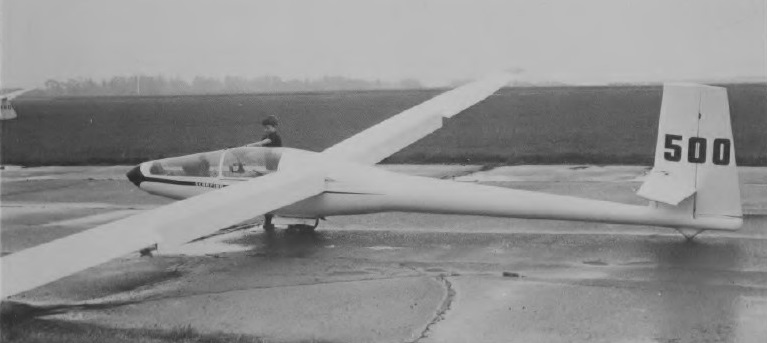
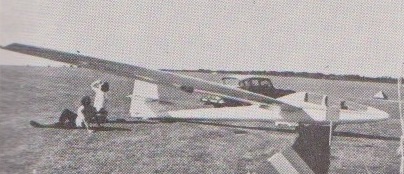
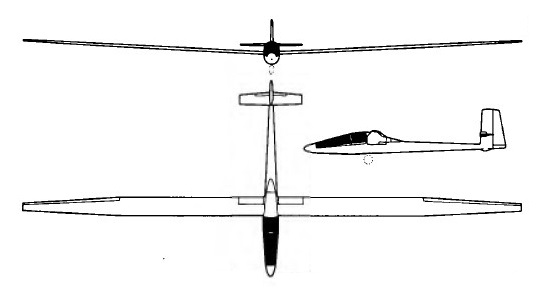
Designed and built entirely by Mr Kenneth Holmes, a meteorologist, this British high performance single seater is characterised by a very high aspect ratio (31.0) wing and a slim fuselage of minimum cross-sectional area; construction is largely of wood.

Design work on the KH-1 began in1968, construction commenced in the following year and the prototype flew for the first time on 24 November 1971. The cantilever shoulder wings are of largely wooden construction with single aluminium spars bonded by epoxy resin and also pop riveted to plywood webs. The spars and closely spaced ribs are covered by a pre-moulded plywood/balsa sandwich to the 50% chord line, by a 2mm thick plywood skin for a further 20% of the chord and with fabric for the remainder of the wing. Small-span trailing edge flaps also act as air brakes, but spoilers are not fitted. The fuselage is built of plywood frames and spruce longerons covered with a birch ply skin, and the landing gear consists of a retactable monowheel and a tail bumper. The tailplane is an all-moving surface with anti-balance tabs controlled by a spring trimmer in the cockpit, and the tall fin and rudder is unswept. A tail braking parachute is fitted for control during the approach and in short field landings.

A second example of the KH-1 named the JSH Scorpion was built by Mr John Halford and first flew in July 1977.

KH-1
Span: 60 ft 8.5 in / 18.5 m
Length: 23 ft 9 in / 7.24 m
Height: 5 ft 0 in / 1.52 m
Wing area: 120 sq.ft / 11.15 sq.m
Wing section: Wortmann FX-61 -184/60-126
Aspect ratio: 31.0
Empty weight: 490 lb / 222 kg
Max weight: 710 lb / 322 kg
Max wing loading: 28.9 kg/sq.m / 5.92 lb/sq ft
Water ballast: None
Max speed: 97 mph / 84.5 kt / 157 km/h
Max rough air speed: 75 kt / 139 km/h
Stalling speed: 36 kt / 67 km/h
Best glide ratio: 37:1 at 55.5 mph / 48 kt / 89 km/h

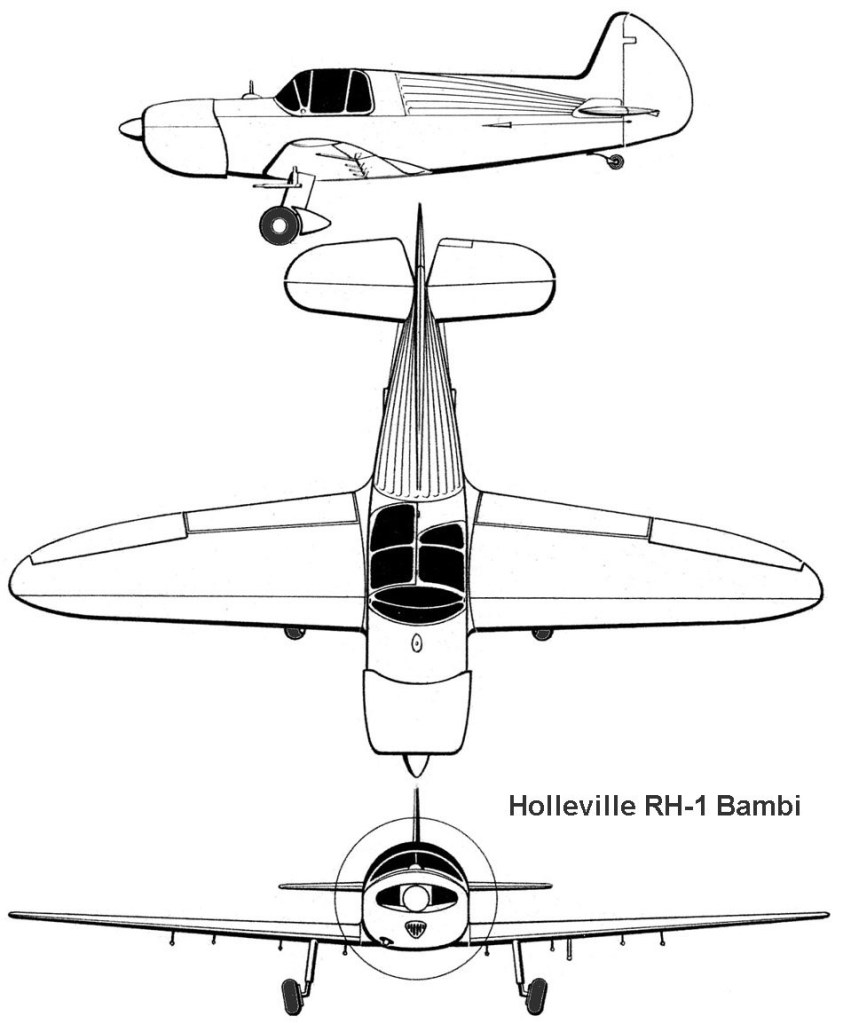
Holleville RH-1 Bambi

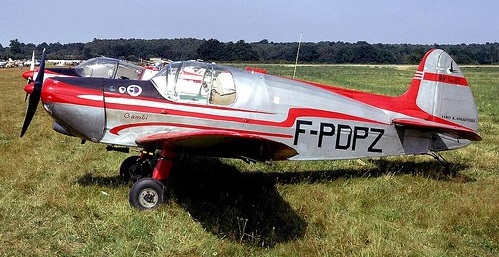
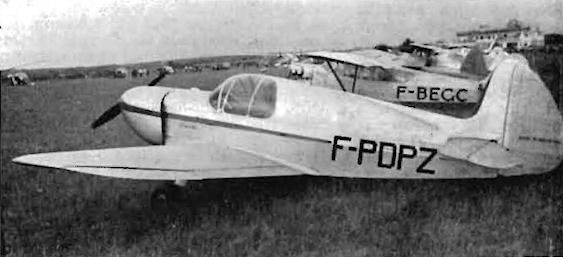
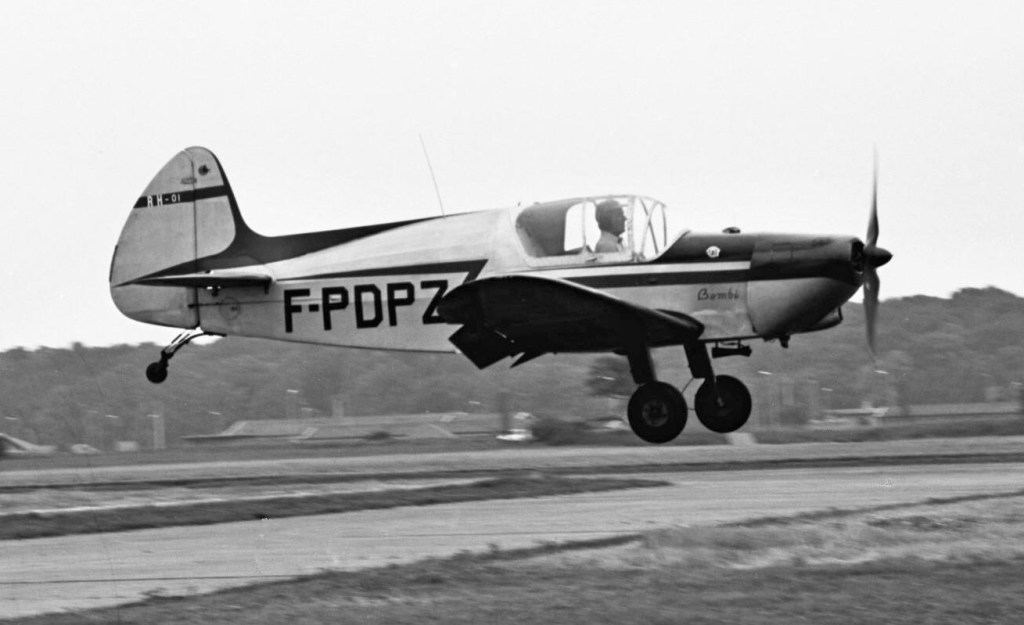
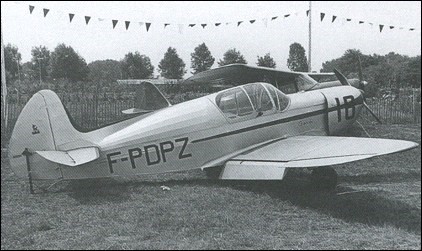
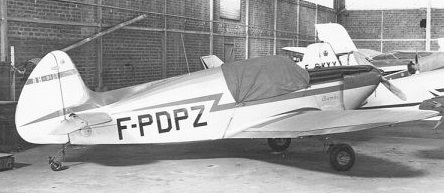
The French-built Holleville RH.1 Bambi was designed and built by Monsieur Roger Holleville and flown for the first time on July 27, 1953. It is a side-by-side two-seat aircraft and was unusual at the time to be among self-build types to make extensive use of synthetic resins and sandwich construction. It was originally intended to make construction plans available to clubs and groups, however, the design was sophisticated and plans to market kits were abandoned.

The Bambi is basically of wooden construction and the exceptional cleanliness of the overall design results in an outstanding performance on a 65 h.p. engine.

The aircraft has a low-wing layout and a fixed tail-wheel undercarriage.

The Bambi was initially operated by its designer from Guyancourt airfield to the west of Paris. By 1964 it was owned by Monsieur Gerard Chaplain and based at St Dizier.

It has visited the United Kingdom to attend light aircraft rallies including at Biggin Hill airport in Kent in 1967. The sole Bambi received a 90 hp Continental C90-8F engine in the early-1980s. In October 2001 the aircraft was donated to the GPPA (Groupement pour la Préservation du Patrimoine Aéronautique) which is operating the Musée Régional de l’Air at Angers Loire Aéroport, Marcé near Angers, France. The Bambi is preserved in airworthy condition in the Musee Regional de l’Air at Angers Aerodrome, 20 km north east of the town.

Engine: 1 × Continental A65, 48 kW (65 hp)
Wingspan: 8.38 m (27 ft 6 in)
Wing area: 9.9 sq.m (107 sq ft)
Length: 6.71 m (22 ft 0 in)
Height: 2.24 m (7 ft 4 in)
Empty weight: 289 kg (637 lb)
Gross weight: 499 kg (1,100 lb)
Maximum speed: 200 km/h; 108 kn (124 mph)
Cruise speed: 169 km/h; 91 kn (105 mph)
Endurance: 4.5 hours
Service ceiling: 4,500 m (14,700 ft)
Rate of climb: 5.5 m/s (1,080 ft/min)
Crew: 1
Capacity: 1 passenger

Holcomb Perigee

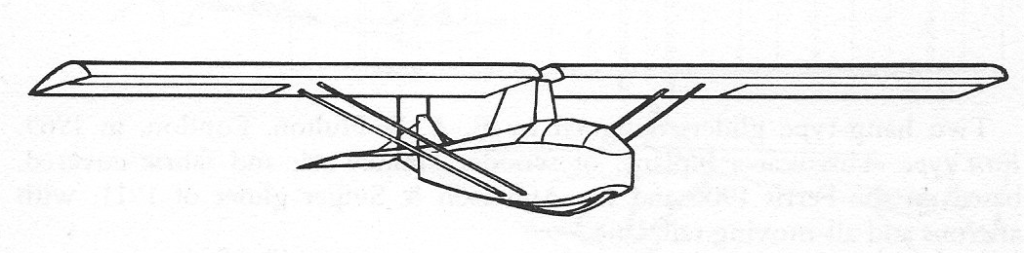
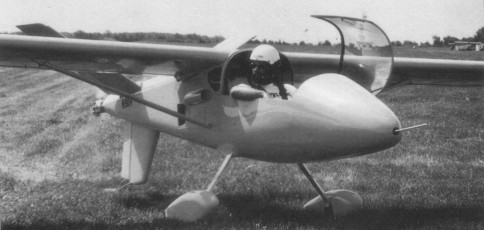
Due to other events, notably the Bullet 2100 project and Molt’s declining health, the Micro-IMP was not developed further. Jerry Holcomb went on however to develop, build and fly a refinement of the Micro-IMP design which he named the “Perigee”.
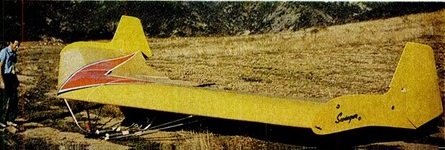
The Perigee, which was designed by Jerry Holcomb of Perigee Associates and initially called the Ultra Imp, first flew in April 1987 and is based on the TPG form of construction pioneered on the Aerocar Micro-Imp. This is a version of the same company’s Mini-Imp, which clearly provided the conceptual starting point for the Perigee.
The TPG (Taylor Paper Glass) form of construction was developed by Moulton B. Taylor, president and general manager of Aerocar, which was created in 1948 to develop Mr Taylor’s extraordinary flying car concept. TPG is a paper core (with metal inlays to accommodate compression loads) covered in glassfibre in a matrix of polyester resin and covered with ripstop Dacron fabric. The Mini-Imp and Micro-Imp both have retractable tricycle landing gear, but the Perigee uses fixed tailwheel landing gear with cantilever main legs ending in elegant speed fairing round the wheels. The need to accommodate a tailwheel led to an alteration of the Y-shape tail unit by comparison with the Aerocar types: in the Perigee it is turned through 1800 so that the vertical surface is at the bottom with the tailwheel attached to its lower edge.
The streamlined fuselaqe is of composite construction with spruce longerons, TPG bulkheads, cockpit floor, tailcone and side skins, a glassfibre nose and some aluminium alloy components. The braced high-set wing has an aluminium alloy/TPG main spar, a spruce/TPG rear spar, wood main ribs, TPG nose ribs, a glassfibre leading edge and fabric covering aft of the main spar. The full-span flaperons are of aluminium alloy sheet over polystyrene foam. The three tail surfaces are similar to the wing in basic construction, but have no wood in them. Propulsion is the task of a twin-blade pusher propeller behind the tail unit, and this is driven by an extension shaft running aft from the engine located behind the cockpit.
Fixed-gear, strut-based monoplane with Y tail, pusher engine. Wings fold for towing on highway. Optional retractable gear, cantilever wing. Powerplant: Cuyuna 430 drives controllable pusher prop. Landing gear: Fixed taildragger.
Information packages were sold but plans and kits never materialized.

Type: sport lightplane
Seats: one.
Powerplant: one 35-hp (26-kW) Cuyuna 430
Maximum speed 120 mph (193 km/h)
Initial climb rate 700 ft (213 m) per minute
Service ceiling 12,500 ft (3810 m)
Range 200 miles (322 km)
Empty weight 380 lb (172 kg)
Maximum take-off 720 lb (326 kg)
Wingspan 28 ft (8.53 m)
Length 15 ft 8 in (4.78 m)
Height 5 ft 2 in (1.57 m)
Wing area 81 sq.ft (7.53 sq.m).
Aspect Ratio 10:1.
Stall speed 40 mph.
Vmax 140 mph.
Takeoff run 300 ft. Landing roll 300 ft.
Fuel capacity 8+ USG.