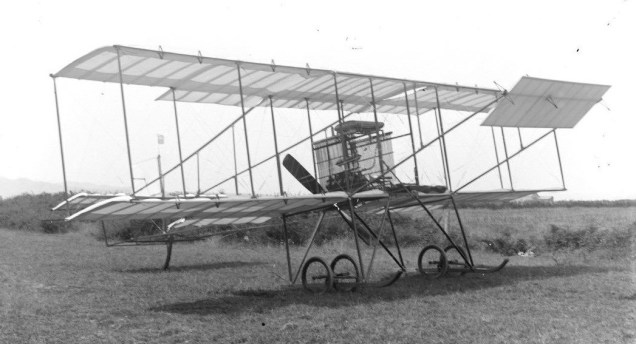
Howard Wright designed and built helicopters, ornithopter, biplanes, and series of monoplanes, including five Avis.
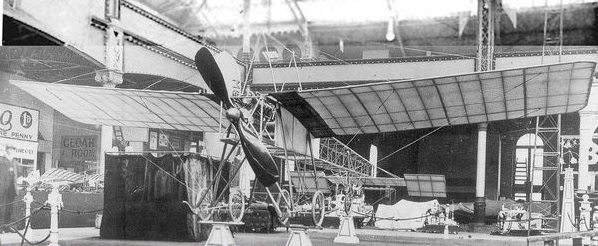
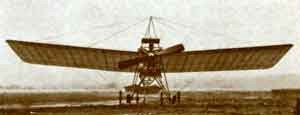
Named “The Golden Plover” – and fitted with an Anzani three-cylinder delivering 25 to 30 hp – this wing-warping monoplane was delivered to the Scottish Aviation Syndicate in 1910.
The 1909 Howard Wright monoplane was designed and built by Howard T.Wright in the UK.
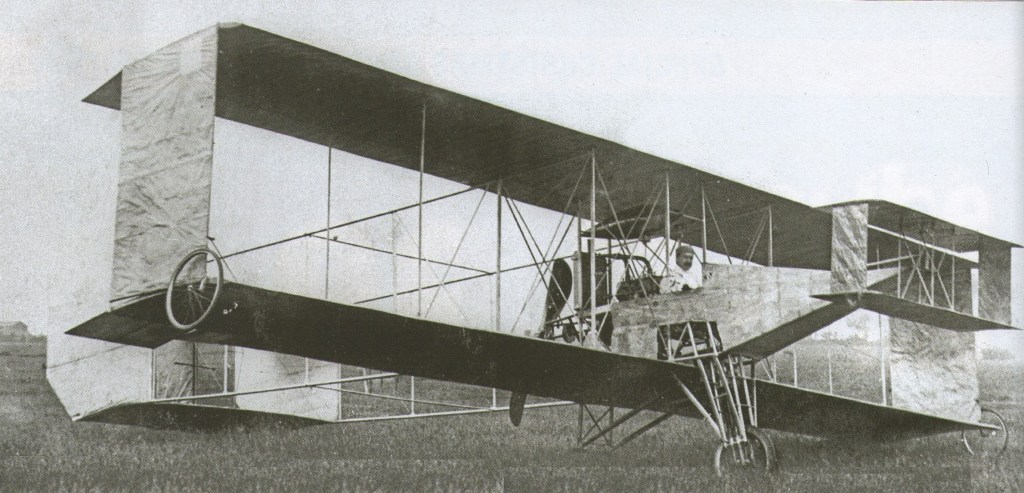
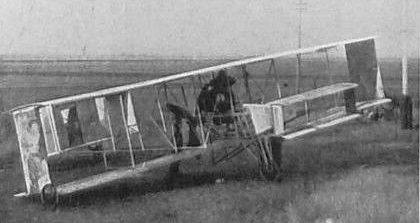
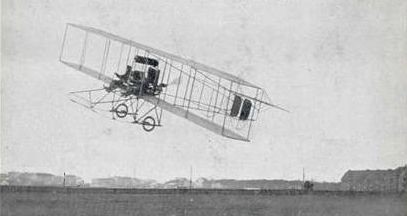
In December 1908 Howard Wright was asked to build an aircraft for Malcolm Serr Keaton. The design was similar to the contemporary Voisins, a pusher biplane with a front-mounted elevator and a rear-mounted box-like biplane tail, but differed in some details, most obviously in having biplane front elevators and an undercarriage consisting of a single wheel carried by a pyramid of struts in front of the wings, with supplementary wheels on either wingtip.
It was powered by a 50 hp Metallurgique engine, which drove a pair of contra-rotating two bladed propellers. Lateral control was by means of four small ailerons fitted to the trailing edges of both wings.
The two-seat aircraft was displayed at the 1909 Olympia Aero Exhibition and flown successfully at Camber Sands.
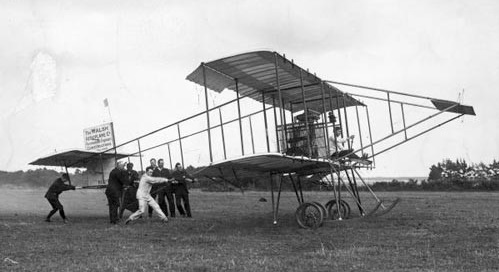
Leo and Vivian Walsh helped to lay the foundations for both military and civil aviation in New Zealand. The brothers were determined to build and fly an aeroplane and succeeded in obtaining financial backing from Auckland businessmen A. N. and C. B. Lester and A. J. Powley. They then bought the plans for a British Howard Wright biplane together with materials and an eight-cylinder engine, worth about £750 in total. It took about 5½ months for the brothers to assemble the aircraft at their family home in Remuera. They were helped by fellow enthusiasts, and their sisters Veronica and Doreen, who machine-sewed hundreds of yards of material for the wings.
Walsh Brothers aircraft Manurewa
The finished aircraft, named the Manurewa No 1, bore an inscription ‘The Walsh Aeroplane Co. Aeronautical Engineers Constructors Auckland’. Beneath this was a crest and the words ‘Aero Club New Zealand’.
Walsh Brothers aircraft Manurewa
Walsh Brother’s Manurewa No 1 made the first undisputed powered flight in New Zealand – flown by Vivian Walsh on Sunday, February 5, 1911, from a grass field at Glenora Park, a total distance of 400 yards at a maximum height of 60 feet (flight data figures differ somewhat depending on the source).
The Howard T. Wright company established “probably the first real aircraft factory in England and certainly the only one to operate at a profit at the time”, from 1908 to 1912.
Howard T. and Warwick Wright, in 1905, set up his own company in Prince of Wales Road, Battersea, London. There they built some 35 biplanes, monoplanes and an unsuccessful, helicopter. One of their biplanes was bought by Tom Sopwith. The Wrights’ exhibited a monoplane at the 1910 Olympia show. Designed and built helicopters, ornithopter, biplanes, and series of monoplanes, including five Avis. In 1910 T.O.M. Sopwith achieved the longest all-British flight to date with a Howard Wright 1910 biplane, a distance of 272km.
German Flugmaschine Wright-Gesellschaft (Johannisthal) Wright biplane designed by Deutsche Wright pilot Robert Thelen in 1911. It had only a single propeller, directly attached to the drive shaft of its 50 hp NAG engine. Thelen used at least one of this type with the Ad Astra Fluggesellschaft, a flight school and exhibition company that Thelen formed with Rudolf Kiepert, also a Wright pilot.
Peter Wright started the construction of a man powered aircraft in January 1971 at Melton Mowbray, UK. Similar to the ‘Puffin’ but differing in having a three unit undercarriage and swept forward wings.
The Mk.I first flew in February 1972 for 120 yards. After several flights it was decided a better test site was needed and that a Mk.II should be built.
The Wright & Co Light Sport was built in 1928. An open cockpit, high-wing monoplane, the sole example was registered N7926 c/n 5. It was sold in 1930, then reported to CAA as no longer in use with engine removed. The registration was cancelled on 14 March 1930.
Wright also was secretary-treasurer of Western Airplane & Supply Co in Burbank at the time and might have had a large part in the construction or design of their 1928 Western Sport.

 All Aero