Ireland Meteor / Curtiss-Ireland Meteor

The Ireland Meteor is often refered to as the Curtiss-Ireland Meteor.

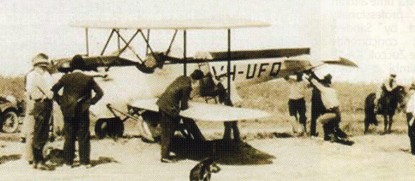
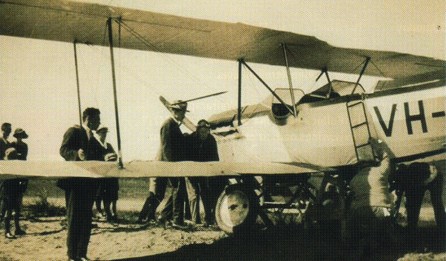
The Ireland Meteor, often referred to as the Curtiss-Ireland Meteor, was created by G. Sumner Ireland, who worked as a salesman for the Curtiss company.

With wings in production and the supply of Curtiss Oriole fuselages ended, G. Sunner Ireland created a new fuselage. Seating was for four in tandem open cockpits, each seating two side by side.
The Meteor never received a US Doc Type Certificate.
At least eight Meteors were built.

Engine: OX-5

Ireland Comet

G. S. Ireland founded his company to manufacture an aircraft known as the Ireland Comet, which combined surplus-Curtiss Oriole fuselages with new wings and tail unit.
With the closure of the Curtiss Oriole production line, a number of completed fuselages became available and Ireland was able to obtain them. With help from friends in the Curtiss design office new wings were created. These had a deeper rib section, and single bay bracing. Following initial flights in 1925, some 40 of these Comets are thought to have been produced before the fuselages ran out.

Ireland Aircraft Inc

USA
One-time sales representative of the Curtiss Aeroplane and Motor Co, G. S. Ireland founded his company to manufacture an aircraft known as the Ireland Comet, which combined surplus-Curtiss Oriole fuselages with new wings and tail unit. Incorporated in 1926, the company began production of the Ireland Neptune, a five-seat amphibian flying-boat.

Irbitis I-1 / I-2 Ikarus

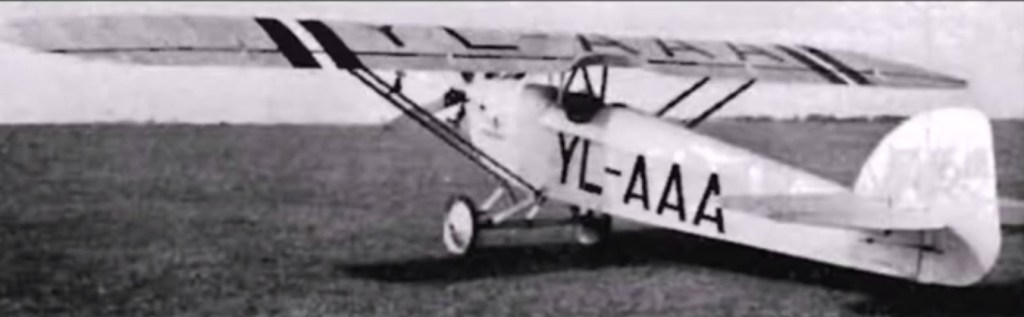
In 1925 Irbitis met Nicholas Pulins. Mr. Pulins had an interest in light aviation and Irbitis influences him to start building a high wing monoplane with Anzani engine. Previously Pulins have interest in biplanes. With the financial support, Irbitris made his first aircraft, the I-1 and it had its maiden flight on 13th June 1925. I-1 was single seat airplane and follow to this is I-2, two seat aircraft and name Ikarus. On I-2 both, Irbitis and Pulins learn to fly.

Irbitis, Karlis

Karlis Irbitis is one of the pioneers of the aircrafts design in Latvia. In his early years Latvia was part of the Russia and he had chance to see some of the Russians war machines of French origins. His early attempt to build aircraft failed when his Nieuport replica crashed so he turn his interest in the modeling.

Karlis Irbitis has enrolled into the Mechanical Engineering Facility and spent time on airframe maintenance for the newly formed Latvian Air Force. In 1925 Irbitis met Nicholas Pulins. Mr. Pulins had an interest in light aviation and Irbitis influencec him to start building a high wing monoplane with Anzani engine. Previously Pulins have interest in biplanes. With the financial support, Irbitris made his first aircraft, the I-1 and it had its maiden flight on 13th June 1925. The I-1 was a single seat airplane and followed by the I-2, two seat aircraft and name Ikarus. On I-2 both, Irbitis and Pulins learn to fly.

After military service, Karlis Irbitis start work as designer in the A.S. Backman company and main work was focused on repairing of aircraft for Latvia. His first work was on Hansa Brandenburg W.29 and this was hard due to the lack of the technical documentation. After several projects A.S. Backman was bankrupted and closed in 1930 and Karlis Irbitis joined the Valsts Elektrotechniska Fabrika electric company. In the 1935 he submit proposal for the company to built aircraft and an aircraft construction division was established in the same year with Irbitis as the head of the division. The very first project was I-11, powered with Minor 90 HP engine and its maiden flight was in July 1936.

Iranian Aviation AVA-202

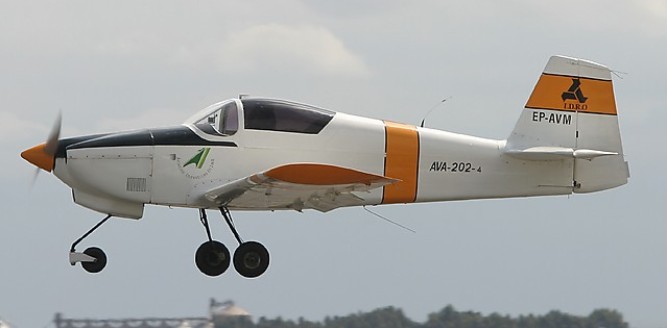
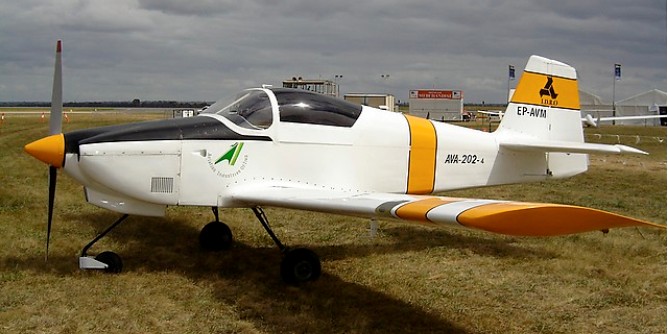
The Aviation Industries of Iran AVA-202 is an Iranian two-seat, light aircraft designed as a trainer and sporting aircraft. It was intended for the Iranian domestic market to avoid dependence on imports.

The AVA-202 was based on the Van’s Aircraft RV-6A and was designed to comply with European JAR-22 and JAR-VLA aircraft certification rules. It features a cantilever low-wing, a two-seats-in-side-by-side configuration enclosed cockpit under a bubble canopy, fixed tricycle landing gear and a single engine in tractor configuration.

The aircraft is made from aluminum sheet. Its 8.74 m (28.7 ft) span wing employs a NACA 63-215 airfoil and the wing root and a NACA 63-015 airfoil at the wing tip. The wingspan is greater than the RV-6’s wingspan of 7.01 m (23.0 ft) from which it is derived. The AVA-202’s wing has an area of 10.87 sq.m (117.0 sq ft) and is equipped with flaps. The standard engine fitted is the 160 hp (119 kW) Lycoming AEIO-320-B2B four-stroke aerobatic powerplant.

First flown on 3 June 1997, four had been built by 2002.

Engine: 1 × Textron Lycoming AEIO-320-B2B, 120 kW (160 hp)
Length: 6.02 m (19 ft 9 in)
Wingspan: 8.74 m (28 ft 8 in)
Height: 2.04 m (6 ft 8 in)
Wing area: 10.87 sq.m (117.0 sq ft)
Aspect ratio: 7.0:0
Airfoil: NASA 632-215
Empty weight: 500 kg (1,102 lb)
Max takeoff weight: 750 kg (1,653 lb)
Maximum speed: 259 km/h (161 mph; 140 kn) at sea level
Cruising speed: 250 km/h (155 mph; 135 kn) (75% power)
Stall speed: 84 km/h (52 mph; 45 kn) (flaps down)
Range: 1,000 km (621 mi; 540 nmi)
Service ceiling: 6,400 m (20,997 ft)
Rate of climb: 7.6 m/s (1,500 ft/min)
Crew: 2

Iranian Aviation

Iran’s aviation industry infrastructure was by and large established in the 1930s, at the time of the Shah Reza Pahlavi, where the German Junkers & Co Aviation provided the foreign expertise and assistance.

The Iran Aviation Industries Organization (IAIO) (Persian: سازمان صنایع هوایی ایران‎) was established in 1966 for the purpose of planning, controlling, and managing the military aviation industry of Iran.

The IAIO was responsible for directing five aviation organizations: SAHA, HESA, PANHA, GHODS, Shahid Basir Industry. These five organizations have different and complementary roles in the Iranian defense industry and Iranian civil aviation, and have progressed, with the exception of Ghods, from repair and maintenance facilities to larger defence enterprises with several thousands employees.

The Iran Helicopter Support and Renewal Company (IHSRC), or PANHA, was formed in 1969, the Iranian Aircraft Industries (IACI) in 1970, and Iran Aircraft Manufacturing Industries Corporation (IAMI), also known under its Persian acronym HESA, in 1974. Two other companies, Iran Aviation Industries Organization of the Armed Forces, (also known as the Iranian Armed Forces Aviation Industries Organization (IAFAIO)), and GHODS Research Center were formed in the early 1980s.

The industry was later expanded in the 1970s in the reign of Shah Muhammad Reza Pahlavi, benefiting from the boosted oil revenues. Not only did the Shah order vast quantities of America’s most advanced weapons, he was also acquiring the capability to produce them in Iran. Under a multibillion-dollar industrialisation programme, the Shah commissioned US arms firms to build entire weapons factories from scratch in Iran.

Thus Bell Helicopter (a division of Textron, Inc.) was building a factory to produce Model-214 helicopters in Isfahan. Northrop Corporation was also a joint partner in Iran Aircraft Industries, inc., which maintained many of the US military aircraft sold to Iran and was expected to produce aircraft components and eventually complete planes. These efforts represented a large share of US industrial involvement in Iran, and were a centrepiece of the Shah’s efforts to develop modern, high-technology industries.

After western sanctions following the Iranian Revolution, the general official policy of Iranian government changed from having the best available in the world to being able to manufacture independently in order to meet domestic needs, specially of technological products and therefore becoming “sanction-proof”.

In no other field this urgency was higher than aeronautics. Therefore Iran has avoided the need to purchase better western aircraft available to it from time to time in favor of inferior ones that could be manufactured in Iran through arrangements of purchasing licenses and technologies as well as reverse-engineering parts, mostly to avoid situations that Iran has gone through during 1980s till now by not being able to maintain what it had due to domestic technological starvation.
Major Projects

Former Iranian President Mahmoud Ahmadinejad had favored the purchase of aircraft such as Iran-140 which are manufactured in Iran. An agreement for licence production of the Antonov An-140 by Iranian Aviation called ‘Iran-140’ was signed in 1993. The first aircraft, supplied as a kit, flew on 7 February 2001.

Negotiations were underway to manufacture 50 An-148 under licence to be named Iran-148. Agreements were signed with Russia for co-development and co-manufacture of an uncertain amount of Tu-334 airliners in Iran with production to commence simultaneously both in Iran and Russia.

Another agreement with Poltava Helicopter Company of Ukraine allows Iran to manufacture the Aerokopter AK-13 ultra-light multi-purpose helicopters in Iran. Yet, Iran says it is prepared to order passenger planes from Boeing and Airbus if the United States lifts sanctions against Iran. In 2010, Iran’s Defense Ministry said it will begin the production phase of a domestically-manufactured medium-size passenger plane designed to carry up to 150 passengers.

Qaher-313, single-seat stealth fighter aircraft publicly announced on 1 February 2013.

In 2006 Textron sued IAIO, for producing counterfeits of six types of its Bell unit helicopters without licenses thereby using trade secrets and patented designs without permission and demanded compensation for damages. In another lawsuit (Bell Helicopter Textron Inc. v. Islamic Republic of Iran, Case No. 06cv1694, in U.S. District Court for the District of Columbia) brought by Iran against Textron earlier, Iran had sought damages against unfulfilled contracts dating back before revolution. Textron ultimately sent five commercial helicopters to Iran in addition to providing spare parts and training in 1994 to settle the dispute.