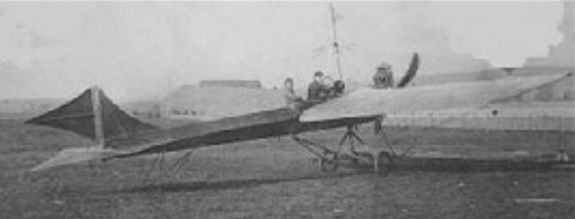
Wysong 1915 biplane

A Curtiss headless type single place open biplane was built in 1915 by college student Forrest E Wysong using written instructions sent to him by Lincoln Beachey.

First flown on 16 March 1915, it was flown four times before his father ordered him to “get rid of the dangerous machine.”

Engine: 75hp Roberts 6 pusher
Propeller: 8′
Wingspan: 22’0″
Length: 18’0″
Speed: 90 mph
Seats: 1
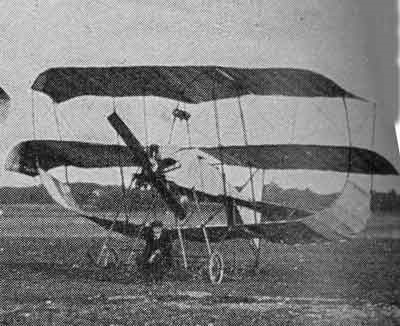
Wyandotte High School Pup

In 1932, Wyandotte High School built the prototype Pup (NX12546) as a shop class project, the first one ever designed and built in a public high school. Desiged by Noel Hockaday and Guy Poyerand costing around $1,800, the Pup first flew on 18 August 1932.

A single place, high wing monoplane, two or three were built, the last one sold to Porterfield Aircraft and introduced at the 1935 Detroit Air Show as Porterfield Flyabout with a 70hp LeBlond engine.

Engine: 40hp Aeromarine AR-3
Wingspan: 32’0″
Length: 21’0″
Useful load: 425 lb
Max speed: 100 mph
Cruise speed: 80 mph
Stall: 33 mph
Seats: 1

Wullschleger-Peier Triplane

Swiss designed and built by Fritz Wullschleger and Albert Peier in 1913; their design of the triplane was uniquely implemented as the wing tips on the upper plane were folded down and on the lowest plane were folded up. The whole resulted in an almost closed-wing construction. As can be seen from other photographs of the machine, it was a two-seater, powered by a 5-cylinder Anzani air-cooled engine. Unfortunately the machine never got off the ground.

Wrong Brothers Right Flyer

When the two Wrong brothers set out to make a right, they called it the Right Flyer, naturally enough. Though catagorized as a powered hang glider in general layout, takeoff can still be made on three wheels, and there is a control stick. Instead of aileron displacement, right-left stick movement applies wingtip rudder deflection that results in fairly good coordinated turns. Body weight is used for pitch adjustments.

Engine: Cuyuna, 22hp
Fuel cap: 5 USG
Endurance: 4 hr
Glide ratio: 9.5 / 230 fpm
Cruise: 25-45 mph
ROC: 450 fpm

Wróblewski-Salvez W-I / W-II / W-III / W-IV

W-II & W-III 1911-12

In 1911 Piotr Wróblewski-Salvez built in France in Berthaud factory at Ambrieu near Lyon a monoplane aircraft with partially metal construction (of fuselage) which made numerous successful flights (piloted by designer’s brother Gabriel Wróblewski-Salvez); one year later it was heavily modified and in July 1912 it made some flights with passengers, one of which was then-12-years old Antoine de Saint-Exupéry for whom it was his first flight.

W-IV 1913-15

Later Wróblewski-Salvez brothers built an improved design but during one of the test flights in 1914 it crashed, killing both brothers.

Wright Redux Assn Flyer

In 2003 the Wright Redux Assn of Glen Ellyn IL. built a Wright Flyer replica with specs and construction techniques reportedly identical to the original 1903 Wright brothers’ machine.

The flying replica was built to coincide with the 100th anniversary celebrations, with a first flight date set for 17 December 2003.

Registered N203WF c/n WOW1903-02, an FAA Special certification in the category of Experimental-Exhibition was issued on 15 March 2003.