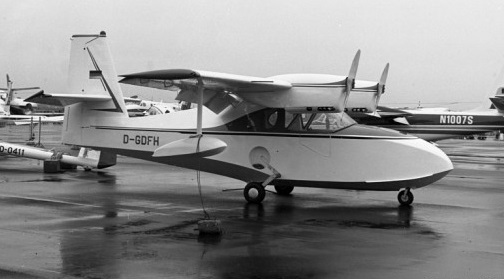
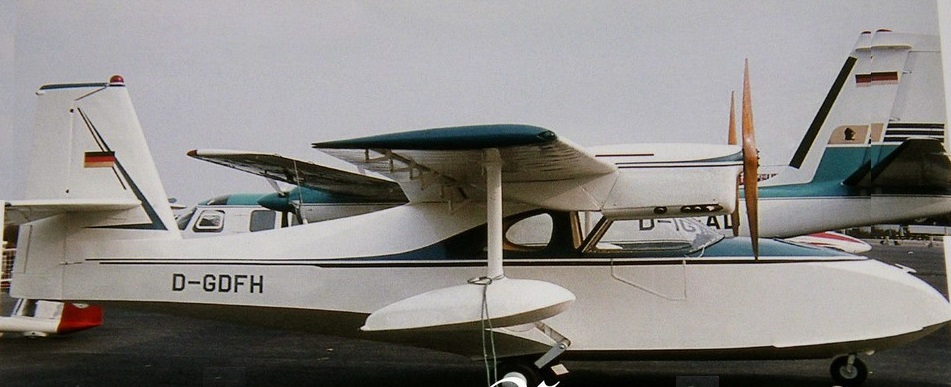
The CAJO 59 was designed by Carl Johansen (hence the name) as a general purpose 3-4 seat amphibious flying boat. It was a high-gull winged twin-engine monoplane with a wooden structure, mostly wooden skinned, apart from glass fibre/foam sandwich panels in the fuselage and fabric covered control surfaces. The wings inboard of the engines were built around two spars and had high dihedral (8.8°), which raised the engines well above the water. Outboard of the engines the wings had a single spar and were without dihedral. They carried full span slotted flaps and ailerons which were lowered when the flaps were fully extended.
The fuselage was flat sided with rounded decking, with the cabin under the wings. Its conventional flying boat V-shaped planing bottom had a change of curvature near midpoint but no discrete step. The vertical tail was straight-tapered, the rudder fitted with a trim tab. The cantilever variable incidence tailplane, with elevators, was mounted above the fuselage at about one third fin height.
The CAJO 59 was powered by two 65 hp (49 kW) Walter Mikron III inverted inline engines. Two fixed floats, mounted well outboard on single struts, stabilised flights off water. It had a manually retractable tricycle wheeled undercarriage, with main legs mounted on the fuselage and retracting into it above the waterline.
The first flight was made from water on 25 July 1967 and the first from land on 17 April 1968. Certification facilities were lacking in Denmark, so the CAJO 59 was taken to Germany and flew as D-GDFH during 1970.
It achieved certification but did not go into production.
Engines: 2 × Walter Mikron III, 48 kW (65 hp) Propellers: 2-bladed , wooden Length: 6.95 m (22 ft 10 in) Wingspan: 9.80 m (32 ft 2 in) Height: 2.75 m (9 ft 0 in) Wing area: 12.80 m2 (137.8 sq ft) Empty weight: 580 kg (1,279 lb) Max takeoff weight: 900 kg (1,984 lb) Maximum speed: 215 km/h (134 mph; 116 kn) Cruising speed: 200 km/h (124 mph; 108 kn) Range: 1,000 km (621 mi; 540 nmi) with maximum fuel Rate of climb MAUW: 4.5 m/s (890 ft/min) Crew: one Capacity: two-three passengers
After the D150, a D160 prototype was built. It was to become a six seater fitted with a six cylinder 235 hp Lycoming engine. The interior was fitted with two sets of individual seats and a rear bench seat. It had an electrically actuated canopy, hinged on the port side. It featured a wing span of 10,86 meters and had a length of 8,32 meters. A version with retractable gear and a constant speed prop was envisioned, but ultimately, the D160 never saw production.
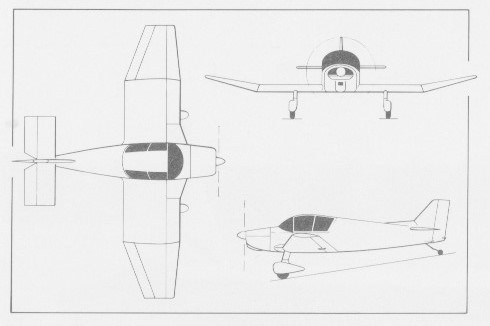
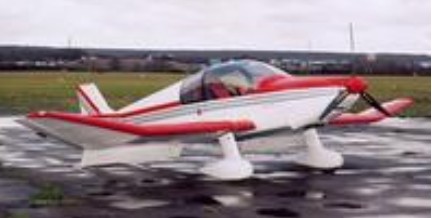
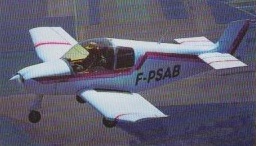
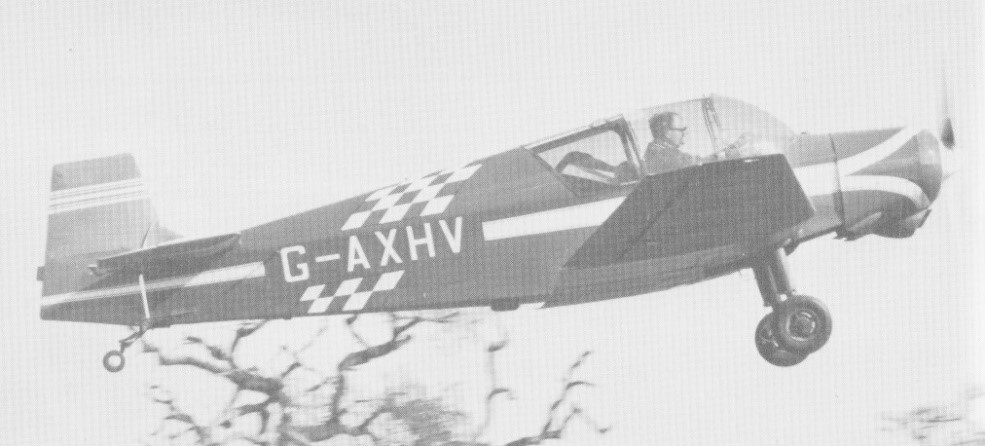
The D150 Mascaret was intended to be the successor of the D11 series. The two seater design, which was created by Delemontez for the S.A.N. factories in Normandie, leaned heavily on the DR1050. The wing was narrowed a little and the fuselage was shortened. A new tailplane construction with a two piece vertical and one piece horizontal tailplane was used. This tail was later adopted by the DR1050 series. The aircraft was given a single large fuel tank behind the seats, carrying 110 litres of fuel. Furthermore, two tanks of 40 litres each were housed in the inboard wing leading edge, giving a total of 190 litres of fuel, good for a staggering 10 hour endurance. The tank behind the panel that is installed in the DR1050 did not reappear in the D150, resulting in much more space behind the panel, which has always been a problem in the DR1050. The new tailplane configuration, and in particular the one piece all moving horizontal tail, is so much more powerful than the original narrower two piece version that the CG envelope has been opened quite a bit farther. This is also why Delemontez could get away with just the fuel tank under the bench seat, and without the tank behind the panel to balance it. All the models following the D150 (the DR200 series and so on) have this larger rear tank and no panel tank. It was fitted with a 100 hp Continental O-200A engine. Interesting note is that the D150 prototype (F-BJST) was originally fitted with the new two piece vertical tail, but still had the old style two piece horizontal. The subsequent production aircraft all had the new tail configuration, which was later also retrofitted to the prototype.
D.150 Mascaret
The prototype was fitted with the rather blunt wheelpants of the DR1050 Ambassadeur, whereas production models received the sleeker Sicile pants. 2 June 1962 – First flight SAN Jodel D.150 Mascaret French two-seat single-engined light aircraft built by Société Aeronautique Normande The D150 design proved successfull, even though only 61 of the breed were produced at S.A.N. in Bernay. S.A.N. decided to market it at a lower price than the 3/4 seater DR1050. This despite the fact that it didn’t cost less to build. In fact, S.A.N. lost money on every D150 that was produced. Among other things, this was what in the end led them into bankrupcy. S.A.B. was still selling plans and even kits for homebuilding.
Like the DR1050 / 1051, the Mascaret is also fitted with either a Continental O-200 or a Potez 4E20 engine. The latter model being desgnated D150 A. A 135 hp Franklin engine has been tried, and a few of these have actually been built. Homebuilt D150’s usually mount O-200’s, even though an O-320 fitted “Super Mascaret” is flying in the UK. The Mascaret is cleared for mild aerobatics.
Variant: Kenny Jodel D 150X Governor
D150 Engine: Continental O-200, 100 hp Length: 20.6 ft / 6.3 m Wing span: 26.7 ft / 8.15 m Empty weight (with oil): 900 lbs / 410 kg Max Take off weight: 1585 lbs / 720 kg Usefull load: 685 lbs / 310 kg Bagage shelf: 130 lbs / 60 kg Power loading: 15.9 lbs/hp / 7.2 kg/hp Fuel capacity (wings): 2 x 9 imperial gal / 2 x 40 lt Fuel capacity (rear): 24 imperial gal / 110 lt Max speed, sea level: 165 mph / 265 km/h Cruise speed: 130 mph / 210 km/h Stall speed (with flaps): 38 mph / 60 km/h Climb rate: 630 fpm / 3.2 m/s Service ceiling: 15000 ft / 4500 m Endurance: 10 hours Fuel burn, 75% pwr: 5.5 gph / 21 liter/hour Fuel burn, 55% pwr: 4 gph / 15 liter/hour Gear: Tailwheel Seats: 2 Controls: Stick and rudder Material: Wood and fabric
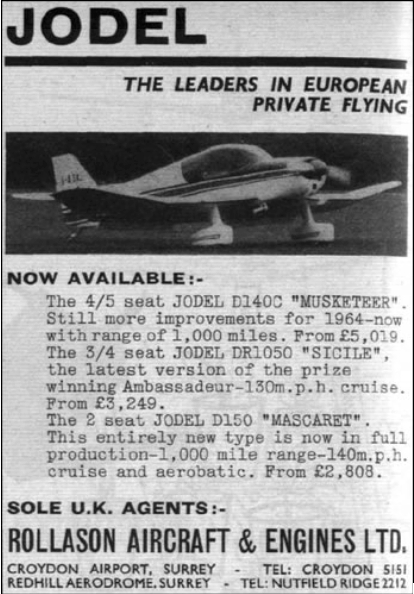
By the time, the whole range of aircraft had been taken over by Robin. Meanwhile, Joly and Delemontez were not sitting idle. Having built the D9, D10 series (=DR100) and D11 series, it was time to move on. After some ideas that never materialised, the D140 Mousquetaire was introduced. In 1956, the Jumbo Jodel was developed by Delemontez and Lucien Querey (founder of SAN) as a touring machine, seating 4 people. It was to become the biggest jodel ever built: a 180 hp tailwheel design with four/five seat capacity. Early Mousquetaires featured a rather ugly triangle vertical tailplane, later ones were fitted with tailplanes like on the DR 1050 M and DR 200 series.
Aft of the cabin, a huge cargo door hides a very roomy space to stow a lot of camping goods, making this aircraft a very nice go places platform. The D140s have been used as air ambulances and originally the cargo door was meant as an entry point for stretchers carrying injured people. SAN evolved the four/five-seat model that first flew in July 1958 as the D.140 with a 134-kW (180-hp) 0-360 engine. Curious detail of the D140 is that the factory prototype carried the serial number 4. The first three (F-BIZE, F-BIZA AND F-BIZB) had already been sold to the launching customer: le Service de la Formation Aeronautique, a French governmental institution. The D140 has been built in several variants, D140A, B, C, E and R. The A and B model had a very distict vertical tailplane, of rather dubious esthetical quality. Later models received the more pleasing tail layout as on the DR1050M models. The D140 C model is very interesting in this respect, since it had both the modern two piece swept vertical tail and the old style two piece horizontal tail.
A total of 193 of the D.140A, B, C, D, and E were built.
The D.140R Abeille was developed from the D.140E for glider towing. Twenty-two were built.
A variant of the Mousquetaire is the D.140R Abeille glider tug, and this is identical to the D.140 apart from its glider-towing fitment and a more extensively glazed cabin for improved rearward fields of vision. In 1969 SAN went into liquidation and production of the two D.140 variants was shifted to Avions Pierre Robin. Avions Mudry purchased the manufacturing rights to the Mousquetaire and continued building them, naming them Abeille (Bee). The abeille has been built with glider towing in mind. This resulted in a lowered turtledeck, omission of the cargo bay and lengthened glass area.
Jodel D.140
D 140 Mousquetaire four/five-seat sport and touring lightplane. Span: 10.27m (33ft 8.25 in). Length: 7.82m (25ft 8in). Engine: 1 x Avco Lycoming O-360-A2A, 134kW (180 hp). Max T/O weight: 1200 kg (2,646 lb). Max speed: 158 mph at sea level. Operational range: 870 miles.
D140A Mousquetaire Introduced: 31/10/1958 Vertical tail: Triangle, rounded top Horizontal tail: Two piece Fuselage: High turtledeck with cargo door Seats: 4
D140B Mousquetaire II Introduced: Soon after the A model Vertical tail: Triangle, straight top Horizontal tail: Two piece Fuselage: High turtledeck with cargo door
D140C Mousquetaire III Introduced: 1962 Vertical tail: Swept Horizontal tail: Two piece Fuselage: High turtledeck with cargo door
D140E Mousquetaire IV Introduced: 1964 Vertical tail: Swept Horizontal tail: Single piece Fuselage: High turtledeck with cargo door Span: 10.27 m / 33 ft 8.25 in Length: 7.92 m / 25 ft 11.75 in Height: 2.13 m Wing area: 18.5 sq.m Engine: Lycoming O-360 A1A, O-360 A2A, IO-360 B2F6 / 180 hp Landing gear Track: 2.27 m Main tires: 500 x 150 Tail wheel: 3.00 x 4 Seats: 5 Front seats: 154 kg Rear seats: 210 kg Front shelf: 60 kg Rear shelf: 90 kg Empty weight: 610/660 kg Max takeoff: 1200 kg / 2645 lb Front fuel tank: 90 lt Rear fuel tank: 125 lt Supplementary front fuel tank: 45 lt Vne: 290 km/h Max speed: 240 km/h Cruise speed 75% 7000ft/2300m: 240 km/h / 129 kt / 149 mph Landing speed: 115 km/h Rate of climb: 3.6 – 4.0 m/s (710 – 780 fpm) Takoff distance (grass, clearing 15 meter obstacle): 520 m Landing distance: 400 m
D140 R Introduced: 1965 Vertical tail: Swept Horizontal tail: Single piece Fuselage: Extended glass, no cargo bay No built: 22 Glider towing: Yes
The Jodel D20 has the wing from the D19 married to a completely new fuselage resembling the shape of the Robin-Jodels. Plans for the D20 are not generally available. Instead S.A.B. do all the woodwork, and it can be bought from them in a ready-to-cover state. Designed from the outset to utilize a JPX 85hp engine, the little two-seater is a good a performer just as the D18 and 19. The aircraft is available in Normal and Microlight kit form, and is delivered in either trigear or taildragger configuration, depending on the customer’s preferences. Available in 2009 from AeroConsult in kit or as ready built.
D20 Wing span: 7.50 m Length: 5.80 m Height: 1.93 m Wing area: 9.93 sq.m Cabin width: 1,12 m Fuel capacity: 100 lt Seats: 2 Engine: JPX 4TX75, 85 hp @ 3000 rpm Empty weight: 250/260 kg Max weight: 500 kg Max speed: 240/250 km/h Cruise speed: 200/220 km/h Range: 1500 km
Jodel D20 UL Legende Stall: 32 kt / 37 mph / 60 kmh Cruise: 108 kt / 124 mph / 200 kmh VNE: 146 kt / 168 mph / 270 kmh Empty Weight: 250 kg / 551 lbs MTOW Weight: 450 kg / 992 lbs Glide Ratio: 13 Take-off distance (50ft obstacle): 490 ft / 150 m Landing distance (50ft obstacle): 300 ft / 90 m
Engine: JPX, 75 hp Wing span: 7.2 m Wing area: 9.93 sq.m MAUW: 560 kg Empty weight: 290 kg Fuel capacity: 100 lt Max speed: 220 kph Cruise speed: 20 kph Minimum speed: 69 kph Climb rate: 3 m/s Fuel consumption: 17 lt/hr Seats: 2 Kit price (1998): 149 900 Fttc
As the D18 has a classical undercarriage and many clubs like a nosegear for their planes, M. Delemontez came up with a variant of the D18 called the D19. Beside the nose wheel, the main difference to the D18 is the flap. The flap drawings contain information for putting a similar flap on the D18, and is a classical Jodel flap of narrow chord. It is not very effective as a high lift device, but a very useful brake on landing. The drag of the nosewheel does degrade the performance to some degree, but ground handling is made simpler. The D 18 and D 19 are small two seater homebuilts that are usually powered by converted Volkswagen engines. Plans are being sold to homebuilders, but they were never factory produced.
Plans for both planes are available through S.A.B. Same firm also sell parts for the aircraft, like hinges, horns, undercarriage assemblies, perspex cockpit canopy, controls and engine mounts. These are definitely home builts and not kit planes.
The Ultralight rules call for a MTOW of 450kg, and that should fit the D18/19 MTOW of 460kg. Same regulations say an ultralight should be able to fly at 65km/h. This is hard to attain with a D18 or 19, but should be possible with a high-lift flap. SAB also seems to have seen this as a new marketing niche. In late 1999 a brochure emerged telling about these recent Jodel developments. The new variants are called D185 and D195, and differ from their D18 and D19 forerunners by having:
an 8 cm wider, more comfortable fuselage.
the hood extended towards the rear, opening by sliding the rear part rearwards.
flap of increased area (which means increasing wing area as well) to lower the stall speed. The increase in area is simply done by stretching the trailing edge of the flap rearwards by 100mm, leaving the wing unchanged. The flap is also extended all the way to the root rib.
hydraulic springs (oléopneumatique) in the undercarriage.
gross weight reduced to 450kg. The rearwards extended hood makes installing the 65l fuel-tank behind the seat the only option left. The brochure lists the specs. of the planes to be very similar to their ancestors. A stall speed of only 60km/h sounds a little optimistic however – at least at gross weight. The engines that are used for the D18/D19 are also listed as suitable for the ultralight variants – VW1600 – 1800, Rotax 912, JPX, Limbach and Jabiru.
D19 Wing span: 7.50 m Length: 5,70 m Wing area: 10 sq.m Cabin width: 1,0 m Fuel capacity: 65 lt Seats: 2 Engine: JPX 1,835 lt, 70 hp Empty weight: 244 kg Max weight: 460 kg Climb (2p): 3-3,5 m/s
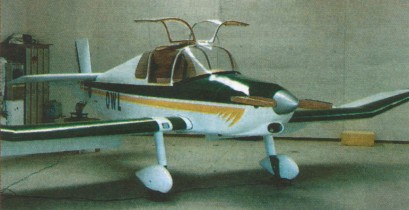
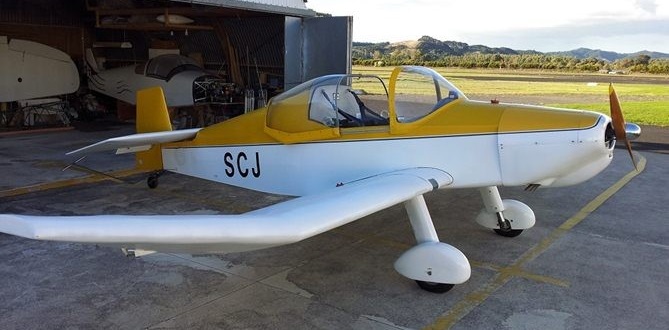
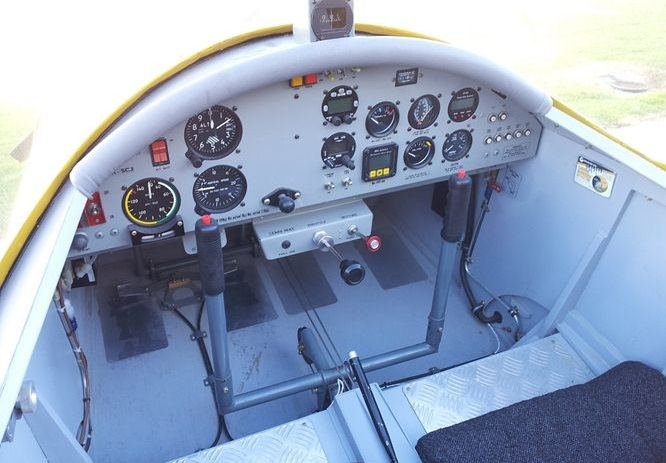
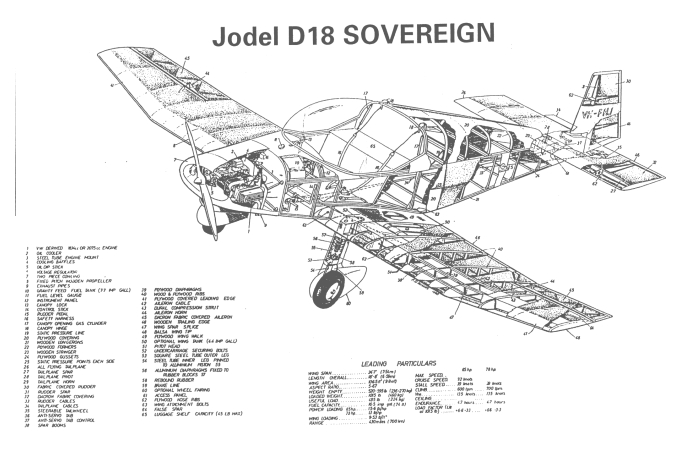
The success of the DC1 lead M. Delemontez to make a thorough revision, and the first D-18 took to the air in the spring of 1984. At first glance looking quite similar to the DC1, there is hardly a single point where Delemontez has not changed something. The prototype has a slightly bigger span than the DC1. An aircraft entirely of wooden construction and built from plans. No kit is available although some sub assemblies can be for control surfaces and undercarriage and perspex canopy can be bought. Douglas Fir is a major material but Australian Hoop Pine has been found very satisfactory. As a two seater the D18 has relevance as a local tourer. The one piece cantilever wing incorporates a sturdy box spar, wooden ribs and ply covered leading edge with dacron covering on the remainder. Flaps are optional. The fuselage is of rectangular cross section with a rounded top decking and made up of wooden longerons, bulkheads, plywood rear formers and is plywood covered. The perspex canopy is attached to a steel tube frame and hinged at the rear. The completed aircraft with some judicious construction will fit into the microlight category and becomes a very cost effective construction project.
As the Ultralight specifications changed during the 1990’s, many builders realised that it should be possible to register a D18 as an U/L with only minor modifications. SAB also seems to have seen this as a new marketing niche. In late 1999 a brochure emerged telling about these recent Jodel developments.
The new variants are called D185 and D195, and differ from their D18 and D19 forerunners by having:
an 8 cm wider, more comfortable fuselage.
the hood extended towards the rear, opening by sliding the rear part rearwards.
flap of increased area (which means increasing wing area as well) to lower the stall speed. The increase in area is simply done by stretching the trailing edge of the flap rearwards by 100mm, leaving the wing unchanged. The flap is also extended all the way to the root rib.
hydraulic springs (oléopneumatique) in the undercarriage.
gross weight reduced to 450kg. The rearwards extended hood makes installing the 65l fuel-tank behind the seat the only option left. The brochure lists the specs. of the planes to be very similar to their ancestors. A stall speed of only 60km/h sounds a little optimistic however – at least at gross weight. The engines that are used for the D18/D19 are also listed as suitable for the ultralight variants – VW1600 – 1800, Rotax 912, JPX, Limbach and Jabiru.
Plans are being sold to homebuilders, but they were never factory produced. In the 13 years that passed between the prototype’s first flight and the summer of 1997, SAB had sold approximately 470 plans.
D18 Sovereign Engine: VW 17l0cc, 58 hp Wing span: 7.50 m Length: 5,70 m Wing area: 10 sq.m Cabin width: 1,0 m Fuel capacity: 65 lt Seats:2 Empty weight: 245/255 kg Max weight: 460 kg Cruise speed: 175 km/h Climb (2p): 3,5 m/s
D18 UL Stall: 32 kt / 37 mph / 60 kmh Cruise: 94 kt / 109 mph / 175 kmh VNE: 134 kt / 154 mph / 248 kmh Empty Weight: 235 kg / 518 lbs MTOW Weight: 460 kg / 1014 lbs Climb Ratio: 700 ft/min / 3.5 m/s Take-off distance (50ft obstacle): 820 ft / 250 m Landing distance (50ft obstacle): 1450 ft / 443 m
M. Alain Cauchy approached M. Delemontez after the 1973 oil crisis wanting to revive the D-11 concept, this time aiming to get the most out of a converted VW engine. The resulting two-seater was named DC1, after Delemontez and Cauchy. After roughly 5000 hours of design, engineering and building the DC1 took to the air for the first time in 1978. The plane is indeed much more related to the D9 than the D11. Major changes are that it has a more modern wing profile, and the fuselage is wide enough for two. The resulting plane has an empty weight of only 216kg its gross weight is 450. With a 1600cc converted Volkswagen engine the cruise speed is 170km/h, and fuel consumption 11 lt/hr.
Engine: VW 16 l0cc, 52 hp Wing span: 7,40m Length: 5,65 m Wing area: 9,56 sq.m Seats: 2 Empty weight: 216 kg Max weight: 450kg Cruise speed: 170km/h Climb (2p): 3,5m/s
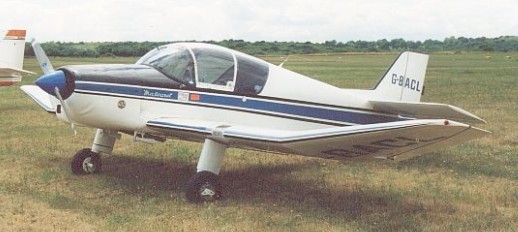
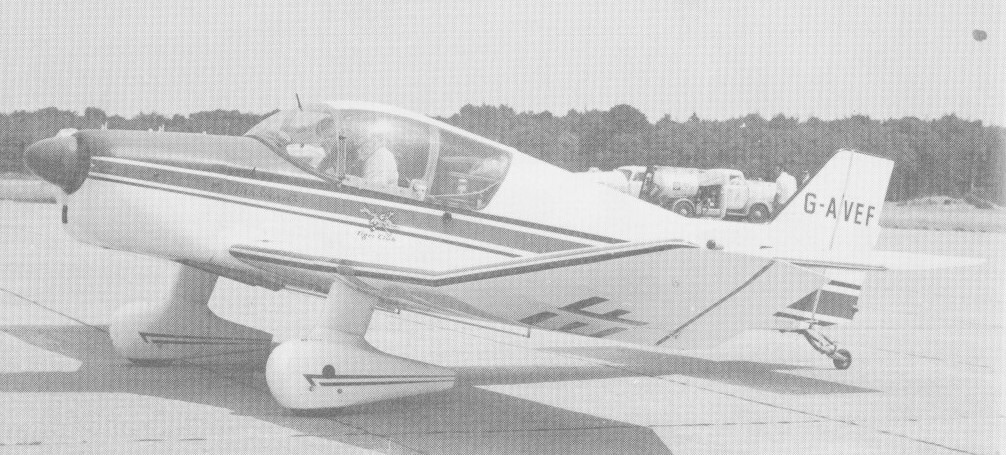
The French government, always keen to encourage local enterprise, showed an interest in the D.9 design and a sligtly larger aircraft, the D11 with two seats, followed. Joly and Delemontez fomally set up a company, combining their names. The Jodel company. The two seat D11 series was designed and constructed as a prototype batch for a French government requirement for an aero club trainer. The Jodel Club is an enclosed, side by side, two seat dual control, low wing monoplane, which is essentially designed for the amateur builder and pilot, and first flown in 1951. Its essenti¬ally simple but rugged construction, together with the excellent flying qualities, have established the D11 as the most popular French two seater, and led to its adoption by many French flying clubs. The one piece cantilever wing has upswept tapered outer panels, typical of the Jodel types, with the inboard part of the wing straight. In other respects the con¬struction is conventional and straightforward in spruce and plywood with fabric covering. The wing is built on a single box spar, which also supports the two legs of the wide track undercarriage. The undercarriage em¬ploys rubber in compression springing, and is fitted with light industrial wheels. The fuselage is a rectangular box structure with a curved spruce top decking and plywood covering. The tailpiece is also plywood covered, while the elevator and rudder are fabric covered. Longitudinal trim is obtained by an elevator trim tab. The design load factor is 6.0 at 1360 lb. The D11 may be powered hp Continental engines from 65 to 100 h.p. and seats two in side-by-side fashion.
The Jodel company did not manufacture that many aircraft itself, their idea being to licence other firms. There were two Jodel-built D.11 prototypes and 11 pre-production D.111. Jean Delemontez worked directly with two organisations in particular to develop the various Jodel models and series.
There were 562 factory built; Wassmer built D.112, SAN 10, Valladeau 50, and other companies. Others were built or sold in kit form in Switzerland, West Germany and Sweden.
The D11 variants, principally the 65 hp D112, the 90 hp D117, 225 produced by Society Aeronautic Normande (SAN) at Bernay and the 90 hp D120 from Avions Wassmer at Issoire, were produced in large numbers for aeroclubs through the French government subsidy scheme. Wassmer started aircraft production at Issoire in 1945, building Jodel D.112 under license. There were versions that were called D119 and 1190.
D.112
Alpavia built 10 D.117A, Valladeau built 10 D.119D. Aerodifusion built the D.1190S Compostela version of the D.119, Wassmer built 350 D.120 Paris-Nice versions, and EAC built four of the D.127 version.
Founded 1958 by Mm d’Assche and Noin, Alpavia sa made the slightly modified Jodel D-117-A (two per month from January 1959). In 1962 partnership with Rene Fournier resulted in Avion-Planeur RF3 with Volkswagen engine. From the 1950s onwards various types, D11, D112, D117 and so on, were built by various companies. There was also a large pool of amateur builders whose examples were generally powered by 90 hp Continental C90s or 100 hp O-200s and usually designated D111. Roughly 1500 commercially built aircraft of this series were produced. With SAN at Bernay Delemontez developed the 180 hp four to five seat D140 Mousquetaire and later the 100 hp two seat D150 Mascaret. New samples of the breed are still being developed, the D18 and D19 being the most recent models.
D.112 Engine: Continental 65 hp Empty weight: 320 kg Gross Wt. 1290 lb. / 530 kg Fuel capacity 10 USG. Wingspan 26’11” / 8,20m Length 20’6” / 6,26m Wing area 136.75 sq.ft / 12,70sq.m Top speed 124 mph. Cruise 100 mph / 160 kph Stall 35 mph. Climb rate 800 fpm / 2 m/sec Ceiling 16,000 ft Takeoff run 500 ft. Landing roll 800 ft. Range 300 miles Seat: 2
Alpavia D.117A Engine: Continental C-90-14F, 95 hp Wingspan: 26 ft 11.5 in / 8.22 m Length: 21 ft 4 in / 6.50 m Empty weight: 760 lb / 345 kg MTOW: 1323 lb / 600 kg Max cruise: 105 kt / 121 mph / 195 kph ROC: 787 fpm / 240 m/min Service ceiling: 16,400 ft / 5000 m Range 20min res: 631 nm / 727 mi / 1170 km Seats: 2