Xian H-6

H-6

A 1961 split ending Soviet assistance, left the Chinese with the task of getting the Tu-16 into production as the Hongzhaji-6 (bomber aircraft no. 6). The Chinese spent two years in reverse-engineering the Tu-16 and its Mikulin AM-3 turbojets, and started production in 1962 for first deliveries in 1968. Since that time the Air Force of the People’s Liberation Army has received more than 100 H-6s for the strategic free-fall bomber and anti-ship roles, the latter with two missiles carried under the wings. Principal version – H-6 (sole production model in several variants up to at least the H-6D, or H-6 IV, which is believed to be the anti-ship type). Low-rate production of the Tu-16 Badger continues at Xian in 1987, and the H-6 is still the mainstay of China’s strategic nuclear bomber force. Local developments of the design include an anti-shipping version carrying C601 missiles and equipped with an under-nose search radar. A four-engined variant of the H-6 has also been reported. Customer: China 120+

Xian H-6 Article

H-6K

After decades of service, Xian finally performed a major overhaul of their H-6 (Tu-16) around the turn of the century. While previous modifications merely upgraded avionics of the design, the new variant developed, the H-6K, redesigned the airframe to extensively use composites, and replaced the old Chinese engines with Russian-made Saturn D-30KP turbofans. As Chinese bomber doctrine has long since shifted to the use of bombers as cruise-missile carriers, the bomb bay was replaced with larger fuel tanks, and the obsolete tailgun armament was replaced with an extensive ECM suite. Similarly, the glazed navigator position was replaced with a more powerful targeting radar. The H-6K first flew in January 2007, and after two years of testing, the bomber entered service with a combat radius nearly double that of the original H-6.
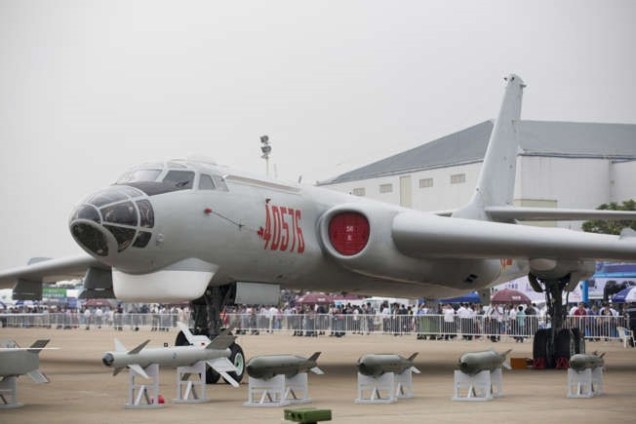
China International Aviation & Aerospace Exhibition in Zhuhai, China, 2014

About 150 of its bombers have been built, and about 120 were still operational in 2025. The H-6 has been upgraded to carry modern weapons, including hypersonic and nuclear-capable missiles.

China sold H-6s to both Egypt and Iraq, but those countries no longer have their bombers operational. According to the Center for Strategic and International Studies, Iraq’s four H-6s were destroyed while in service.

The H-6 has four crew and is powered by two Soloviev D-30KP-2 turbofan engines, each with 27,000 pounds of thrust. Its top speed is 670 mph, and its cruising speed is 477 mph. Its combat range is 2,200 miles.
It can also carry 26,500 pounds of bombs, both guided and unguided (dumb bombs), but no longer carries free-fall nuclear bombs, as the H-6 could not be relied upon to penetrate an enemy’s air space.

Xian H-6
Type: six-seat strategic medium bomber and anti-ship missile carrier
Engines: 2 x 20,944-lb (9,500-kg) thrust Xian WP-8 turbojets
Maximum speed 616 mph (991 km/h) at 19,685 ft (6,000 m)
Initial climb rate 4,100 ft (1,250 m) per minute
Service ceiling 40,355 ft (12,300 m)
Range 2,983 miles (4,800 km) with an 8,157-lb (3,700-kg) warload
Empty weight about 82,010 lb (37,200 kg)
Maximum take-off weight 158,733+ lb (72,000+ kg)
Wing span 108 ft 1.2 in (32.95 m)
Length 114 ft 2.1 in (34.80 m)
Height 35 ft 5.2 in (10.80 m)
Wing area 1,772.87 sq ft (164.70 sq.m)
Armament: four 23-mm cannon in twin-gun dorsal and tail turrets, and up to 19,842 lb (9,000 kg) of bombs

Xian

This major aircraft company was established in 1958. In 1961 it took over from Harbin production of the H-6, a Chinese version of the Soviet Tupolev Tu-16 Badger bomber, and also developed the H-6D as a cruise missile carrier. Produced the Y7 short/medium-range transport based on the Soviet An-24, the first flying in December 1970, and improved versions continue in production. Y7H and Y7H-500 are military and civil versions of the An-26. A supersonic strike aircraft first flew in 1989 as the JH-7, which might have entered service in small numbers with the PLA Naval Aviation for maritime strike duties from 1994. An export version of JH-7 was revealed in November 1998 as the FBC-1 Flying Leopard.

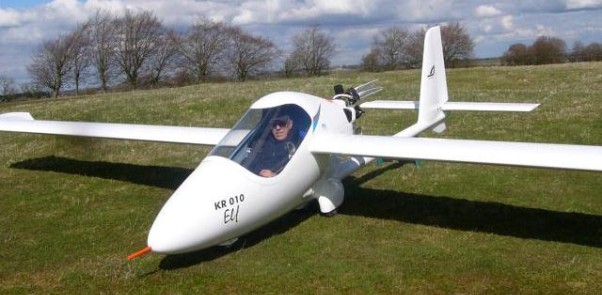
XC Aviation KR 010 Elf

Elf self launch Ultralight sailplane.

Jerzy Krawczyk, in addition to Ekolot’s Junior and Topaz, has several light aircraft, crop sprayer, and sailplane designs to his credit. In creating the self launching Elf sailplane, he employed composite sandwich and carbon structures to achieve the exceptional strength and durability required to pass UK BCAR Section ‘S’ airworthiness certification.

The Elf prototype used the JPX 330 engine which, unfortunately, was withdrawn from production in 2006 after over 20 years in the market. Fortunately, Compact Radial Engines in Canada has produced a very similar unit. This is 20% more powerful than the JPX and also employs a clutch which eliminates folding prop ‘chatter’ on start-up and allows the prop to fold whilst the engine is on idle. This engine has displayed instant re-start capability.

The Elf employs full span flapperons, and airbrakes, and has excellent rudder/stick co-ordination. The NN17-18 aerofoil possesses mild stall characteristics and overall, the handling conveys a strong sense of stability and security to the pilot.

Production aircraft will have the more powerful Compact Radial engine and a 126cms prop with a projected climb rate of 500 ft/min.

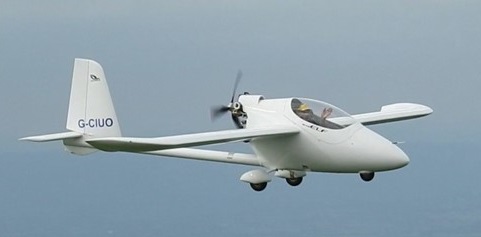
KR-010 “Elf” G-CIUO over Scotland

Engine off, the Elf with it’s 120 ft/min sink rate is capable of slowing down to exploit the slightest lift and core the smallest thermal. This is where the fun and skill challenge begins and where, if the pilot falls out of lift into sink, he can be confident of a quick engine restart and climb back to the area of lift.

Prototype
Engine: JPX 330, 24 hp
Prop dia: 116cms , folding
Weight: 145 kg (with BRS)
Gross Weight: 260 kg
Area: 10.8 sq/m
Span: 11.2 m
Length: 5.7m
Aerofoil: NN18-17
Fuel Capacity: 15 litres (3 hours + reserve)
Proof Load: +6 / -3
Max Pilot Height: 1.9m (6’3”)
Max Pilot Weight: 100kg (220lbs)
Cruise: 50 mph at 5,100rpm
Max Climb: 400ft/min at 30mph
Stall: 27mph
Best L/D: 26.4:1, 150ft/min at 45mph
Min Sink: 120ft/min at 39 mph
Airbrake: 300ft/min at 45mph (13:1)
Fuel burn: 4.5 litres/hour

X-Air Falcon / X-Air F

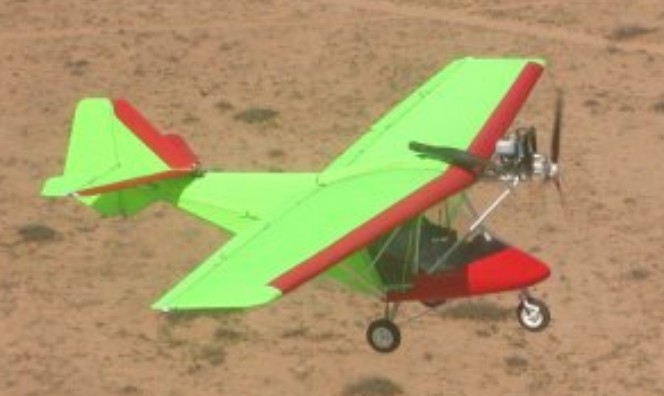
The “F” model or “FLAP” model is an evolution of the standard X-Air; it has three stage flaps to slow the aircraft down for landing and more streamlined fuselage section. The wing and tail on the Flap model also differs from the Standard X-Air, the flap model flies faster than the standard X-Air because of the different profile wing.

The kit is essentially the same.

The upgraded design gives an improved cruise speed, and makes handling in rough weather even better.

The X-air Falcon also known as the Xair-F in some countries, has the same configuration as the standard Xair, high wing, 2 side by side seats, dual controls, the pilot has toe brakes, elevator trim etc. as the Xair, with the addition of a 3 stage flap. The X-AIR can also be fitted with an emergency brake operated by the instructor. The X-Air also has a solid wooden floor in the cockpit.

The maximum all up weight of 450kg is the same, but has an improved wing profile which is shorter in span and cord. The wing section is now also fully double surfaced to the root and the fuselage tail section extends to the rudder post.

The Falcon is manufactured in India, and is supplied in kit form, which comes very complete. Only the choice of Engine/Prop & Instruments are required to finish it, ready for flight.

The X-Air can be pulled down in about 15 minutes. Firstly, the Velcro attached wing nappy is removed, the wing skin tensioning belts are released, the aileron cable is detached and with the assistance of a helper the wing struts are removed and finally, the wings are detached from the main fuse tube. All the wing removal can be done without tools. The wing can be reattached in about 25 minutes.

Nearly all of the exposed tubing, comes White Epoxy painted for long life. Some components come pre-assembled, e.g. Tailplanes & Elevators, and all the required nuts & bolts are in their relevant place’s, to speed up assembly.

The Falcon like the X-air is fitted with full Dual controls, i.e. two sticks, two throttles. The advantage of being in the left seat is to use of the independent toe brakes, fitted to the top of the Rudder pedals.

The seating is fitted with headrests. The cockpit floor is solid, and there is an optional door kit. Each wheel has its own shock absorbing system. The suspension design is similar to shock absorbers on a motorcycle and can handle all the bumps and potholes on grass and bush strips with ease. The front wheel has dual shock suspension with trailing link design steering; the trailing link design straightens up immediately on touch down, so even landing in cross wind is relatively easy in the X-Air. The shock absorber design used on the X-Air offers rebound dampening. The undercarriage is rated to 9 g’s.

Structurally the Falcon has been tested, at it’s all up weight of 450kg, to 6 Gs positive and 3 Gs negative.

The flap model X-AIR were available with three engines from Rotax-Bombardier of Austria, the Australian produced Jabiru engine and the HKS from Japan. Available Rotax options being the 52 HP “503” or the 65 HP “582” and the 80HP “912”. All Rotax engines feature carbon fiber Brolga ground adjustable props.

The fuel tank capacity of just over 59 liters gives a comfortable endurance of at least 3 hours at normal cruise with a 1/2 hour reserve and the optional 80 L fuel tank was available.

The Jabiru engine produces 80 horsepower and consumes approximately 15 liters of fuel per hour and the HKS engine has been successfully fitted to several aircraft.

The recommended engine selection is the Rotax 582. The 582 engine bolts to the X-Air without modification, it provides up to 1200 ft/min climb one up, 900 to 1000 ft/min climb two up). The Rotax 503 climb performance is about 600 ft/min.

General Configuration
Two seater, side by side
3 Axis; Ailerons, elevator and rudder
Full dual control – two sticks, two throttles
High wing, high mounted engine
Tricycle Gear, with independent hydraulic shock absorbers
Steerable nose wheel, linked to rudder pedals
Toe operated differential brakes
Enclosed cockpit, lexan windscreen
Enclosed fuselage
Elevator trim
3 stage Flaps
Two 27L Tanks
Polyester Sail Cloth
G loading +6 -3
6061 T6 Alluminium
Tubing epoxy/polyurethane painted

X-Air F
Engine: Rotax 503
Length: 5.70 m / 18 ft 8 ins
Wing span: 9.45 m / 31 ft
Max height: 2.55 m / 8 ft 4 ins
Wheel track: 1.60 m / 63 ins
Wing area: 14.28 sq.mWheel track: 1.60m
Wheel base: 1.45m
Wheel size: 500 mm / 16 ins
Wheel base: 1.45 m / 57 ins
Empty weight: 230-251 kg
Empty weight w/opts: 242-279 kg

Engine: Rotax 582 ‘C’ Box engine fitted with two blade DUC Prop
Length: 5.70 m / 18 ft 8 ins
Wing span: 9.45 m / 31 ft
Max height: 2.55 m / 8 ft 4 ins
Wheel track: 1.60 m / 63 ins
Wing area: 14.28 sq.m
Wing loading: 31.50 Kg/sq.m
Wheel size: 500 mm / 16 ins
Wheel base: 1.45 m / 57 ins
Empty weight: 237-270 kg
MTOW (Australia): 490 kg

582DCDI
Stall Speed: 28 mph
Vne: 98 mph
Cruise Speed: 70 mph
Climb Speed: 40 mph
Rate of Climb: 700 ft/min
Glide Ratio: 7@40 mph
Fuel Consumption: 16 Ltr/hr
Empty weight: 237-270 kg
MTOW (Australia): 490 kg

X-Air F
Engine: Rotax 618
Length: 5.70 m / 18 ft 8 ins
Wing span: 9.45 m / 31 ft
Max height: 2.55 m / 8 ft 4 ins
Wheel track: 1.60 m / 63 ins
Wing area: 14.28 sq.mWheel track: 1.60m
Wheel base: 1.45m
Wheel size: 500 mm / 16 ins
Wheel base: 1.45 m / 57 ins
Empty weight: 230-251 kg
Empty weight w/opts: 242-279 kg

Jabiru
Engine: Jabiru fitted with Newton 2 blade wood 60″ x 40″.
Empty weight: 263kg/580 lbs
Stall Speed: 32 mph
Vne: 98 mph
Cruise Speed: 75 mph
Climb Speed: 40 mph
Rate of Climb: 700 ft/min
Glide Ratio: 7@40 mph
Fuel Consumption: 11 ltr/hr
MTOW (Australia): 490 kg

Verner 133M
Engine: Verner 133M 2:1 box fitted with 2 blade DUC prop.
Stall Speed: 32 mph
Vne: 98 mph
Cruise Speed: 80 mph
Climb Speed: 40 mph
Rate of Climb: 800 ft/min
Glide Ratio: 7@40 mph
Fuel Consumption: 11 ltr/hr
MTOW (Australia): 490 kg
Empty weight: 263kg/580 lbs

X-Air H / Hanuman / Hawk / Raj Hamsa Altraughts X-Air / Rand Kar X’Air

Joel Koechlin of Raj Hamsa the manufacturing company in India, wanted to build a new aircraft, which kept the features of the original Xair, and add all the things owners wanted. Like bigger doors, adjustable seats, folding wings, more speed, overhead visibility, better comfort etc. The Hanuman is very different from the existing X-Air’s. The Hanuman has been designed to accept a larger range of engines which include the Jabiru 2.2, the Rotax 912 / 914 and some of the bigger Hirth 4 cylinder engines, the aircraft would also perform reasonable well on the 582 or 618 Rotax two strokes.

The flap lever has been sited on the top left hand side of the cabin, so no more need to change hands on the stick. The seat belts now come through the headrest which means they fit better over the shoulders. The seats are adjustable. The X-Air also has a solid wooden floor in the cockpit.

The Standard Xair pilots had a draft that came between the seats, but now there is a piece of clear fabric sewn in place to seal it up, but still allowing you to see the big 80 litre fuel tank.

A Baggage compartment is located behind the seats and the dashboard has now also been sloped forward & closer to the occupants. A purpose surround for the compass is now incorporated on the top of the dashboard.

The Hawk like the original X-air is fitted with full Dual controls, i.e. two sticks, two throttles and the pilot has toe operated brakes; aircraft used for training can also be fitted with an emergency brake operated by the instructor. All the controls are now under the floor so there is a much better & cleaner look.

The Doors are now wide so access is easy. They hinge at the front so they are totally out of the way when opened and allow excellent access. Overhead visibility is provided with four clear lexan panels in the fiberglass roof section.

The Hanuman model is generally fitted with the Rotax or Jabiru 80 hp four stroke engines and these generally have a different instrument specification to the standard two stroke powered X-Air aircraft. The Jabiru 2.2 and Rotax 912 engines both need to modify the engine mounts.

The Hawk has achieved BCAR ‘S’ Certification and can be built from a kit, through the PFA system. This aircraft is a 2 place aircraft, and features the Jabiru engine, a wing fold system, Kevlar reinforced, coated fabric, a ‘proper’ bungee-sprung, undercarriage; dual controls and a wide, comfortable cockpit with excellent forward/side visibility. A cockpit heat system is also included.

The X-Air can be pulled down in about 15 minutes. Firstly, the Velcro attached wing nappy is removed, the wing skin tensioning belts are released, the aileron cable is detached and with the assistance of a helper the wing struts are removed and finally, the wings are detached from the main fuse tube. All the wing removal can be done without tools. The wing can be reattached in about 25 minutes.

The suspension design is similar to shock absorbers on a motorcycle and can handle all the bumps and potholes on grass and bush strips with ease. The front wheel has dual shock suspension with trailing link design steering; the trailing link design straightens up immediately on touch down, so even landing in cross wind is relatively easy in the X-Air. The shock absorber design used on the X-Air offers rebound dampening. The undercarriage is rated to 9 g’s.

A Clear illustrated build manual with colour photographs and pre assembled parts make assembly easy.
Some of the added benefits are:
Cabin Heat
Easy Remove/Folding Wings
Four Stroke Engine
90+ mph Cruise
60 litre fuel tank now up to 5+hrs flying time
Quick Adjusting seats on Sliding Rails
85hp Jabiru 2200 Engine as standard

The X-air Hawk is the UK/Eire Version of the Xair-H, also referred to as the Hanuman in other countries.

The Xair Hawk is available both as a BCAR Section ‘S’ Microlight and as a Group A VLA at 499kg.

The aircraft has been in the design for some years, undergoing various tests and trials, with the first showing of the prototype at Blois in 2002.

X-Air Hawk
Engine:85hp Jabiru
Prop: 2 blade wooden Newton
Length 6.09m/20ft
Wing span 10.05m/33ft
Max height 2.4m/7ft 10ins
Wheel track 1.74m/68 ins
Wing area 13.92sqm
Wheel size 500 mm/16 ins
Wheel base 1.50m/59 ins
Empty weight Jabiru 266kg/588 lb
Stall speed: 33 mph
Vne: 125 mph
Cruise Speed: 90 mph
Climb Speed: 55 mph
Rate of Climb: 900 ft/min
Glide Ratio: 7@40 mph
Fuel Consumption: 10 Ltr/hr
Two seater, side by side
3 Axis; Ailerons, elevator and rudder
Full dual control – two sticks, two throttles
High wing, conventional front mounted engine
Tricycle Gear, with Elastic shock absorbtion
Steerable nose wheel, linked to rudder pedals
Toe operated differential brakes
Enclosed cockpit, lexan windscreen
Elevator trim
3 stage Flaps
80L Fuel Tank
Polyester Sail Cloth
G loading +6 -3
6061 T6 Aluminium
Tubing epoxy/polyurethane painted

Hanuman
Stall: 29 kt / 33 mph / 53 kmh
Cruise: 76 kt / 87 mph / 140 kmh
VNE: 105 kt / 121 mph / 195 kmh
Empty Weight: 263 kg / 580 lbs
MTOW Weight: 450 kg / 992 lbs
Climb Ratio: 900 ft/min / 4.8 m/s
Take-off distance (50ft obstacle): 360 ft / 110 m
Landing distance (50ft obstacle): 720 ft / 220 m

X-Air X-Air

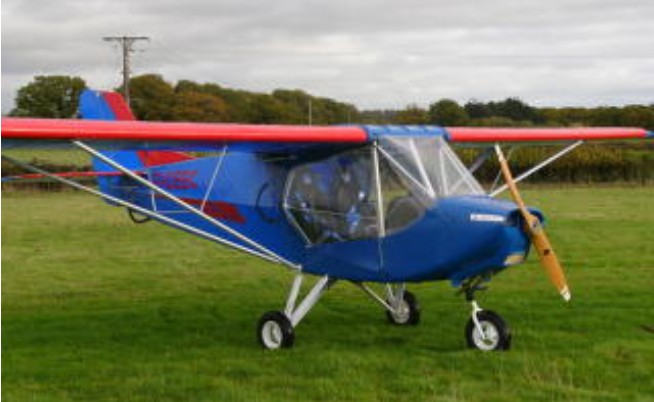
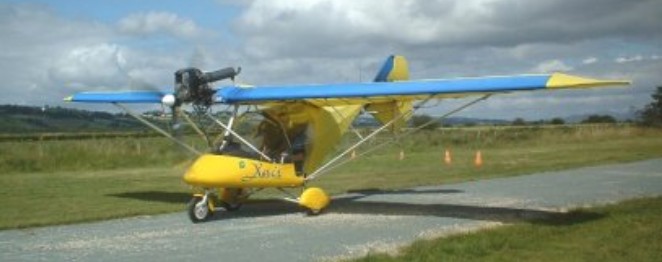
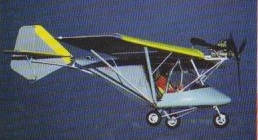
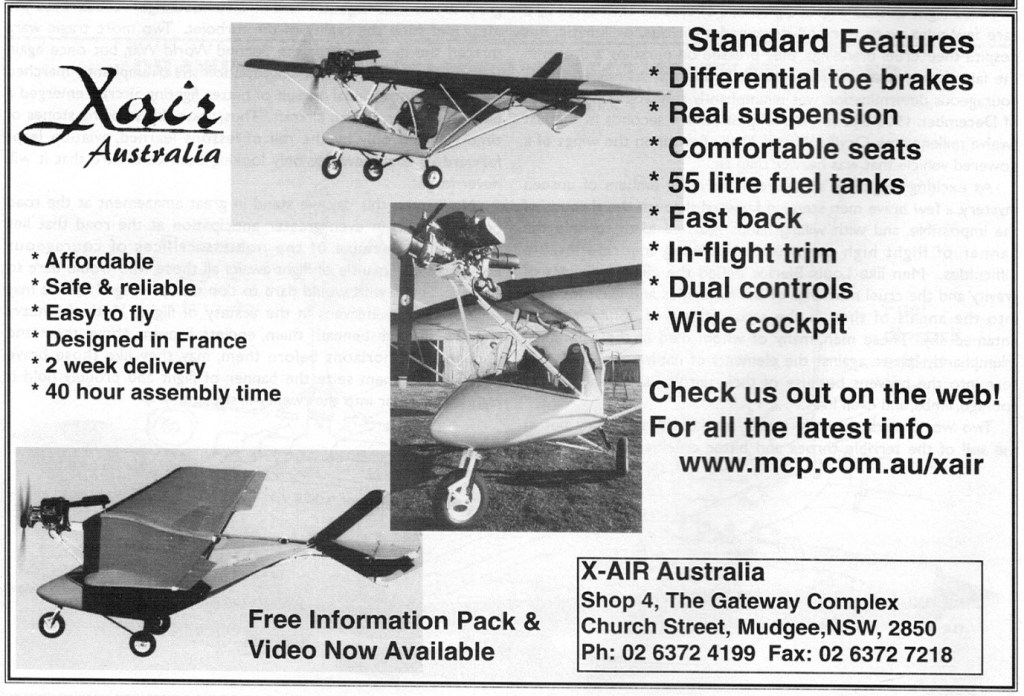
The French designed, Indian manufactured X-Air is a fully featured, affordable light aircraft, developed over several years and there are over 1,000 flying world-wide in 2014. The X-air is a high wing, 2 seat, side by side, conventionally controlled, microlight/ultralight aircraft, with full dual controls, toe brakes, and elevator trim. The fuel tank capacity of just over 59 liters gives a comfortable endurance of at least 3 hours at normal cruise with a 1/2 hour reserve and there was an optional 80 L fuel tank. The fuel tanks are filled at the side of the fuselage. The X-air’s layout consists of a high mounted tractor engine set up, tricycle undercarriage, and a maximum all up weight of 450kg.

The X-air is manufactured in India, and was supplied in kit form, which comes very complete. Only the choice of Engine/Prop & Instruments are required to finish it, ready for flight.

Nearly all of the exposed tubing, comes White Epoxy painted for long life, and some components come pre-assembled, e.g. Tailplanes & Elevators, and all the required nuts & bolts are in their relevant place’s, to speed up assembly.

The X-air is fitted with full Dual controls, i.e. two sticks, two throttles. Both the pilot and the passenger have their own control stick which is located between the legs. The advantage of the left seat is the use of the independant toe operated drumbrakes, fitted to the top of the Rudder pedals.

The standard and flap model X-AIR were available with three engines from Rotax-Bombardier of Austria, the Australian produced Jabiru engine and the HKS from Japan. Rotax options being the 52 HP “503” or the 65 HP “582” and the 80HP “912” with carbon fiber Brolga ground adjustable props.

1998

The recommended engine selection is the Rotax 582. The 582 engine bolts to the X-Air without modification, it is economical, has good performance (up to 1200 ft/min climb one up, 900 to 1000 ft/min climb two up). The Rotax 503 producing 52 HP offers good performance and economy but with two heavy pilots the climb performance is about 600 ft/min. The Jabiru 2.2 and Rotax 912 engines both need to modify the engine mounts.

The seats are fitted with headrests. The cockpit floor is solid wood, lexan windscreen, and there is an optional door kit. Each wheel has its own shock absorbing system. The suspension design is similar to shock absorbers on a motorcycle and can handle all the bumps and potholes on grass and bush strips with ease. The front wheel has dual shock suspension with trailing link design steering; the trailing link design straightens up immediately on touch down, so even landing in cross wind is relatively easy in the X-Air. Steerable nose wheel, linked to rudder pedals. The shock absorber design used on the X-Air offers rebound dampening. The undercarriage is rated to 9 g’s.

The X-Air can be pulled down in about 15 minutes. Firstly, the Velcro attached wing nappy is removed, the wing skin tensioning belts are released, the aileron cable is detached and with the assistance of a helper the wing struts are removed and finally, the wings are detached from the main fuse tube. All the wing removal can be done without tools. The wing can be reattached in about 25 minutes.

The X-air came in a range of 15 different colour combinations.

March 1999

In 2012 the X-Air LS was still priced at US$59,995.

General Configuration
Two seater, side by side
3 Axis; Ailerons, elevator and rudder
Full dual control – two sticks, two throttles
High wing, high mounted engine
Tricycle Gear, with independant shock absorbers
Steerable nose wheel, linked to rudder pedals
Toe operated differential brakes
Enclosed cockpit, lexan windscreen
Elevator trim
Two 27L Tanks
Polyester Sail Cloth
G loading +6 -3
6061 T6 Alluminium
Tubing epoxy/polyurethane painted
Length: 5.70 m / 18 ft 8 ins
Wing span: 9.80 m / 32 ft
Max height: 2.55 m / 8 ft 4 ins
Wheel track: 1.60 m / 63 ins
Wing area: 16.00 sq.m
Wing loading: 28.13 Kg/sq.m
Wheel size: 500 mm/16 ins
Wheel base: 1.45m/57 ins
Empty weight 503: 226 kg / 498 lbs
Empty weight 582 232 kg / 510 lbs
Empty weight 618: 242 kg
Empty weight fully optioned 503: 251 kg
Empty weight fully optioned 582: 270 kg
Empty weight fully optioned 618: 279 kg
MTOW Weight: 450 kg / 992 lbs (Australia 490 kgs)
Roll rate: 3.5sec – 45deg left to right
Stall: 26 kt / 30 mph / 48 kmh
Cruise: 61 kt / 70 mph / 113 kmh
VNE: 83 kt / 95 mph / 153 kmh
Climb Rate: 900 ft/min / 5 m/s
Glide Ratio: 1:7
Take-off distance (50ft obstacle): 880 ft / 269 m
Landing distance (50ft obstacle): 750 ft / 230 m

Engine: Rotax 503, 52 hp
Wing span: 9.80 m
Wing area: 16 sq.m
MAUW: 450 kg
Empty weight: 230 kg
Fuel capacity: 50 lt
Max speed: 110 kph
Cruise speed: 85 kph
Minimum speed: 48 kph
Climb rate: 3 m/s
Fuel consumption: 10 lt/hr
Seats: 2
Kit price (1998): 78 500 Fttc