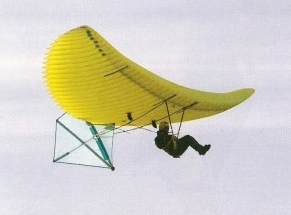
The 1994 Delka glider apparently flew well enough on early test flights with weight shift for pitch control, and tip rudders for roll however weight shift for pitch must have been compromised with the pilot moved inside the wing (no pendular agumentation). The pitch control was some how assisted by control surfaces.
Apparently the test pilot Didier Favre was killed on testing due to structural failure. Laurent Kalbermatten dropped the concept however has proceeded with the Woopy Fly paraglider hang glider hybrid.
Wing area: 13.7 m² Wing span: 10.5 m Hang glider weight: 25 kg
The Kalbermatten Woopy is a Swiss high-wing, single-place, hang glider that was designed by Laurent de Kalbermatten of Villars-sur-Glâne, Switzerland. The price was about 15’000CHF and ready to fly about 10 minute.
The Woopy fuselage is made from aluminum tubing, with a conventional tail, a seated pilot position and weight shift controls. The wing is inflatable and based on the same concept as an air mattress, kept inflated by two small battery-powered fans. Launch and landing is carried out on foot.
Much of the development was undertaken using scale flying models to speed construction and reduce pilot risk. Two models were developed, the Woopy Fly and the Woopy Jump, plus a powered version of the Woopy Fly. The Woopy Fly aircraft was developed in Siberia and can be assembled in 15 minutes, the wing is inflated by two small electric fans underneath the wing, and it is powered by small 20 hp engine.
Variants:
Woopy Fly Initial model Wingspan: 9.7 m (31.8 ft) Aspect ratio: 4.58:1 Wing area: 20.5 sq.m (221 sq ft) Empty weight: 17 kg (37 lb) Glide ratio: 9:1
Powered Woopy Fly Engine: HE R120 120 cc two-stroke, 20 hp Propeller: 70 cm (28 in) Empty weight: 123 lbs (56 kg) MTOW: 240 lbs (109 kg) Cruise speed: 32 kts / 37 mph / 59 kph Stall speed: 23 kts / 26 mph / 43 kph VNE: 40 kts / 46 mph / 74 kph Take-off distance: 197 ft (60 m) Landing distance: 164 ft (50 m) Fuel consumption: 1 GPH (3.8 LPH)
Woopy Jump More portable development model Empty weight: 7 kg (15 lb) Folded length: 160 cm (63 in)
Henry J. Kaiser was a world leader in shipbuilding, associated primarily with the prefabricated Liberty Ship of Second World War. In 1942 Kaiser proposed construction of 5,000 transport flying-boats for troop carrying. Lacking aviation experience, he formed a joint company with Hughes Aircraft, Hughes to undertake design and Kaiser construction of the Hughes-Kaiser HK-1, the world’s largest aircraft. In November 1942 a contract was signed for three aircraft, one for static test and two for flight. By 1944 construction of the first was still at the preliminary stage, and the U.S. Army and Navy withdrew technical assistance. The contract was reduced to one aircraft; Kaiser withdrew, and thereafter the design was called the Hughes H-4 Hercules.
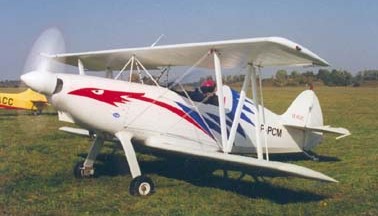
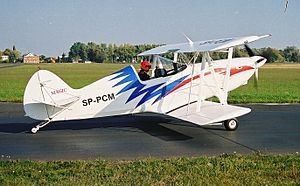
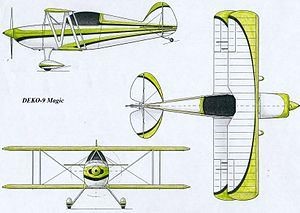
A single-seat aerobatic sports and recreation biplane, the prototype aircraft developed on order from the German Kaiser-Flugzeugbau GmbH. The construction of the prototype, strength tests and flight tests carried out in Military Aviation Plant No. 3 Deblin (later called the Military Aviation Plant No. 1 SA branch) in Dęblinie, Poland. The design work, construction of prototypes and the necessary infrastructure took from 1996 to 1998.
The team headed by Lt.-Col. MSc. Wieslaw Pochylskiego, established a composites laboratory and strength tests, and a thermal tent enabling the study of metal-composite structures at elevated temperatures. Other members included Dr. Eng. Marek Debski and M. Sc. Christopher Kotliński. Builders and MSc. Marian Jakoniuk, MSc. Witold Wiraszka, Eng. Bruno Biernacki and Dr. Eng. Daniel Debski.
Calculations and strength tests were conducted by M.Sc. Vladimir Urbaniak – load, dr. Andrew Szot, MSc. George Mularczyk – static strength tests, Dr. Eng. Wojciech Hajec, MSc. James Kulecki – model airplane spin research, Warsaw University of Technology.
A biplane, the crew seats in tandem with a one-piece canop, and with a fixed main landing gear and tail wheel. The supporting structure of the fuselage is duralumin tube in composite nodes. The wings are double-girder construction with beams made of duralumin tubes and fixed to them duralowej pressed sheet metal ribs. The tail is welded construction made of thin-walled steel pipes. Polish made aircraft are overed with a heat-shrinkable polyester fabric, Dekonit 140 g / m².
First flight of the aircraft on 30 September 2000 and flight tests were performed by test pilot, MSc. , Maciej Aksler. The aircraft was presented at exhibitions air: ILA Berlin 1998 and 2000 and Fredrichshafen AERO 1999 and 2001.
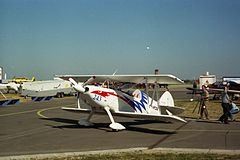
ILA Berlin 2000
The engine of six produced by PZL Rzeszow was the 200 hp PZL Franklin 6A-350C1R , suitable for inverted flight and driving a three-bladed MT-Propeller MTV-9-DC / C188-18a propeller with hydraulically controlled pitch.
Also developed of four-cylinder Franklin 4A-235B4 92 kW (125 hp) powered version with open cockpit.
Engine: PZL Franklin 6A-350C1R, 205 hp (150 kW) Span: 6.8 m Length: 6.5 m Height: 2.2 m Wing area: 15.4 m² Empty weight: 500 kg Useful load: 250 kg MAUW: 750 kg Fuel capacity: 100 lt Max speed: 220 km / h (119 kts IAS) Cruising speed: 190 km / h (103 kts IAS) Minimum speed: 90 km / h (49 kts IAS) Vne: 350 km / h (189 kts IAS) Rate of climb: 12 m / s (2362 ft / min) Ceiling: 4000 m (13123 ft) Range: 700 km (378 nm) Take-off dist: 120 m (393 ft) Landing dist: 120 m (393 ft) Load factor design: + 6 / -3 g Seats: 2
Germany Has developed and is marketing the Kaiser Magic single-seat biplane with a choice of 125 hp or 200 hp PZLFranklin piston engine. Displayed at ILA Berlin in 1998.
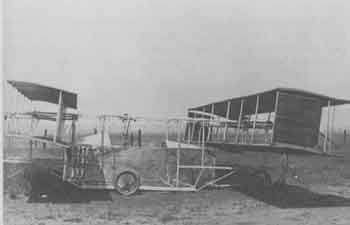
Dan Kaiser’s interesting tandem biplane, with tilting fore and aft biplane wing cells and a metal-covered fuselage enclosing aviator and engine, was tested at Cicero Flying Field, Chicago, in 1912.
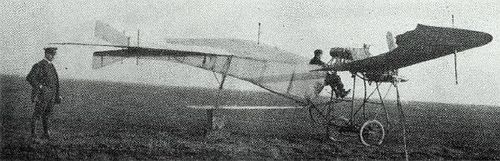
Thirteen meter span monoplane – with which two passengers could be carried beneath the pilot – built by Oswald Kahnt in Leipzig-Lindenthal. Kahnt was taught to fly by Hans Grade and opened the “1. Sächsische Fliegerschule” in Leipzig. Apart from some Grade machines, he built this monoplane during 1911. The power-plant used was initially a 45 hp Oerlikon; later a 70 hp Schröter inline engine was installed. With his “Falke”, Kahnt flew over the “Völkerschlachtdenkmal.” As head pilot at the Gothaer Waggonfabrik during the war, he was killed in a crash.
Conrad Kadlec and his partners August Helpertz and Gustav Schlößer of Düsseldorf-Holthausen were granted a patent for this “Flugmaschine mit Wendeflügelrädern” in 1910. Little more is known of the unlikely-looking machine with rotating and twisting wings on a transverse horizontal axle.
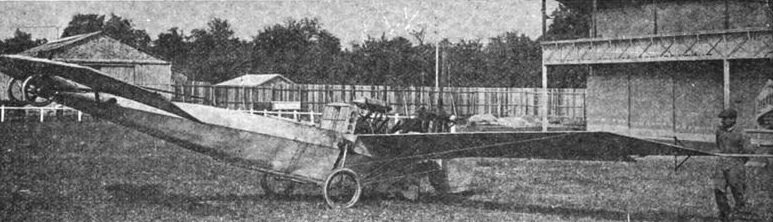
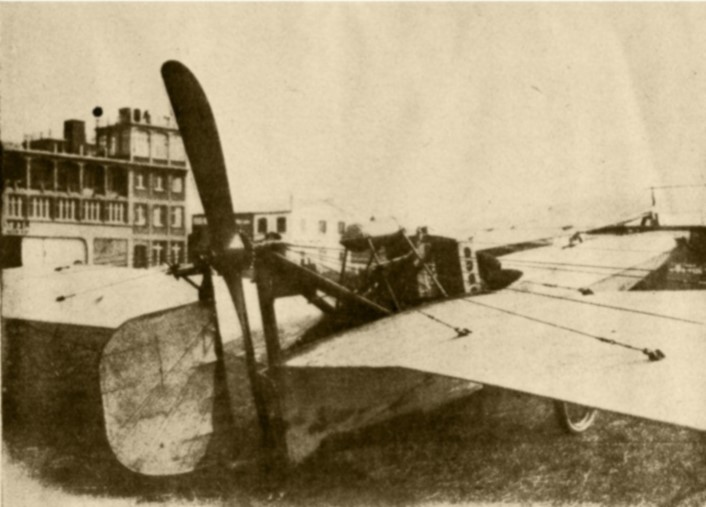
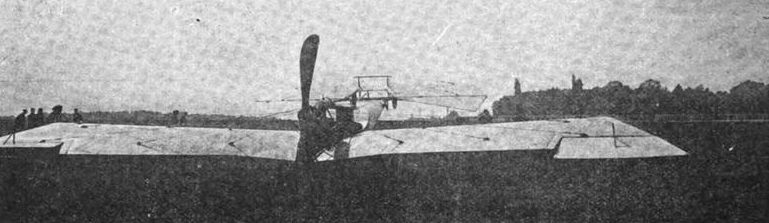
The Canard was a design of Pierre Juvigny which was in the list of about 56 enlisted competitors of the Concours de sécurité 1914 which was published on 17 January 1914. The Concours started in June 1914, but the Juvigny Canard was not ready for competition.
It is noted that the jury nevertheless inspected the incomplete machine (unable to compete) and inspected the variable incidence mechanism of the wing. Due to the weight of the engine and ancillary equipment the machine stood with the nose high when on the ground. There is no information that it took to the air and after the outbreak of the war in begin August 1914 experiments were presumably halted.