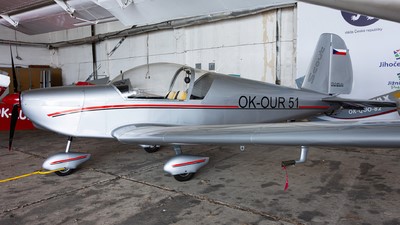
In 2005 Petr Kubiček, encouraged by aerospace engineering students at Brno University, began to design a modernised Mráz M-2 Skaut with the hope of production. The first Kubicek M-2 Scout (the name was Anglicised) of the 21st century appeared, unflown, at Aero ’09 held in Friedrichshafen in the spring of 2009 and flew for the first time on 7 May 2009. The Scout design began with the original plans reassessed with modern methods and using a metal rather than wood structure, supplemented with some composite materials for the engines cowling and flying surface tips.
Externally the old and new aircraft are similar, wings and tail having the same features and the side-by-side seating retained. The aircraft is made from riveted and bonded aluminum sheet and is completely corrosion-treated after assembly. Electrically operated flaps are fitted to the Scout and there is a central trim tab on the elevator. Its fixed tricycle undercarriage is mounted on the fuselage with cantilever composite mainlegs. The mainwheels have brakes operated with a central lever and the nosewheel has helical springing. All wheels are spatted.
The new M-2 was designed to comply with the Fédération Aéronautique Internationale microlight rules and US light-sport aircraft rules.
After its first flight in May 2009, the Scout prototype appeared at several Czech airshows and fly-ins.
Two versions are being developed, one to meet the US Light Sport requirement with a maximum take-off weight (MTOW) of 598 kg (1,320 lb) and a second for the European Ultralight MTOW limit of 450 kg (992 lb). Both these MTOWs are less than that of the original Skaut and empty weight are also less. Certification was proceeding in 2010, with the aim of first deliveries during 2011.
M-2 Scout LSA
US light-sport category
Engine: Rotax 912ULS, 73.5 kW (98.6 hp)
Propeller: 3 blade ground adjustable
Wingspan: 9.6 m (31.5 ft)
Wing area: 12.4 m2 (133 sq ft)
Length: 6.87 m (22 ft 6 in)
Height: 2.35 m (7 ft 9 in)
Empty weight: 320 kg (705 lb)
Gross weight: 600 kg (1,323 lb)
Fuel capacity: 90 L (23.5 US gal; 19.8 Imp gal).
Maximum speed: 220 km/h (140 mph, 120 kn)
Cruise speed: 180 km/h (110 mph, 97 kn)
Stall speed: 72 km/h (45 mph, 39 kn) in the landing configuration
Never exceed speed: 260 km/h (160 mph, 140 kn)
ROC: 6.0 m/s / 1.181 ft/min
Endurance: 6 hours
g limits: +4/-2
Crew: one
Capacity: one passenger
Cockpit width: 120 cm (47 in)
M-2 Scout UL
European ultralight category
Engine: Rotax 912ULS, 73.5 kW (98.6 hp)
Propeller: 3 blade ground adjustable
Wingspan: 9.6 m (31.5 ft)
Wing area: 12.4 m2 (133 sq ft)
Length: 6.87 m (22 ft 6 in)
Height: 2.35 m (7 ft 9 in)
Empty weight: 320 kg (705 lb)
Gross weight: 472.5 kg (1,042 lb)
Fuel capacity: 90 L (23.5 US gal; 19.8 Imp gal).
ROC: 5.0 m/s (984 ft/min)
Cockpit width: 120 cm (47 in)
Crew: one
Capacity: one passenger