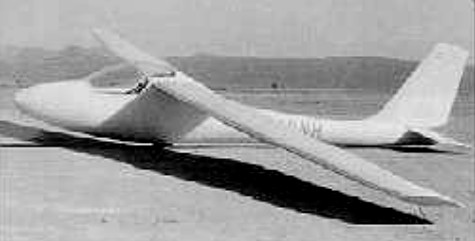
Laister LP-46 / LP-49

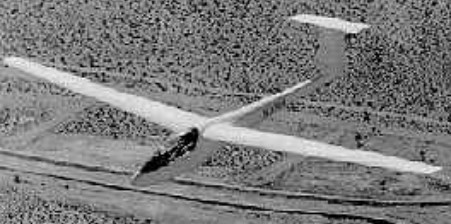
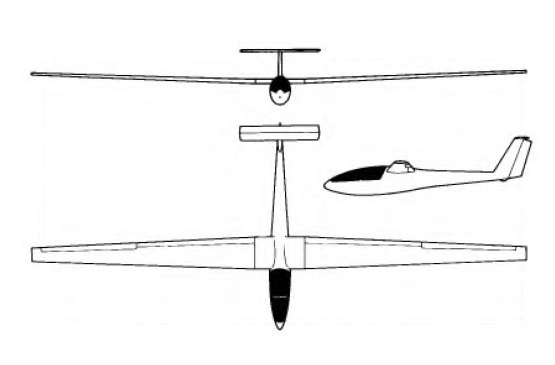
The LP-49, popularly known as the ‘Forty Niner’, is a Standard Class single-seater that was first rolled out in prototype form, designated LP-46, on 4 July 1966. It is of metal and glassfibre construction, but designed to be sold in kit form for the amateur constructor, and more than 50 LP-49 kits had been sold by early 1976, about 35 of which had been completed and flown.

The high cantilever wings are of laminar flow section, the extruded aluminium main spar booms being curved in a chordwise direction to follow the aerofoil section; the roll contoured aluminium sheet wing skin is butt jointed and flush riveted with blind pop rivets. The semimonocoque fuselage is made up of two premoulded glassfibre halves joined over aluminium bulkheads and fittings. The tail unit is of aluminium with a swept back fin and rudder, and the landing gear consists of a shock- strutted retractable monowheel with a brake and a glassfibre nose skid with a steel shoe; a fixed shrouded tailwheel replaces the retractable tailwheel of early production aircraft. The LP-49 has an automatic aileron and dive-brake control hookup and internal control- surface counterweights.
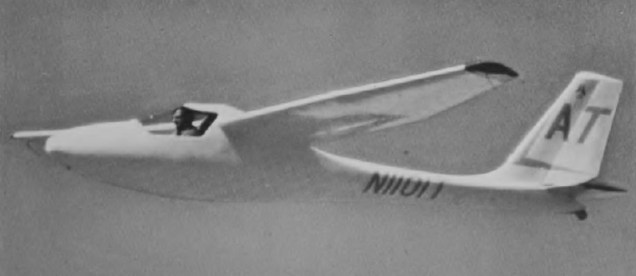
LP-49

The ship is approved for spins, loops and wing-over, and has been static tested to 12 g. The LP-49 was sold in both kit form and as a complete, ready-to-fly sailplane.

Jerry Haynes
haynesja@yahoo.com
Need help to find Stabilizer ? Elevator / pictures / drawings to build a new tail group
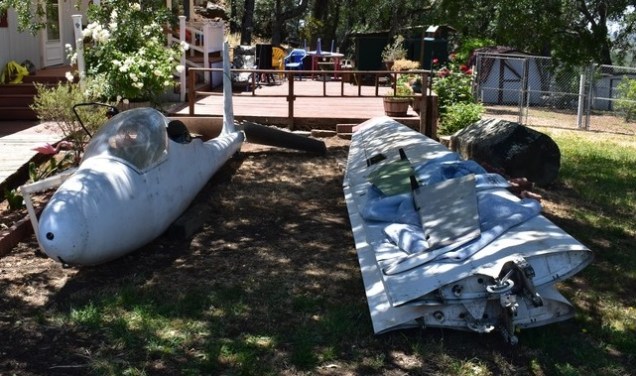
28 May 2018

LP-46
Span: 13.56 m. / 44.5 ft.

LP-49
Span: 15.0 m / 49 ft 2.5 in
Length: 20 ft 7.25 in
Wing area: 13.29 sq.m / 143 sq ft
Aspect ratio: 16.9
Airfoil: NACA 64(3)-618
Empty Weight: 215 kg / 475 lb
Gross Weight: 408 kg / 900 lb
Payload: 125 kg /275 lb
Water ballast: None
Max wing loading 30.72 kg/sq.m / 6.29 lb/sq ft
Max speed: 135 mph /117 kt / 217 km/h
Stalling speed: 30 kt / 56 km/h
Max rough air speed: 117 kt / 217 km/h
Min sinking speed: 0.63 m/sec / 2.07 ft/sec at 50 mph / 43 kt / 80 km/h
Best glide ratio: 36.5:1 at 58 mph / 50 kt / 92.5 km/h
No. of Seats: 1
No. Built: 53
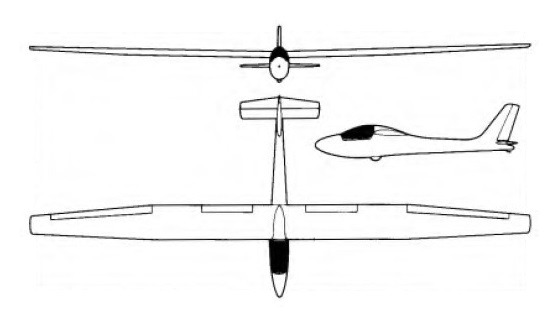
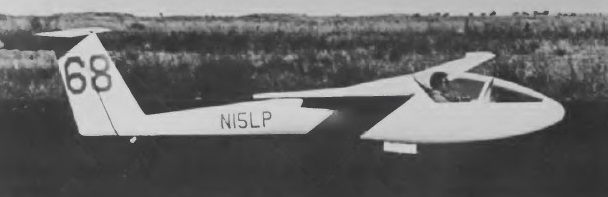
LP-49

Laister LP-15 Nugget

Laister-Kauffman Aircraft Corp was later succeeded by Laister Sailplanes Inc and in 1970 Jack Laister and his son Bill, an aerodynamicist, started design work on the LP-15 Nugget Standard Class single-seater of metal construction.

It is a cantilever shoulder-wing monoplane with a T-tail and long-span flaps which are raised slightly for high speed flight, are lowered 8° for soaring in thermals and can be extended to 85° for use as air brakes. Up to 185lb of water ballast can be carried on the center of gravity. The wings and top-hinged plain ailerons are of Chem-Weld bonded aluminium alloy construction, while the semi-monocoque fuselage has the forward portion of moulded glassfibre and the rear part of bonded aluminium alloy construction which incorporates the swept fin. Landing gear consists of a retractable monowheel and the pilot sits in a semi-reclining seat under a two-piece canopy with a removable section and a sliding ventilation panel.

They decided to wait for the recommendations of the CIVV conference on Standard Class requirements before starting construction of the prototype in February1971, and this first flew in June that year, its maiden flight also being a contest flight; the Nugget was certificated in mid-1975.

The ship was available only as a factory-built product and 15 were built. One Nuget belongs to the National Soaring Museum.

Wingspan: 15.0 m / 49 ft 2.5 in.
Wing area: 10.13 sq.m / 109 sq.ft
Airfoil: Wortmann FX 67170/150
Wing aspect ratio: 22.2
Length: 6.1 m / 21 ft
Height: 1.27 m / 4 ft 2 in
Gross Weight: 408 kg / 900 lb
Empty Weight: 193 kg / 425 lb
Wing loading: 40.27 kg/sq.m / 8.26 lb/sq ft
Payload: 215kg / 475lb
Water Ballast: 84 kg / 185 lb
Max airspeed: 135 kts 126 kt / 233 km/h
Rough air speed: 126 kt / 233 km/h
Stall: 34 kt / 63 km/h
Lift to drag: 37 at 93 kph / 50 kts / 58 mph
Sink: 0.66 m/s / 2.16 fps / 1.29 kt at 43 kts
Seats: 1

Laird, Charles L.

Charles L Laird, Wichita KS.
Brother of Matty Laird.
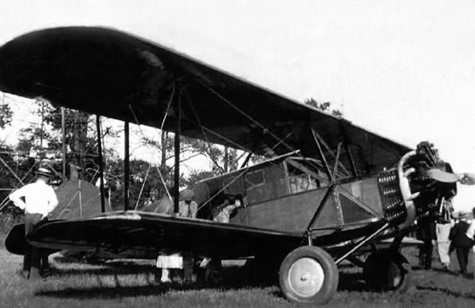
Charles Laird of Wichita, Kansas, built the Whippoorwill cabin biplane and changed company name in 1927 to avoid confusion with his brother “Mattie” of E. M. Laird Airplane Company.

1930: Aircraft Engineering, Chicago IL.

Charlie Laird established Aircraft Engineering (unrelated to the parent company for ACE biplane) in Chicago after he left Wichita in 1930, also had a hand in the Greer College Bryan-Laird B-1B N516K.

Laird-Turner LTR 14 Pesco / (Lawrence) Brown Pesco Special

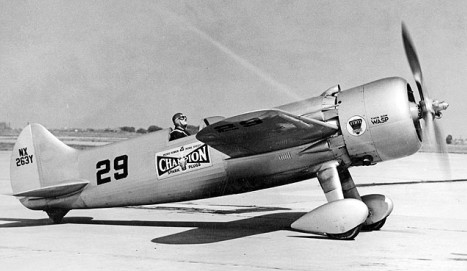
The Laird-Turner LTR 14 Pesco (or (Lawrence) Brown Aircraft Co Special / Pesco Special) was designed by Howard Barlow and Roscoe Turner, and built by the (Lawrence) Brown Aircraft Co of Montebello CA., USA, in 1937. It was sometimes known as the Turner-Laird because of its Laird-built wings, originally 22’0″.

Registered NR263Y Ring-Free Meteor, it was renamed by Turner in 1938 for sponsor Pesco Pump Co, and won the 1938 and 1939 Thompson Trophies.

Engine: P&W Twin Wasp, 1830 hp
Wingspan: 25’0″
Length: 23’0″
Max speed: 330 mph
Stall: 87 mph
Seats: 1

Laird LC-DW-500 Super Solution

In the Super Solution, Doolittle had won the 1931 Bendix and gone on to set a transcontinental speed record of 2,882 miles in 11 hours, 16 minutes, and 10 seconds, while averaging 217 mph. But in the seventh lap of the Thompson, the plane’s 525-hp Pratt & Whitney Wasp Junior radial engine blew a piston, forcing Doolittle to drop out.

Less than two weeks remained before Labor Day weekend and the 1932 National Air Races at Cleveland, Ohio. The main events—the Burbank-to-Cleveland Bendix Trophy endurance race and the closed-course, 100-mile Thompson Trophy dash—demanded two very different types of aircraft, but Doolittle believed he had a plane capable of winning both.
The pace of innovation meant that not even the Super Solution could age a year without the threat of obsolescence. Figuring the decreased drag would more than offset the increased weight, Doolittle replaced its fixed, spatted wheels with a retractable landing gear. He was about to regret the decision. As he attempted to winch down the hand-cranked gear, which had functioned according to plan in ground tests, the pressure of the slipstream prevented the wheels from deploying.

“I spent two hours trying to jar the gear loose…nothing worked,” recalled Doolittle. Finally he resigned himself to bellying in the LC-DW-500. He emerged unhurt, but with the plane’s prop blades bent and fuselage crumpled, the Super Solution would never make the Nationals.