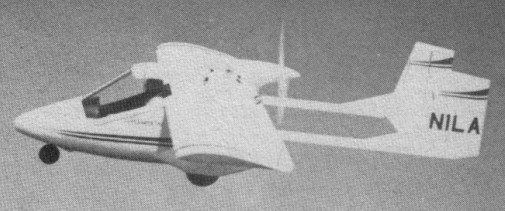
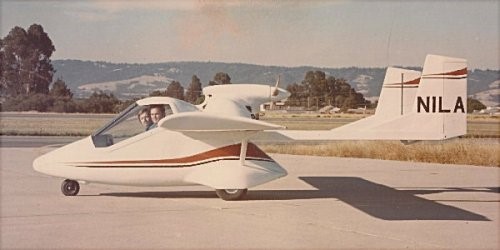
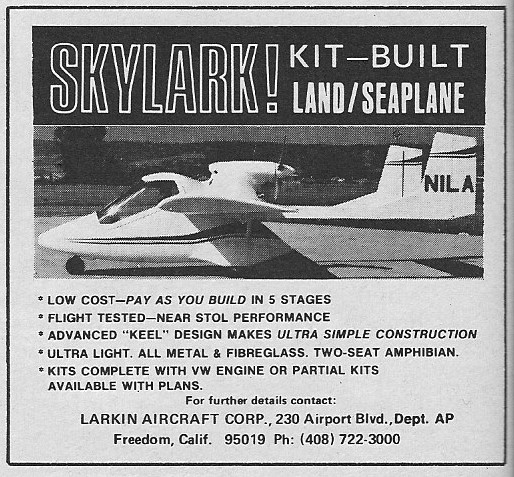
The Larkin KC-3 Skylark was a single-engine amphibious two-seater homebuilt aircraft, a pusher-style design with a single 100 hp Volkswagen air-cooled engine above and behind the fully enclosed cockpit. The booms are at¬tached to the wings and connected at the rear, between twin vertical stabilizers, by one single-elevator surface. One unique feature of the airplane’s structure is the use of a square tubular aluminum keel which is responsible for the loads from the landing gear and the main fuselage. The cockpit seats two occupants in side-by-side configuration, with a large Plexiglas canopy curving around both occupants. The landing gear is a tricycle arrangement with the nose gear positioned at the foremost point of the nose and the two main gear semi-recessed into teardrop-shaped fairings on the lower sides. For amphibious operations, there is an optional V-shaped lower hull of fiberglass which can be added.
The Skylark KC-3 first flew in 1972 and was registered N1LA.
Dec 1973
My father, Tony Austin, worked for Larkin Aircraft in the late 1960s-early ’70s. He collaborated on the engineering and fabrication of the fuselage and other structural components of the one prototype. I had opportunity as a boy to witness the Skylark’s construction and first flight, and have sat in the actual aircraft. I never flew in it as it was only ever piloted by the designer, Keith Larkin himself, to my knowledge. Thad Austin
Engine 65-hp Volkswagen. Wingspan 26’6” Length 19’6” Gross Wt. 1246 lb Empty Wt. 790 lb Fuel capacity 17 USG Top speed 115 mph Cruise 105 mph. Stall 42 mph Climb rate 550 fpm Ceiling 12,000 ft Takeoff run 600 ft Landing roll 400 ft Range 525 miles Seats: 2
Australia Formed as the Larkin-Sopwith Aviation Company of Australasia, which began operation in 1919 and became Lasco, at Melbourne, in 1921. Built 32 de Havilland Gipsy Moths under license for the government. In 1930 built one- and three-engined transports, known as the Lascoter, Lascowl, and Lasconder. At least one de Havilland D.H.50 constructed. Withdrawal of government subsidy and economic depression caused close-down.
Arthur Lardin, W A McCurdy, E Smith, of New Castle DE, USA were all by employees of Bellanca Corp who in 1934 built the AL-1 NX12Y c/n 1 as an off-hours project.
A single place, open cockpit monoplane, power was an 85hp DH Gypsy.