Lippisch completed the Delta III, which had tractor and pusher engines, and an order came in which was to be built by Focke Wulf in Bremen.
Aircraft
Lippisch 272 Fafnir
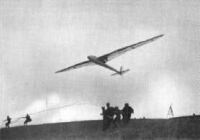
Günther Groenhoff demonstrated his skill and courage while conducting research for a Munich meteorology conference in May 1931. On a mission to gather weather data, he installed various instruments on his Alexander Lippisch built “Fafnir” model 272 glider and was towed to altitude by a powered aircraft piloted by pilot Peter Reidel. As they approached towering cumulus clouds over Munich, Groenhoff’s Fafnir was released to his fate. For the next eight hours, he was bounced and buffeted around the thunderstorm amid lightning flashes, hail and torrential rain, all the while collecting valuable information on weather conditions. Many times he flew in the blind. His journal indicates that he experienced one rapid descent in zero visibility to emerge from the cloud to see the ground only a few hundred feet below. He managed to bank and return to the front side of the thundercloud. He wrote, “as soon as the storm reached me, some powerful force pulled the plane straight up into the center of the clouds. It seemed to me as if I were riding an express elevator of a high skyscraper.”
After soaring with the storm for eight hours, he had traveled 240 miles and finally landed on a riverbed, coming to rest a few meters short of an electric line near Kaaden, Czechoslovakia. Groenhoff wrote that he was gratified that he was able to bring home “the rich material for meteorological research.”
Back at Wasserkuppe on July 23, 1932, Groenhoff once again soared into the strong, turbulent winds of a thunderstorm. However, his good fortune had run out. The rudder of his Fafnir snapped and he crashed on the west slope, dying instantly. He was 23 years old.
Lippisch Delta 1
By 1931 Alexander Lippisch had progressed to a triangular wing form which he called ‘delta’, and his Delta 1 was ready for demonstration to top German aviation ministry officials at Berlin’s Templehof airport. The test pilot, Gunther Gronhoff, performed a low level aerobatic routine (even spinning the 30 hp Bristol Cherub powered delta), they remained unconvinced. Lippisch would not get an airworthiness certificate, they declared, until he put tails on his aircraft.
Lippisch DM-1
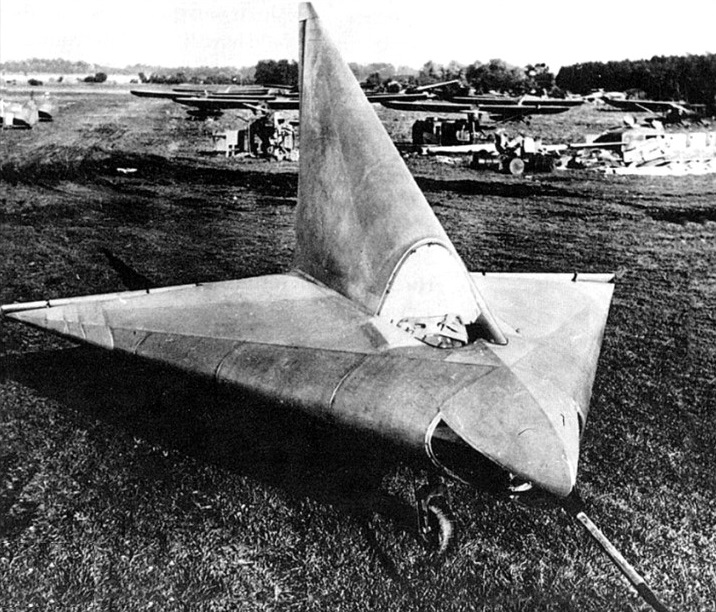
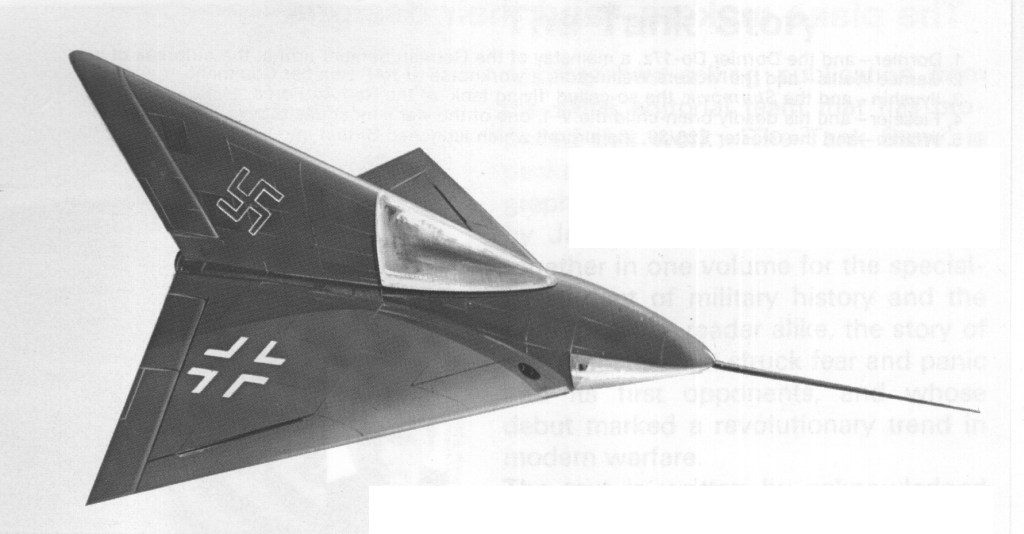
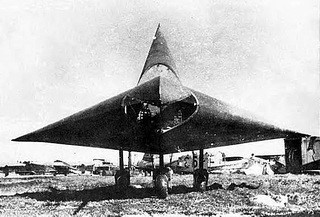
During World War II, Dr. Alexander Lippisch proposed a ramjet propelled point defence fighter, the Lippisch P.12/13a. It was a sharply-swept delta flying wing with the engine buried the a thick, blunt-nosed wing. The pilot was accommodated in the forward section of the tail fin, which was as thick as the wings and almost as large. A scale model was successfully flown at Spitzerberg, near Vienna.
Lippisch himself lost interest in the design and began work on the P.13b with a different wing, but he was approached by students of Akaflieg Darmstadt and Akaflieg München, who asked for vital war work so that they would not be drafted. By this time in 1944 Lippisch realised that the war was hopeless and was happy to oblige, arranging for them to build a full-scale aerodynamic test glider for the P.12/13a project.
Construction was begun at the workshop of the Akaflieg Darmstadt, as the Darmstadt D-33. The workshop was bombed in September 1944, so the part-built airframe was moved to the Akaflieg München workshops at Prien am Chiemsee, where it was redesignated the DM-1 (for Darmstadt-München 1). At Prien, Wolfgang Heinemann and Hans Zacher from Darmstadt, with Klaus Metzner and Hermann Nenninger from Munich, continued the work.
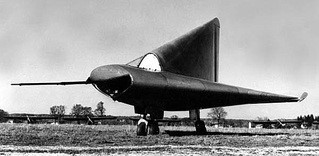
The DM1 was a single-seat glider made from steel tubing, plywood and bakelite impregnated plywood. The cockpit canopy was integrated into the fin leading edge. Launching the DM-1 was to be by piggy-back or aero-tow.
After occupation by U.S. Troops in May 1945, work continued at the DM-1 on behalf of the U.S. military government, with General Patton and Charles Lindbergh visiting Prien to see the project.
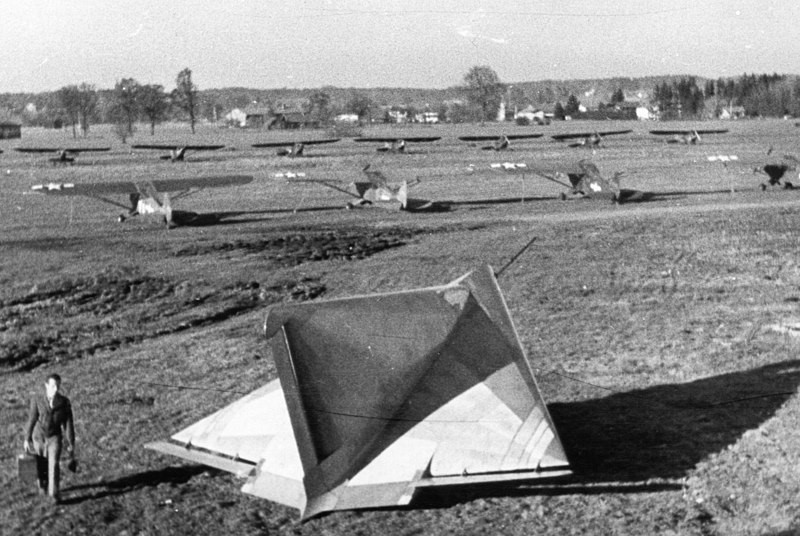
Completed in early November 1945, the DM-1 was shipped in a wooden box to Langley Field in Virginia where the flow behaviour of the DM-1 was examined in the NACA (National Advisory Committee for Aeronautics, forerunner of today’s NASA) full-size wind tunnel.
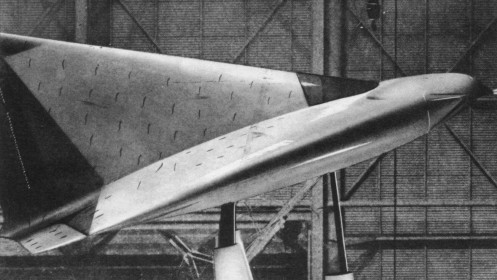
When tested at Langley, the DM-1 was found to perform poorly. It generated significantly less lift at low speeds than small-scale models had suggested. The cause proved to be vortex lift generated by the models which, due to its much higher Reynolds number, the full-size aircraft did not produce.
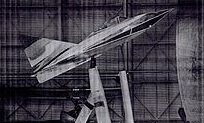
As a consequence it underwent a programme of modifications. Like all Lippisch deltas it had a thick wing with a blunt leading edge. A strip was fixed along the leading edge to simulate a sharp profile. This created the vortices seen on the model and greatly increased the lift. The origin of modern vortex lift theory may thus be traced to the NACA study and the modified DM-1.
The large and even thicker vertical stabilizer was removed and replaced with one of much smaller size, along with a cockpit canopy from a Lockheed P-80 Shooting Star in a more conventional position. Together with improvements to the elevon hinges, this significantly reduced overall drag.
After completion of testing the DM-1 was retired to the National Air and Space Museum, Smithsonian Institution in Washington, D.C. for storage at the Paul E. Garber Preservation, Restoration, and Storage Facility.
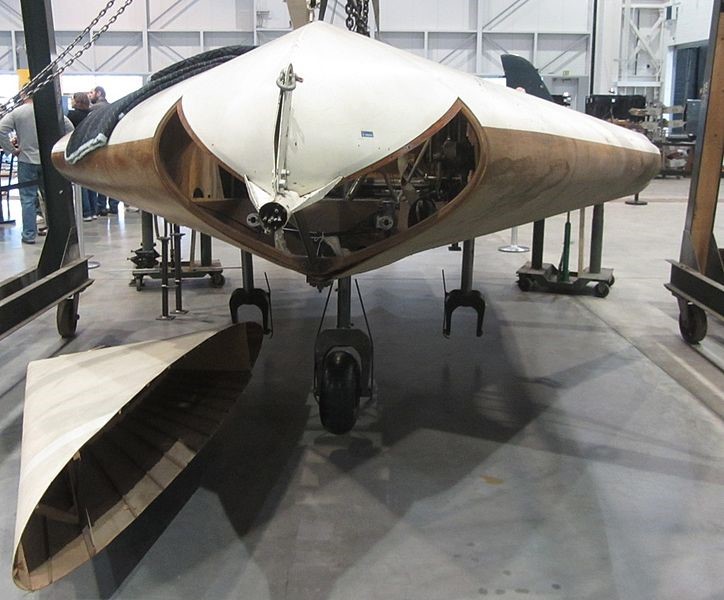
Besides the NASA modifications, the Akafliege Darmstadt and München defined some powered designs for a development programme derived from the DM-1.
DM-1 (Lippisch). Glider as originally built but never flown, with thick wings and large tail.
(NACA). Glider as modified with leading-edge strip, small thin fin, conventional cockpit and sealed elevon hinges.
DM-2. Larger, supersonic test plane with 8.5 metres (27 ft 11 in) span, 8.94 metres (29 ft 4 in) length and prone pilot. Powered by a Walther liquid-fuelled rocket. All-up weight 11,500 kilograms (25,400 lb).
DM-3. Developed version of the DM-3 with pressure cabin and more powerful Walther C engine.
DM-4. Engine flight testbed, initially fitted with a Walther C. Airframe weight (without engine) 2,500 kilograms (5,500 lb)
DM-1
Wingspan: 6 m (19 ft 8 in)
Wing area: 19 m2 (200 sq ft) ca
Length: 6.32 m (20 ft 9 in)
Height: 3.25 m (10 ft 8 in)
Empty weight: 375 kg (827 lb)
Gross weight: 460 kg (1,014 lb)
Maximum glide ratio: 7
Crew: 1
Lippisch 1923 Glider
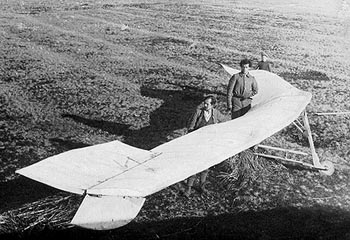
Alexander Lippisch designed his first tailless glider in 1921.
Lippisch Zögling / Pander PH-1
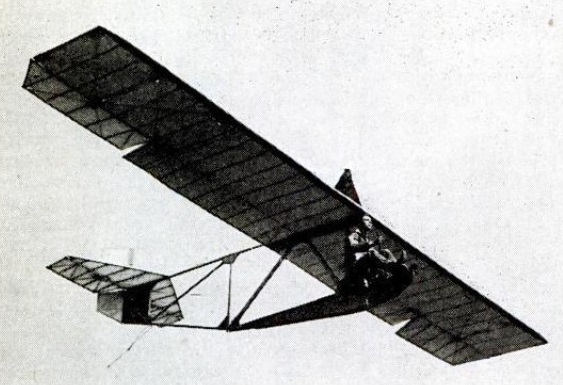
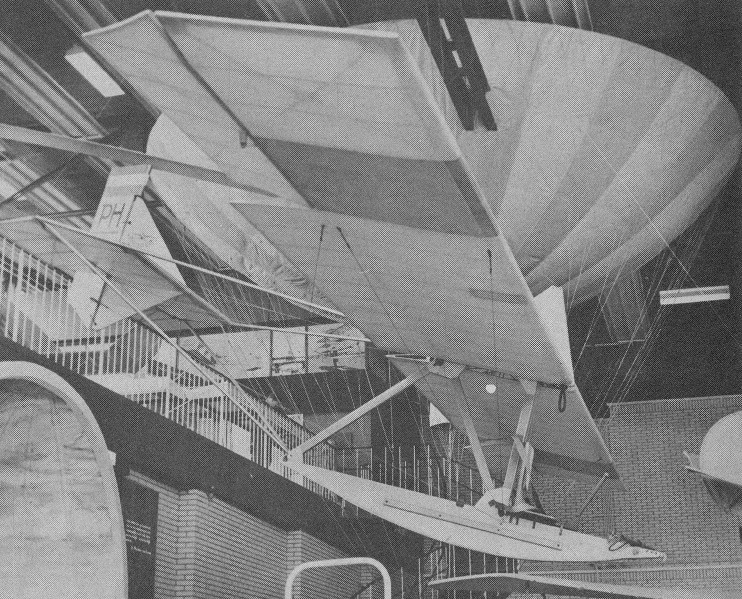
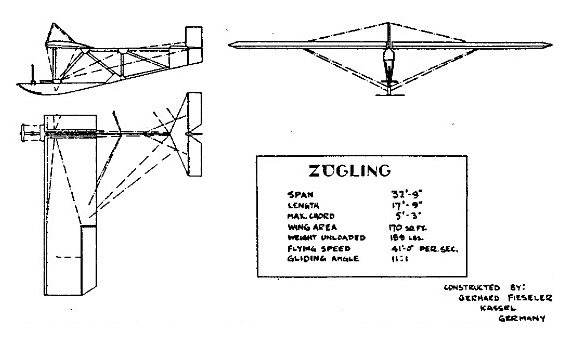
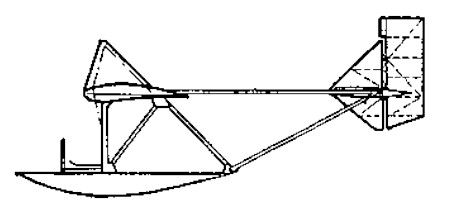
The 1926 Zögling was a simple lightweight glider for basic flight instruction. It was designed to start with rubber ropes, a common way to start a glider in the years short after WWI. It was designed by Alexander Lippisch.
On 27 December 1929 the Dutch Gliding Club was founded. For a few guilders, Theo E. Slot, an aircraft designer at the Pander Aircraft Factory, bought the construction rights to the Zogling glider and on 21 January 1930, the construction of this machine began. By April the PH-1 was completed and flew for the first time in Holland on 6 April, piloted by J. E. van Tijen. A record flight of 43 min 25 sec was made on 4 October with van Tijen at the controls.
Zögling
1926
Length : 17.356 ft / 5.29 m
Height : 6.594 ft / 2.01 m
Wingspan : 32.94 ft / 10.04 m
Crew : 1
Zögling 33
1933
Length : 17.356 ft / 5.29 m
Height : 6.988 ft / 2.13 m
Wingspan : 32.94 ft / 10.04 m
Crew : 1
Zögling 35
1935
Length : 17.356 ft / 5.29 m
Height : 7.612 ft / 2.32 m
Wingspan : 32.94 ft / 10.04 m
Crew : 1
Lipnur NU-200 Sikumbang
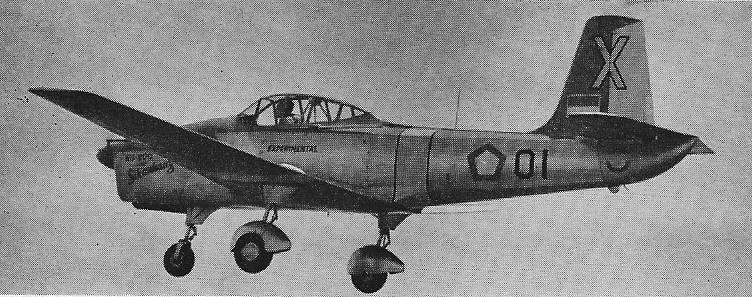
The NU-200 Sikumbang (Bee) was designed in 1953 by Major Nurtanio Pringgoadisuryo of the Experimental Section of the Indonesian Air Force’s Technical Staff.
Of mixed construction, the wing being of all-wood construction with plywood covering and the fuselage being a welded steel-tube structure with metal covering. The Sikumbang was to carry a fixed forward-firing armament of two machine guns and various underwing stores.
The prototype Sikumbang was first flown on 1 August 1954 and the type was intended as a light ground support monoplane.
Engine: 200 hp de Havilland Gipsy Six
Wingspan: 34 ft 9.5 in
Length: 26 ft 9 in
Height: 11 ft
Loaded weight: 2400 lb
Max speed: 160 mph at SL
Cruise: 140 mph
ROC: 1000 fpm
Service ceiling: 16,500 ft
Range: 600 mi
Seats: 2

Lipnur Aircraft Industry / Lembagaindustri Penerbangan Nurtanio / Lembaga Persiapan Industri Penerbangan
1961:
Departemen Angkatan
Udara
Reaublik
Indonesia
Lembaga Persiapan Industn Penerbangan
Husein Sastranegara
Air Force Base
Bandung
In 1953, the Indonesian Air Force began the development of a series of light combat and training aircraft at its research, development and production depot near Bandung.
The first was a single-seat light ground support aircraft named the Sikumbang, of which two prototypes were built.
It has been followed by the Belalang, a major conversion of the Piper L-4J, and an ultralight single-seater called the Kunang.
The Belalang was in production at the depot in 1961, which was renamed the Lembaga Persiapan Industri Penerbangan (Institute for the Preparation of an Aircraft Industry) in August 1961.
Formed at Bandang in 1966 from the Institute for Aero Industry Establishment. LIPNUR built a prototype series of light aircraft and from 1963 began production under license of the Polish PZL 104 utility aircraft under the name of Gelatik (Rice Bird). It was hoped to assemble DH Canada Otters at the Institute.
Also manufactures the LT-200, a modified Pazmany PL-2 light aircraft, for military and civil training.
Lipczyński 1925 Monoplane
Young (a pupil at the secondary school at the time) aeroplane enthusiast Kazimierz Lipczyński designed in 1925 a small (wingspan: 8,54m, length: 5,4m) monoplane aircraft. Design was scrutinized and approved by aeroclub specialists and construction begun, although most likely was never completed for financial reasons.
Lioré-et-Olivier 1911 monoplane
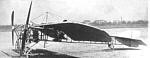
The 1911 Liore et Olivier monoplane designed and built by Liore et Olivier featured two tractor propellers.
Span: 28’2″
Length: 29’6″
Weight: 770 lb

