The Young-Hearne 1911 biplane had the engine mounted span-wise driving 2 propellers through bevel gears. It was designed and built by Claude M. Young.
Aircraft
Young Model A / Special
Built in 1928 by Richard E Young in 1928, the Model A / Special cabin biplane first flew on 5 October 1928. The registration NX7960 was cancelled on 1 January 1959.
Engine: Warner Scarab, 90hp
Wingspan: 28’0″
Length: 19’6″
Seats: 4
Young, Richard E
Ypsilanti MI.
USA
Airplane builder circa 1928.
Young Eddyo F-2
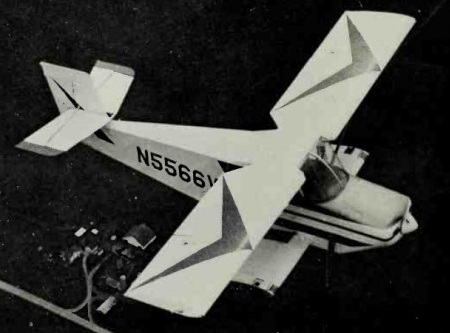
Designed by FAA employee Edward Young of Erie, Colorada, USA, the Young Eddyo F-2 was a two-seat side-by-side light aircraft and took three years of spare-time activity to complete at a cost of $2,500.
The Eddyo F-2 was a sesquiplane and had Vee-braced upper wings, which carried the ailerons, and cantilever lower stubwings which contained the fuel tanks. It had full span trailing-edge flaps. Construction was conventional, with wooden wings and a steel-tube fuselage and tail unit, all fabric-covered. The design featured tail-wheel landing gear which utilised cantilever spring steel main legs. The engine was a Lycoming O-290-D2 four-cylinder 135 hp horizontally-opposed air-cooled which drove a two-blade fixed-pitch propeller.
The sole aircraft, registered N55566V, first flew on November 4, 1963.
The aircraft registration was finally cancelled on 12 December 1983.
Powerplant: Lycoming O-290-D2, 135 hp
Wing span (upper): 23 ft 1 in (7.04 m)
Constant chord: 3 ft 10 in (1.17 m)
Length: 19 ft 5 in (5.92 in)
Height: 6 ft 0 in (1.83 m)
Empty weight: 997 lb (452 kg)
Maximum take-off weight: 1,525 lb (692 kg)
Maximum level speed at sea level at MTOW: 145 mph (233 km/h)
Cruising speed: 130 mph (209 km/h)
Landing speed: 70 mph (ll3 km/h)
Service ceiling: 8,000 ft (550 m)
Range with maximum fuel: 425 miles (685 km)
Accommodation: 2 seats
Yorkshire Sailplanes YS 55 Consort / Birmingham Guild BG 135 Gipsy / BG 100/12
The Swales SD3-15 was developed from the Birmingham Guild BG 135 Gipsy, the 13.5m span version of the BG 100/12 designed by J. C.Gibson, K. Emslie and L. P. Moore of Sailplane Design Ltd. Manufacturing rights of the BG 135 were acquired by Yorkshire Sailplanes Ltd, who built a batch of seven as the YS 55 Consort. The BG 135 was itself developed from the earlier and very similar Birmingham Guild Gipsy 12/15 project which, like the BG 100/12, was intended to be a low cost lightweight Standard/Sports Class sailplane in which either a medium-performance 12m wing or a high performance 15m one could be fitted to a common fuselage and tail unit. This was to be achieved by special attention to structural efficiency resulting from efficient wing skin stabilisation, with rigid foam cores, and low cost was achieved by eliminating taper as well as twin-skin sandwich or ribbed forms of construction. The prototype BG 100/12, with a 12m (39ft 4in) span wing, first flew on 7 April 1970 and was a cantilever shoulder-wing monoplane of all-metal construction with a V-tail and a large hinged moulded cockpit canopy; a 13.5m span wing was later fitted.
Structurally, the SD3-15 is very similar to the BG 135 and BG 100/12.
Yorkshire Sailplane YS53 Soverign
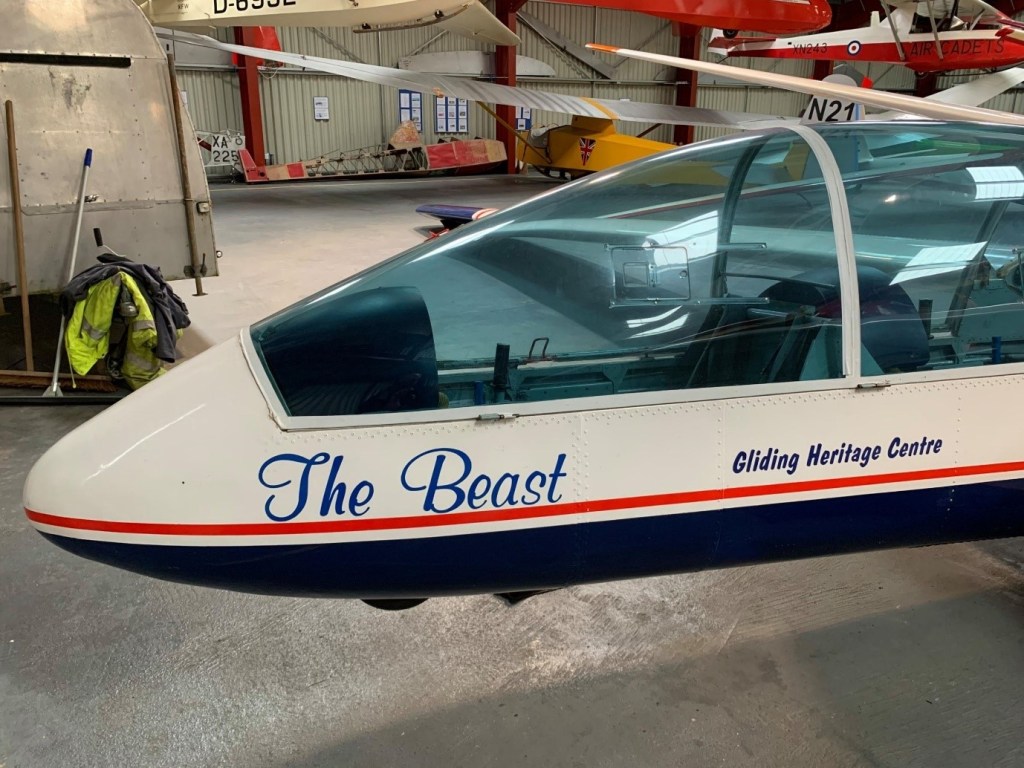
Slingsby sold jigs and production rights of their T.53 upon Slingsby’s 1969 receivership to Yorkshire Sailplane which produced an improved version with both nose and centre of gravity tow hooks known as the YS 53 Sovereign.
Yorkshire Sailplanes only turned out three of these all-metal two-seaters, conceived as a T31 replacement for the Air Training Corps only to be rejected due to unpleasant spinning characteristics.
York Y-2
In 1966 Leon York built the single place cabin, low wing monoplane Y-2, registered N6101.
Engine: Lycoming O-290-G, 125hp
Wingspan: 19’8″
Length: 18’6″
Useful load: 367 lb
Max speed: 145 mph
Cruise speed: 130 mph
Stall: 55 mph
Range: 575 mi
Seats: 1
York June Bug
The 1954 June Bug built by Leon York was a home-built designed for “cow pasture operation.” An open cockpit, low wing monoplane, it first flew in November 1954.
Engine: Continental A-80, 80hp
Wingspan: 23’6″
Length: 16’0″
Max speed: 125 mph
Seats: 1
York, Leon
Midland TX.
USA
Airplane builder 1954-66
York Laser Z-200

Cruise: 165 mph
Stall: 64 mph
Range: 410 sm
Rate of climb: 2500 fpm
Takeoff dist: 1000 ft
Landing dist: 1500 ft
Engine: Lycoming, 180 hp
HP range: 150-200
Fuel capacity: 20 USG
Empty weight: 950 lb
Gross weight: 1400 lb
Length: 19.1 ft
Wing span: 24.4 ft
Wing area: 98 sq.ft
Seats: 1
Landing gear: tailwheel
Plan price 2008: US$275
 All Aero