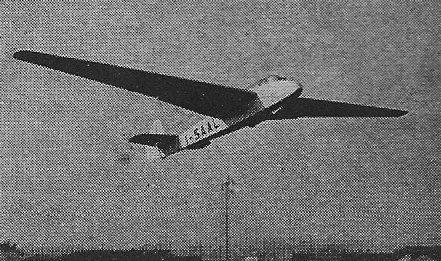
1938 designed by Silva
The BS-28 Alcione, single-seat four ailerons (conv. + spoilers)
1938 designed by Silva
The BS-28 Alcione, single-seat four ailerons (conv. + spoilers)
A 1933 19m parasol-wing aerobatic glider, 1 built
A 1933 9m span experimental glider, Burnelli-style wing with endplates
The BS-09 Bertina II was a 1933 9.28 m span single-seat experimental glider

The BS.8 Biancone was a higher performance version of the BS.7 primary trainer. The two designs, both high-wing monoplanes, shared a fuselage boom, empennage and wing bracing struts, but the later type had a nacelle with a conventional open cockpit and a pedestal in place of the B.7’s simple boom and open girder, together with a new wing of much higher aspect ratio.
The new wing was a wooden two spar structure, largely fabric-covered, like the old. The forward spar was close to the leading edge; from it forward around the edge the wing was plywood covered, forming a torque-resistant D-box; aft the covering was fabric. The rear spar was just behind mid-chord. The central panel, occupying a little under half the span, was straight-edged and had constant chord. Outboard the wing was straight tapered to rounded tips, ailerons occupying all the trailing edge. The centre section was supported by the fuselage pedestal and braced on each side by steel asymmetric V-form struts. These were fixed to the two spars close to the ends of the centre panels and to the fuselage boom directly below the leading edge. It had both a greater span and a lower area than that of the BS.7, increasing the aspect ratio from 7.5 to 12.4.
Like the BS.7, the BS.8 had a fuselage based on a slender, triangular-cross-section, plywood-covered beam, sloping upwards aft from below the leading edge to place the strut braced triangular tailplane at the same height as the wing, on top of a trapezoidal fin. The fin carried a deep, unbalanced rudder, rectangular except at the bottom where it was cropped to match the keel line of the boom. It worked in a notch between the two otherwise rectangular elevators, also unbalanced. The beam now extended to the nose, with a rubber-sprung landing skid attached below it, starting near the nose and reaching back almost to the wing trailing edge. The BS.8 had a conventional, fabric-covered upper fuselage or nacelle on top of the beam from its nose to well behind the trailing edge. The pilot’s position was, as before, under the leading edge, but he was now in a “comfortable” cockpit with an “ovoid” seat.
The BS.8 flew for the first time in about 1933, having been first registered in July 1932. Six were built. For a time, one was fitted with floats so that it sat on water with its hull immersed and could be tow-launched behind a motor-boat.
Wingspan: 13.40 m (44 ft 0 in)
Wing area: 14.50 m2 (156.1 sq ft)
Aspect ratio: 12.40
Length: 6.40 m (21 ft 0 in)
Empty weight: 115 kg (254 lb)
Gross weight: 190 kg (419 lb)
Wing loading: 13.1 kg/m2 (2.7 lb/sq ft)
Maximum glide ratio: 14:1 estimated
Rate of sink: 0.74 m/s (146 ft/min)
Crew: One
A 1929 11.14 m span, single-seat training glider
A 1932 16 m span, single-seat training glider
A 1936 parasol-wing (12 m) single-seat Zögling-type glider, 2 built
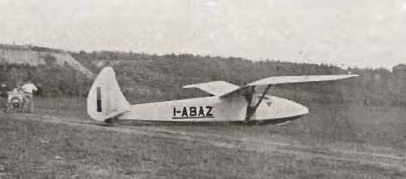
The Balestruccio was a single seat glider with a high aspect ratio gull wing built in four parts. The two inner panels, straight edged with constant chord and carrying dihedral, joined on top of the fuselage, their extremities braced from the lower fuselage with flat steel V-struts, encased in faired wood to reduce drag and assisted on each side by a pair of jury struts. The upper end of each strut was attached on one of the two wing spars. The outer wing panels were straight tapered, with rounded tips. There were differential ailerons on the outer trailing edges and flaps inboard.
The fuselage of the Balestruccio was hexagonal, with deep, near vertical sides. Its comfortable cockpit was immediately in front of the wing leading edge and was originally provided with a wooden canopy with small side openings, similar to that used on the German DFS Fafnir, but this was later replaced with a more conventional open arrangement which provided better all-round visibility. A single, sprung skid and a tail bumper provided an undercarriage. The fuselage tapered aft to a mid-mounted horizontal tail consisting almost entirely of the elevator; although this had straight leading edges, a combination of their slight sweep and the full, rounded trailing edges gave the planform an almost elliptical appearance. There were aerodynamic balances and a large cut-out for rudder movement. As first constructed, the vertical tail was rather similar, with a small fin and a full, deep, curved, balanced rudder which extended slightly below the keel. Later, with the fuselage shortened by one frame or about 700 mm (28 in), the Balestruccio was given a new, angular fin and rudder with straight taper and square tip. Like the old rudder, this was also balanced and deep, though extending only to the keel. The original horizontal tail was retained.
The Balesruccio proved to be versatile and efficient and was flown by Vittorio Bonomi and Enrico Rolandi from Mottarone and Campo dei Fiori di Varese. On 18 December 1932 Rolandi flew it for 25.8 minutes, setting a new Italian national endurance record, covering 15.7 km (9.8 mi) and winning the Castiglione Trophy. As late as 1937, it was demonstrating its performance in Asiago.
Wingspan: 18.00 m (59 ft 1 in)
Wing area: 17.14 m2 (184.5 sq ft)
Aspect ratio: 18
Wing section: Gottingen 549
Length: 8.33 m (27 ft 4 in), later 7.55 m (24 ft 9 in)
Empty weight: 125 kg (276 lb)
Gross weight: 205 kg (452 lb)
Wing loading:11.50 kg/m2 (2.36 lb/sq ft)
Maximum glide ratio: estimated 24:1
Rate of sink: 0.58 m/s (114 ft/min)
Crew: One
Italy
Most Aeronautica Vittorio Bonomi construction was carried out by Aeronautica Lombarda – hence the common use of Aeronautica Lombarda BS-28, etc
In 1937, Lombarda bought out Aeronautica Vittorio Bonomi, building light aeroplanes and gliders. After the Abyssinian War turned to military aircraft production. During Second World War built Heinkel He 111 and Loire 130.
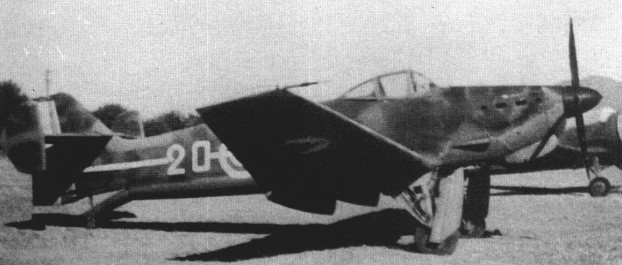
The LN.40 was evolved from the Nieuport 140 in response to a French naval requirement for a ship-borne dive-bomber, and emerged as a compact single-seater with inverted gull wings and a crutch to lever the single large bomb clear of the propeller before release. The prototype flew in June 1938, trials revealing the need for tail modifications. It was also decided to use the extended main landing gear legs as dive brakes, allowing the removal of the tail-mounted dive brakes. Some 42 LN.401 production aircraft were ordered, although only 23 or so had been delivered by the fall of France. The French Air Force also ordered 40 LN.411s, these having no arrester hook, wing-folding mechanism or flotation bags; again only about 23 had been delivered by the fall of France. After the Armistice SNCASO assembled another 24 LN.401s and LN.411s from components.
LN.401
Span: 14m (45ft 11.25 in).
Length: 9.75m (3l ft 11.75in).
Powerplant: l x Hispano-Suiza l2Xcrs, 515kW (690 hp)
Max TO weight: 2825 kg (6,228 lb).
Max speed: 236 mph at 13,125 ft.
Operational range: 746 miles.
Armament: 1 x 20-mm Hispano¬-Suiza cannon and two 7.5-mm (0.295-in) Darne mg plus provision for 1 x 225-kg (496-lb) bomb carried under the fuselage.
LN.411

