During the 1950s Joe Yutz of Pottsville PA. USA built a single place high wing monoplane, registered N69270.
Engine: Continental A-40, 40hp
Wingspan: 22’0″
Length: 15’0″
Speed: 85 mph
Empty weight: 436 lb
During the 1950s Joe Yutz of Pottsville PA. USA built a single place high wing monoplane, registered N69270.
Engine: Continental A-40, 40hp
Wingspan: 22’0″
Length: 15’0″
Speed: 85 mph
Empty weight: 436 lb
Pottsville PA.
USA
Circa 1950s airplane builder
Designed by Felix Knoll during 1929-1930, the Y-1 and Y-2 were three place open cockpit biplanes.
The Y-1 N421N c/n 1 was powered by a 165hp Warner. When the company floundered it sold for a whole dollar ($1) to Carrol Beckwith of Larned KS. The registration was cancelled by CAA 7 January 1933 after he informed them it was dismantled.
The Y-2 N490N c/n 2 was powered by a165hp Wright R-540A. the Y-2 crashed on 27 March 1930 and its registration was cancelled.
Established in 1929
(George C) Yunker Aircraft Co
115 Osage St
Wichita KS.
USA
Airplane builder
In receivership in 1930.

The Yuneec International E430 is a Chinese two-seat electric aircraft designed for commercial production by electric model aircraft manufacturer Yuneec International.
The E430 is a two-seat, V tailed, composite aircraft with a high-aspect ratio wing. Take-off speed is 40 mph, cruise speed is 60 mph, and max speed is 95 mph.
The company claims that the battery packs have an expected lifespan of 1500 hours and cost US$7000 each, with the aircraft carrying 3-5 battery packs, giving two to two and half hours endurance. The batteries can be recharged in 3–4 hours from a 220v outlet.
The aircraft was being developed as a kit aircraft for the US market. The development of the E430 was being funded entirely by Yuneec CEO Tian Yu.
The aircraft was first flown on 12 June 2009 from the Yuneec factory near Shanghai, China, and then shipped for further testing to Camarillo, California. On 14 July 2009 the prototype aircraft was registered in the USA as N386CX and on 18 July 2009 it was given a Certificate of Airworthiness by the Federal Aviation Administration and further test flights were carried out, totalling 22 hours. The prototype E430 was then shipped by truck to Wisconsin and displayed at EAA AirVenture Oshkosh in July 2009. It was also on display at that venue in summer of 2010.
In July 2009 the company estimated that the price for a commercially available light sport aircraft production version of the E430 would be US$89,000.
At AirVenture 2010 the company announced that it would start accepting orders for the aircraft after the show. At that date the aircraft was advertised as having an endurance of 2.25 to 2.5 hours with a useful load of 390 lb (177 kg). The E430 was named the winner of the Lindberg prize for electric aircraft at AirVenture in 2010. The Lindbergh Electric Aircraft Prize (LEAP) was awarded by Erik Lindbergh, the grandson of Charles A. Lindbergh and Anne Morrow Lindbergh. In the same year it was named Brit Insurance Design of the Year in the transport category. Deliveries were initially scheduled for late 2011, but by the end of 2012 there was no indication that more than prototypes had been completed.
Yuneec International, created GreenWing International and in June 2013 it was announced that their GW280 (eSypder) and GW430 (e430) airplanes will be produced, marketed and supported by GreenWing International, however that company went out of business in about 2014.
By December 2012 a total of two examples had been registered in the United States with the Federal Aviation Administration. The first one was the initial prototype shipped to the US, registered in the Experimental – Exhibition category on 14 July 2009, although its registration expired on 31 March 2012. The second was registered in the Experimental – Research and Development category on 26 January 2011 to Flying Tian of Monterey Park, California.
E430
Engine: 1 × Yuneec Power Drive 40, 40 kW (54 hp)
Batteries: Yuneec OEM Lithium Polymer, 13 kg (28.6 lbs), 66.6V (30 Ah) each
Propeller: 2-bladed fixed pitch
Length: 6.98 m (22 ft 11 in)
Wingspan: 13.8 m (45 ft 3 in)
Wing area: 11.37 sq.m (122.4 sq ft)
Empty weight: 250 kg (551 lb) with batteries
Gross weight: 470 kg (1,036 lb)
Maximum speed: 150 km/h (93 mph; 81 kn)
Cruising speed: 90 km/h (56 mph; 49 kn)
Stall speed: 70 km/h (43 mph; 38 kn)
Range: 227 km (141 mi; 123 nmi)
Maximum glide ratio: 25:1
Rate of climb: 3.5 m/s (690 ft/min)
Wing loading: 41.3 kg/sq.m (8.5 lb/sq ft)
Seats: 2

The Flightstar is a large family of single and two-seat, high wing, single engined kit aircraft that was produced by Flightstar Sportplanes of South Woodstock, Connecticut. In 2009 the rights, tooling and parts inventory were sold to Yuneec International of China when Flightstar Sportplanes’ business was wound up.
In April 2014 Yuneec International of China debuted its eSpyder electric at the AERO event in Germany. The eSpyder is a reworked Flightstar ultralight from the 1980s. Flight Design USA’s Tom Peghiny, producer of the Flightstar for many years, sold the design to Yuneec but continued helping with development. The eSpyder, has completed Germany’s DULV aviation standard.
In July 2009 a new single seat model was exhibited at EAA AirVenture Oshkosh. The aircraft is intended to be developed into a commercially available kit and forecast to be available for under US$25,000.
The e-Spyder is an electric-powered and beefing up (enlarging and strengthening) version of the Flightstar Spyder. The aircraft replaces the Spyder’s two-stroke engine with a Yuneec Power Drive 20 20 kW / 27 hp electric motor and two 28 lb (13 kg) Lithium polymer battery packs which provide a 40-minute endurance.

The E-Spyder, a single seat electric powered aircraft featuring the PowerDrive 24 propulsion system integrating the Motor, Motor Controller, 75 Volt Battery, and Charger, received the world’s first type certification for an electric aircraft from Deutschen Ultraleichtflugverbandes (DULV) E.V in 2013.

Yuneec International created GreenWing International to further develop and market their GW280 (eSypder) and GW430 (e430) airplanes. GreenWing International went out of business in about 2014.
GreenWing International had announced the release of its first 50 eSpyder single-seat electric planes, which were to be sold as build-it-yourself kits for for under US$40,000. The company was to ship 25 eSpyders in the United States at a cost of US$39,990. Another 25 were to be sold in Europe for €34,990 each.
Power: PowerDrive 24, 24 kW / 32 hp
Battery: 75 Volt, 13-kWh lithium
Wingspan: 10.1 m / 33.1 ft
Length: 5.9 m / 19.4 ft
Height: 2.4 m / 7.9 ft
Empty weight: 186 kg / 410 lb
Max cruise: 68 mph / 109 km/h
Economy cruise: 38 mph / 61 km/h
Standard flight time: 60 – 90 min
Battery recharging: 2 – 3 hr

AB Yumashiev built the Yu-1 glider in Kiev in 1925. Designed as a training glider, it was developed with a view to participating in the competitions that year in Crimea.
The Yumashiev Yu-1 (Russian: Юмашев Ю-1) was conceived as a single-seat training glider. It was conceived as a high-wing cantilever monoplane. The wing, with the Pr-426 profile, had a double spar structure and a trapezoidal shape in the plane.
The fuselage was built with a plywood frame structure and had an aerodynamic wing profile shape (curved at the top and flat at the bottom). The front 2/3s were covered in sheets of plywood. The tail section was covered with fabric.
The Yu-1’s offset rudders featured a rounded shape.
The landing gear featured a conventional wheeled structure, but for record flights they could be concealed within the fuselage. For training flights they were kept exposed.
First flying in September 1925, the Yu-1 glider was entered in the III National Sailing Competitions held in Koktebel in 1925. On September 30, Yumashiev managed to stay in the air in this glider for 1 hour and 30 minutes, which was a national record.
A day later, on October 1, Yumashiev at the controls of the Yu-1 would achieve for the first time in the USSR, a long-distance flight taking advantage of thermal currents. This flight recorded 4800 meters and was considered a national record, because in the competitions the longest flight value would be 24.4 km, reached by the German Nering on his “Consul” glider. For this flight Yumashiev would receive the award for second place in the competition.
Yumashiev Yu-1
Wingspan: 12.20 m
Wing area: 17.20 m²
Length: 5.70 m
Empty weight: 83 kg
Wing loading: 9.5 kg / m²
Rudder surface area: 2.00 m²
Ailerons surface: 3.00 m²
Wing elongation ratio: 8.7
Accommodation: 1
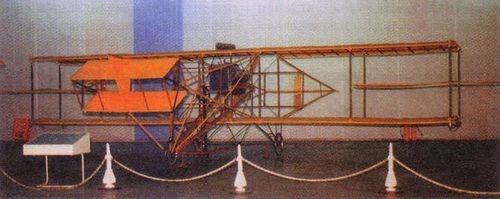
Although the “Feng Ru No. 1″ airplane was damaged during the first test flight, it can be proven that it flew, and the Chinese immigrants in the USA were legitimately very proud. They continued to support Feng Ru’s airplane endeavors, and in January 1911 Yue started his new airplane”Feng. 2” in Oakland.
Yue launched his second airplane above the Piedmont hills on September 21, 1909. The Feng Yue #2 was Curtiss-like, but had some differences in the front elevator assembly.

This was the first airplane manufactured by an Oakland resident to fly in that area. Unfortunately, this airplane crashed as well after a twenty minute flight when the bolt holding the propeller shaft broke. Fong continued building planes, and in 1911, his plane stayed in the air for 40 minutes and landed without a mishap.
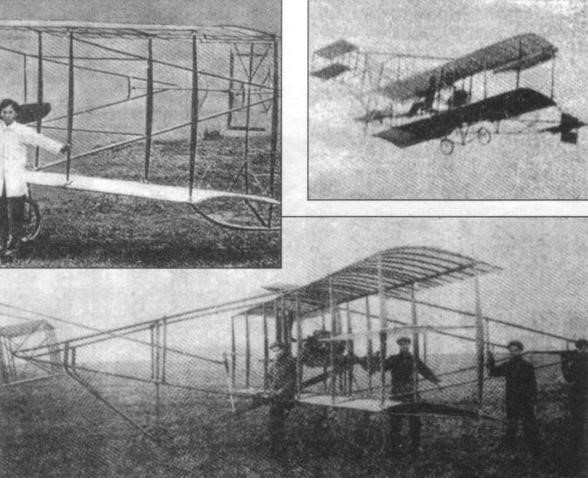
With financial support from other Chinese immigrants in the USA, Feng Yue began to build an airplane in 1906. In 1907, in Oakland, a city east of San Francisco, in spite of all kinds of difficulties, he constructed the Guangdong Airplane Factory. By 1909 he had built an aeroplane, the first which had been designed and built by a Chinese. He called it “Feng Ru No. 1”.
On September 21, 1909, Feng Ru completed the first test flight from a hill in the proximity of Oakland, which was witnessed by some American journalists as well as three of his coworkers. Feng Ru reached a height of 4.5 meters with his airplane, and flew some 800 meters along the hill. Thus, he was the first Chinese who had built and flown an airworthy airplane.
After approximately 20 minutes, the flight came to a sudden end when the propeller failed and the aeroplane fell to earth from a small height. Fortunately, Feng Ru got off with only a bad scare and was not hurt. The first one crashed into his own workshop, starting a fire that burned it to the ground.

Born on 15 December 1882 in the Yanping district of Kwangtung province, Fong Yue (or the now more accepted spelling of his name, Feng Ru, also seen as Fung Joe Guey and Feng Ru) came to the United States at the age of twelve, living and working in various parts of California and attended evening classes to study English before trying to settle in San Francisco in 1906. The earthquake spoiled his plan and sent him fleeing to Oakland. He developed an interest in machinery and electrical technology, spending his evenings home carrying on experiments to satisfy his curiosity. He designed and constructed electric motors and set up a wireless telegraph set in his own room. He was always interested in machinery, and one of the first things he did after arriving in Oakland was to organize an airplane manufacturing company, only a few years after the Wright Brothers’ Kitty Hawk flight.
1904 brought the Japanese-Russian war in northeast China. Feng Ru participated in the happening in China in the USA, and he was conscious itself of the military meaning of the new flight apparatuses. He said: “Had we had thousands of airplanes at the Chinese border, the foreign forces would have surely been deterred.” Thus he decided to dedicate himself to the development of aviation in China.
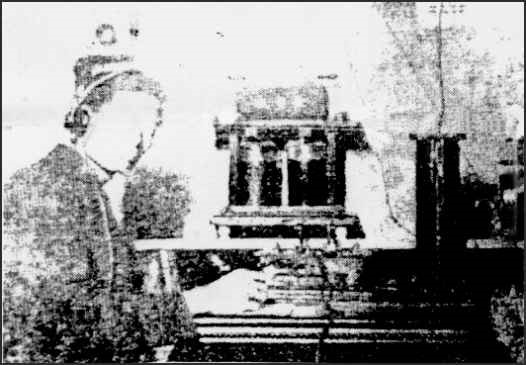
Within two years of founding the company in 1908, Fong Yue constructed his first airplane and even manufactured his own motor.
On its test flight the first one crashed into his own workshop, starting a fire that burned it to the ground. Assumably the airplane went with it, but Yue was undaunted, and built a second ship that he flew from the Piedmont Hills on 21 September 1909, as reported by Associated Press. After 20 minutes a bolt on its propeller shaft broke and it, too, crashed, and its creator was thrown out, but escaped injury. He returned to China in 1911 with his mechanic and two Curtiss planes, and built China’s first aircraft. Yue was killed in a crash there in 1912, but his legend is perpetuated by a play, “Dragonwings,” last presented, as known, in San Francisco 1992.
Undaunted, the aviation pioneer found space to build his second airplane which he launched above the Piedmont hills on September 21, 1909. This was the first airplane manufactured by an Oakland resident to fly in that area. Unfortunately, this airplane crashed as well after a twenty minute flight when the bolt holding the propeller shaft broke. Fong continued building planes, and in 1911, his plane stayed in the air for 40 minutes and landed without a mishap.
Dr. Sun Yat Sen, the prominent revolutionary who at the time was in the USA and had heard of the flights of the Chinese Feng Ru in Oakland. When he learned more of the successful test flights, Sun Yat Sen commended the flight pioneer Feng Ru’s courage and encouraged him to dedicate himself to aviation in China and help organize a national air force.
He did. In February 1911, Feng Ru made his way to China from Oakland, taking with him two airplanes. He wanted to develop aviation in China.
A revolution led by Sun Yat Sen caused the downfall of the Qing dynasty monarchy in China in October, 1911. Feng Ru participated in it and was appointed Captain of the Air Force by the revolutionary government of the Guangdong province. In March 1912, he built his first airplane in China, the very first airplane to be manufactured in China. At that time, the country as a whole acknowleged that Feng Ru had become the pioneer of Chinese aviation.
Later, he organized aviation shows on several occasions in China in order to popularize aviation among the Chinese. On August 25, 1912, at one of the shows in Guangzhou, Feng Ru crashed and died. He was only 29 years of age.
The contribution of Feng Ru to the development of aviation in China is not forgotten. After his death a monument for him was erected in Guangdong.
 All Aero