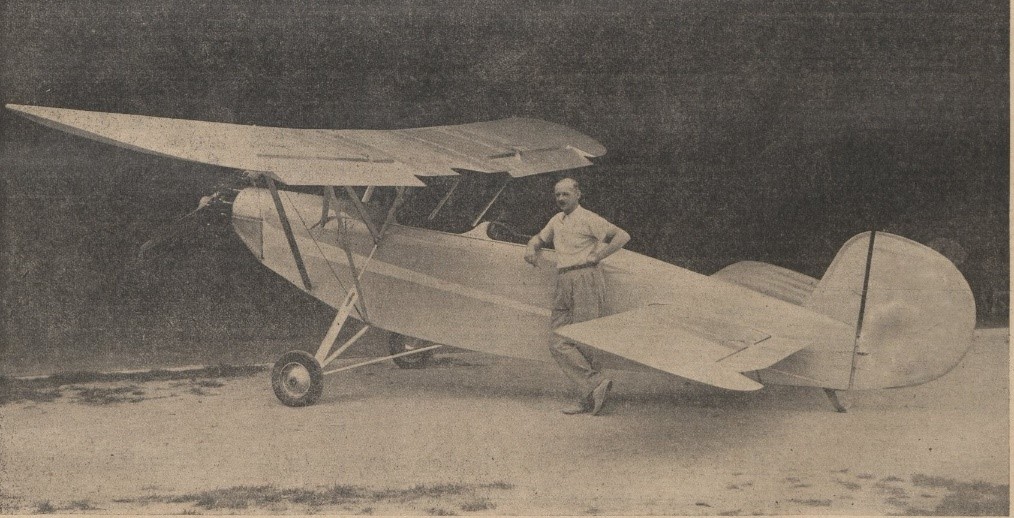
M. Louchet’s ‘Le Pyrale’, which was presented to the world on the eve of WWII – and, in consequence, was not heard of thereafter.
M. Louchet’s ‘Le Pyrale’, which was presented to the world on the eve of WWII – and, in consequence, was not heard of thereafter.
The 1911 Loubery biplane designed and built by Loubery in France had twin engines and three propellers.
Lotus has long been known for sophisticated yet affordable sports cars, but founder Colin Chapman also aimed to build aircraft. Colin Chap¬man, founder and head of the Lotus Car company, discussed a microlight project with Alain-¬Yves Berger, who had met Colin on the motor racing circuits many years before and had remained in touch with him. Colin envisaged making a very high performance composite construction tandem two seater using a canard wing, and a four stroke engine of his own design, and had set himself some tough performance targets a design top speed of 125 mph (200 kph), fuel consumption per hour of 1. 3 US gal (1.1 Imp gal, 5.0 litre), and a selling price around £5500 for a production run of 500 aircraft.
Chapman believed that Lotus composites technology could be applied to build an aircraft that still met ultralight rules, would be cheap and easy to fly, and very attractive to buyers. After reading up on German glider technology, Chapman approached the Rutan brothers in 1982 to study the feasibility of the project and commissioned Burt to design a new type of microlight based on Rutan’s love of composites, efficiency, and the use of the “canard” wing layout for which Rutan is famous. Several designs were envisaged, one being the Rutan Model 91 ML (for MicroLight), a one-person 300 lb. ultralight aircraft, powered by two 25 hp jet engines. Despite Burt Rutan’s dismissing the idea as complicated, Chapman insisted that the new plane should be a two-seater.
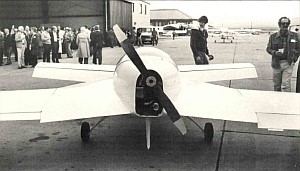
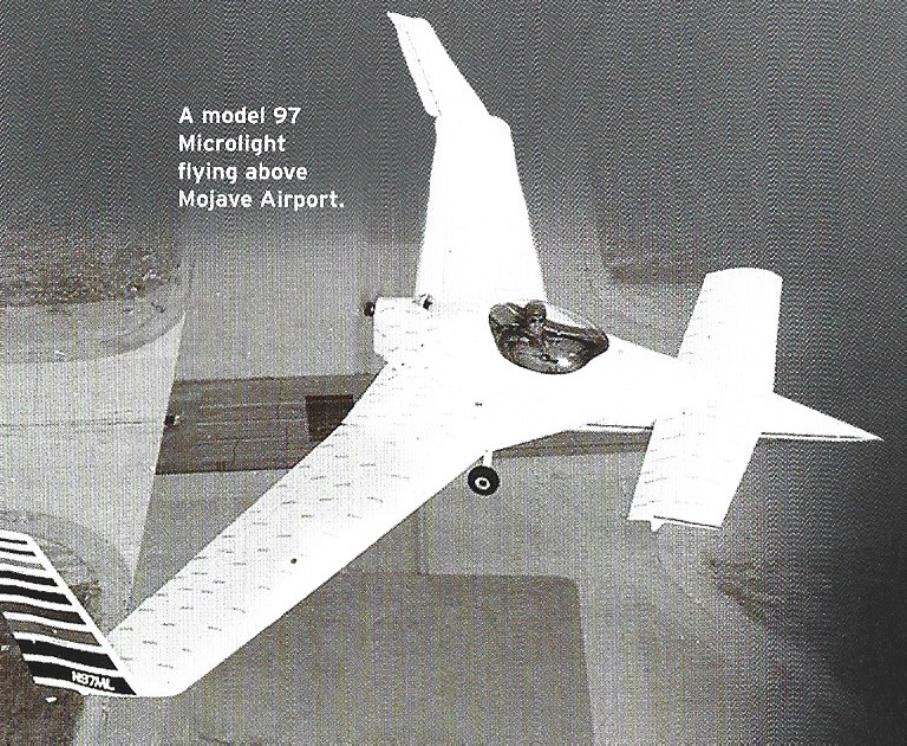
By June 1982, the final configuration was chosen out of nine different studied designs, and in December, the prototype Lotus MicroLight (Rutan Model 97M), built by Scaled Composites Inc. and appropriately registered N97ML, arrived at the Group Lotus airfield at Hethel in Norfolk, England. It was a side-by-side two-seater with a pointy nose, an enclosed cockpit, a retractable front wheel, and is of a unique design with a canard foreplane and a swept back wing, and a pusher propeller behind the cockpit. Pitch control by elevator on canard; yaw control by tip rudders; roll control by spoilerons; control inputs through stick for pitch/roll and pedals for yaw. Undercarriage has three wheels in tricycle formation; glass fibre carbon fibre suspension on main wheels. Push right go-¬right nosewheel steering. Brakes on main wheels. Composite fuselage, totally enclosed. Engine mounted below wing driving pusher propeller.
Tragically Colin Chapman, the visionary who championed the Lotus MicroLight, died December 16, 1982 at the age of 54, the day before the prototype’s first flight.
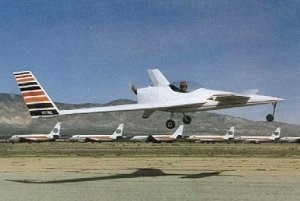
It is often said that the program was shelved by Lotus due to the death of Mr. Chapman. This was not so. Prototype trials continued with a little Italian KFM 109 ER two-stroke 23 hp engine, up to the end of the proof-of-concept phase. Specs for the Lotus MicroLight are lacking, but a 25 hp engine was originally planned for it. A Lotus engine that was being developed by Tony Rudd (a senior officer at Lotus), the 50 hp Magnum 4.5, was to have been installed in the production aircraft. The plane was assembled and flown for the first time in public in August 1983. It arrived in a crate at Hethel in August 1983, two days before the Lotus Open Day. It was assembled on Friday and Saturday, and was taxied in daylight on Saturday afternoon, and “accidentally” hopped in the dusk. Its first proper flight was Sunday morning, and the demo flight was in the afternoon for the crowds. It was now registered as G-MMLC.
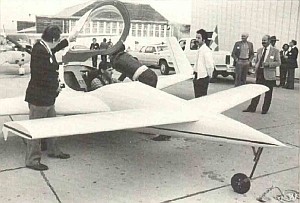
The Lotus MicroLight was apparently a technical success, but a marketing failure. Despite both Lotus’s and Rutan’s credentials, the business arrangements didn’t work out. Lotus wanted to build a business for the MicroLight, and sought backing to continue alone. When that wasn’t approved, Lotus went looking for partners and teamed up with the Eipper company to distribute it in the USA, while Malcolm Lawrence’s Aviation Composites of Thatcham in Berkshire, was to distribute it in the UK and Europe.
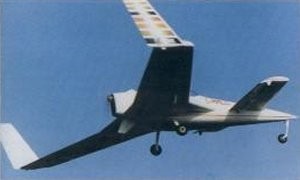
Lotus originally planned to build the basic structure themselves, with Aircraft Composites finishing and distributing it. It was then decided that the materials (epoxy glass) and the quality control techniques were not part of the Lotus core business, and Aircraft Composites agreed to take over the development and build, with the help of Peter Jackson’s Specialised Mouldings (a firm in motorsport). Since Lotus was struggling to cope with the aftermath of Colin Chapman’s death, the Aircraft Composites move into taking over the whole project was heaven sent. Instead, Aviation Composites used the design’s features as a basis for a different aircraft. The company employed VariEze builder Ivan Shaw, and built a similar but much heavier version, the Mercury prototype (G-INAV), which incorporated various modifications from the Rutan design and had several problems with it.
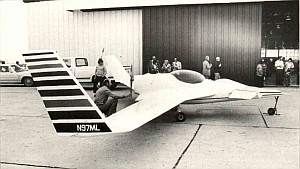
The MicroLight was de-registered and returned to the USA in 1988, but it was lost in an accident in which both the owner and test pilot of the aircraft were killed
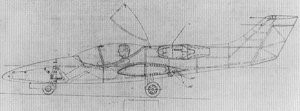
Aeroplanes Hanriot et Cie
Compagnie des Avions Hanriot
Operated at Argenteuil as Aeroplanes Hanriot et Cie to 1930, when it became Lorraine-Hanriot, a division of Societe Generate Aeronautique. When this organization broke up in 1933 the company became known as Compagnie des Avions Hanriot.
Lorraine-Dietrich was a French automobile and aircraft engine manufacturer from 1896 until 1935, created when railway locomotive manufacturer Société Lorraine des Anciens Etablissments de Dietrich and Cie (known as De Dietrich et Cie, founded in 1684 by Jean de Dietrich) branched into the manufacture of automobiles. The Franco-Prussian War divided the company’s manufacturing capacity, one plant in Niederbronn-les-Bains, Alsace, the other in Lunéville, Lorraine.
In 1896, managing director of the Lunéville plant, Adrien, Baron de Turckheim, bought the rights to a design by Amédée Bollée. This used a front-mounted horizontal twin engine with sliding clutches and belt drive. It had a folding top, three acetylene headlights, and, very unusual for the period, plate glass windshield. While the company started out using engines from Bollée, de Dietrich eventually produced the entire vehicle themselves.
After World War I, with Lorraine restored to France, the company restarted manufacture of automobiles and aero-engines. Their 12-cylinder aero-engines were used by Breguet, IAR, and Aero, among others.
The de Dietrich family sold its share in the company, which became simply known as Lorraine from 1928 on.
Automobile production eventually became unprofitable and, after the failure of their 20 CV model, the concern ceased production of automobiles in 1935.
In 1930, de Dietrich was absorbed by Société Générale Aéronautique, and the Argenteuil plant was converted to making aircraft engines and six-wheel trucks licenced from Tatra. By 1935, Lorraine-Dietrich had disappeared from the automobile industry. Until World War II, Lorraine concentrated on the military market, manufacturing vehicles such as the Lorraine 37L armoured carrier.
The Lunéville plant returned to rail locomotives. In 2007, it still operated as De Dietrich Ferroviaire.
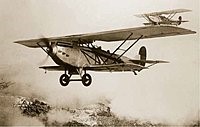
The Loring R-III or R-3 was a 1920s Spanish two-seat sesquiplane reconnaissance and light attack aircraft designed by engineer Eduardo Barrón and built by Dr. Jorge Loring’s company — Talleres Loring.
In the mid 1920s, during General Primo de Rivera’s dictatorship the R-III entered a contest along with the Potez 25 for the modernization of the Spanish Military Air Arm. Both planes had similar characteristics, but the Military Directory favoured the Loring R-III in order to promote local industries. First flying in 1926, the Aeronáutica Militar placed an order of 110 units, which put the Loring company at the head of the Spanish aeronautical industry of the time.
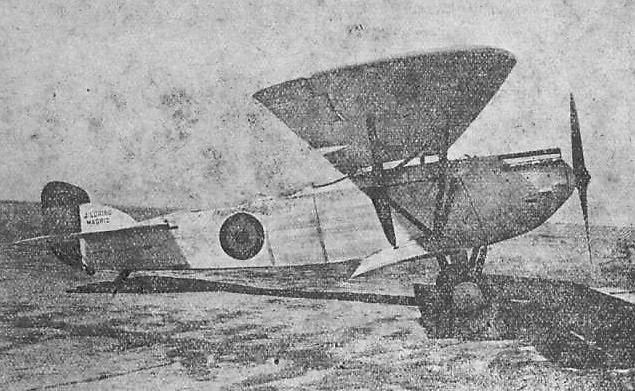
In October and November 1926 three variants of the R-3 were exhibited at the Loring section of the National Aeronautics Exhibition held in Madrid’s Palacio de Cristal: The R-3, the C-1 fighter (one built in 1926) and the T-1 light trainer (one built in 1926). Neither the fighter nor the trainer variants, however, went into production.
Some R-3s remained in service well after the proclamation of the Spanish Republic until the outbreak of the Spanish Civil War. It is not clear, however, whether they saw active service in the civil war.
Engine: 1 × Hispano Suiza 12Hb, 447 kW (600 hp)
Wingspan: 14.50 m (47 ft 7 in)
Length: 9.7 m (31 ft 10 in)
Height: 2.60 m (8 ft 6 in)
Empty weight: 1,400 kg (3,080 lb)
Gross weight: 2,380 kg (5,240 lb)
Maximum speed: 235 km/h (146 mph)
Crew: 2 (pilot, observer)
Armament:
2 × fixed, forward-firing 7.7 mm (0.303 in) machine guns in the engine cowling.
2 × trainable 7.7 mm (0.303 in) machine guns on a Scarff ring for the observer.
40 × 11 kg (24 lb) bombs on under-fuselage racks, or 8 × 50 kg (110 lb) bombs
First Spanish indigenous design was the R.1 for the army.
Spain
Founded in Madrid by Dr. Loring of the Compania Espanola de Trafico Aereo. Received order for 20 Fokker CIV for Spanish Army Air Corps in 1924. First indigenous design was the R.1 for the army. Further reconnaissance types followed, and light aircraft. Built Cierva Autogiro under license.

In September 1990 it was reported the name SwiftThunder was adopted for the derivative of the SwiftFury offered to the USAF’s enhanced flight screening aircraft programme. The two aircraft differ only in the tricycle undercarriage on the Swift Thunder. A three-day evaluation of the SwiftFury prototype was being made during August 1990 at the Air Force Academy, Colorado Springs, with five sorties to be flown each day.
LoPresti Fury
Engine: Lycoming IO-360-A1B6, 200 hp @ 2700 @ SL
TBO: 2000 hrs
Fuel type: 100/100LL
Propeller type/diameter: Hartzell CS/76 in.
Landing gear type: Tri/Retr.
Max ramp weight: 2300 lb
Gross weight: 2300 lb
Max landing weight: 2300 lb
Empty weight: 1450 lb
Useful load: 850 lb
Payload, full fuel: 490 lb
Usable fuel (gals.): 60
Wingspan: 29 ft. 3 in.
Overall length: 22 ft. 6 in.
Height: 7 ft. 2 in.
Wing area: 138.6 sq. ft
Wing loading: 16.6 lbs./sq. ft
Power loading: 11.5 lbs./hp
Wheel base: 12 ft. 5 in.
Wheel track: 9 ft. 9 in.
Wheel size: 6.00 x 6 in
Seating capacity: 2
Cabin width: 44 in
Cabin height: 45 in
Baggage capacity: 200lb
Cruise speed 75% power @ 8,300 ft.: 182 kt
Cruise speed 65% power @ 8,300 ft.: 175 kt
Max range (w/ reserve) 55% power: 870 nm
Fuel consumption 75% power: 10.5 USgph
Fuel consumption 65% power: 9.1 USgph
Fuel consumption 55% power: 7.7 USgph
Stall speed (flaps up): 49 kt
Stall speed (flaps down): 44 kt
Best rate of climb: 1350 fpm
Service ceiling: 21,000 ft
USA
Founded 1991 to take over development of Swift Fury two-seat aerobatic lightplane (first flown 1989 as Lopresti Piper development of Globe/Temco Swift).

