UK
Formed 1935 to develop Major R. H. Mayo’s concept of composite aircraft. A heavily laden long-range upper component, too heavy to become airborne under its own power, was carried aloft on the back of a short-range aircraft whose function was simply to effect take-off. Ordered by Air Ministry for experimental operation by Imperial Airways, the two components of the Short-Mayo Composite were built by Short Bros at Rochester, and comprised S.20 Mercury floatplane as upper component and S.21 Maia as the lower. Components completed 1937, first separation in flight February 6,1938. On July 21,1938 Mercury carried a 454kg payload non-stop 4,667km from Foynes, Eire, to Montreal and on to New York, a total distance of 5,214km in 22 hr 31 min flying time.
Aircraft
Mayer Mr. D
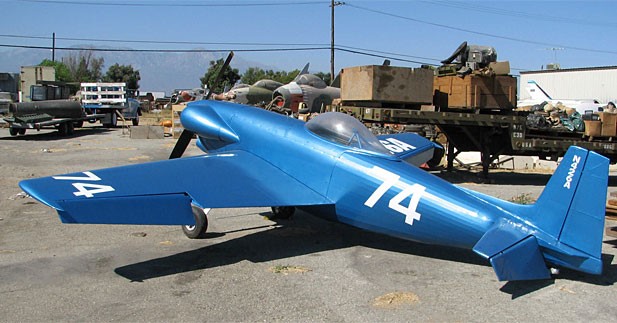
The Mr. D Midget Racer designed and built by Robert Mayer of Michigan, race number 74 was raced by pilot Hank Orlowski in 1951 at the Detroit Air Races. It qualified at a speed of 160 mph.
The aircraft was later raced at Wallingford, Ct., and took 4th place in the Formula One race. Following this, the airplane was retired.
Mr D’s short racing career spanned the years 1951- 1953.
This original Midget Racer was donated to the Planes of Fame Air Museum and was restored by Museum volunteers in 2004- 2005.
Engine: Continental C-85, 85 hp
Span: 19 ft. 0 in
Length: 14 ft. 9 in
Crew: 1
Max Schüler 1908 biplane

In 1908 the then 20 year old Max Schüler built a biplane (‘Drachenflieger’) in Chemnitz – Germany. The machine was a big pusher biplane having characteristics of both the Voisin and Wright machines. According to Lange it was destroyed when trying to take off during its first flight.
Max Schüler Aeroplan

Max Schüler had built a monoplane in Chemnitz, Germany, and designed a motor. He began the construction of a double-decker here but failed. Max Schüler came to Johannisthal in 1909, set up an aircraft construction workshop.
After this failure, he wanted to try again with a monoplane, but had no more money. He sought support and found it with Wolfgang Harlan. This funded with a repayment date and agreed to surrender the aircraft in the event of non-regular repayment instead of money. Whatever happened Schiller’s workshop was the first in Johannisthal which had to give up because of lack of money.
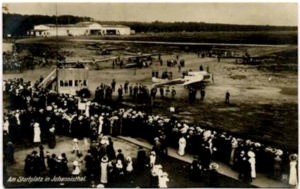
In 1910 the ‘Aeroplan’ monoplane was built by chemist Max Schuler.
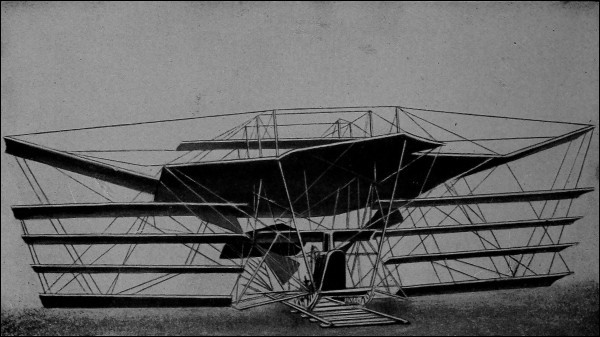
Maxim 1894 Biplane
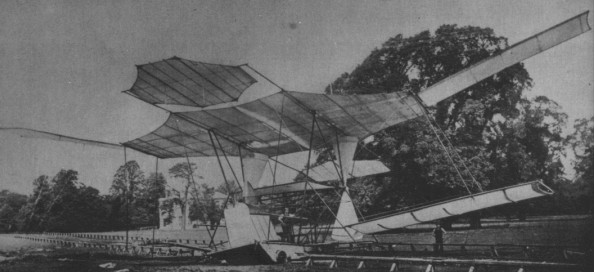
Sir Hiram Stevens Maxim (1840 1916) began building this huge aeroplane in 1891, describing it as ‘a flying machine that would lift itself from the ground’; he did not intend it to fly in the true sense. When tested in 1894, it ran along a railway track until, at a speed slightly above 42 mph (68 km/h), the wheels lifted clear of the track, fouled the guard rails placed to prevent a complete take off, and the machine had to be brought to a halt. Maxim did not pursue its development further.
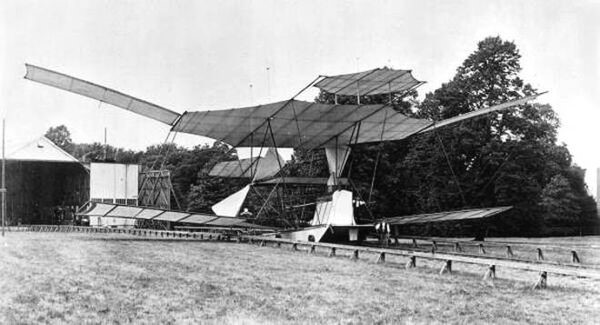
Powered: Two 180 hp Maxim steam engines
Props: 2 x 17 ft 10 in (5.44 m) diameter two blade pusher
Wing span: 104 ft 0 in (31.70 m)
Wing/elevator area (total): 4,000 sq ft (371.6 sq.m)
Length: approx 95 ft 0 in (28.96 m)
Gross weight: 8,000 lb (3,629 kg)
Accommodation: Crew of 4
Max Holste M.H.1521 Broussard
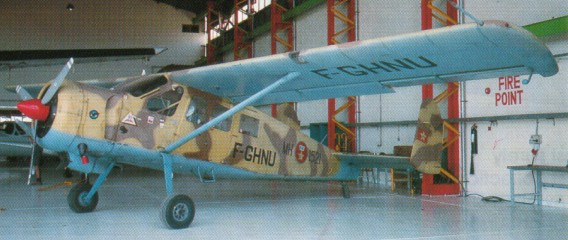
First flown on November 17, 1952, and originally intended as a liaison and ambulance plane, the Broussard saw service in the French attempt to suppress the rebellion in Algeria.
Max Holste M.H.1521 Broussard Article

The French Holste M.H.1521M Broussard (Bushman) was primarily used by all the French armed services. Two hundred and thirty were built from 1953 until 1961, with many eventually serving with the air wings of former French colonies. It carried five passengers, two stretchers, or about a tonne of cargo at its military overload weight of 2,714 kg. Powered by the 450-bhp Pratt & Whitney R985, its economical cruise speed was 120 knots.
Argentina purchased ten.
Max Holste M.H.250
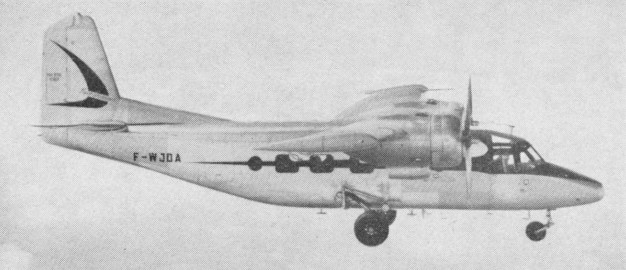
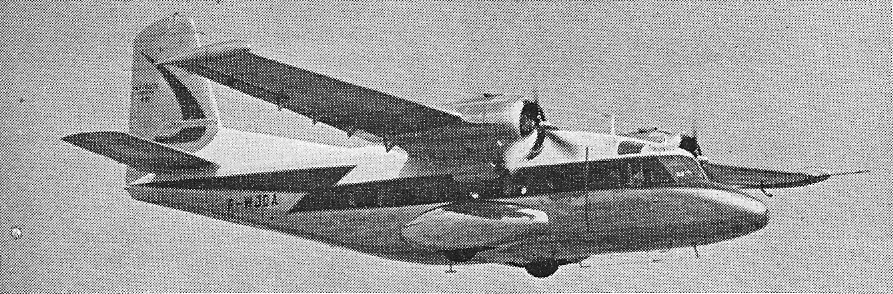
A 17-seat light commuter airliner, known as the M.H.250 Super Broussard started in 1957. The prototype of the MH250, powered by two Pratt & Whitney Wasp-1830 piston engines, flew first on 20 May 1959. It was soon realised that turboprops should be employed and further development resulted in the MH260 (Nord 260) with enlarged fuselage and powered by Turboméca Bastan turboprops.
Max Holste M.H.152

In 1959 a Max Holse M.H.152 aerial observation monoplane was modified to take a 4450 hp Turbomeca Astazou turbo-prop. The modification, undertaken by SFERMA, first flew on 23 April 1959 and served as a prototype for the M.H.1521 Broussard.
Max Holste M.H.53 Cadet
The MH.53 Cadet was a trainer variant of the M.H.52, characterised by a twin-fin tail.
Max Holste M.H.52
A two-seat lightweight sporting aircraft with tricycle landing gear.

