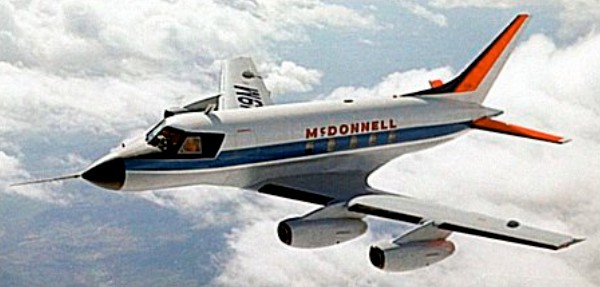
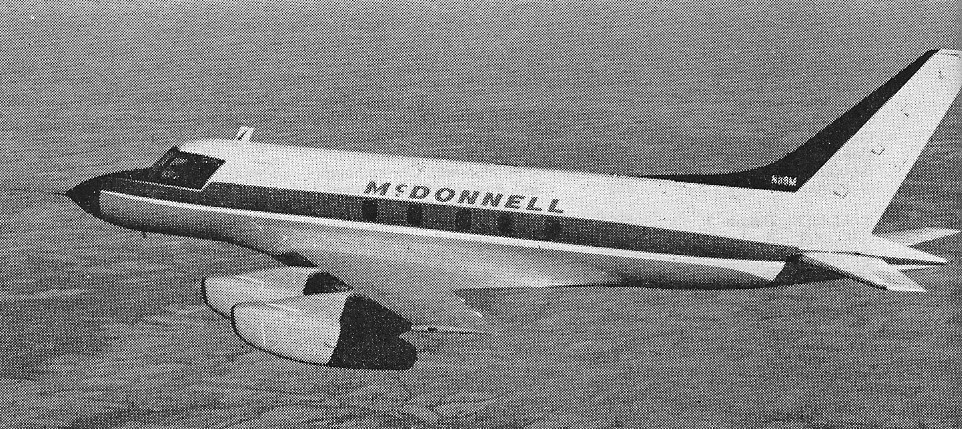
In the early 1960s Lockheed, McDonnell and North American were each vying for a military utility aircraft con¬tract and built commercial derivatives of their Air Force offerings to enter into the bizjet market.
First flown on 11 February 1959, the prototype was powered by 3250 lb Westinghouse J34 turbojets. They were to be replaced by newer 2900 lb Pratt & Whitney J60s.
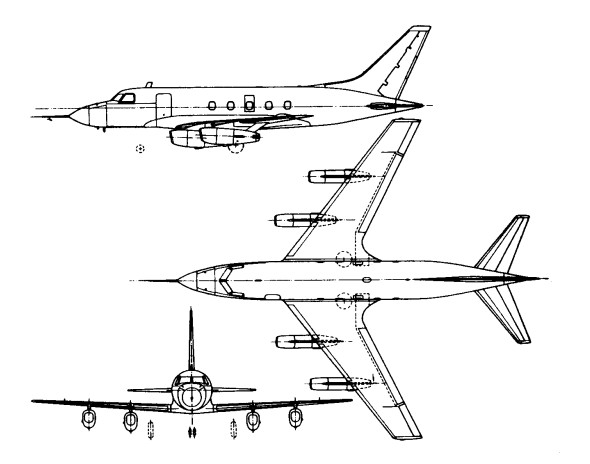
The four engine McDonnell Model 220 only saw service as a one of a kind corporate barge for McDonnell executives.
The Model 119/220 was the first business, non-airline-type jet aircraft to receive an FAA Class I provisional type certificate as airworthy in the transport category.
Max take-off weight: 20560 kg / 45327 lb Empty weight: 10529 kg / 23213 lb Wingspan: 17.55 m / 57 ft 7 in Length: 20.27 m / 66 ft 6 in Height: 7.21 m / 23 ft 8 in Wing area: 51.10 sq.m / 550.04 sq ft Max. speed: 901 km/h / 560 mph Cruise speed: 837 km/h / 520 mph Ceiling: 13685 m / 44900 ft Range: 3765 km / 2340 miles
The low wings are swept back at 45 degrees, swept-back tail surfaces and 23 degrees anhedral on the one-piece all-moving tailplane. The wings have a ‘dog-tooth’ leading edge and dihedral on the outer panels which fold upwards for stowage. The ailerons move only down and are supplemented by spoilers on the upper surface of each wing. Trailing-edge flaps and small leading-edge flaps are blown. The tricycle undercarriage has a single wheel on each main unit and twin wheels on the nose unit. The mains retract inward into the wings and the nose wheels retract rearwards. A fire-control radar is in the nose, with infra-red equipment in a small bulge underneath.
The first flight for the F4H-1 Phantom prototype came on 27 May 1958. This aircraft differed from the 1955 mock-up mainly in the flying surfaces and around the jet intakes.
To protect against suspected lateral instability, the outer panels of the wings were canted upwards and the anhedral already planned for the tailplanes was increased. The jet intakes were enlarged and the edges cut back from the top to bottom.
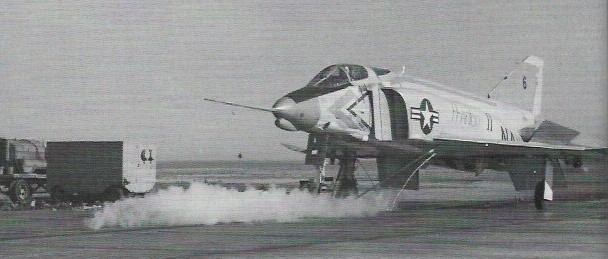
The sixth Phantom protype (BuNo 143391) was used for initial catapult launching testing.
sixth Phantom prototype (BuNo 143391) Feb 1960
By February 1960 a second missile had been added with an IR sensor, and an AAA-4 seeker was fitted under the radome of the F4H-1’s 24in antenna APQ-50 search radar.
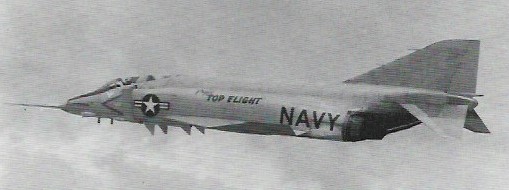
In late 1959, after it had been relieved of primary test responsibilities by the four remaining RTD&E airframes, the first Phantom far assigned to Project ‘Top Flight’, for a manned aircraft altitude record. On 6 December 1959 it reached 98,557 ft, breaking the previous Russian record by more than 4000ft.
Operation Top Flight
Powered by two 7711kg afterburning thrust General Electric J79-GE-8 engines. The first Phantom attained a speed record of 2585km/h on 22 November 1961, and a low-altitude speed record of 1452km/h on 20 August 1962.
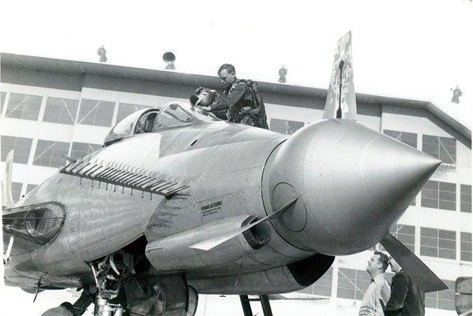
During the testing of early Phantoms, some problems had been encountered with the original design of the intake, and in an attempt to improve airflow at all speeds a number of different configurations were tried. Here the splitter plate has been enlarged and the rake in the leading edge eliminated.
Of the 47 F4H-1/F-4As, 27 were assigned to test duties, the remainder going to training squadrons.
Eleventh Phantom BuNo 145310 with another variation in splitter plate and intake leading-edge design, and extended cooling intake behind radome which replaced NACA-style flush inlet of earlier prototypes.
The first squadron to receive F4H-1s was the ‘Grim Reapers’ of VF-101. The eleventh prototype was re-assigned from RTD&E to Det A of VF-101 in 1961.
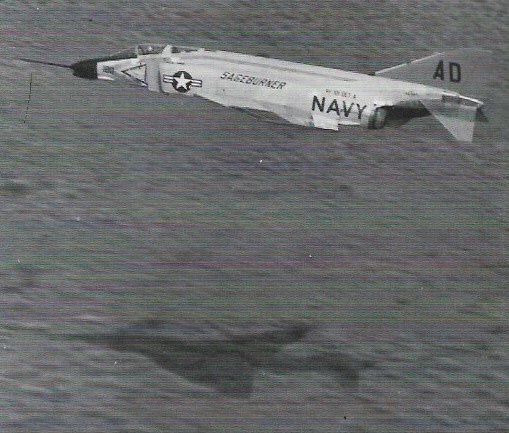
Aircraft 145310 in August 1951 was in Operation Sageburner, a high-speed, low altitude, cross-country test run from San Diego, California, to NAS Oceana, Virginia.
Operation Sageburner
Aircraft 145310 was again on test duties in June 1963, by now designated F-4A.
Aircraft 145310 June 1963
The F-4B differed from the -A with a larger radar, the 32in-diameter APQ-72 introduced on a few F-4As, became standard, along with the requisite larger radome; the back seat was raised; and the entire canopy redesign was altered to give better forward vision for both crewmen. F-4Bs were also fitted with uprated engines, J79-GE-8s, in place of the -A’s -2s.
F-4B BuNo 149449
F-4B BuNo 149449 was assigned Project ‘High Jump’ to break the world’s time-to-climb records. During April 1962 new records were set at all eight recognised height increments between 3000 and 30,000m, reaching 30,000m in 371.43 seconds.
Production of the F 4B amounted to 649 aircraft. A large number of the F 4Bs have since been updated to F 4N standard
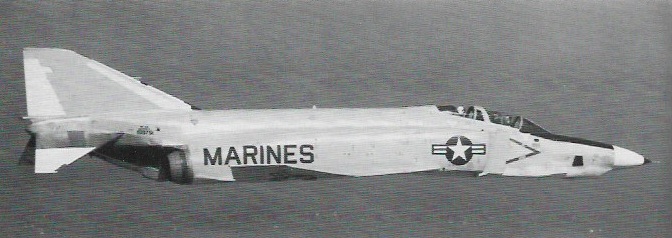
The RF-4B reconnaissance derivative served only with the US Marine Corps. The RF-4B was the second photo reconnaissance version of the Phantom, being a standard F-4B fitted with the nose developed for the Air Force F-4C. The first was RF-4B BuNo 151975t.
RF-4B BuNo 151975t March 1965
Photo Phantoms exchanged the large APQ-72 for a smaller APQ-99 radar.
The USAF reached an agreement with the Navy to take 27 more F-4Bs off the assembly line, all to be re-designated F-4C. A series of changes to the basic F-4B were implemented to make the Phantom more suitable for land-based service. These included larger, low-pressure mainwheel tyres (necessitating the thickening of the wing root) and the fitting of full dual controls and cartridge starters. The Navy retractable refuelling probe was replaced by a receptacle behind the cockpit.
The fourth F-4C 63-7410 on 27 Jan 64
The F-4C (F-110A) Phantom was the initial version for the USAF. The USAF’s Phantom II program was first designated F-110A Spectre but this name was later dropped and the USAF’s Phantom II was designated F-4C. The USAF F-4C made its first flight on May 27, 1963, and production deliveries began in November 1963 and the F-4C became operational with the 12th and 15th Tactical Fighter Wings at MacDill AFB, Florida, in January 1964. The F 4C was powered by J79 GE 15 engines.
Although very similar to the US Navy’s F-4B, it included some slight differences to make the aircraft suitable for air force use. Some of the items are: 1. The probe-and-drogue method of in-flight refuelling favoured by the US Navy was discarded in favour of the standard USAF boom’ method. 2. Full flying controls and instrumentation were duplicated in the rear cockpit. 3. In order to allow use from un-sophisticated airfields an anti-skid braking system was fitted, which included the use of thicker main-wheels. 4. The USAF version could carry a greater variety of external wea¬ponry.
The aircraft has flown a lot of combat mission in South-East Asia during the Vietnam War and has claimed 277 air-to-air combat victories.
During the Vietnam War in 1967 production was 72 Phantom IIs a month. 583 F 4Cs were built. 40 were transferred to Spain.
The service-test YRF-4C (YRF-110A) led to the RF-4C (RF-110A), 499 of which were constructed for the photo-reconnaissance role. Consideration was given to the possibility of developing a reconnaissance configured variant of the McDonnell Douglas F-4 Phantom at an early stage in the type’s operational career, but it was not until the US Air Force selected, the basic fighter model to equip Tactical Air Command units that this proposal began to move ahead rapidly. Known by the designation RF-4C, the resulting aircraft flew in prototype form for the first time on 8 August 1963, the last of which was formally handed over to the USAF over 10 years later, on 16 January 1974.
Easily recognised by the modified nose section which contains cameras and other reconnaissance sensors, the RF-4C entered operational service at Shaw AFB, South Carolina, in September 1964, although nearly a year passed before the first unit could be considered as combat ready. When that milestone was reached, overseas deployment followed quickly, aircraft being dispatched to South East Asia for combat duty by the end of 1965, and the RF-4C remaining in use as the principal tactical reconnaissance tool for the remainder of the Vietnam War.
The second reconnaissance model to appear, designated RF-4B, was intended specifically for service with the US Marine Corps and this made its maiden flight on 12 March 1965 with deliveries to El Toro, California, following just two months later. A total of 46 RF-4Bs was supplied to this service, and were the subject of modification and life-extension programmes.
By the mid-1960s, the Phantom was just about the best-known fighter in the world. On 2 January 1967 in Operation ‘Bolo’, F-4Cs of the 8th TFW under Colonel Robin Olds shot down seven North Vietnamese MiGs. Increasingly, F-4Ds took over from the Republic F-105 the job of bringing ordnance to bear on Vietnamese ground targets.
F-4 Phantom IIs in Israeli service are claimed to have shot down 116 aircraft during a number of conflicts.
Some F 4Cs were converted into EF 4Cs under the ‘Wild Weasel’ programme to suppress enemy weapon radar systems.
The F-4D differed from the -4C externally only in having a slightly larger nose cross-section, in order to house the new APQ-109 radar with its improved air-to-ground capability. A new weapons release computer and 30kVA generator occupied the forward fuselage fuel cell, reducing fuel capacity and range.
The F-4D Phantom fighter-bomber introduced a capability to deliver precision-guided munitions (PGM), or ‘smart’ bombs. Some 825 were built, including 32 delivered new to Iran and 36 transferred to South Korea.
On 28 March 1974, the Royal Hellenic Air Force received the first of 38 F-4 Phantom IIs ordered.
Once in action in Vietnam in 1965, the Phantom seemed to need a gun to augment its missile armament in close-quarter battles with MiGs. The SUU-16/A 20mm external gun pod was an interim measure. The F-4E, first flown on 7 August 1965, introduced the 17,900 lb thrust (with afterburning) General Electric J79-GE-17 engines but its principal change was the internally-mounted M61A1 20mm cannon. The F-4E established a 2.5-to-1 kill advantage over North Vietnamese MiG-17, MiG-19 and MiG-21 fighters. Armament is one 20 mm M61A 1 multi barrel cannon and eight air to air missiles or up to 16,000 lb (7,250 kg) of ground attack weapons.
The F-4E became the definitive Phantom, and 1,397 rolled off the line. Examples were supplied to Australia (on loan), Greece, Iran, Israel, Turkey, South Korea and West Germany. The RF-4E was an export reconnaissance derivative, supplied to Greece, Iran, Israel, Japan and West Germany.
As well as producing reconnaissance Phantoms for the home market, McDonnell Douglas also developed the RF-4E variant, initially in response to a Luftwaffe requirement for 88 aircraft to undertake this mission. Flown for the first time on 15 September 1970, the RF-4E subsequently also joined the air arms of Greece, Iran, Israel, Japan and Turkey, just over 160 aircraft of this type being built before production ceased.
The RF 4E reconnaissance version and the F 4M RAF version carrys the service designation FGR.Mk 2.
The F-4F was a specialised air superiority version for the West German Luftwaffe, and 175 were delivered. The F-4G designation had been used initially for 12 aircraft taken from the US Navy F-4B production line. They had the two-way ASW-21 data-link system for automated carrier landings, and all later reverted to F-4B standard. In the 1970s, the F-4G appellation was used again for the US Air Force’s ‘Advanced Wild Weasel’ electronic warfare aircraft, 116 of which were converted from F-4E standard. Originally seen as a counter to enemy SAM missile sites and associated radars, the F-4G now carries out a wide portfolio of electronic missions. Aircraft are stationed as far afield as the 3rd TFW Clark Field, Philippines, and 52nd TFW, Spangdahlem AB, West Germany.
The F-4J was an improved production fighter for the US Navy with 8119kg afterburning thrust J79-GE-10 engines, enlarged wing and improved avionics.
On the 1st of November 1968, Japan signed a letter of agreement with Mc Donnell Douglas and it was also announced that it would become one of the few countries worldwide that was going to license-produce this aircraft. Over the following years, the Nihon Koku Jietai (Japan Air Self-Defence Force) received a total of 154 F-4EJ and RF-4Es. The F-4EJs (the export version for Japan) were mostly similar to the F-4Es, although the Japanese aircraft had their in-flight refuelling and ground-attack capabilities removed to align with Japan’s defensive posture, the F-4EJs were delivered without the AN/AJB-7 bombing computer system.
The first two F-4EJs (JASDF serials 17-8301 and 17-8302) were built by McDonnell Douglas in St Louis and first flew on January 14, 1971. The next 11 F-4EJs (JASDF serials 27-8303/8307, 37-8307/8310, and 47-8311/8313) were built by McDonnell Douglas in kit form and were assembled in Japan by Mitsubishi Heavy Industries, Ltd. The first Japanese-assembled aircraft (27-8303) flew on May 12, 1972. Subsequently, Mitsubishi built all the rest 127 F-4EJ during the following nine years. The last example was delivered to the JASDF on May 20, 1981. This was the last F-4 ever built in the world.
Japan also acquired 14 RF-4Es built by McDonnell Douglas to serve in the reconnaissance role. These RF-4Es were delivered between November 1974 and June 1975. They were virtually identical to the USAF RF-4C, with the only differences being the deletion of certain equipment such as the radar homing and the warning suite which had not been released for export to Japan.
The F-4EJs entered service with the JASDF in August 1972 with a total of six squadrons operating the aircraft: the 301st, 302nd, 303rd, 304th, 305th and 306th squadrons. The RF-4Es equipped the 501st that had previously operated one of the less-well-known Sabre models, the RF-86F.
Mitsubishi was the prime contractor in a modernization programme for up to 110 of the JASDF’s fleet of F-4EJ Phantoms. Known as the F-4EJKai, the prototype updated aircraft flew in July 1984. Improvements include installation of a Westinghouse AN/APG-66J pulse-Doppler radar, a Kaiser/VDO headup display, a Litton LN-39 inertial navigation system, and a J/APR-4Kai radar warning receiver. The F-4EJKai will have a look-down capability, armed with AIM-9L Sidewinders and AIM-7F Sparrows, and will also be able to carry two ASM-1 anti-shipping missiles. Funding for the first eight production F-4EJKai conversions was authorised in the FY1987 budget. Aircraft not covered by the upgrade programme will be converted later to RF-4EJ reconnaissance fighter stan¬dard.
Israel Aircraft Industries has flown a prototype conversion with one PW1120 turbofan and one standard J79 turbojet. This aircraft flew in July 1986, and has since been further modified and flown with two PW1120s. Flight testing continues.
An improved version of the EF 4C has been developed as the F 4G Advanced Wild Weasel, being basically a modified F 4E equipped with special electronics and carrying air to surface missiles to detect and attack early warning and weapon radar systems. The first of 116 entered service in 1978.
During its bombing attacks on North Vietnam, the USAF proved the effectiveness of the ‘Wild Weasel’ concept; that is the use of specially-equipped aircraft flying with, or slightly in advance of the main attack and tasked with destruction or suppression of hostile radars, particularly those associated with SAM and AA gun guidance, Republic F-105G Thunderchiefs performed well in this role in the early 1970s and 35 FAC Phantoms were similarly converted in 1968-9, but when the specification for an Advanced ‘Wild Weasel’ aircraft was drawn up in 1975 the F-4E variant of the Phantom was selected as the basis for modification. Already established as one of the world’s most effective interceptor and fighter-bomber aircraft, the Phantom took to the mission with ease, becoming the McDonnell Douglas F-4G ‘Wild Weasel’ in the process. First requirement of a ‘Wild Weasel’ is to locate and classify enemy radars. This is undertaken by a McDonnell Douglas AN/APR-38 radar homing and warning system (RHAWS), the principal external features of which are a receiver and computer pod beneath the nose (replacing the Vulcan rotary cannon) and 56 antennae in a small fintip pod, on the fin sides, upper fuselage and other locations. Three cathode-ray tube displays in the rear cockpit (backed by digital readouts, aural warning system and indicator lights) provide the electronic warfare officer with a detailed picture of the tactical situation and automatically allocate attack priorities to the 15 most pressing threats in order of the danger which they represent. Weapons delivery is also aided by computer, allowing the F-4G to attack its target ‘blind’ with bombs, anti-radiation missiles and the latest AGM-65D Maverick which has infra-red TV-type guidance. There were 116 conversions to F-4G, these aircraft entering service in 1978 and including 24 based at Spangdahlem, West Germany, with the 81st RFS/52nd TFW for operations on the NATO Central Front.
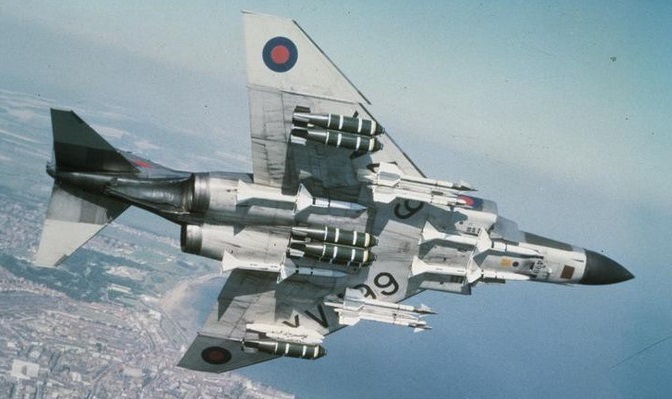
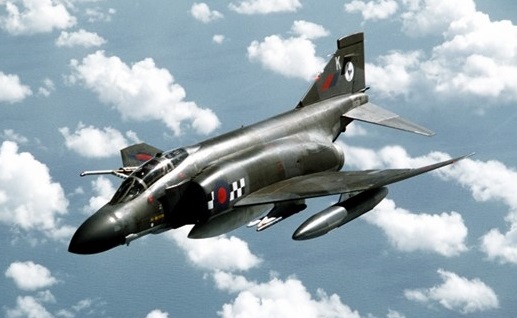
The F-4K was developed for the UK’s Royal Navy and the F-4M for the Royal Air Force, though both were operated by the RAF which, with expanded commitments following the 1982 Falklands war, has also inherited 15 ex-US Navy F-4Js.
Those supplied to the Royal Navy (F-4K) were powered by Rolls Royce Spey turbofan engines. Two versions of the Rolls Royce Spey-powered Phantom entered service with the Royal Air Force. The FG1 (the version also used by the Royal Navy) in the interceptor role and the FGR2 in the ground attack and tactical reconnaissance role in Germany. From 1977, all the Royal Air Force Phantoms were used exclusively as interceptor fighters over United Kingdom air-space.
Originally, adapting F-4B to smaller British carriers seemed to require only a change from GE J79 to RR Spey engines would be needed. By 1964, more modifications were required including drooped ailerons to slow landing speed, extended wing area and fuel capacity and others. These delayed closing the deal to reconfigure feasibility and costs.
Great Britain bought fifty two Phantom FG1s and 118 Phantom FGR2s.
With the deployment of Phantoms to the South Atlantic in 1982 an additional order for 15 Phantoms was placed. These were second hand United States Navy F-4Js fitted with General Electric F-79 engines. After an extensive refurbishment and the fitting of some British equipment they were designated F-4J(UK).
The collapse of the threat from the Eastern Europe led to an accelerated run down of the Phantom fleet and the last unit disbanded at the end of September 1992.
The German Luftwaffe was the biggest operator of the Phantom flying the F-4F ICE upgrade until the Eurofighter takes over its air defence role. Turkey and Greece were also still flying the F-4, their F-4E aircraft undergoing extensive upgrade work. Turkey was upgrading them to F-4E/2020 Terminator in cooperation with IAI. The Greek Air Force (HAF) upgrade program is known as Peace Icarus I&II and covered 40 aircraft. They also operated a number of RF-4 photo reconnaissance aircraft.
The Air National Guard was the last US operator of the F-4 until retirement in 1995/1996.
The EF-4B designation went to one airframe used for ECM training, and two modified, development airframes bore the NF-4B designation.
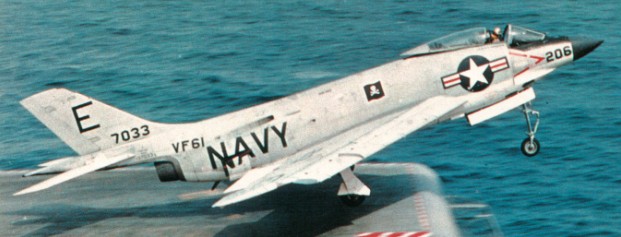
The F-4N is an upgraded ‘rebuild’ of the F-4B, and has in turn been converted to the QF-4N drone. The F-4S is an upgraded F-4J with wing manoeuvre slats and was the final Phantom variant to serve aboard an aircraft carrier, with VF-151 and -161 aboard the USS Midway.
Production ended in America after more than 5,050 had been delivered.
Operators: US Air Force, US Navy, US Marine Corps, Germany, United Kingdom, Turkey, Greece, Spain, Egypt, Iran, Israel, Australia, Japan, South Korea
By March 2000, 336 F4E and F4G airframes – most at Davis Monthan AFB, Arizona – had been identified for conversion to drones. The newer “G” and “E” models were chosen because their airframes typically have time remaining before USAF-regulated depot maintenance would be required for safe flight.
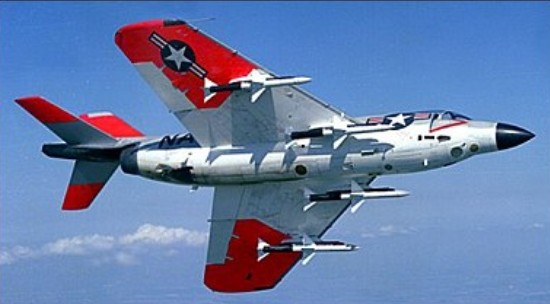
The fighters are flown to Mojave, Calif, where BAE Systems removes certain equipment and installs a drone autopilot, new computers, improved navigation systems and an onboard destruction package. Tails and wingtips are painted orange for easier visual acquisition during live-fire missions. Converting each F4 to a drone configuration costs approximately $2 million. Once QF-4s arrive it Tyndall AFB, they are classified in one of three roles: A manned flyer, flyable-storage drone, or a mission-ready drone. Some are sent to an 82nd ATRS detachment at Holloman AFB, N.M., to support Army and other aerial target requirements.
About 14 QF-4s are maintained as “manned” aircraft and flown regularly by USAF and Lockheed Martin pilots for mission rehearsals, proficiency and pilot upgrades.
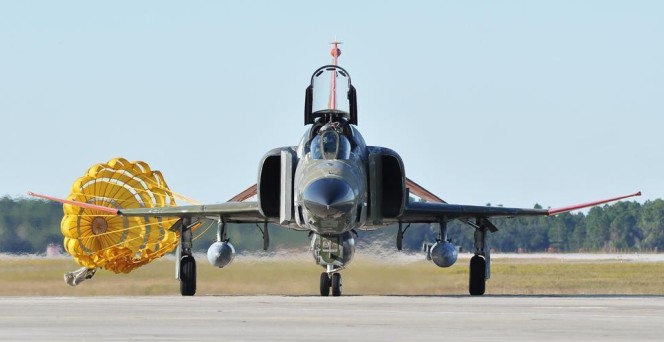
Tyndall Air Force Base, Fla. (AFNS) — The 82nd Aerial Target Squadron received the last of the “new” QF-4 aerial targets on 19 November 2013.
The QF-4, Aircraft 68-0599, spent more than 20 years in the Air Force “Boneyard” at Davis-Monthan Air Force Base, Ariz., before being brought back to life for one last mission.
The supersonic, reusable QF-4 provides a realistic full-scale target for air-to-air weapons system evaluation, development and testing. Since the QF-4 replaced the QF-106 in 1998, more than 300 found a new purpose. The Phantoms began returning to work after the 309th Aerospace Maintenance and Regeneration Group reinstalled the parts to the aircrafts making them serviceable again. The next step involved contractors BAE Systems converting the F-4 to the QF-4, which would be flown remotely by highly-trained civil service pilots with an average of 4,000 flight hours.
The teamwork of contractors, civilian and military members contributed to more than 16,000 manned and 600 unmanned QF-4 missions. Ultimately, 250 of the Phantoms succeeded in their missions and been successively destroyed over the Gulf of Mexico and the ranges near Holloman Air Force Base, NM.
There are only about 60 QF-4s remaining in the program both at Tyndall AFB and Holloman AFB by the end of 2013. The limited availability of F-4s and the continuing advancement of fighter aircraft such as the F-22 Raptors are forcing a shift to the fourth generation QF-16, a converted F-16 Fighting Falcon that should be ready for use in 2014.
Production of the Phantom at St Louis eventually totalled 5057 complete machines, the last of which was flown away on Friday 26 October 1979. Eleven further F-4Ejs were provided a knock-down kits to Mitsubishi Industries in Japan, for a total of 5068 complete airframes. Japan brought the eventual total up to 5195 when the last F-4EJ was rolled out in May 1981.
F-4B (F4H-1) Engines: 2 x General Electric J79-GE-2A, 16,150 lb Wing span: 38 ft 5 in (11.7 m) Length: 58 ft 3 in (17.76 m) Height: 16 ft 3 in (4.96 m) Max TO wt: 54,600 lb (24,765 kg) Internal fuel capacity: 3665 gal External fuel capacity: 500 gal (under fuse) / 2×300 gal underwing. Max level speed: M2+.
F-4C (F-110A) Engine : 2 x General Electric J79-GE-8 (4950/7711kp), 75645 N Length : 62.828 ft / 19.15 m Height : 16.273 ft / 4.96 m Wingspan : 38.386 ft / 11.7 m Wing area : 530.019 sq.ft. / 49.24 sq.m Max take off weight : 54606.8 lb / 24765.0 kg Weight empty : 28003.5 lb / 12700.0 kg Max. speed : 1376 kt / 2548 km/h Cruising speed : 499 kt / 925 km/h Service ceiling : 70997 ft / 21640 m Cruising altitude : 40026 ft / 12200 m Wing load : 103.12 lb/sq.ft / 503.0 kg/sq.m Maximum range : 1998 nm / 3700 km Range : 1998 nm / 3700 km Range (max. weight) : 783 nm / 1450 km Crew : 2 Armament : 4x AIM 7E Sparrow III, 4x AIM 9 Sidewinder / 16,000 lb / 7250kg ext.
F-4D
F-4E Power Plant: Two General Electric J79-GE-17A axial-flow turbojets each with a normal continuous rating of 11,110 lb St (5044 kgp), a max continuous (30-mm) rating of 11,870 lb st (5 390 kgp) and an afterburner rating of 17,900 lb st (8 127 kgp) Fuel capacity, 1 225 US gal (46371) in seven bladder tanks in fuselage, 630 US gal (23851) in two integral wing tanks and up to 1,340 US gal (50721) in three drop tanks; max possible capacity, 3,333 US gal (12615 lt) Max speed, Mach= 2.17, 1,245 kts (2304km/h) at 36,000 ft (10 973 m) Max rate of climb (clean), 49,800 ft/mm (253 m/sec) Service ceiling (clean), 58,750 ft (17 907 m) Ferry range, 1,401 naut mls (2593 km) Range w/max.payload: 700 km / 435 miles Empty weight, 30,328 lb (13770 kg) Basic weight, 31,853 lb (14461 kg) Design weight (for 8.5g subsonic, 6.5g supersonic), 37,500 lb (17 025 kg) Design take-off weight (7.75g subsonic, 5.93g supersonic), 58,000 lb (26 332 kg) Max take-off weight, (5.17g subsonic, 3.95g supersonic), 61,795 lb (28 055 kg). Max. payload : 31476.4 lb / 14275.0 kg Span, 38 ft 4 in (11,68 m) Span folded, 27 ft 6 in (8,38 m) Length, 63 ft 0 in (19,20 m) Height, 16 ft 5 in (5,00 m) Undercarriage track, 17 ft 9 in (5,41 m) Wing area, 530 sq ft (49,24 sq.m) Aspect ratio, 2.82:1 Dihedral, zero on centre wing, 12 deg on outer panels Sweepback, 45 deg at quarter chord. Landing speed : 148 kt / 275 km/h Cruising speed : 504 kt / 934 km/h Initial climb rate: 29921.26 ft/min / 152.00 m/s Wing load : 114.6 lb/sq.ft / 559.0 kg/sq.m Crew : 2 Hardpoints: 9 Armament: One General Electric M61A1 multi-barrel 20-mm cannon under forward fuselage with 640 rounds. Provision for four AIM-7E-2 Sparrow missiles semi-recessed under fuselage. Centre line pylon up to 2,170-lb (986-kg) + up to 3,020-lb (1 371-kg) + four wing pylons / one AGM-45A Shrike or one Walleye ASM + inner pylons two AIM-4D Falcon or two AIM-9D or -9E Sidewinder AAMs.
F-4E(S)
F-4EJ Wing span: 38 ft 5 in (11.71 m) Max speed: M2.2.
F-4F Phantom II Engines: 2 x GE J79-GE-17A, 17,900 lb / 8119 kg thrust Span: 38 ft 7.5 in / 11.77 m Length: 63 ft 0 in / 19.20 m Height: 16 ft 5.5 in / 5.02 m Empty weight: 31,328 lb / 13,757 kg MTOW: 61,795 lb / 28,630 kg Wing area: 530 sq.ft / 49.24 sq.m Speed: 1433 mph / 2301 kph Ceiling: 58,750 ft / 17,905 m Range: 1424 mi / 2280 km Armament: 1 x 20mm Vulcan Bombload: 16,000 lb / 7257 kg ROC: 30,000 fpm / 9145 m/min Tactical radius: 700 mi / 1125 km Seats: 2
F-4G Wild Weasel’ Phantom Powerplant: two 8119-kg (17,900-1b) thrust General Electric J79-GE-17A afterburning turbojets. Maximum speed with external stores Mach 2 + Initial climb rate at maximum take-off weight 2003 m (6,570 ft per minute) Service ceiling 16580 m (54,400 ft) Combat radius 1145 km (712 miles). Empty weight 13757 kg (30,328 lb) Maximum take-off weight 28030 kg (61.795 lb) Span 11.77 m (38 ft 7½ in) Length 19,20 m (63 ft 0 in) Height 5.02 m (16 ft 5½ in) Wing area 49.2 sq.m (530 sq ft). Hardpoints: 7 Armament: up to 7258 kg (16, 000 lb)
F-4J
F-4J(UK)
F-4K (FG.Mk 1)
F-4M (FGR.Mk 2)
F-4N
F-4S
EF-4C
RF-4B
RF-4C Powerplant: two General Electric J79GE-15 turbojets, 7711-kg (17,000-lb) afterburning thrust. Maximum speed at low level 1464 km/h (910 mph) or Mach 1.19 Maximum speed at altitude 2414 kph (1,500 mph) or Mach 2.27 Ferry range 3700 km (2,300 miles) Empty weight 13290 kg (29,300 lb) Maximum take-off 26309 kg (58, 000 lb) Span 11, 71 m (38 ft 5 in) Length 19.20 m (63 ft 0 in) Height 5.02 m (16 ft 5 1/2 in) Wing area 49.24 sq.m (530 sq ft)
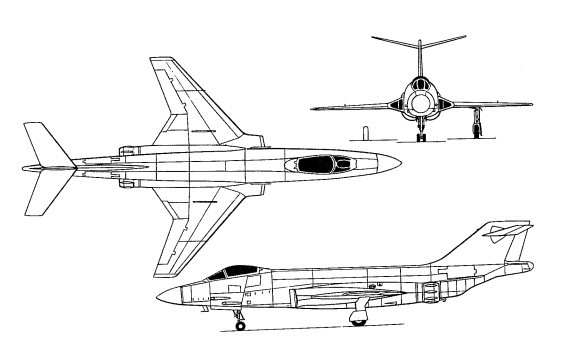
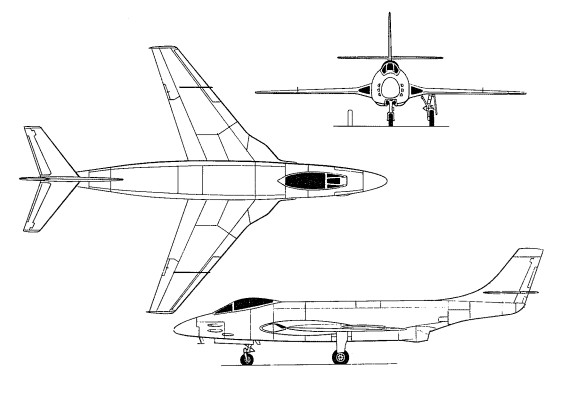
Though the 1950 penetration fighter competition among XF-88, XF-90 and YF-93A resulted in no production contract, the Strategic Air Command still wanted an escort fighter, its F-84F being seen as only an interim solution. McDonnell’s design team under Herman Barkey responded with the heaviest single-seat fighter ever built. Powered by two 5307kg Pratt & Whitney J57-P-13 turbojets, the F-101 would carry four 20mm cannon plus three Hughes GAR-ID or GAR-2A Falcon missiles or 127mm high-velocity aircraft rockets (HVAR) mounted on rotary bomb doors. A single-seater, with the two engines side-by-side, the wing has a 35 degree sweepback on the leading edge and distinctive ‘W’-shape trailing edge.
The F-101 has mid-set wings with 35 degree sweepback, and swept-back tail surfaces with a one piece all-moving tailplane mounted near the tip of the fin. Conventional ailerons, rudder and trailing edge flaps are fitted, with an airbrake on each side of the tail-boom. A tricycle undercarriage has single wheels on each main unit and twin wheels on the nose unit. The mains retract inward into the wings and the nose wheels retract forward. A fire-control radar is in the nose.
The first F-101A flew on 29 September 1954 at St Louis, and exceeded Mach 1 on its maiden flight. This was a production craft, there being no service-test machine. SAC dropped its requirement and the 77 F-101As built went to the Tactical Air Command. The first delivery was made 2 May 1957 to the 27th Tactical Fighter Wing. Seven of these airframes were later designated JF-101A while being used for temporary tests.
F-101A Voodoo
The first of two YRF-101A service-test reconnaissance Voodoos flew on 10 May 1956, followed by 35 RF-101A airframes delivered to TAC’s 363rd Tactical Reconnaissance Wing at Shaw AFB, South Carolina. The reconnaissance Voodoo had a lengthened nose with space for downward or oblique cameras and other sensors.
On 12 December 1957, Major Adrian E. Drew, USAF, established a World Air Speed Record of 1207.6 mph, in an F-101 Voodoo.
An RF-101A was shot down during the Cuban missile crisis of October 1962.
The F-101B Voodoo was developed by modifying the single seat F-101 fighter involved extending the fuselage forward to house a new weapons system and a second crewman to operate it. The bigger F-101B Voodoo was fitted with 5438kg Pratt & Whitney J-57-P-55 engines, with their characteristic large afterburners.
The first F-101B flew on 27 March 1957 at St Louis. For long-range intercept, it could carry two Douglas MB-1 Genie nuclear unguided rockets as well as three Falcons. Deliveries began on 18 March 1959 to the 60th Fighter Interceptor Squadron.
Eventually, the F-101B equipped 16 ADC squadrons, guarding against the Soviet bomber threat to North America. ANG units operated the F-101B between 1970 and 1982.
The JF-101B designation was applied to two machines used for temporary tests. One NF-101B was structurally modified for development work. Very late in their careers, with reconnaissance Voodoos still needed long after the interceptor variant was retired, 22 of the two-seat airframes were converted to RF-101B. The TF-101B was a version of the interceptor with full dual controls.
The F-101C single-seat tactical fighter differed from the F-101A primarily in having the capability to carry a US tactical nuclear weapon, and 47 were delivered to TAC.
The RF-101C, the first of which was flown 12 July 1957, was an improved development of the RF-101A; 166 went to TAC squadrons. The USAF began operating the RF-101C in South East Asia in 1964 and suffered its first combat loss on 21 November 1964 when an RF-101C of the 15th Tactical Reconnaissance Squadron was shot down over Laos.
Though not as much publicised as other combat types, the RF-101C remained in combat until 1970. No less than 31 airframes were lost in battle, plus another six to operational causes. In the mid-1960s, a few RF-101Cs served with the Nationalist Chinese air force, flying clandestine missions over the mainland.
Other Voodoo variants were the F-101F, the USAF designation for the CF-101F interceptor operated by Canadian forces; the RF-101G, a conversion of high-hour RF-101A airframes for reconnaissance duties with the Air National Guard; and the RF-101H, another reconnaissance conversion.
After the cancellation of the Avro Arrow in February 1959, Canada urgently needed a fast interceptor to meet the continued threat from manned Soviet bombers. By late 1959, the RCAF picked the Voodoo as the aircraft that best met Canada’s requirements. In June 1961, the RCAF agreed to purchase sixty six nearly new CF-101B Voodoos from existing USAF stocks. The deal transferred the aircraft to five front line squadrons and an OTU, to replace obsolete CF-100s.
In 1961 and 1962, 410 Cougar and 425 Alouette Squadrons of Bagotville, 409 Night Hawk Squadron of Comox, and 416 Lyns Squadron of Chatham were equipped with 66 Voodoos in total (55 CF-101B and 10 CF-101F), all built by McDonnell-Douglas.
At the beginning of the 1970’s, the aging CAF Voodoo fleet was exchanged for sixty six lower timed USAF Voodoos. These replacement aircraft were equipped with a superior missile control system. Even with the Voodoo fleet restored to its original size, serviceability began to be a problem. In 1977, the CAF launched a program to find a new fighter to replace the Voodoo and by April 1980, the search eventually narrowed down to the CF-18 Hornet.
Since the Summer of 1983 each of the four Voodoo Squadrons has been stood down. First 410 Squadron converted to the CF-18 OTU. 409 Squadron became the first operational CF-18 Sqn. 425 and 416 Squadrons received CF-18s in December 1984.
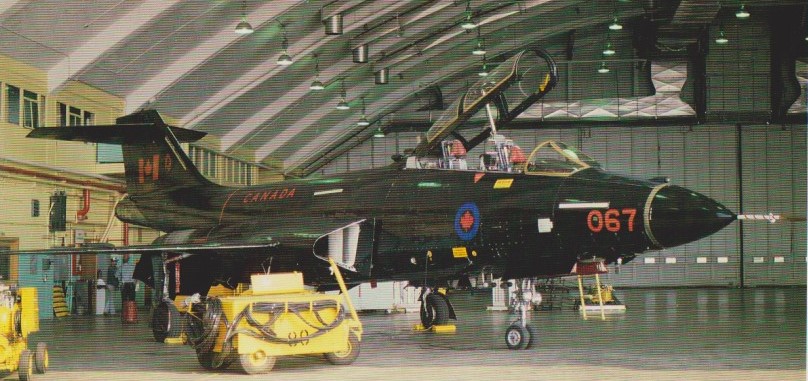
EF-101B 101067 “Electric” Voodoo
One aircraft remained in service. The CAF received Voodoo 191067 in the early 1980s and modified it to an EF-101B for ECM duties. The aircraft ws operated by 414 ‘Electronic Warfare’ Sqn and known as the “Electric” Voodoo. The EF-101B was retired by the end of 1986.
Most of the Voodoo fleet was phased-out by the end of 1984 and the last Voodoo flight anywhere was made in April 1987, when #101006 was delivered to CFB Chatham for display at CFB Cornwallis.
One F-101B appeared briefly on the US civil register, as N8234, used for thunderstorm research by Colorado State University.
Altogether 807 Voodoos were built for the USAF. The McDonnell Aircraft Co. manufactured 479 F-101B Voodoos in the United States, between 1957 and 1961.
F-101 Engines: 2 x P&W J-57-P-13, 52.0kN Max take-off weight: 18000-22250 kg / 39683 – 49053 lb Empty weight: 12700 kg / 27999 lb Wingspan: 12.1 m / 39 ft 8 in Length: 20.6 m / 67 ft 7 in Height: 5.5 m / 18 ft 1 in Wing area: 43.2 sq.m / 465.00 sq ft Max. speed: 1940 km/h / 1205 mph Cruise speed: 950 km/h / 590 mph Ceiling: 15800 m / 51850 ft Range w/max.fuel: 4800 km / 2983 miles Crew: 1 Armament: 4 x 20mm machine-guns, 15 missiles
F-101A Voodoo Long-range escort fighter Engines: 2x Pratt and Whitney J57 turbojets 10,000 lb. thrust with afterburners. Crew: 1 Wingspan: 39 ft. 8 in Length: 67 ft. 5 in Armament: 4×20 mm. cannon
F-101B Voodoo Engines: 2 x Pratt&Whitney J57-P-55, 53347 N / 16,900 lb Length: 67ft 5in / 20.54 m Height: 18.012 ft / 5.49 m Wingspan: 39ft 8in / 12.09 m Max take off weight: 46679.9 lb / 21170.0 kg Max. speed: 1060 kts / 1963 km/h / 1,134 mph at 35,000 feet Service ceiling: 52001 ft / 15850 m Max ROC: 14,000 fpm Range: 1350 nm / 2500 km Crew: 2 Armament: 3x Missile AIM-4E Super Falcon, 2x AIR-2A Genie
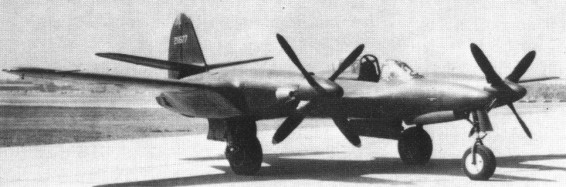
On 29 July 1941 the McDonnell Aircraft Corporation received a contract for two prototype of a long-range single-seat fighter designated XP-67. The design embodied several innovatory features, not least was an attempt to maintain true aerofoil sections throughout the entire fighter, the centre fuselage and thc rear portions of the engine nacelles merging to give the aircraft a unique appearance. The two 1,350 hp Continental XI-1430 12-cylinder inverted-vee engines were fitted with General Electric D-23 turbo-superchargers and featured exhaust thrust augmentation. The cabin was pressurised and proposed armament comprised six 37-mm M-4 cannon. The first XP-67 was flown on 6 January 1944, and flight trials continued until 6 September 1944, when the prototype suffered irreparable fire damage. This accident and the unsatisfactory nature of certain aspects of the fighter’s performance led to the decision to abandon the second prototype and terminate the development contract.
Engines: 2 x Continental XI-1430 12-cylinder inverted-vee engines with General Electric D-23 turbo-superchargers and exhaust thrust augmenta¬tion, 1,350 hp. Max speed, 405 mph (652 km/h) at 25,000 ft (7 620 m) Max climb, 2,600 ft/min (13,20 m/sec) Max range, 2,385 sm (3 838 km) Service ceiling: 11400 m / 37400 ft Empty weight. 17,745 lb (8 049 kg) Normal loaded weight, 22,11l4 lb (10 031 kg) Span, 55 ft 0in (16,76m) Length, 44 ft 9.25 in (13,65) Height, 15 ft 9 in (4,80 m) Wing area, 414 sq ft (38,46 sq.m)
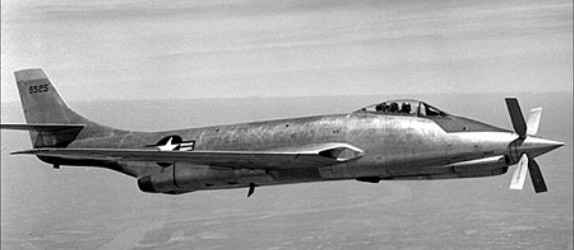
Designed to meet a requirement for a single-seat long-range escort fighter, the XF-88 was recipient of a contract for two prototypes on 14 February 1947. Powered by two 3,000 lb st (1361 kgp) Westinghouse XJ34-WE-13 turbojets, the first XF-88 was flown on 20 October 1948, but proved seriously underpowered. The second XF-88 was therefore fitted with two XJ34-WE-22 engines fitted with short afterburners which boosted thrust to 3,600 lb st (1 633 kgp), a change in designation to XF-88A accompanying this modification.
Performance was still insufficient, but the XF-88 was considered by the USAF to possess development potential and a Letter of Intent was issued covering further evolution of the basic design into what was eventually to become the F-101 Voodoo.
The first prototype was then recast as the XF-88B testbed for the Allison XT38 turboprop, with which it undertook many flights from April 1953 with 27 different propellers featuring varying numbers of blades in diameters between 4 and 10 ft (1.2 and 3.05 m). The XF-88s airframe then went forward to provide the structural and aerodynamic basis for the F-101 interceptor and reconnaissance fighter.
Engines: 2 x Westinghouse J34-WE-13 turbojets, 3000-lb (1361-kg) thrust Max speed, 641 mph (1 032 km/h) at sea level Time to 35,000 ft (10 670 m), 14.5 min Range, 1,737 mls (2 795 km) Empty weight, 12,140 lb (5 507 kg) Normal loaded weight, 18,500 lb (8 391 kg) Span, 39 ft 8 in (12,09 m) Length, 54 ft 1.5 in (16,50 m) Height, 17 ft 3 in (5,26 m) Wing area, 350 sq ft (32,52 sq.m)
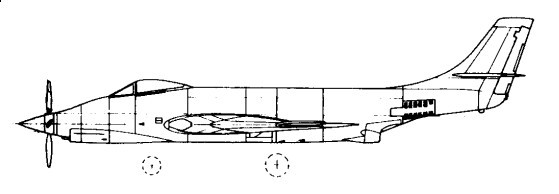
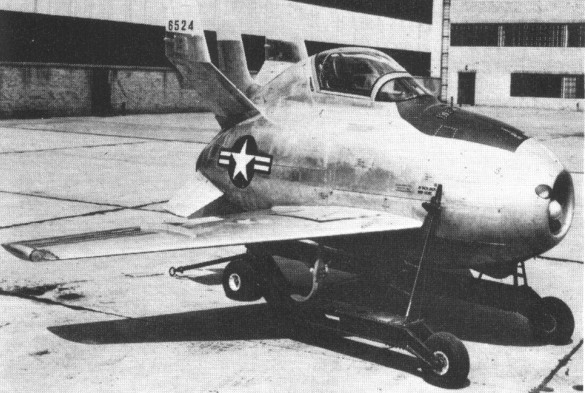
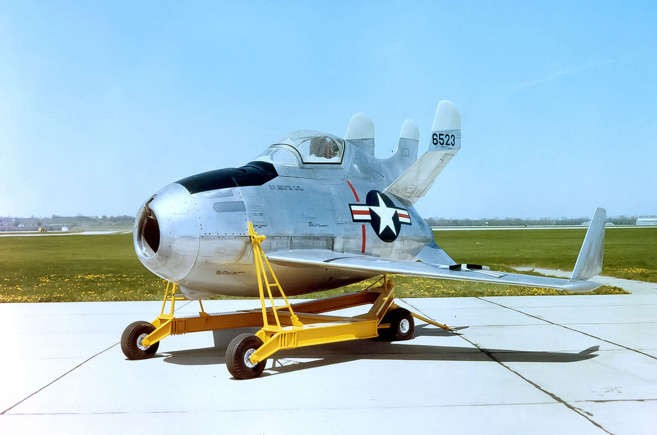
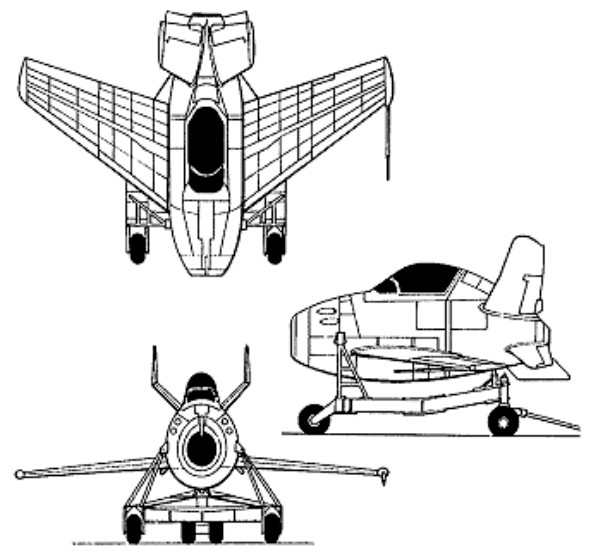
McDonnell proposed a ‘parasite’ (‘symbiote’) fighter had to be small enough to be carried aloft by a bomber and released as required. As early as 1942 McDonnell had proposed such a type as the MX-472 for semi-external carriage by the B-29, and further evolution of the concept resulted during 1945 in four variants of the Model 27 design for internal carriage by the Northrop B-35 and Convair B-36 heavy bombers. Under the spur of early ‘Cold War’ events, McDonnell reworked the Model 27 into the XF-85 Goblin. Designed under the leadership of Herman D Barkley, the XF-85 the subject of a Letter of Intent for two prototypes on 9 October 1945. The XF-85 was to be stowed in the number one or four bomb bay of the B-36 intercontinental bomber. Over target, it would be dropped free to protect the B-36 from enemy interceptors.
The fuselage was virtually filled by the 3000-lb (1361-kg) thrust Westinghouse J34-WE-7 turbojet and its fuel plus the four 0.5-in (12.7-mm) machine-guns and their ammunition, the pilot being seated astride the engine under a bubble canopy immediately aft of the hook that permitted aerial release and recovery of this tiny fighter. The wings were swept at 37 degrees and arranged to unfold from their vertically stowed position, which gave the fighter a ‘hangared’ width of only 5 ft 4.75 in (1.64 m), for an extended span of 21 ft 1.5 in (6.54 m) after being lowered from the parent aircraft. The fighter was intended to be launched from and recovered by a retractable trapeze which was to be extended beneath the parent bomber, no undercarriage being fitted.
In 1947, indoor tests were begun to evaluate the mating arrangement between the Goblin and a mock-up of a B-36 fuselage. On 9 November 1947 the first of two XF-85s was disassembled at the manufacturer’s St Louis plant and flown aboard a C-97 transport to Moffett Field, California, for wind-tunnel tests. While being positioned in the tunnel, the aircraft fell 12.2 m, was badly damaged, and had to be returned to St Louis, being replaced at Moffett by the second machine.
On 5 June 1948, this second XF-85 was transported to Muroc AFB, California, and, with no B-36 airframe available for evaluation of the parasite fighter concept, experiments began using an EB-29B Superfortress. Ed Schoch, a former US Navy F6F Hellcat pilot with four air combat kills in the Pacific war, was the only man ever to fly the XF-85.
Flight trials were initiated by the second prototype which was powered by a 3,000 lb st (1361 kgp) Westinghouse J34-WE-37 turbojet. After five captive flights on the trapeze of a specially modified Superfortress (EB-29B), the XF-85 was launched at 20,000 ft (6 095 m) on 23 August 1948, this first free flight terminating in an emergency landing. On his first attempt on 23 August 1948, Schoch was attempting to re-engage the bomber’s trapeze when he slammed into it, shattering his canopy, ripping his helmet off, and knocking him unconscious. Schoch recovered in time to make a shaky landing on the XF-85’s underside skid in the Muroc desert, damaging the plane.
The second flight on 14 October 1948, resulted in a normal mid-air drop and subsequent hook-up. Three more times, however, struggling to manoeuvre the tricky Goblin, Schoch was forced to make belly landings in the desert rather than regain his link-up with the Superfortress.
On 8 April 1949, the original XF-85 made its first and only flight. In budget-lean 1949, the XF-85 programme was quietly terminated after 2 hr 19 min of test flying, although the Strategic Air Command eventually became interested in the parasite fighter concept when it became possible to carry an RF-84K aboard a B-36. The first XF-85 is on display at the Air Force Museum in Dayton, Ohio, while the second is at the Strategic Air Command Museum in Omaha, Nebraska, displayed in inaccurate markings with a spurious tail number.
Max speed (calculated), 664 mph (1 068 km/h) Combat endurance, 30 min Empty weight, 3,740 lb (1 696 kg) Loaded weight, 4,550 lb (2 064 kg) Span, 21 ft 1½ in (6,44 m) Length, 14 ft 10.5 in (4,53 m) Height, 8 ft 3.25 in (2,56 m) Wing area, 90 sq ft (8,36 sq.m)
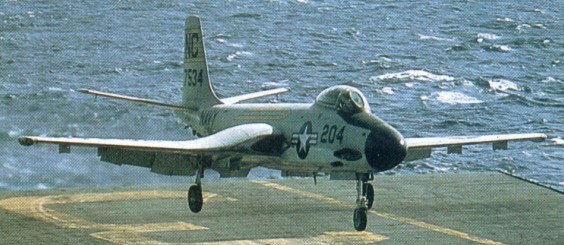
The prototype of the Demon naval fighter first flew on 7 August 1951 but proved to have poor stability, poor forward visibility and a low roll rate. These faults were corrected on the initial production model, but the poor reliability and performance of the J40 engine meant that most of the 58 built never flew.
The airframe had mid-set wings, swept-back at 45 degrees, swept-back tail surfaces and one-piece all-moving tailplane. The wings were fitted with leading edge slats and trailing edge slotted flaps. Airbrakes were in the upper surface of each wing root trailing edge and on the sides of the rear fuselage. The outer wings fold upward for storage. In-flight fuelling is fitted.
The tricycle undercarriage had a single wheel on each unit, the mains retracting inwards into the wings, and the nose wheel retracting rearward.
By June 1955 the F3H 2 had been produced with the Allison J71 engine, which still gave limited power. A modified afterburner system gave power in the range needed to make safe carrier landings.
They served with the US Navy in three versions – F3H-2N all-weather fighter, F3H-2M missile-armed day fighter, and F3H-2P for photo-reconnaissance.
The first naval fighter to be armed with guided missiles was the F3H-¬2M.
F3H-2 Demon Engine: 1 x Allison J71-A-2E turbo-jet, 62.23kN / 14,250 lb with afterburner Wingspan: 10.77 m / 35 ft 4 in Wing area: 48.22 sq.m / 519.04 sq ft Length: 17.96 m / 58 ft 11 in Height: 4.44 m / 14 ft 7 in Max take-off weight: 15377 kg / 33901 lb Empty weight: 10039 kg / 22132 lb Max speed: 730 mph at SL Max ROC: 12,800 fpm Service ceiling: 13000 m / 42650 ft Range w/max.fuel: 2205 km / 1370 miles Armament: 4 x 20mm cannons, 2722kg of weapons Crew: 1
F3H-1N Demon Carrier-based day and night fighter Engine: Westinghouse J40-WE-22 turbojet, 7,500 lb with afterburner Wingspan: 35 ft. 4 in Length: 59 ft Loaded weight: about 23,370 lb Max speed: over 750 m.p.h. Ceiling: 45,000 ft. Range: about 2,000 miles. Armament: 4×20 mm. cannon Crew: 1
F3H-2N Engine: Allison J71-A-2 turbojet, with afterburner, 9,700 lb. thrust
By the beginning of 1943 Westinghouse had made considerable progress with the engines, and the next job was to design an efficient airframe. The US Navy’s Bureau of Aeronautics decided to call on the services of the McDonnell Aircraft Corporation, the resultant joint effort to be designated XFD-1.
The designers set out to produce the smallest possible fighter that would satisfactorily carry a pilot, four 0.50-inch guns and their ammunition for a specified length of time. Weight, wing area and even engine power were treated as secondary consideration. Everything was to be kept as simple as possible with no “frills” or unnecessary gadgets to complicate production. Unorthodox ideas such as a tailless or tail-first layout (to keep the tail out of the way of the jet exhaust) or a prone position for the pilot were quickly put aside.
The McDonnell engineering team took just about a year to finalise the design of the XFD-1, although a preliminary mock-up inspection was held at St Louis at the end of May 1943. The release of drawings for structural work began on 25 January 1944 and construction of the prototype took a further year. By January, 1945, the last drawings had been finished, the last airframe parts made and assembled. On paper, the Westinghouse 19B was now promising a thrust of 1,500 lb (680 kg) in a version designated WE-19XB-2B for the prototypes of the XFD-1, but, in practice, engines reaching McDonnell were unable to produce this thrust and deliveries were lagging behind airframe availability.
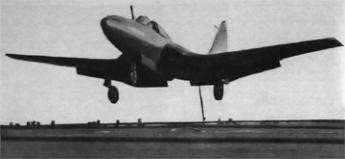
The first prototype McDonnell Phantom during deck-landing trials aboard U.S.S. Franklin D. Roosevelt.
In order to minimise the delay, taxy trials of the first XFD-1, by now named Phantom, began with only one engine installed, and ballast in the other engine bay, during January 1945. Although the 19B engine was producing only 1,325 lb at this stage, the company’s chief test pilot Woodward Burke felt confident enough to allow the aircraft to get airborne on 26 January 1945 in what has subsequently become widely re¬corded as the Phantom’s first flight. According to Kendall Perkins, though, this was only an “initial hop (rising a short way off the ground)”; the first real flight followed a few days later, after the second engine had been installed.
Satisfactory results were recorded in the first few weeks of flight testing, including a speed of 483 mph (778 km/h) at 20,000 ft (6 100 m), an initial rate of climb of 5,000 ft/min (25 m/sec) and a range of 750 mls (1 200 km). Consequently, the Navy was ready to initiate production of its first jet fighter, placing a contract for 100 FD-1s on 7 March 1945. They were to be powered by 1,600 lb st (726 kgp) Westinghouse J30-WE-20 turbojets, these being productionised WE-19s. The pro¬duction aircraft would closely resemble the prototypes, but would have increased internal fuel capacity, provision for a belly drop tank, a taller, square-tipped fin, slightly lengthened front fuselage and (on all but the first three production aircraft) dive brakes in the upper and lower surfaces of the outer wing panels.
Within a few months of production being launched, the war was over, first in Europe and then against Japan. VJ Day, on 2 September 1945, brought massive and immediate cuts in aircraft contracts in the US and that for the FD-1 was cut back to 30 aircraft, but later increased again to 60. Some considera¬tion was given to using an improved Model 19C version of the Westinghouse engine in the second batch of 30 aircraft, perhaps to have been designated FD-2s, but this did not materialise, and the entire production run was of the FD-1 configuration. After a first flight of a production FD-1 on 28 October 1946, deliveries were made from January 1947 to 29 May 1948, with the designation changing from FD-1 to FH-l halfway through the run, on 21 August 1947 (and then becoming retrospective for the Phantoms already in service).
First production aircraft designed by the company, the McDonnell FH-1 Phantom was notable in being also the first jet designed to operate from an aircraft-carrier. The US Navy placed the original letter of intent on 30 August 1943, and the first prototype made its initial flight from St Louis airport, Lambert Field, on 26 January 1945. The type was certainly not over-powered, because the final propulsion system, adopted after many studies of alterna¬tives, was two slim Westinghouse 19B engines buried in the wing roots. Later produced in small numbers as the J30, these were hardly enough for ade¬quate performance.
The first flight is thus all the more remarkable in that, at that time, Westinghouse had been able to deliver only one engine, and one of the wing-root engine bays was empty.
At that time McDonnell’s US Navy designator letter was D, the pro¬totype being the XFD-1, but because of confusion with Douglas (which also used letter D) McDonnell was assigned letter H, so that the 60 pro-duction Phantoms were designated FH-1, first flying on 28 October 1946. They were gentle and easy to fly, and on 21 July 1946 a prototype landed on and took off from USS Franklin D. Roosevelt. The production aircraft were delivered from December 1946 and served mainly with US Marine fighter squadron VMF-122. Their fault was lack of performance and lack of fire¬power, and the next-generation F2H Banshee was a vast improvement on both counts and after equipping one US Navy and two USMC squadrons, were withdrawn in 1950.
FH-1 Phantom Powerplant: two 726-kg (1,600-lb) thrust Westinghouse J30-20 turbojets Maximum speed 771 km/h (479 mph) at sea level / 813 km/h (505 mph) at high altitude Cruising speed 215 kt / 399 km/h Service ceiling 13000 m (43,000 ft) Range 1110 km (690 miles) without belly drop tank. Empty weight 3031 kg (6,683 lb) Maximum take-off weight 5459 kg(12,035 lb) Wing loading 43.67 lb/sq.ft / 213.0 kg/sq.m Wingspan 12.42 m (40 ft 9 in) Length 11.81 m (38 ft9 in) Height 4.32 rn (14 ft2 in) Wing area 25.64 sq.m (276 sq ft) Armament: four 12.7 mm (0.5-in) machine-guns in upper part of nose Crew: 1
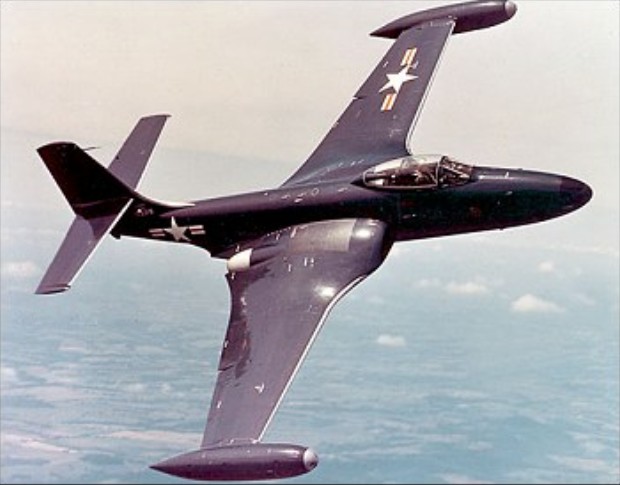
The McDonnell F2H Banshee began life even before the end of World War II when the US Navy requested an improved version of the FH-1 Phantom. Designed by a team headed by Herman D. Barkley, bearing a resemblance to the earlier type, the Banshee was of increased size, incorporating folding wings, and with a lengthened fuselage to house more fuel, and with similarly-mounted and more powerful Westinghouse turbojet engines. Conventional ailerons, elevators and rudder were fitted, and split trailing-edge flaps. Small air-brakes were in the top surface of the outer wings. A tricycle undercarriage, with a single wheel on each unit, has the mains retract outward into the wings, and the nose wheel retracts rearward. Fuel was in five tanks in the fuselage.
Three prototypes being ordered on 22 March 1945, as XF2D-1s, these later gaining the name Banshee. First flying in prototype form from St Louis, Missouri, on 11 January 1947, by then redesignated XF2H-1.
Initial trials were successfully accomplished, McDonnell being rewarded in May 1947 by a contract for 56 production F2H-l fighters, which began to enter service with VF-171 of the Atlantic Fleet during March 1949.
Like the later Phantom II, the Banshee proved to be a versatile machine, satisfactorily undertaking day and night fighter tasks, all-weather interception, close air support and photographic reconnaissance.
Following on from the original F2H-1 came the F2H-2, which had slightly more powerful engines and a longer fuselage. Production of the basic F2H-2 totalled 364, some of which were later modified to F2H-2B standard for close support tasks.
F2H-2 Banshee
14 examples of the F2H-2N specialized night-fighter derivative were also completed, these incorporating airborne interception radar in a slightly longer nose.
For reconnaissance, 89 F2H-2P aircraft were completed as new, these being unarmed and featuring six cameras in an elongated nose section.
Production then switched to the F2H-3 (in 1962 redesignated F-2C), which was optimized for all-weather fighter duties, the first of 250 entering service during April 1952 and being easily recognizable by virtue of a fusel¬age- rather than fin-mounted tailplane, and was 8 ft longer than the -2, with more than double the internal fuel capacity and APQ-41 radar in the nose (250 built).
During the summer of 1949 the first US pilot to ever use an ejection seat escaped his F2H-1 Banshee while speeding over coastal South Carolina at 500 kts.
From November 1955, 39 ex-US Navy F2H-3s were transferred to the Royal Canadian Navy. That service’s first operational jet fighters, they were operated from HMCS Bonaventure until 12 September 1962, when the last examples were retired from service. They proved to be the last carrier-based fighters in Canadian service. Plans to acquire the F2H-3P for reconnaissance were abandoned.
The final production model was the F2H-4 (F-2D), which introduced improved APG-41 radar and more powerful engines, the 150th and last bringing production of the ‘Banjo’ to a close in August 1953.
The F2H was finally phased out of front line US Navy use on 30 September 1959, but remained with reserve units until the mid-‘sixties.
Contracts were to call eventually for a total of 892 production aircraft.
XF2D-1 / XF2H-1 Engines: 2 x Westinghouse J34 turbojets Number produced: 3
F2H-1 Banshee Engines: 2 x Westinghouse J34-WE-22 turbojets, 3000 lbs.st. Length 40 ft 2 in Armament: 4 x 20 mm cannon. Number produced: 56
F2H-2 Banshee Engines: 2 x Westinghouse J34-WE-34 turbojets, 3250 lbs.st. Length 40 ft 2 in Armament: 4 x 20 mm cannon. Number produced: 364
F2H-2B Banshee Engines: 2 x Westinghouse J34-WE-22 turbojets, 3000 lbs.st. Length 40 ft 2 in Armament: 4 x 20 mm cannon, 2 x 500 lb bomb.
F2H-2N Length 40 ft 2 in Number produced: 14
F2H-2P Banshee Armament: none Number produced: 89
F2H-3 / F-2C Engines: two 14.45kN (3,250-lb) thrust Westinghouse J34-WE-34 turbojets Maximum speed 933 km/h (580 mph) at sea level Service ceiling 14874 m (48,800 ft) Max range 2374 km(1,475 miles) Maximum speed 35,000 ft / 10,668 m: 532 mph / 856 kph Empty weight 55056 kg (11,461 lb) Maximum take-off 7802 kg (17,200 lb) Wingspan 12.73 m (41 ft 9 in) Length 14.68 m (48 ft 2 in) Height 4.42 m (l4 ft 6 in) Wing area 27.31 sq.m (294 sq.ft) Armament: four 20-mm cannon, plus (Canadian aircraft only) two AIM-9 Sidewinder air-to-air missiles. Crew: 1 Number produced: 250
F2H-4 / F-2D Engines: 2 x Westinghouse J34-WE-38 turbojets, 3600 lbs.st. Wingspan: 44 ft. 11 in Length: 47 ft. 6 in Loaded weight: approx. 19,000 lb Max speed: 610 m.p.h Ceiling: 56,000 ft Typical range: 2,000 miles at over 500 mph Armament: 4 x 20 mm. cannon Crew: 1
The McDonnell Aircraft Corporation was formed on 6 July 1939 by James S. McDonnell. Built Fairchild AT-21 gunnery trainers at Memphis, Tennessee, plant and designed XP-67 experimental twin-engined fighter in 1942. Developed first U.S. Navy twin-jet fighter, FH-1 Phantom I, which was first flown January 26,1945. Enlarged version was F2H Banshee, flown January 11,1947. F3H Demon single-engined jet fighter, maiden flight August 7,1951. XF-88 jet fighter for USAF cancelled 1950 but developed later as F-101 Voodoo, flown September 29,1954. F-4 Phantom II twin-engined missile-armed attack fighter flown May 27,1958, subsequently standard USAF, USN and USMC fighter, built also for reconnaissance and antiradar roles and widely exported; 5,057 built in U.S.A. up to June 1979, and production by Mitsubishi in Japan continued until 1981.
Merged with Douglas Aircraft Corporation Inc April 28,1967 to form McDonnell Douglas. Douglas files bankruptcy and was forced to sell at a knocked down price to McDonnell of St. Louis, which had been making handsome profits out of its F-4 Phantom, supplied to the air force in Vietnam.