Zeppelin-Staaken E.4/20

Designed in 1917 by Adolf Rohrbach, the Staaken E-4 was a stressed metal monocoque fuselage canatlevered monoplane four-engined passenger aircraft with galley, w.c., baggage stowage and full communications. The most advanced aircraft of its time, the E.4/20 flew successfully in 1920. Completed after the armisitice and extensively tested by the Allies who ordered it destroyed because of its potential as a bomber – it was faster than any Allied fighter of the day. It was dismantled in 1922.

E-4/20
Engines: 4 x Maybach IVa, 190kW
Max take-off weight: 8500 kg / 18739 lb
Wingspan: 31.0 m / 102 ft 8 in
Length: 16.6 m / 54 ft 6 in
Wing area: 106.0 sq.m / 1140.97 sq ft
Max. speed: 230 km/h / 143 mph
Cruise speed: 211 km/h / 131 mph
Range w/max.fuel: 1200 km / 746 miles
Crew: 3
Passengers: 12-18

Zeppelin-Staaken E-4/20

Zeppelin-Staaken 8301

The first prototype flew in 1918. Three built.

Zeppelin 8301
Engines: 4 x Mercedes D-IVa
Max take-off weight: 12500 kg / 27558 lb
Empty weight: 9000 kg / 19842 lb
Wingspan: 42.4 m / 139 ft 1 in
Length: 21.0 m / 69 ft 11 in
Height: 6.8 m / 22 ft 4 in
Wing area: 340.5 sq.m / 3665.11 sq ft
Max. speed: 130 km/h / 81 mph
Range w/max.fuel: 1000 km / 621 miles
Crew: 5
Armament: 5 machine-guns
Bombload: 1800kg

Zeppelin-Staaken 8301

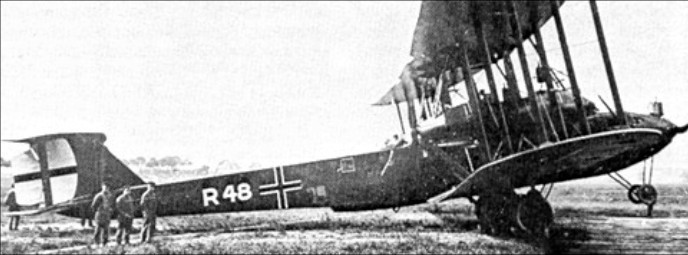
Zeppelin-Staaken R.VI / Staaken L

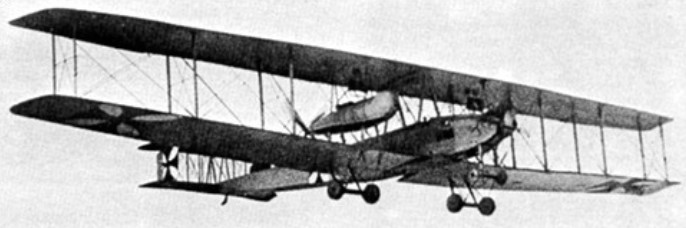
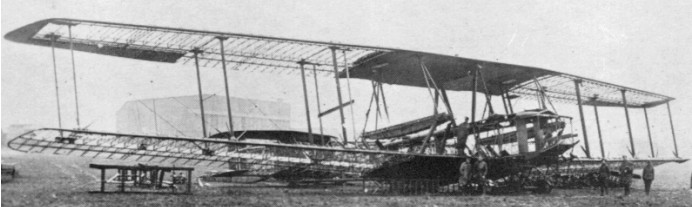
First flown in mid-1917, the Zeppelin-Staaken R VI, with 18 examples built, was to be by far the most numerous of the giant, long ranged R-planes. Powered either by four 245hp Maybach Mb IVs, or four 260hp Mercedes D IVa engines, mounted back to back in twin nacelles to drive two pusher and two tractor propellers, the R VI’s top level speed was 135km/h, while its normal range with a 1000kg bomb load was around 880km. Delivered to Rf Abt 501, by now transferred to the Western Front, the RVIs sometimes operated alongside their smaller G type bretheren in raids against the English mainland and more distant French ports and cities.
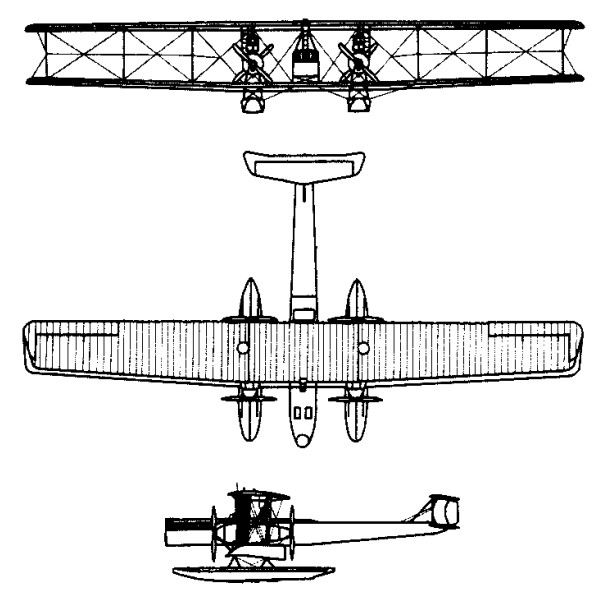
The Navy operated a sole, float-equipped example of this bomber under the designation Zeppelin-Staaken Type L, serialled 1432. It was wrecked during trials in 1918.

Zeppelin-Staaken R.VI Article

Gallery

R.VI
Engine: 4 x Maybach Mb.IV, 183kW
Max take-off weight: 11848 kg / 26121 lb
Empty weight: 7921 kg / 17463 lb
Wingspan: 42.2 m / 138 ft 5 in
Length: 22.1 m / 73 ft 6 in
Height: 6.3 m / 21 ft 8 in
Wing area: 332 sq.m / 3573.61 sq ft
Max. speed: 135 km/h / 84 mph
Ceiling: 4320 m / 14150 ft
Range: 800 km / 497 miles
Crew: 7
Armament: 4 x 7.92mm machine-guns
Bombload: 2000kg

Zeppelin-Staaken R.IV

The company’s first product, the Rs I multi-engined flying-boat, was wrecked before its first flight, but three differing examples were developed progressively, the Rs IV prototype flying in 1917.

The R.VI which was built by Automobil and Aviatik, Ostdeutsche Albatros Werke and Luftfahrzeugbau Schütte-Lanz and carried out successful raids against Allied territory, dropping bombs as large as 1,000kg.

The R.VI had four engines, 4-7 machine-guns, eighteen wheel landing gear, and the capability of carrying eighteen 220 lb bombs internally. With a maximum take-off weight of just over 11.25 tons, it was used to make attacks on both France and Britain.

R.IV
Engine: 4 x Benz Bz.IV, 164kW + 2 x Mercedes D.III, 119kW
Max take-off weight: 13035 kg / 28737 lb
Wingspan: 42.2 m / 138 ft 5 in
Max. speed: 125 kmh / 78 mph
Armament: 6-7 x 7.92mm machine-guns

Zeppelin-Staaken Rs III

The giant seaplane Rs III was a high-wing monoplane of all-metal design with fabric covering of the wing and empennage.
The intrinsically stable hull was a monocoque design made of duraluminium with traverse and longitudinal steps. The hull housed the gun station, the flight deck for two pilots, the engineer’s station and the fuel system.
The four Maybach engines were arranged in tandem in two nacelles and installed between the hull and the wing. The tail boom was mounted on the wing and had a box-type horizontal tail assembly with split elevator without compensating surfaces; the rudders and tail fins were divided into halves by the fuselage.
First flight took place on November 4, 1917. On 19 February 1918, a 7-hour non stop flight was made from Friedrichshafen to Norderney for further testing by the Seaplane Test Command Warnemonde.

Rs III
Engine: 4 x Maybach HS, 180kW
Take-off weight: 10670 kg / 23523 lb
Empty weight: 7865 kg / 17339 lb
Wingspan: 37 m / 121 ft 5 in
Length: 22.70 m / 74 ft 6 in
Height: 8.10 m / 26 ft 7 in
Wing area: 238 sq.m / 2561.81 sq ft
Max. speed: 136 km/h / 85 mph
Ceiling: 2700 m / 8850 ft
Range: 1380 km / 858 miles

Zeppelin-Staaken / Zeppelin-Lindau

Zeppelin-Werke Staaken GmbH
Zeppelin-Werke Lindau GmbH

This company was established under the patronage of Graf von Zeppelin, located formerly at Gotha, to design and construct aircraft with Claudius Dornier as chief designer, the Riesenflugzeug (giant aeroplane) “R” series bombers. The company’s first product, the Rs I multi-engined flying-boat, was wrecked before its first flight, but three differing examples were developed progressively, designated Rs II, Rs III, and Rs IV.
The Staaken design team evolved four-, five- and six-engined bombers, leading to the four-engined R.VI which was built by Automobil and Aviatik, Ostdeutsche Albatros Werke and Luftfahrzeugbau Schütte-Lanz and carried out successful raids against Allied territory, dropping bombs as large as 1,000kg. A floatplane version of the R.VI, the Staaken L, was wrecked during trials in 1918.
Other aircraft built by Zeppelin-Lindau included the C.I, C.II, D.I and VI biplanes, and Cs.I two-seat monoplane seaplane. Developed the Gs.I commercial flying-boat after the Armistice, which was broken up on the instructions of the Allied Control Commission. An advanced four-engined all-metal monoplane airliner, the E.4/20, flew successfully in 1920 but was then destroyed by order of the Allied Control Commission under the terms of the Armistice.
In 1922 the company was renamed Dornier GmbH.