
John Bevins Moisant designed and built two aircraft between August 1909 and 1910, before he became an officially licensed pilot. His first was the Moisant Biplane.
Moisant designed and built the Le Corbeau / Crow in 1910.
John Bevins Moisant designed and built two aircraft between August 1909 and 1910, before he became an officially licensed pilot. His first was the Moisant Biplane.
Moisant designed and built the Le Corbeau / Crow in 1910.

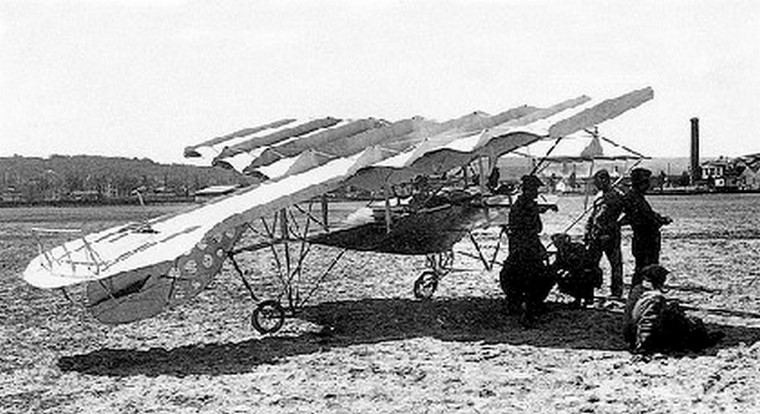
John Bevins Moisant designed and built two aircraft between August 1909 and 1910, before he became an officially licensed pilot. His first was the Moisant Biplane. This experimental aircraft became the first all-metal aircraft in the world, being constructed entirely from aluminium and steel. Also known as the “aluminio-plane”, an all-metal sesquiplane built at Issy-les-Moulineaux by American aviator John Benjamin Moisant entirely of steel and aluminium; constructed by workmen hired from the Clément-Bayard airship hangar and completed in February 1910.
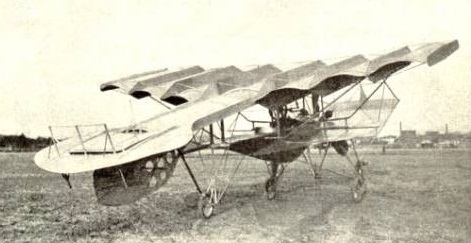
Revolutionary in the construction of its wing – patented by John Moisant (a US citizen) in France as 414,748 – described as aiming to make the machine automatically stable laterally without any form of ailerons or wing warping.
The Moisant biplane’s inaugural flight, and Moisant first flight, ultimately resulted in a crash after ascending only 90 feet.
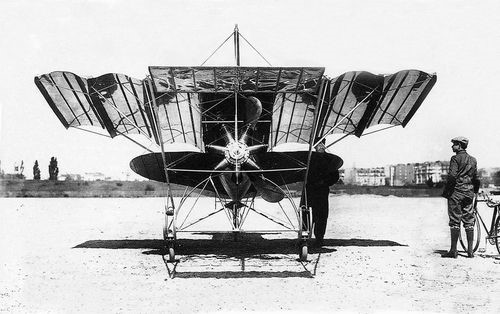
Engine: Gnôme, 50 hp
Wingspan: 5.5 m
Length: 9 m
Wing area: 22 sq.m
Weight 250 kg
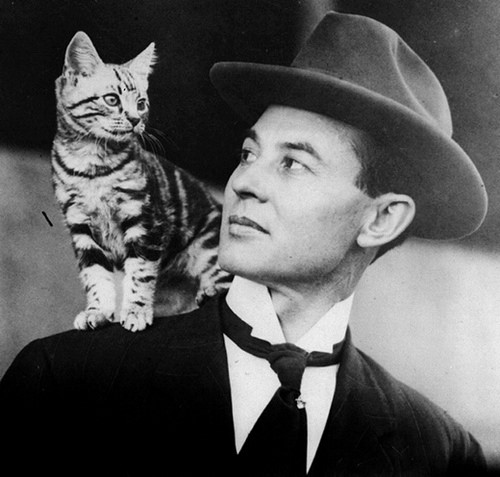
John Bevins Moisant (25 April 1868 – 31 December 1910) was an American aviator born of French/Canadian parents. As a pilot, he was the first to conduct passenger flights over a city, across the English Channel, from Paris to London.
Moisant entered the aviation field in 1909 as a hobby after attending the Grande Semaine d’Aviation de la Champagne air show in Reims, France in August 1909. In the spring of 1910, Moisant took four flying lessons at the Blériot School, headed by Louis Blériot.
Moisant funded his aviation career with proceeds from business ventures in El Salvador, where he had led two failed revolutions and coup attempts against President Figueroa in 1907 and 1909.
He designed and built two aircraft between August 1909 and 1910, before he became an officially licensed pilot. His first was the Moisant Biplane. This experimental aircraft became the first all-metal aircraft in the world, being constructed entirely from aluminium and steel. This aircraft was completed in February 1910.
The Moisant biplane’s inaugural flight, and Moisant first flight, ultimately resulted in a crash after ascending only 90 feet.
On August 9, 1910, Moisant flew his third flight as a pilot in his first recently purchased Blériot XI from Étampes to Issy-les-Moulineaux over Paris, landing the aircraft at the starting line of the Le Circuit de l’Est aerial time trial circuit. Accompanying Moisant as a passenger on the flight was his mechanic, making the trip the first passenger flight over a city in the world.
Only months after becoming a trained pilot, Moisant died after being ejected from his airplane over a field just west of New Orleans, Louisiana, where he was competing for the 1910 Michelin Cup.
Mohawk Aircraft Corporation formed at Minneapolis in 1927, developing their Spurwing two-seat monoplane with a Warner Scarab engine and similar three-seater Redskin.
Mohawk Aircraft Corporation formed at Minneapolis in 1927, developing their Spurwing two-seat monoplane with a Warner Scarab engine and similar three-seater Redskin.
Subsidiary of Allegheny Airlines Inc., Washington D.C., formed to control conversion program for Mohawk 298, UACL PT-6A-45-powered Nord 262 airliner, being undertaken by Frakes Aviation Inc. First example flew January 7,1975.
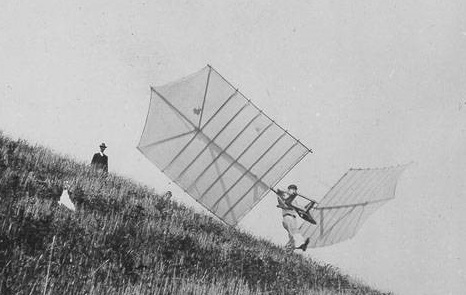
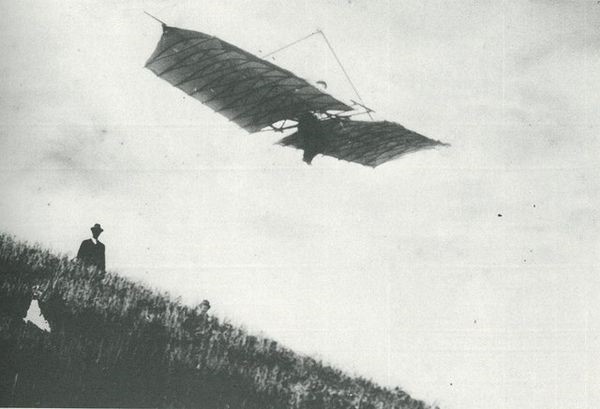
One of the gliders built by Charles Proteus Steinmetz – the “Wizard of Schenectady” – and others in 1894. While working for General Electric at Schenectady, N.Y., Steinmetz organized a band of fellow flying machine enthusiasts into the Mohawk Aerial Navigation Company, and over the summer of 1894 built and tested a man-carrying kite and two true gliders. None were particularly successful.
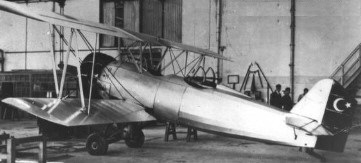
The aircraft designer Selahattin Resit Alan worked after studying in France at the Aircraft-Repair-Center, Eskisehir. Apart from his official activities at the center, he constructed, with the help of the carpenter master Mehmet and a small team, the two-seat training and reconnaissance aircraft MMV-1. The aircraft was ready for flight in October 1932. Except the fact that the aircraft was flown on 29 October 1935 for the ceremonies for the establishment of the Turkish Republic, there is no further indication it was ever flown again. Since the Ministry of Defence did not have any interest in the aircraft, Alan quit his position and began to work with Nuri Demirag in 1935.
For the Maintenance Command Development Centre, Air- Vice Marshal Harjinder Singh of the Indian Air Force designed Kanpur I four-seat light aircraft, prototype built at MCDC in 132 days.
Kanpur II with 250 hp Lycoming engine, first flown October 1961.
India
For the Maintenance Command Development Centre, Air-Vice Marshal Harjinder Singh of the Indian Air Force designed Kanpur I four-seat light aircraft, prototype built at MCDC in 132 days. Kanpur II with 250 hp Lycoming engine, first flown October 1961.

