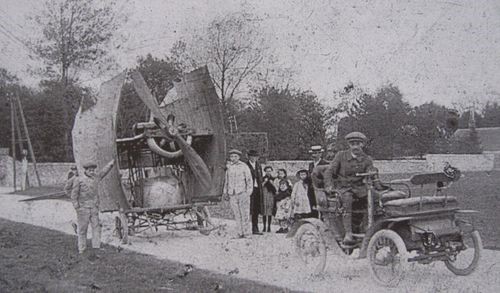
A De Dion-Bouton “Vis-à-vis” automobile towing a “Frères Moreau Aéroplane a stabilisation automatique” in 1911 at Combs-la-Ville. Different than other machines built by brothers Jules Albert & André Moreau, the No.2 was equipped with a Gnôme engine and the wings do not seem to be covered of silk, but with emaillit.
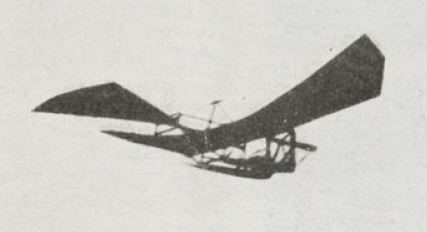
Circa 1908-1909 the Moreau brothers’ (Albert and André) built a relatively large model, with a wing area of two square metres, made flights of up to 1500 metres when tested in the Jura mountains. It was intended for verifying the Moreau brothers’ (Albert and André) theories about control systems, which were later put to practice in their “Aérostable” machines of 1912-1914.
The machine had automatic pitch control by the weight of the pilot and his nacelle, which were pendulum suspended and operated the elevators via levers and rods.
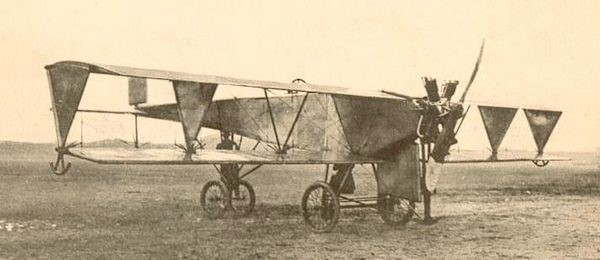
Designed by capitaine Morel de l’infanterie coloniale and built by Pierre Pons – who had formed the SAFA (Société Anonyme Français d’Aviation). Entered in the 1911 Grand Concours Militaire de Reims, as evidenced by the Liste officielle des concurrents du concours militaire 1er janvier 1911; named in the list as Pons (Adresse – Paris). As no further mention of the machine can be found in this concours it is likely that it was not ready in time for the competition.
The Morel (Pons) Canard was evaluated in a French official military report dated March 6, 1912, and, as quoted by Opdycke, did some flying in April 1912 at Issy-les-Moulineux. Constructed of aluminium and steel in its entirety, the design made it possible for it to be disassembled completely by loosening only nine bolts.
Constructed of aluminium and steel in its entirety, this aeroplane was designed and built by Capitaine Morel to carry two passengers in addition to its pilot, was powered with an Anzani 60 hp, 6-cylinder radial.
Engine: Anzani 60 hp Length: 7 m Span: 9 m Wing area: 23 m sq. Weight: 380 kgs
Pierre Morel was a French aviator born February 8, 1886, in Nogent, most notably active during 1912-13, and had qualified for his pilot brevet (Aero Club de France No.62) on October 19, 1910, flying a Sommer biplane.
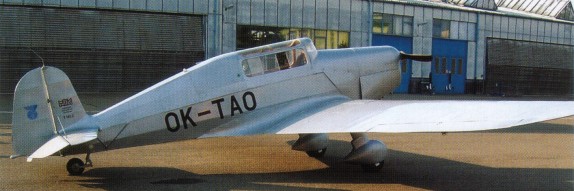
Only one Tatra T.101 was built in the late 1930s. It held various world records in its day, including a distance record of 4340 km, Prague to Al-Khartoumn.
The aircraft has 11 fuel tanks in both wings and fuselage giving around 30 hours endurance. The wing is one piece, of wooden construction.
Engine: Tatra T-100 Wingspan: 13 m Endurance: 30 hr
Czechoslovakia Founded in 1935 as part of the Ringhoff-Tatra combine. Obtained licenses to build the Avro 626 as T.126, and the Bucker Bu 131 Jungmann as the T.131. Produced also an own-design two-seat trainer under the designation T.1. Ceased production at the outbreak of Second World War.
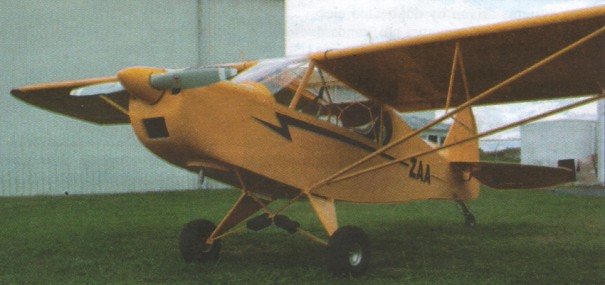
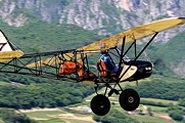
Designed in Italy by Pasquale Russo with some help from Bonaldo, Franchini and Vizzini in 1997, and manufactured in the Czech Republic by the Morava Zlin Aero, at their Otrokovice factory, is a J3 Cub lookalike. The Savage is a single-engine, high-wing, two-seater tandem microlight aircraft.
With a Rotax 912S 100 hp performance is lively. There is ample baggage space behind the front seat, the one piece door hinges up and fastens on and the aircraft can be flown with the door open. There are features such as sight glasses in the wing root to view the tank contents, an effective flap to 35 degrees, disk brakes and electric start. With a comfortable 95 kts cruise, the large balloon tyre undercarriage and fully castoring tailwheel allows for some off runway outlandings.
Available as a basic kitset through to a fully assembled option, the type is powered by the 100 hp Rotax 912S and turns a 183 cm propeller. An interesting feature of the Zlin tube framed aircraft is the option to pressurise the frame with an inert gas. Should the frame crack and the gas leak out, a drop in pressure will be detected through a gauge on the instrument panel. The two spar (foldable) wing, with flaps, is fabric covered and contains two 34 litre fuel tanks.
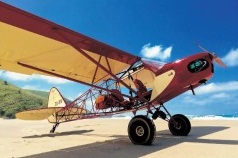
Zlin Savage Bobber
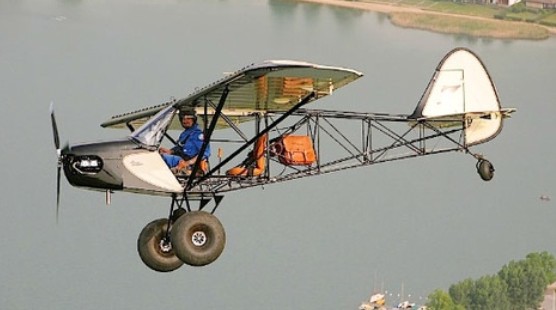
The Zlin Savage Cub fleet includes the iCub (with docked Apple iPad) and its Bobber open-frame, totally customizable variant.
Zlin Bobber
Savage Engine: Rotax 912S 100 hp Stall: 31 kt / 36 mph / 58 kmh Cruise: 92 kt / 106 mph / 170 kmh VNE: 111 kt / 127 mph / 205 kmh Empty Weight: 288 kg / 635 lbs MTOW Weight: 560 kg / 1235 lbs Climb Ratio: 800 ft/min / 4,8 m/s Take-off distance (50ft obstacle): 660 ft / 200 m Landing distance (50ft obstacle): 520 ft / 160 m
Zlinska Letecka Akciova Spolecnost formed 1934 as subsidiary of Bata Shoe Company. First aircraft produced was Zlin XII two-seat, low-wing cabin monoplane, followed by Zlin 381, a licence-built Bucker Bu 181 Bestmann. The Zlin 22 appeared in 1947 as a two-seat trainer and was produced also in three-seat Zlin 22M version. Company name changed to Moravan Narodni Podnik in 1949, then Moravan Inc, although products continued to be known as Zlins. The Zlin 26 all-wood two-seat tandem trainer was superseded by the metal Zlin 126 Trener, which went into production in 1953. The basic design was developed subsequently through Z 226, Z 326, Z 526, and Z 726 models in both Trener (two-seat) and Akrobat (single-seat competition aircraft) variants with retractable landing gear and a variety of engines. As one of the world’s foremost aerobatic aircraft, the Zlin was also widely exported outside the Eastern bloc. Production thereafter included Zlin 42 M two-seat light training and touring aircraft, Z 50 L and later Z 50 LS aerobatic aircraft (first flown 1975 in original Z 50 L version) and Z 726 trainer. An agricultural and firefighting monoplane was the Z137 T (first flown 1981). Later produced were the Z 142 two-seat basic and advanced civil/military piston-engined trainer (first flown December 1978), Z 242 variant of Z142 with a U.S. Textron Lycoming engine in place of the L0M Prague type, and Z143 L four-seat lightplane with Textron Lycoming engine (first flown April 1992).
The LG-130 Kmotr (or Z-130) was a product of Moravan Otrokovice (aka Zlin).