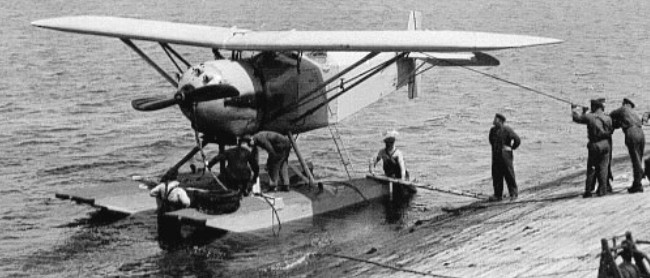
A Navy scout and fighter of 1925.
A Navy scout and fighter of 1925.
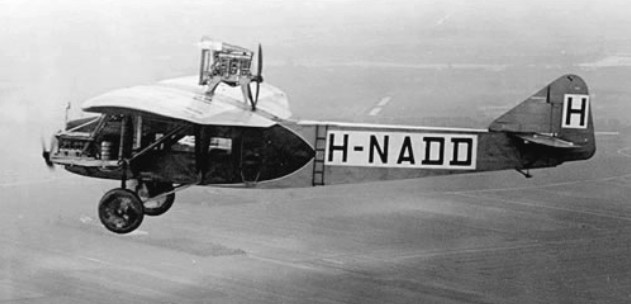
Three engine airliner for nine passengers, 1925

A civilian trainer of 1924.
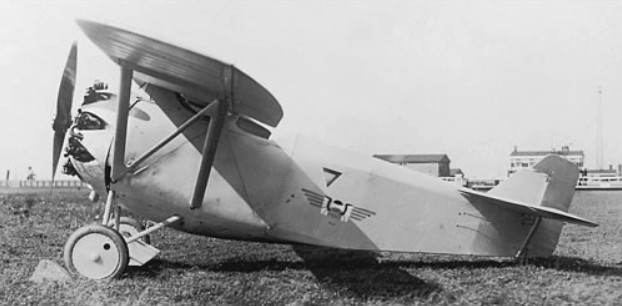
A fighter/reconnaissance aircraft, this biplane was designed by Fre¬derik Koothoven in the early 1920s for the NV (Nationale Vliegtuigindustrie, national aircraft industry), a small number being pro¬duced in 1924 25. Powered by a 400 hp Bris¬tol Jupiter radial engine, it seated a pilot and observer/gunner in tandem open cockpits, operating respectively two fixed, forward ¬firing machine guns and two ring mounted.
Reconnaissance versions sometimes carried a fifth gun, firing downward through the floor of the rear cockpit. Performance was not up to LVA (Luchtvaartafdeling, army air service) requirements, but the F.K.31 was used until about 1930 by the Netherlands East Indies army air service as a fighter trainer.
The Finnish air force operated 12 over a similar period, four of them built in Finland under licence. Louis de Monge in France also built a few, with Gnome Rhone (Bristol) Jupiter engines.
Gross weight: 1760 kg (3880 lb)
Maximum speed: 235 km/h (146 mph)
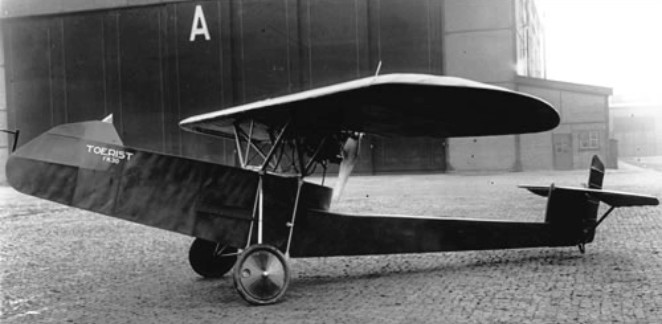
On formation of the N.V. Koolhoven, Frits Koolhoven took with him the design of the FK-30 “Toerist” light sportsplane original designed for NVI, but not built.
Several “Toerists” were built in 1927, featuring a rotating wing for transport.
Netherlands
In 1921, a group of businessmen founded the N.V. Nationale Vliegtuig Industrie (National Aircraft Industry, Inc.), and hired Frederick Koolhoven as their chief designer. The company lasted only four years. N.V.I. turned out many technically advanced designs, which attracted attention from all over the world but virtually no orders.
In 1926 he became a consultant engineer at The Hague; then designed several aircraft, including the F.K.23A, a single-seat biplane fighter; F.K.29 three-seat commercial biplane; and F.K.31 two-seat high-wing monoplane which served in the pursuit, interception, and army observation roles, and F.K.41 three seat cabin monoplane.
At the demise of N.V.I., Koolhoven convinced several shareholders that the company would still have been viable if he had had complete control of the operations. So when N.V.I. was dissolved, its assets were taken over by a new company: N.V. Koolhoven Vliegtuigen (Koolhoven aircraft, Inc).
In 1934, when the NV Koolhoven Vlietuigen was formed, it was claimed that 51 F.K. types had been produced. More followed, including the F.K.52, an outstanding two-seat fighter biplane with cantilever undercarriage, and the F.K.58 single-seat fighter monoplane, ordered in quantity by France.
Apart from the Heidevogel of 1911, Koolhoven designed 59 aircraft, which he consecutively numbered FK-1 to FK-59. About half of this were design studies that were never built. Koolhoven designed projects FK-1 to FK-28 in England for Armstrong Whitworth and BAT, projects FK-29 to FK-34 for N.V.I. and projects FK-35 to FK-59 for his own company.
National Dynamics redesigned the Reed Rooivalk single-seat aerobatic biplane as Falcon
South Africa
Formed 1975 after acquiring the prototype and all production rights of the Patchen Explorer/Observer four-seat cabin lightplane conceived originally by Thurston Aviation Corporation in the U.S.A., as a landplane development of the Teal amphibian.
Also offered Schweizer Aircraft Corporation products and the Air Nova Falcon aerobatic sailplane, and redesigned the Reed Rooivalk single-seat aerobatic biplane as Falcon.
The 1929 Air Prince two-place cabin monoplane was designed to be marketed as an inexpensive trainer a $3250. Powered by a 90hp LeBlond engine, only one prototype was built (NX43N), which was still registered in 1936.
The 1928 Air King Mono-4 four-place, high wing, cabin monoplane, was powered by a 220hp Wright J-5 and only built in prototype form (N7610 c/n 101).

