Duigan, John

John Duigan (1882-1951) was born at Terang, Victoria, Australia, and later trained as a pilot and engineer in London.

Duigan designed and built the first Australian made aeroplane. He flew it on 16 July 1910, for a distance of 9m / 28 ft. He made 26 more flights in the aircraft, which was a biplane powered by a 20 hp engine built in Melbourne, Australia.

Ebneter E-1

In July 2010, 82 year-old Arnold Ebneter of Woodinville, Washington State, flew his home-made lightweight airplane, the E-1, non-stop from Everett, Washington State, to Fredericksburg, Virginia – a journey of 2327 mi / 3746 km – in 18 hours 27 minutes,

Boom XB-1

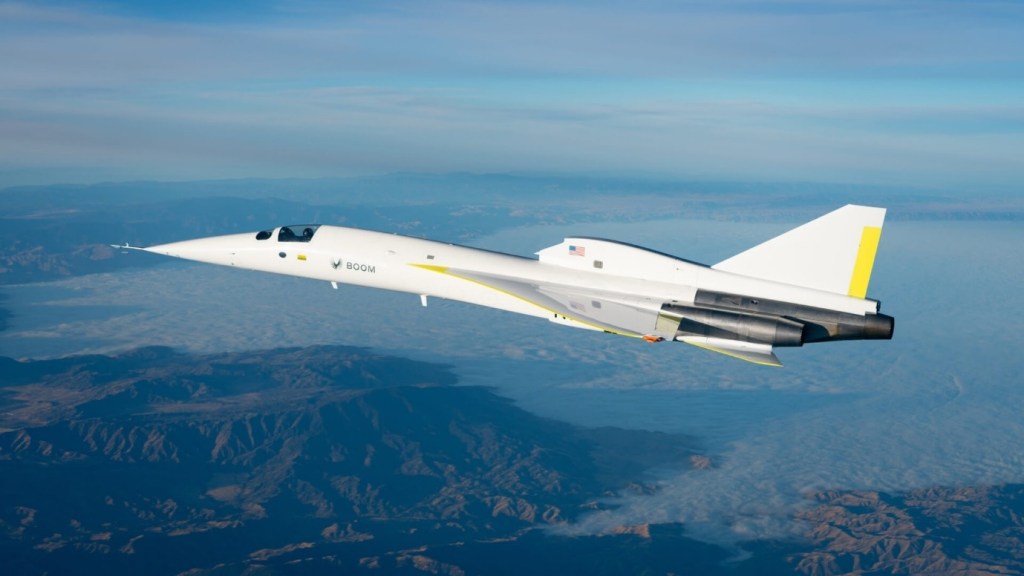
The XB-1 jet, the company’s prototype, was designed to bring back supersonic travel in a more efficient and accessible way, aiming to halve flight time from the traditional eight hours to just 3.5 hours.

After starting its tests in March 2024, the XB-1 reached a record speed of Mach 0.87 and reaching 27,716 feet of altitude during its ninth test flight.

Modifications to the vibration system made after the previous flight helped make the jet’s progress safer and more efficient.

The test pilot is Tristan Brandenburg.

After years of testing and refinement, a pilot flying the aerospace company’s XB-1 scale prototype finally broke the sound barrier during a livestream event—not once, not twice, but three times.
XB-1 took off from the runway at Mojave Air & Space Port near Barstow, California at about 11:21 AM EST. From there, Boom Supersonic’s Chief Test Pilot Tristan “Geppetto” Brandenburg ascended in the experimental plane to an altitude of 34,000 ft before turning left and beginning its supersonic test. After successfully achieving Mach 1.1 at 11:32 PM EST, Brandenburg continued XB-1 on its deceleration and descent path. At one point, however, XB-1 briefly broke the sound barrier once again.

XB-1 reached max dynamic pressure during final handling checks during its 10th test flight

“Alright, knock it off, knock it off,” someone in Boom Supersonic’s flight control room could be heard joking during the livestream.

XB-1 surpassed Mach 1 yet again a few minutes later before landing 11:54 PM EST after a total flight time of 33.49 minutes.
Tuesday’s success comes less than a year after the demonstrator aircraft’s debut flight on March 22, 2024. The XB-1 conducted another 10 flights prior to today’s Mach 1 breakthrough. Its most recent took place on January 10, when Brandenburg topped out at Mach 0.95 at an altitude of 29,481 ft (575 knots true airspeed, or roughly 661 mph).
At almost 63-feet-long, the XB-1 is about one-third the size of Overture, Boom Supersonic’s proposed commercial jet.
XB-1’s first flight was originally scheduled for 2021, but required pushbacks to address various engineering and design concerns.

Boeing 417

Boeing’s vision of a futuristic regional airliner, the model 417, emerged in the years following WWII.
Boeing took a fresh look at the travel requirements of a postwar populace and identified a need for a smaller airliner to serve regional routes. In 1946, it came up with the 417, an 18,365-pound, twin-engine aircraft designed to carry 20-24 passengers at a speed of 200 mph.

Boeing chose the 800 hp Wright Cyclone C7BA1, essentially the same powerplant as the R-1300 used by the North American T-28 Trojan trainer.

The Boeing appeared more advanced than the competing DC-5, but the performance numbers were nearly an exact match with the exception of the 417’s short-field performance, which was notably optimistic. The 417 was claimed to require only 1,200 feet to clear a 50-foot obstacle and 1,735 feet very impressive performance for its size and weight.

Proposed performance on the ground was similarly impressive, with features that were said to enable turnaround times of six minutes or less.

Boeing claimed this was achievable through the aircraft’s independence from ground equipment. The airstair door enabled boarding without the need for separate stairs, and the height of the cargo hold floor was said to match the height of truck beds, eliminating the need for ramps or hoists. In this diagram, we see the aircraft being refueled with the right engine running as cargo is loaded and passengers begin to board.

Presenting the concept to potential customers like Pan Am was one thing. Boeing also released data and artists’ renderings to the media, and it became prominently featured on magazine covers.

Boeing even ran its own ads in various publications.

Boeing did secure at least one order for the 417 when Empire Airlines ordered three of them to replace their Boeing 247s. In the September 1946 issue of Boeing Magazine, the 417 was said to provide a 57 percent greater break-even load factor than the 247D, promising greater profitability with fewer seats filled.

Just as Boeing was presenting the 417 to customers, Convair was doing the same with its 107, albeit without such a strong marketing and promotional effort.

While both concepts were forward-thinking solutions to shorter, lower-capacity routes, their roles would ultimately be filled with the glut of surplus aircraft from the war effort—namely, the DC-3, which provided similar performance for pennies on the dollar.
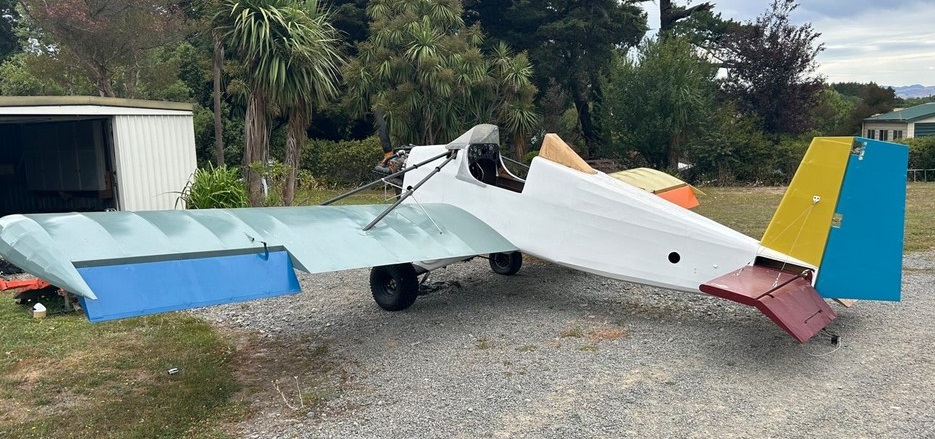
Žurovec 1912 monoplane

This monoplane was built at the home of the Žurovec brothers in the village Harty (German: Lilien) near Petrvald (Groß Peterswald) in 1912. When completed it was exhibited in the village inn of the neighbouring Albrechticky (Klein Olbersdorf).

Afterwards it was tested on the meadows between these villages, where today the airport of Ostrava (Ostrau) is located. But because of the quickly overheating 40 hp Delfosse engine only short flights with heights of no more than 40 metres could be obtained.

It was the first aircraft built and flown in Moravia (Mähren). Josef Žurovec was the driving person behind this design. He later should have joined the k.u.k. Fliegertruppe, but not much is known of him. Better known is his elder brother Vilém Žurovec, for his work with Petroczy and Kárman and the developement of the PKZ-1 and PKZ-2 helicopters.

Zuck-Whitaker Plane-Mobile

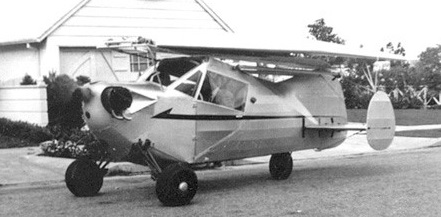
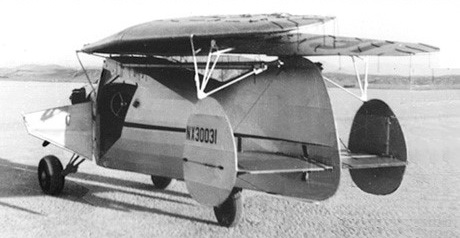
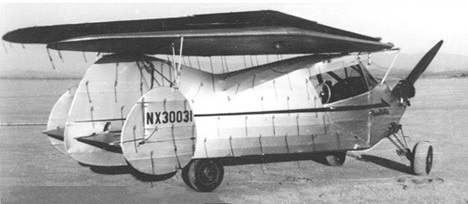
Plane-Mobile NX30031

The 1947 Plane-Mobile built by Daniel R Zuck and Stanley D Whitaker was a roadable airplane with a floating, or pivotal, wing, free to change its angle of attack according to the vagaries of the air currents. There were no rudders or elevators in the tail, instead the wings had “ailerators,” a combination of ailerons and elevators.

Registered NX30031, it reportedly suffered a severe ground loop during a test flight.

Engine: Continental A-40, 40hp
Wingspan: 31’6″
Length: 15’6″
Useful load: 375 lb
Max speed: 90 mph
Cruise speed 80 mph
Stall: 40 mph
Range: 285 mi
Seats: 2

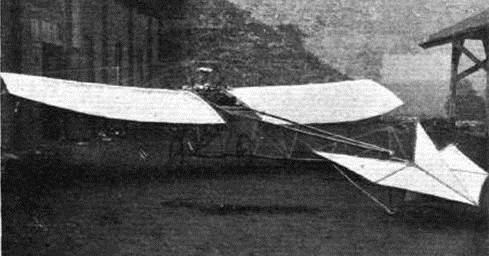
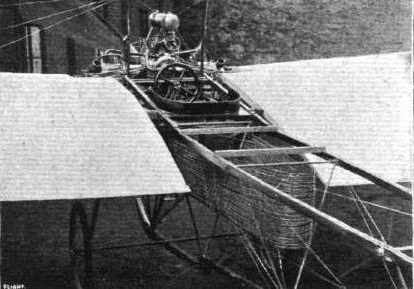
Zselyi 1910 monoplane

Reported in Flight, April 16, 1910, as a monoplane which had just been constructed at Budapest by an engineer, Aladar Zselyi. The frame is constructed of spruce and steel-tubing, braced in the ordinary way by steel wires. The two main-planes fit into sockets in the main frame at a small dihedral angle. They have a span of 20 ft. and a chord of 6 ft., while the total lifting surface of the machine is 130 sq. ft., and the elevator has an area of 21.5 sq. ft. A two-bladed Chauviere tractor-screw, 6 ft. in diameter, is driven direct by a 30-h.p. Darracq water-cooled motor,

Engine: 30-h.p. Darracq
Prop: two-blade Chauviere 6 ft diameter
Wing span: 20 ft
Wing chord: 6 ft
Wing area: 130 sq. ft
Elevator area: 21.5 sq. ft
Length: 23 ft
Empty weight: 340 lb
Loaded weight: 475 lb