1959: Navion Aircraft Co (Div of Tusco Corp) Galveston TX. USA
1965: Navion Aircraft Corp, Seguin TX. USA
Founded in 1965 by the American Navion Society to provide spares and support for owners of Ryan/North American Navion lightplanes. All rights to the aircraft were acquired and a developed version, the five-seat Navion Rangemaster H, was produced before the company was liquidated and taken over by the Navion Rangemaster Aircraft Company.
c.1970: Janox Corp Arcanum OH. USA
1972: Navion Rangemaster Aircraft Corp, Wharton TX. USA
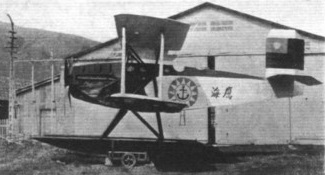
The Ding was a dual-purpose torpedo bomber and passenger seaplane. In a military configuration, the fairly standard tractor biplane had a crew of three – a pilot just under the wing, a gunner behind him, and a bombardier in a compartment in the fuselage between the pilot and engine. Two main floats were placed on either side of the fuselage, providing clearance for a single torpedo or load of conventional bombs. It was powered by the same 360hp 12-cylinder liquid cooled Rolls-Royce engine of the Beeng fighter-bomber. As a passenger aircraft, the bombardier’s cabin provided sufficient room for four people to sit comfortably. The aircraft had a loaded weight of 5,300lb, wingspan of 46ft, and length of 36ft.
As part of frantic efforts to catch up with aviation in the rest of the world, a variety of design were hastily developed. Among these was the Beeng, quite possibly the first fighter ever designed in China. The Beeng a tractor flying boat, carrying a crew of three – a pilot and two gunners. Free space in the hull could carry either extra ammunition or small bombs to be dropped by hand. As a secondary role, the aircraft could be quickly converted for use as a passenger plane. In the space where ammunition or bombs would be carried, four seats could be installed for passengers. While the design itself was domestic, China couldd not hope to develop suitable engines, so a 360hp Rolls-Royce 12-cylinder liquid cooled engine was used. The aircraft itself was 39 feet long, 16 feet tall, and had a wingspan of 56 feet. Details of its service, however, are unclear.
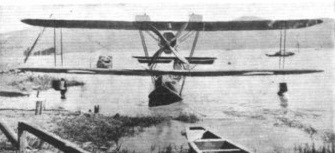
The Naval Air Establishment Chiang Hung (江鴻 – “River Swan”) was a reconnaissance seaplane developed for the Chinese Navy.
First flown in July 1931, it was a conventional biplane design with single-bay, unstaggered wings of equal span and accommodation for the pilot and observer in tandem, open cockpits. The landing gear consisted of twin pontoons. Only two were built, by the Shanghai Naval Air Establishment.
Powerplant: 1 × Wright Whirlwind, 123 kW (165 hp) Length: 8.33 m (27 ft 4 in) Wingspan: 10.87 m (35 ft 8 in) Height: 3.55 m (11 ft 8 in) Empty weight: 740 kg (1,628 lb) Gross weight: 1,180 kg (2,596 lb) Crew: Two
The Naval Air Establishment was a division of the Chinese Navy established in 1918 in Mamoi to develop seaplanes for maritime reconnaissance, training, and torpedo-bombing. It was transferred to Shanghai in 1931.
Organization: Captain Yu Tsao Barr Captain Tseng Yee King – Director General from 1931 onwards Captain Wong Tsoo Lieutenant S F Wong
Early aircraft produced by the NAE were made of timber and fabric with assistance of foreign designers. Two principal aircraft types were built: the Chiang Hung two/three-seat touring seaplane, which first flew in July 1931, and the Chiang Gae’n two-seat reconnaissance biplane or advanced military trainer.
Aircraft produced include: Chiang Hung (1930) – 2 or 3 seat touring plane and reconnaissance aircraft Chiang Hau (1932) – powered with single 165 hp Wright Whirlwind engine Chiang Gaen Nin Hai DH.6 like seaplane Beeng (1918?)- tractor biplane/float fighter bomber with single 360 hp prop engine Char1918 – 2 seat primary trainer seaplane Ding (1934) – 2 seat bombing/torpedo seaplane using a single 360hp Rolls Royce engine Wu (1918?) – general purpose observation aircraft Yee (1918?) – 2 seat advance trainer and variant of Char seaplane
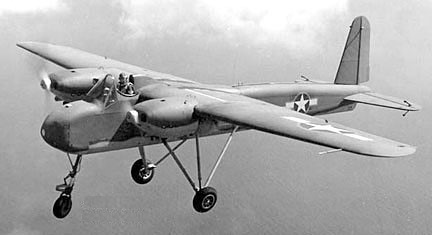
The 1943 NAF TDN was a maned or unmanned, radio-controlled, tv-directed torpedo drone. They carried ordnance loads up to a ton of bombs or torpedoes and was controlled from a “mother” aircraft in its vicinity or from ships at sea. It was able to release its weapons or be flown directly into the target.
In 1936, Lieutenant Commander Delmar S. Fahrney proposed that unpiloted, remotely controlled aircraft had potential for use by the United States Navy in combat operations. Due to the limitations of the technology of the time, development of the “assault drone” project was given a low priority, but by the early 1940s the development of the radar altimeter and television made the project more feasible, and following trials using converted manned aircraft, the first operational test of a drone against a naval target was conducted in April 1942. That same month, following trials of the Naval Aircraft Factory TDN assault drone, Interstate Aircraft received a contract from the Navy for two prototype and 100 production aircraft to a simplified and improved design, to be designated TDR-1.
Control of the TDR-1 would be conducted from either a control aircraft, usually a Grumman TBF Avenger, with the operator viewing a tv screen showing the view from a camera mounted aboard the drone along with the radar altimeter’s readout, or via a pilot on board the TDR-1 for test flights. Powered by two Lycoming O-435 engines of 220 horsepower (160 kW) each, the TDR-1 used a remarkably simple design, with a steel-tube frame constructed by the Schwinn bicycle company covered with a molded wood skin, thus making little use of strategic materials so as not to impede production of higher priority aircraft. Capable of being optionally piloted for test flights, an aerodynamic fairing was used to cover the cockpit area during operational missions. The TDR-1 was equipped with a fixed tricycle landing gear that would be jettisoned in operation after takeoff for improved performance.
In September 1942, the U.S. Navy chose DeKalb, Illinois to be the site for the manufacture of the drone TDR-1 aircraft, and built an airport on the city’s east side. This early airport consisted of an airfield and a large hangar that were fenced and guarded around the clock. DeKalb was chosen because Wurlizter, manufacturer of pianos, and known for its expertise in the production of wood products, was located there. Interstate Aircraft and Engineering Corporation (based in El Segundo, CA) assembled the planes at the new airport in DeKalb. About two hundred drones were built, tested, and boxed at the DeKalb Airport and were shipped to the South Pacific, where they were used against the enemy during World War II.
Under the code-named Operation Option, the U.S. Navy projected that up to 18 squadrons of assault drones would be formed, with 162 Grumman TBF Avenger control aircraft and 1000 assault drones being ordered. However technical difficulties in the development of the TDR-1, combined with a continued low priority given to the project, saw the contract modified with the order reduced to only around 300 aircraft. A single TDR-1 was tested by the U.S. Army Air Forces as the XBQ-4, however no production contract resulted from this testing. In 1944, under the control of the Special Air Task Force (SATFOR), the TDR-1 was deployed operationally to the South Pacific for operations against the Japanese. Additional testing was conducted by SATFOR in July, complete with a strike against a previously beached Japanese freighter, Yumasuki Maru, including management of the flight from a 7 miles (11 km) distant TBM Avenger control aircraft, which could monitor the view from the TDRs via early television technology.
SATFOR equipped a single mixed squadron, Special Task Air Group 1 (STAG-1), with TDR-1 aircraft and TBM Avenger control aircraft; the first operational mission took place on September 27, conducting bombing operations against Japanese ships. Despite this success, the assault drone program had already been canceled after the production of 189 TDR-1 aircraft, due to a combination of continued technical problems, the aircraft failing to live up to expectations, and the fact that more conventional weaponry was proving adequate for the defeat of Japan. The final mission was flown on October 27, with 50 drones having been expended on operations, 31 aircraft successfully striking their targets, without loss to the pilots of STAG-1.
Following the war, some TDR-1s were converted for operation as private sportsplanes.
Engines: two Lycoming XA-435-4 Wingspan: approx. 50’0″ Length: approx. 36’0″
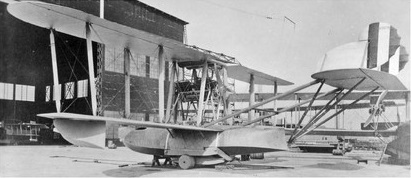
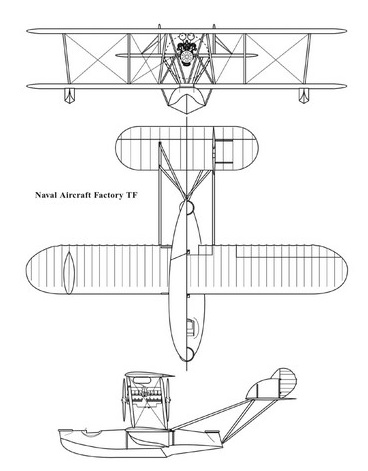
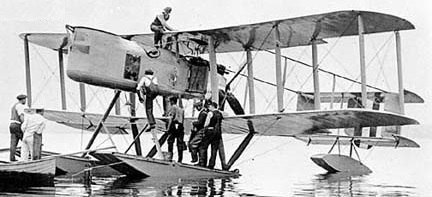
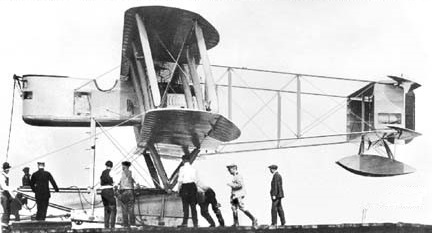
The origins of the TF (Tandem Fighter) can be traced to a 1918 requirement issued by the British Technical Committee for a long-range sea-borne fighter to escort patrol aircraft (H-16s, F-5s, etc) on maritime sorties. After the armistice, Navy officials retained sufficient interest in the idea to authorise NAF to proceed with design proposals. After reviewing various options, the Navy approved a twin-tandem engine design that incorporated a hull and tailplane arrangement nearly identical to the larger NC series and authorised construction of four prototypes. Originally, the TF was to have been powered by Curtiss-built 400 hp Kirkham engines, however mechanical problems with the Kirkham engines led to the decision to substitute the less powerful Wright-Hispanos.
Construction of the first prototype commenced in August 1919 and the first flight took place on 1 October 1920. Testing revealed poor handling characteristics plus a marked tendency of the engines to overheat at high RPM settings.
Although three more prototypes were completed and tested during 1921 and 1922, results were still rated as unsatisfactory, and the program was formally cancelled in January 1923.
The fourth prototype was reportedly completed with 400 hp Packhard I-A V-12 engines.
3 place Navy escort fighter Engine: 2 x Wright-Hispano H-3, 300 hp Prop: 4 blade wood fixed pitch Wing span upper: 60 ft 0 in Length: 44 ft 0 in Wing area: 930 sq.ft Empty weight: 5575 lb Loaded weight: 8846 lb Max speed: 95 mph Cruise: 72 mph Ceiling: 13,000 ft Range: 650 mi Armament: 2 x flexible Lewis .50in mg in bow, 1 x flexible Lewis .30in mg in rear cockpit Number built: 4
The 1918 N-1 USN gunship was a two place open cockpit, biplane flying boat. A twin-boom, triple-tail aircraft with a nacelle fuselage, a 37mm cannon was fitted in the nose.
Two were built, A4341 and 4342, and a contract for 2,284 was cancelled.