Nels J. Nelson, a 22-year-old Swedish immigrant working as an automobile mechanic in his shop on Elm Street in New Britain, began building and flying his own aircraft. On May 1, 1911, young Nelson made his first flight from the new field in Plainville, now known as Robertson Airport and the oldest in Connecticut.
That summer he flew some 40 miles to the ball field that also served as an airfield in Saybrook. Located at the end of Dudley and Coulter Streets, the area remained open fields until housing was built there in the 1940s. After arriving, he tested his biplane but it did not rise more than a few feet from the ground.
That evening a crowd of about 2,000 people gathered to see his flying machine and to watch the Saybrook and Deep River baseball game. When the time came, he took his machine to one end of the field, got good speed on the ground and, it was reported, “glided upward like a bird.”
He skillfully circled around while ascending to the magnificent height of two or three hundred feet. While circling, the engine’s radiator cap flew back and broke the wooden propeller. With the loss of thrust the aircraft came down rapidly and struck a fence as it landed. He was in the air for about five minutes.
Nelson continued to fly and build airplanes but, unable to get government contracts, ultimately lost out to other manufacturers. He died at his home in Yonkers, New York, in 1964.
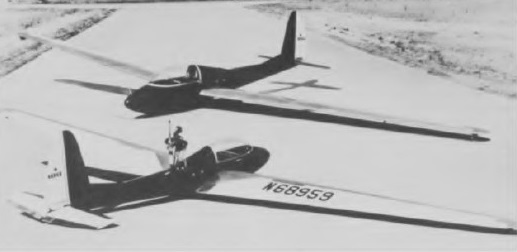
Designed by Harry Perl & Ted Nelson, Nelson developed the Hummingbird in 1953 after discontinuing the Dragonfly. It is a two-place tandem self-launching sailplane. The fixed gear is two wheels in tandem, the front one steerable with rudder pedals. It features an all-moving horizontal tail with anti-balance tab, spoilers and dive brakes, and styrofoam-filled leading edges. The original version, of which two were built, was almost all wood; later models were metal.
Built by the Nelson Aircraft Corporation of Irwin, Pennsylvania, which firm also makes the 45hp Nelson H-63CP four-cylinder horizontally-opposed two-stroke engine that powers it. This is mounted aft of the cockpit and drives a two-blade fixed-pitch pusher propeller; it retracts forward into the fuselage behind the one-piece tear drop cockpit canopy when not in use.
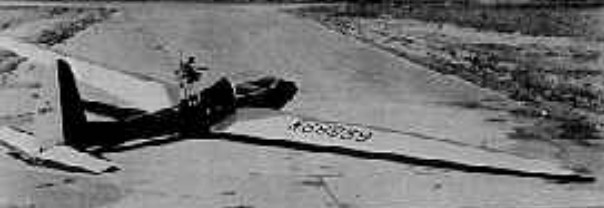
Three or four were built, including N68581, N68959. Two belong to the National Soaring Museum, and one belongs to the Smithsonian Air & Space Museum, Washington.
PG-185B Engine: 40 kW/ 40 bhp. Nelson H-59 Span: 54 ft 0 in / 16.46m Length: 22 ft 0 in Wing area: 185.0 sqft / 17.18sq.m Aspect ratio: 15.76 Airfoil: Go 549 (root), Go 676 (tip) Empty Weight: 363kg / 800lb Gross Weight: 544kg / 1200 lb Max speed: 120 mph Cruising speed: 90mph Stall: 39 mph MinSink: 25 at 89 kph / 48 kt / 55 mph L/DMax: 0.91 m/s / 3.0 fps / 1.78kt Seats: 2
William Nelsch of St Louis MO., USA, built an experiment in roadable airplanes. A single place cabin, high-wing monoplane, featuring folding wings, and caged motor for ground operation.
At the end of World War II Brazil was conducting the “National Aviation Campaign”, a program of re-equipment and incentive to air clubs and the national aeronautical industry.
The lack of gliders to replace the Brazilian fleet, then composed mostly of German aircraft of the 1930s, was of great concern. Josė Carlos de Barros Neiva then developed a project that retained the characteristics of the Grunau Baby, (which made up a large part of the Brazilian fleet), but biplace.
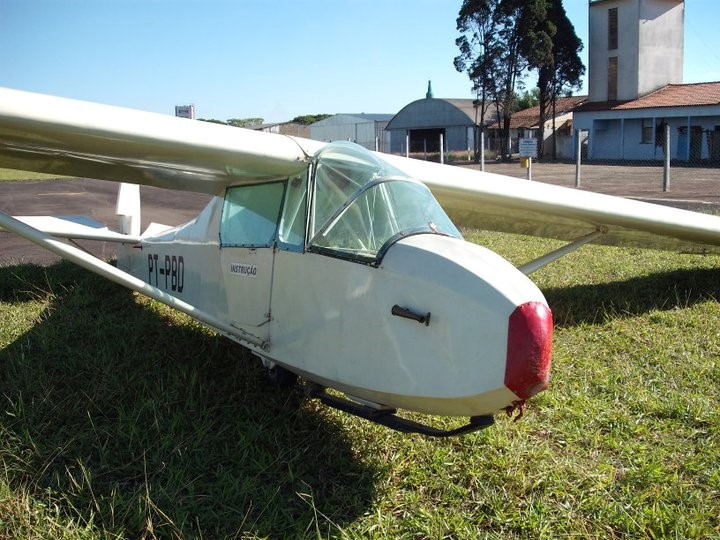
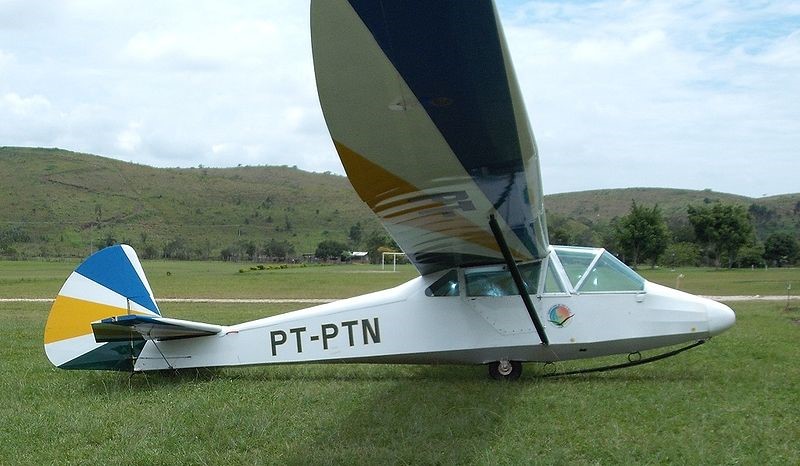
The B Monitor is basically constructed of wood, high wing configuration with central torsion cabin, freijó stringer (Cordia goeldiana) and aeronautical plywood cover. The rear section to the centre of the wing is covered with fabric.
The aircraft has a dihedral of 0.5° and the wings are attached to the fuselage with wooden uprights. Ailerons are wood covered with fabric and wooden spoilers located just in the extruder of the wing.
The fuselage is mostly of wood, semi-monocoque construction and steel tubes in the wing-fuselage joint. The cockpit has dual controls, with factory instrumentation on the front seat (although some have been modified with addition of a rear panel). The empennage is conventional. The fixed landing gear has a wheel behind the centre of gravity. The aircraft has a front skid with rubber shock absorbers under compression.
The prototype, PP-PCB, made the first flight in 1945 and the type certificate was issued in 1946.
The “National Aviation Campaign” bought the prototype and another 20 units for distribution to the air clubs, built between 1945 and 1955.
The Neiva B has a low-load, which provides good performance in thermal rise and low stall speed (52 km / h). The wings, because they are heavy, have a lot of rolling inertia, making the aileron commands slow to respond. The elevator and rudder controls, however, have good efficiency. The small size of the spoilers resulted in the common use of slip during the final approach.
In 1959 Neiva developed the version Neiva B “Monitor Modified”, with different nose, and larger cockpit. The fuselage became welded steel tubes, retaining the original wing. One copy (serial number CTA-02 A-223) was built for testing at the Aerospace Technical Centre, later donated to the CVV-CTA.
The only Neiva “B modified” produced, in operation in the CVV-CTA in 2009
The “B” Monitors were distributed to several aero clubs and trained hundreds of pilots. Many Brazilian records were broken with the type. Up to 2000, was still used in aero clubs such as CVV-CTA, Rio Claro, Tatuí, Bauru and Brasília.
Wingspan: 15.86 m (52 ft 0 in) Wing area: 18.4 m 2 (198 sq ft) Aspect ratio: 13.67 Aerofoil: Göttingen 535 – NACA 0009 Length 7.1 m (23 ft 4 in) Height: 1.13 m (3 ft 8 in) Weight Empty 215 kg (474 lb) Max takeoff weight: 375 kg (827 lb) Speed Never Exceeds: 145 km / h (90 mph; 78 kn) G range: +5.33 -3.31 at 145 km / h (90.1 mph, 78.3 kn) Maximum glide ratio 18 at 67 km / h (41.6 mph, 36.2 kn) Sinking Ratio: 0.78 m / s (154 ft / min) at 55 km / h (34.2 mph, 29.7 kn) Loading: 20.3 kg / m 2 (4.2 lb / sq ft) Crew: 2
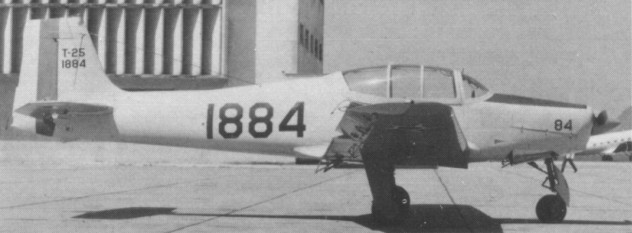
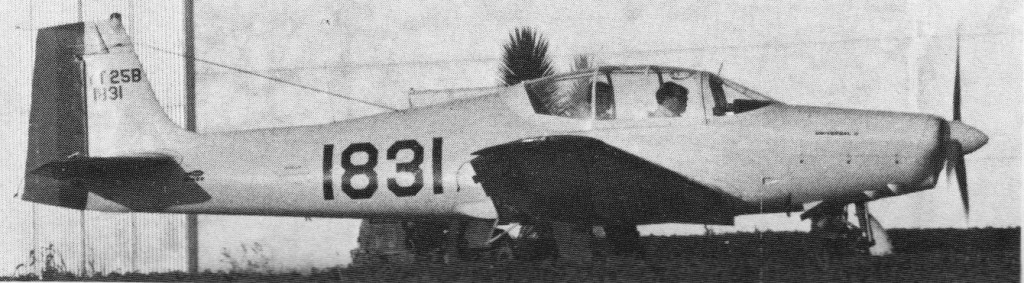
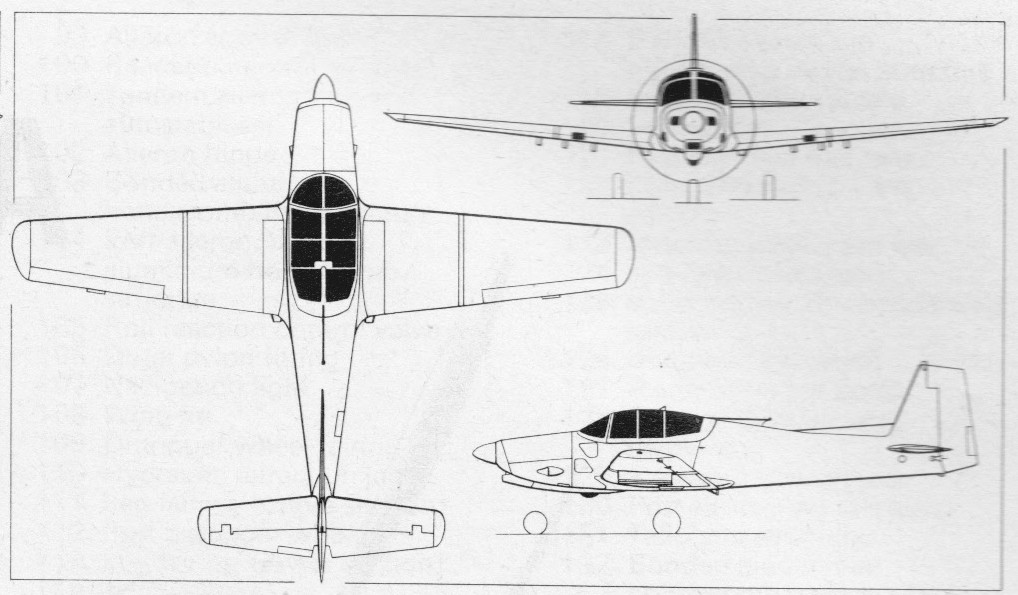
Designed to replace Fokker S-11 and Harvards with the Brazilian Air Force. The Universal is designated T-25 in Brazilian service and operates as a 2/3 seat basic trainer. About 140 were delivered plus 10 to the Chilian Air Force. An armed version with underwing pylons is designated AT-25.
Sociedade Construtora Aeronautica Neiva Ltda Industria Aeronautica Neiva Sa
Neiva has produced over 3,200 aircraft since 1956, many under license from Piper and including Ipanemas, Urupema gliders, Cariocas, Coriscos, Tupis, Minuanos, Sertanejos, Senecas/Cuestas, Navajos, and Carajas.
Neiva produced Model N621/T-25 Universal trainers for the Brazilian Air Force and a series of lightplanes.
In March 1980 it was renamed Industria Aeronautica Neiva S.A, as a subsidiary of EMBRAER. All work on the EMBRAER/Piper series of light aircraft and production of the EMB-202 Ipanema agricultural aircraft were transferred (over 780 built).
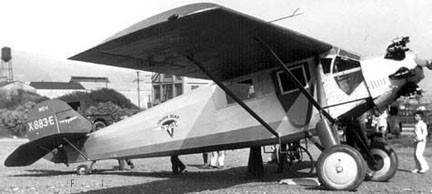
Designed by Richard Korman, the three-place cabin Neilsen Steel Aircraft Co NC-1 Golden Bear, or Coach, was a fabric-covered Ryan B-3 type. Subsequent models were planned to be metal-clad.
Priced at $7,500 in 1928, it was destroyed by an angry crowd at a “thrill show” at Oakland Speedway in Aug 1939 after its performance failed to meet their expectations.
A second one, with 300hp Wright J-6, was reportedly under construction at the time, but its history is unknown.
Engine: 130hp Comet Wingspan: 37’6″ Length: 29’0″ or 28’6″ Useful load: 800 lb Max speed: 130 mph Cruise speed: 110 mph Stall: 40 mph Range: 800 mi Seats: 3