Between 1919 and 1921 in the young Soviet state the glider began to develop as a type of sport. In the winter of 1921, a group with KK Artseulov founded the first circle of Soviet planners known as “Thermal Flight” (Парящий полет). This group was originally made up of four military pilots, nineteen cadets, and students from the Air Fleet Academy and the Moscow Higher Technical School. Eight of its members: KK Artseulov, VP Nievdachin, VS Pyshnov, SV Ilyushin, SN Lyushin, BI Cheranovski, MK Tijonrarov and IP Tolstix would become the builders of the first Soviet gliders.
The record-breaking single-seater glider “Buriviestnik”, built by the military pilot VP Nievdachin, was calculated to achieve high flight speeds and was originally designed for the participation of one of the best Soviet pilots in international competitions to be held in the French Rhône.
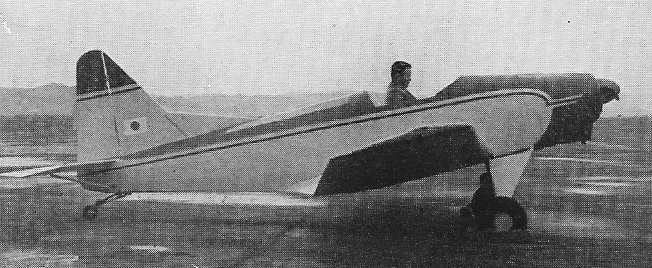
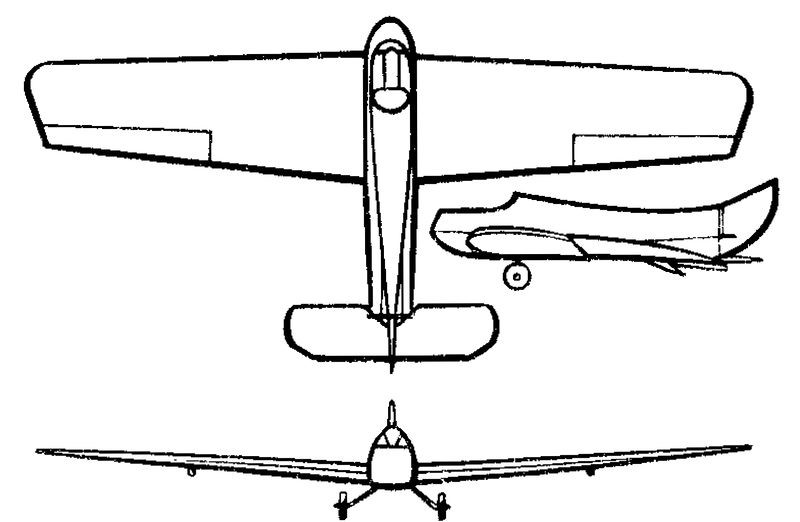
The Buriviestnik or P-5 (Russian: Невдачин “Буревестник” (П-5)) was designed as a cantilever low-wing monoplane with an airplane layout and clean lines. The constructive base of the fuselage was made up of the force knot called by its author the central cell, on which the pilot’s seat was located and to which the wings, landing gear and tail were fixed.
Built at Factory “Promvozdux” of Tversk in 1923, the entire construction was made of wood and covered with calico. The wings, of double spar, could be separated from the fuselage to facilitate the transport. The wing spar was covered with grid-shaped ribs. The wing leading edge consisted of a 2 mm thick curved sheet of plywood attached to a thin frame located in the open part of the cockpit. The wing trailing edge also ended in a frame attached to the exit of the wing nerves. The wing profile used was a variation of Pr-426.
The entire surface of the glider was covered with a layer of enamel and then two layers of enamel with aluminum powder. During the tensioning of the fabric, an unconventional system was used whereby the fabric was “sewn” to each of the ribs of the wing without passing the tension cord through the wing.
The cockpit cover was installed in front of the central cell and the fuselage armor was installed behind it. The tail section consisted of three stringers made up of 20 x 20 mm pieces of wood joined together by pieces of plywood. The cross section of the fuselage in this area was reminiscent of a 5-pointed pyramid with the upper vertex drifting towards the keel. The weight of the fuselage without the rudders and landing gear was only 18 kg.
The landing gear was made up of a bent ash shaft at the end of which and by means of metal fixings, the axles made of steel tubes were supported. The wheels were made of wood with the edges covered in leather. They weighed 5 kg.
In the rear section of the fuselage, offset rudders were located for direction and depth. The control of the glider was carried out as in a conventional airplane. The elevator was linked to the lever by means of a square section wooden bar. For the control of the wing ailerons, a combined system made up of metal turnbuckles and ropes was used. The pedals were used to control the rudder, to which they were linked by ropes.
The “Buriviestnik” glider was built using an unstable scheme. The center of gravity of the empty glider was behind the center of pressure. Because the pilot’s seat was located in front of the center of gravity, the stability of the aircraft was neutral during flight. This was probably the main cause of the accident of the pilot Yungmeister during the competitions in Crimea, which resulted in the destruction of the landing gear and the subsequent overturning of the glider on the back.
The “Buriviestnik” was ready in time to participate in the First National Sailing Competitions, promoted by the ODVF and held between November 1 and 18, 1923 in the mountains. Uzun-Sirt, in the Crimea. Ten gliders appeared in this contest. During the glider construction process, two endurance tests were carried out. After the final assembly of the wings, support points were located at the midpoint of their wingspan and three people were located in the cabin.
On October 28, the planeristas’ camp was set up on the slopes of the Uzun-Sirt mountain, in the region of the Sultanovska village, and the Technical Committee began its work under the direction of Professor VP Vietchinkin of TsAGI. Static resistance tests were carried out between November 1 and 7 and 8 of the models presented were authorized to fly. On the 15th, the flight of the ninth of the aircraft would be authorized.
During the first flight tests the “Buriviestnik” glider achieved the second longest time in the air, reaching 49 seconds, preceded by the Tijonrarov AVF-1 Arap, which flew for 1 minute and 5 seconds.
The first competition flight took place on November 3 with pilot LA Yungmeister at the controls. After taking off from the top of the mountain with a 6.7 m / s wind, the rope used to give the tension in the launch did not come off and throughout the flight it kept dragging on the ground. The second flight of the “Buriviestnik” lasted 2 minutes and 2 seconds, but during the landing, probably due to centering problems, the glider climbed abruptly and ended up hitting the ground and breaking one of the wheels.
The “Buriviestnik” performed brilliantly in the competitions and took second place. Its builder was awarded.
The 26 of February of 1924 at the premises of the Council of the ODVF in Krasnopresnienskaya street in Moscow exhibition opened gliders participants in competitions in Crimea. This exhibition was organized by the circle “Flight in Thermal” under the direction of IN Vinogradov and in it the gliders A-5, Buriviestnik, “Korshun”, “Makaka” and “Maori” were exhibited.
In 1924 in Smolensk the glider “Smoleniets” was built, which basically repeated the scheme of the “Buriviestnik” and in Krasnodar the design was also repeated in the “Berkut”.
The “Buriviestnik” glider scheme was so effective that its author decided to motorize it into a light aircraft, which would serve as the basis for a whole family of airplanes of this type.