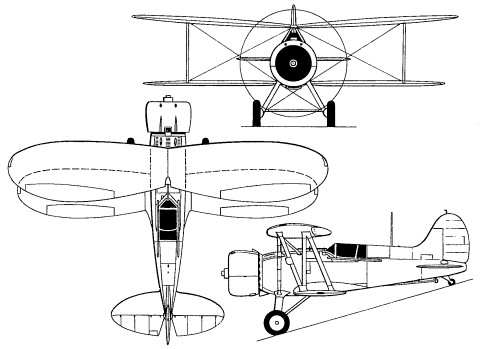
Berliner-Joyce XF3J-1

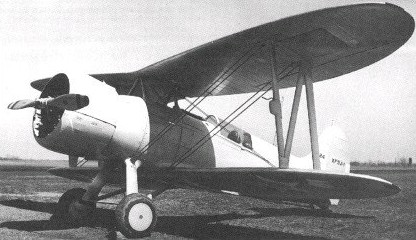
Designed by the US Navy Bureau of Aeronautics, the XF3J-1 was turned over to the Berliner-Joyce Corporation for development and construction. Ordered on 30 June 1932, this experimental single-seat shipboard fighter was completed in January 1934.
Of all-metal construction with a semi-monocoque fuselage and fabric-covered wings, the XF3J-1 was powered by a 625hp Wright XR-1510-26 radial. Armament was two 7.62mm synchronised machine guns, and provision was made for two 50kg bombs beneath the wings.
Although offering a good performance, the XF3J-1 was surpassed by the Grumman XF2F-1, and no further development was undertaken.

Engine: 625hp Wright XR-1510-26 radial
Empty weight: 1233 kg/2718 lb
Wingspan: 8.84 m/29 ft 0 in
Length: 6.98 m/23 ft 11 in
Height: 3.28 m/11 ft 9 in
Wing area: 22.26 sq.m/239.60 sq ft
Max. speed: 336 km/h/209 mph
Range: 1157 km/719 miles
Armament: two 7.62mm synchronised machine guns, two 50kg bombs
Hindustan Aeronautics HTT-40

HAL HTT-40 at AeroIndia 2017

If the Indian armed forces assess the need for a dedicated manned counter-drone fighter capability, Hindustan Aeronautics Limited’s (HAL) HTT-40 could be cost-effectively upgraded to fulfil the role within a reasonable timeframe.

On March 7, 2023, the Indian Ministry of Defence (MoD) signed a contract with HAL to procure 70 HTT-40 basic trainer aircraft. Earlier, in July 2022, HAL had signed a $100 million contract with U.S. engine-maker Honeywell for 88 engines to power the HTT-40 fleet.

The 70 aircraft on order will be delivered over six years from the date of contract signing.

The HTT-40 is a tandem-seat turboprop trainer that is fully aerobatic and offers excellent low-speed handling characteristics. It features an air-conditioned cockpit, modern avionics, hot refueling capability, running changeover, and zero-zero ejection seats.

The HTT-40 procurement aims to address the Indian Air Force’s (IAF) shortage of basic trainer aircraft and includes associated equipment, training aids, and simulators.

HAL first pitched the HTT-40 as an indigenous trainer for the IAF at Aero India 2013, showcasing a mockup of the aircraft.

However, on May 10, 2012, the Cabinet Committee on Security (CCS) had already approved the procurement of 75 Pilatus PC-7 MkII aircraft for the IAF, Indian Navy, and Coast Guard. The Pilatus had been selected through global bidding to replace the aging HPT-32 fleet.

Ironically, in response to HAL’s display of the HTT-40 mockup at Aero India 2013, then IAF Chief of Air Staff Air Chief Marshal NAK Browne had remarked, “There is no need for [the HTT-40 trainer]. We have the Pilatus PC-7. It’s a proven aircraft. The HAL project is starting from scratch. Our indications are that the cost will be too high. There is no need for all this.”

UFO One

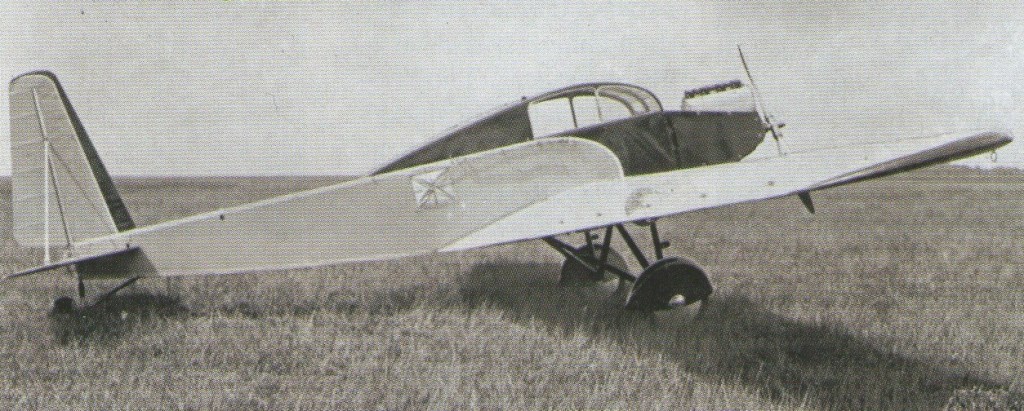
This cabin monoplane, possibly a homebuilt job, looks like it was scaled up from a flying model. It is all straight lines and simplicity, but its fixed taildragger undercarriage has a tailwheel, and spats cover the mainwheels, The tall narrow-chord fin and rudder is strut-braced, and the aerofoil-shaped cockpit cover sits atop a squaresection fuselage. The upright four-cylinder inline air-cooled piston engine in the nose drives an adjustable-pitch two bladed metal propeller. Although the aircraft is finished in a two-tone scheme it carries no markings to reveal either maker or registration, apart from an indecipherable emblem in a square on the fuselage side, in line with the wing trailing edge, and another small and even more indistinct logo on the rudder. The flat grassland offers no clues at all as to whereabouts, and it is even difficult to date the picture, which is just as likely to have been taken in the 1930s as the 1950s.
AEROPLANE NOVEMBER 2006

UFO 2

The glider is probably pre 1914 and located in the Hawke’s Bay, New Zealand, area. The occupant appears to have a car steering wheel-type control at his disposal but no obvious foot controls. The undercarriage appears to be a basic bicycle forks and wheel construction.
NZ Wings June 1982

UFO 5

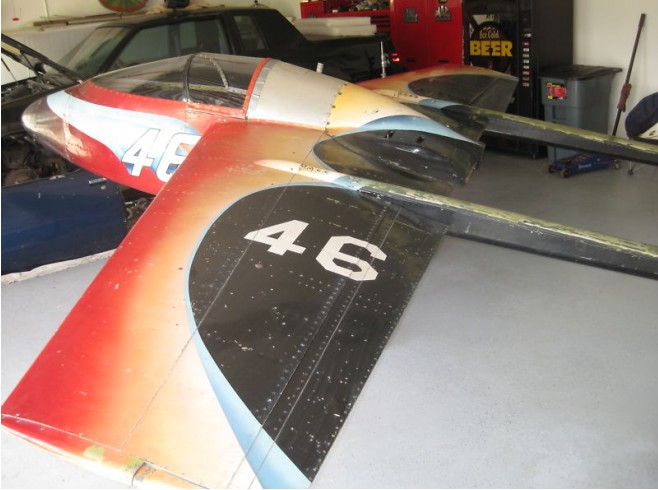
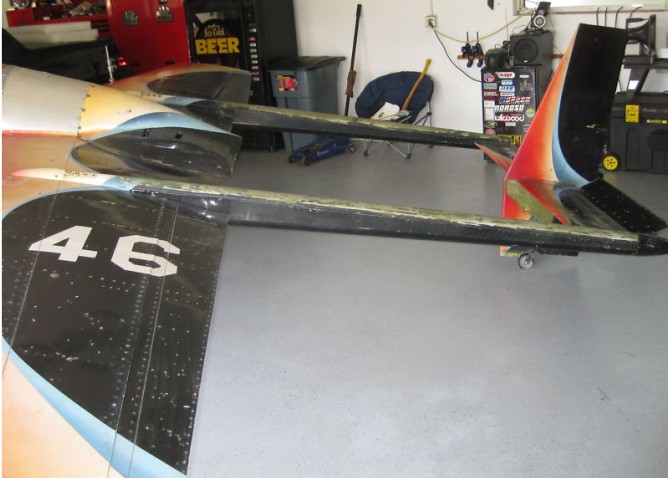
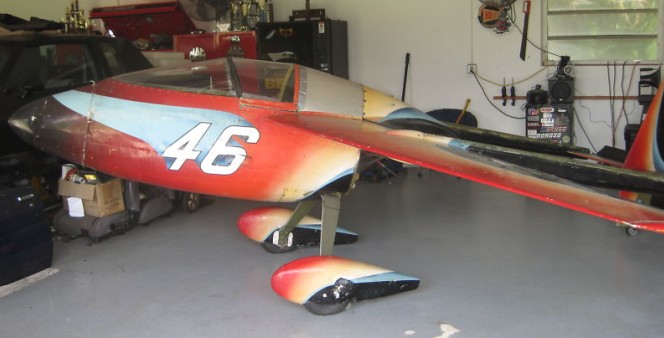
1966 Formula 1 Racer Pusher Type Experimental

This is a 1966 formula 1 racer pusher type experimental, the aircraft is a stressed skin design with cantilever wing construction and twin booms to accomodate pusher engine and conventional landing gear. The entire airframe components, internal structure, and all skin surfaces are made from 2024-T3 alclad aluminum, wingspars are of 2024 -T3 aluminum web with extruded spar cap top to bottom.The cockpit area is formed of half hard aluminum.The canopy is formed of plexiglass, all fittings are welded chromoly, all flight controls are cable operated except ailerons these are push type controlled.Engine is a O-200 or C-85.

It was built for the Goodyear races, by three engineers who passed away together in an airline accident and the aircraft was never finished or flown.

Henry Guantt later purchased this aircraft from a Mr. Watts in 1973.

This aircraft was then aquired by a father and son team around 2006 for the purpose of fixing and flying the aircraft but that never came to be because the father passed and they never got to finish this project. Around 2012 the craft was again on the market, hoping someone could dedicate the time to it and fly it. This included all of its documentation and specs and all of the parts to complete it except the engine but including the pusher type propeller.

UFO 6

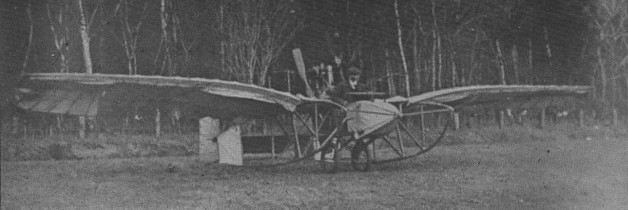
The machine is a monoplane with arched wings. Its cloth-capped pilot is seated in a faired central nacelle, immediately in front of a large vertical piston engine, possibly with four cylinders, driving a two-bladed wooden pusher propeller. The nacelle is supported on a twin-wheel undercarriage, and a few feet out on either side are open frames extending rearwards to carry the tall surfaces. The rear ends of these frames are covered in to serve as fins There appears to be a monoplane tailplane, possibly with an elevator, plus twin rudders behind the tailplane. The wings appear to be double-surfaced only along their leading edges, back to the front spar, and single surfaced aft of the front spar, and their fabric covering is clearly poorly applied, as it may be seen hanging down beneath the inboard leading edges. Inset ailerons are fitted at the wingtips. It is extremely difficult to date it any more precisely than 1909-13.

Aeroplane Monthly August 2006