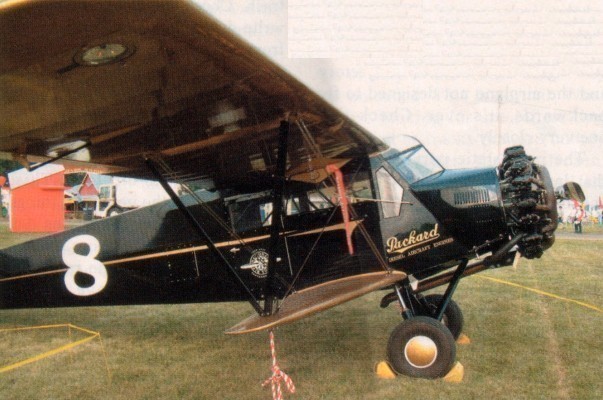
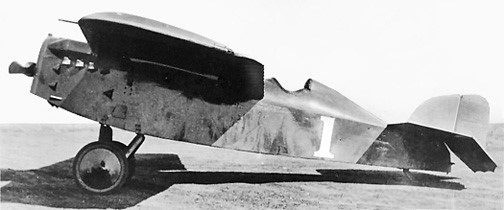
The 1929 Packard sesquiplane was powered by a radial Wright diesel engine.
The 1929 Packard sesquiplane was powered by a radial Wright diesel engine.
Packard Motor Co
Packard was founded in 1899 by two brothers, James Ward Packard (5 November 1863 – 20 March 1928) and William Doud Packard (November 3, 1861 – November 11, 1923) of Warren, Ohio who ran the Packard Electric Company. In 1926 about 20 New York business men, including James Packard, and a group of US Navy officers expressed an interest in building an airplane designed to break the standing air speed record. Navy officials agreed that they would finance the proposal when funds became available. The aircraft was to be completed in time to participate in the 1927 Schneider Trophy Race, which would be held in Italy.
The engine was designed by Navy Captain Lionel Melville Woolson, an aeronautical engineer at the Packard Motor Company of Detroit. The engine was an “X” configured design similar to one upright and one inverted V-12 engine mounted on the same crankshaft with a common crankcase. With 5.375 in (136.5 mm) bore and 5 in (130 mm) stroke, the resulting displacement was 2,775 cu in (45.47 l). The Packard X-2775 engineering involved in the design of the crankshaft, single piece crankcase and the master/slave rod system was very complex.
Built in 1959, the single place, low wing monoplane midget racer ‘Grey Ghost’, alias ‘Little A-Go-Go’, alias ‘Little Bit’, registered N211P, raced from 1959 to 1969. The fastest race speed achieved was 188 mph.
Engine: 85hp Continental C-85
Wingspan: 13’0″
Length: 16’0″
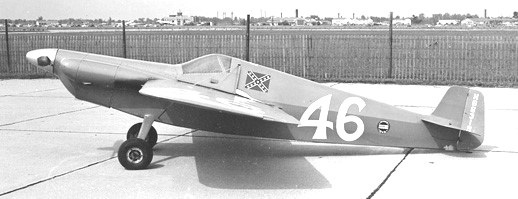
Built in 1950, the midget racer ‘Stars & Bars’ aka ‘Johnny Reb’ was piloted by Joe Magnano and Al Bennyworth. Registered N66319 it was damaged in mid-air collision during a 1950 race and rebuilt.
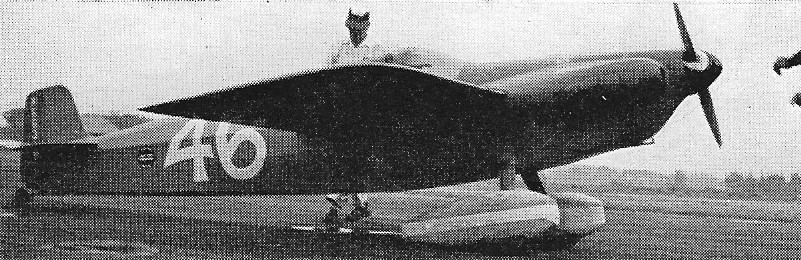
Engine: Continental C-85, 85hp
Wingspan: 14’8″
Length: 17’0″
Cruise speed: 175 mph
Seats: 1
Built in 1948, the single place, low wing monoplane midget racer ‘Li’l Rebel’ N66317 achieved a race average of 191 mph piloted by Jimmy Wilson.
Rebuilt as ‘Wilson Li’l Rebel’ after being damaged.
Engine: 85hp Continental C-85
Wingspan: 16’0″
Length: 16’10”
Built in 1948 as midget racer ‘Rebel Raider’ N97M the craft was destroyed on a test flight. Pilot Garland Pack was uninjured. The model B was a single place low wing monoplane.
Engine: Continental C-85, 85hp
Wing span: 13’0″
Length: 16’0”
Garland & Associates built the model A in 1948 as midget racer ‘Miss Nashville’. A single place low wing monoplane, registered NX66311 and piloted by Al Bennyworth, the fastest race was at 139.53 mph in 1948. Power was from an 85hp Continental C-85.
The craft was dismantled circa 1949 and parts were used in subsequent racers.
Garland Pack
Nashville
TN
USA
Circa 1948 airplane builder
Designed by Otto Timm of the Pacific Airplane & Supply Co, the Model C-1 single-seat racing monoplane in 1921, was built by (John W) Rogers Aircraft Co with a 90 hp Curtiss OX-5 engine. Unrecognizable as being modified from a Standard J-1, it was flown by Emory Rogers until a fatal crash on 11/27/22. It did win the 1921 Curtiss Cup race.
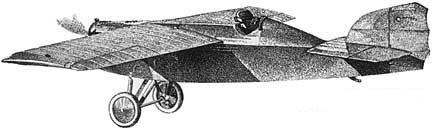
Pacific-Standard C-1 / Rogers C-1
Engine: 90hp Curtiss OX-5
Wingspan: 23’3″
Length: 19’6″
Cruise speed: 137 mph
Stall speed: 41 mph
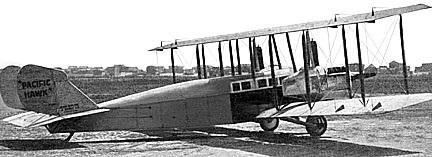
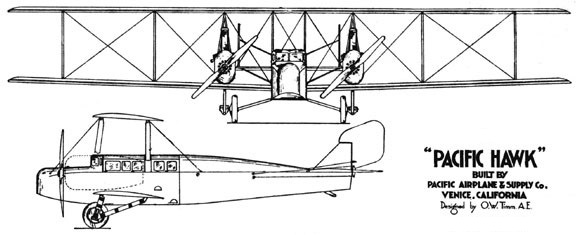
A 1920 six-seat twin-engined commercial biplane. Designed by Otto Timm the Hawk was first flown in September 1920, piloted by Frank Clarke, christened The Skylark. It was repowered with 200hp Hall-Scott L-6 when the OX-5 motors proved insufficient for the task. Last seen at Clover Field, Santa Monica, in 1923.
Engines: two 90hp Curtiss OX-5
Wingspan: 52’0″
Length: 32’0″
Useful load: 1320 lb
Max speed: 82 mph
Stall speed: 45 mph
Range: approx. 440 mi
Seats: 6