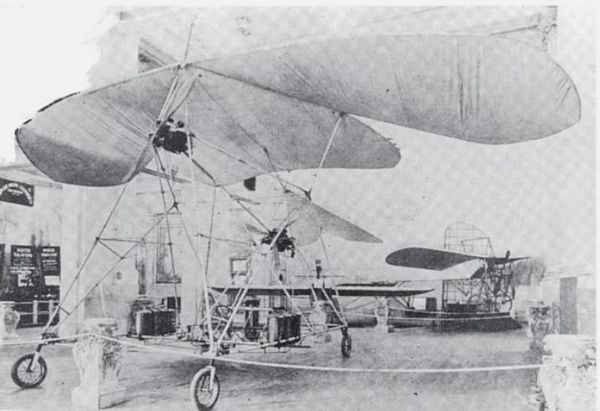
A monoplane equipped with two 50-horse power motors and two propellers. There are two blades in front and three in the rear. Built of steel tubing and aluminium, the machine weighed 1,000 pounds and had a stated carrying capacity of twelve persons. Designed and built by David A. Palmgren, as displayed at the Grand Central Palace Aero Exhibition, New York, in May 1912.
1910 newpaper reports describe this as an “auto-plane” with folding wings. Two 35hp Adams-Farwell rotary motors geared together so that “if one stops, the other keeps the propeller moving while the first acts as a flywheel.” The two motors also revolved in opposite directions to neutralize the gyroscopic effect. Reports failed to mention if it ever flew.
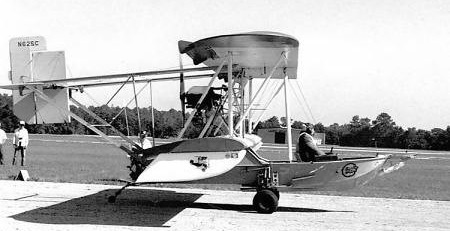
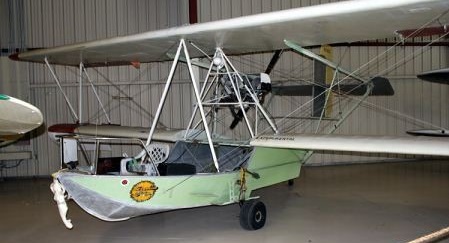
The Sunshine Clipper was a small two-seat amphibious homebuilt aircraft designed and constructed by Henry C. Palmer of St. Petersburg, Florida, USA. The aircraft uses a 14 ft (4.27 m) Orlando Clipper aluminum boat of 1948 vintage as basis for the fuselage, which was then combined with the wings of a Piper J-3 Cub, and parts and components of Piper J-3 Cub, PA-22 Tri-Pacer and PA-25 Pawnee aircraft.
The aircraft (N62SC c/n 1) first flew in November 1987, powered by a 65 hp Continental A65 engine. The aircraft remained a one-of-a-kind design and was registered to the SUN ‘n FUN Aviation Foundation on August 21, 1999 and is on display at the Florida Air Museum.
Engine: Continental A65, 65 hp Span: 33 ft 0 in (7.20 m) Weight empty: 1,100 lb (360 kg) Loaded weight: 1,500 lb (572 kg) Max speed: 65 mph (145 kmh) Cruise speed: 55 mph (120 kmh) Climb: 100 ft (1,000 m)/min
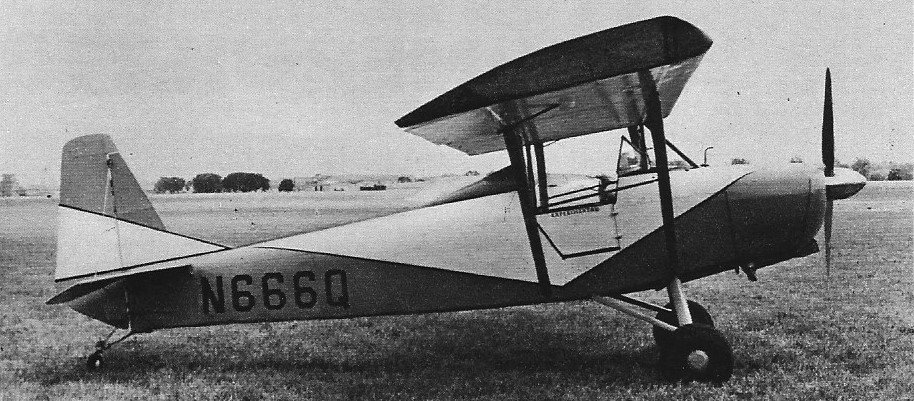
An executive pilot for Eastman Kodak’s Gulfstream, Joseph Palermo built his single-seat P-10 registered N666Q from plans published in Mechanics Illustrated magazine, but changed the tail configuration and skinned the steel tube fuselage with .025 magnesium alloy. The $600 craft took six years to build.
The wing has fabric covered wood structure and is fitted with Palermo’s own designed tips.
Engine: Continental A-65-A8, 65 hp Wingspan: 26 ft / 7.92 m Empty weight: 540 lb / 245 kg MAUW: 740 lb / 335.7 kg Cruise: 87 mph / 140 kph Landing speed: 35 mph / 56 kph ROC: 900 fpm / 4.57 m/sec Range: 270 mi / 435 km
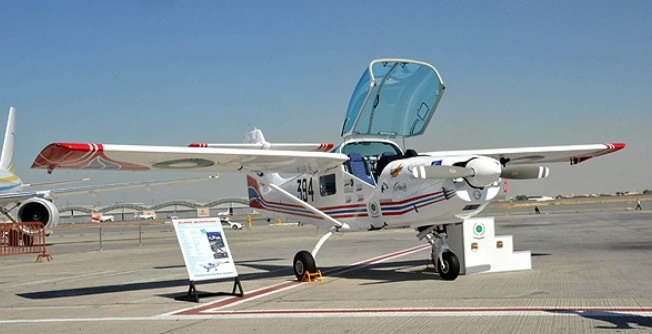
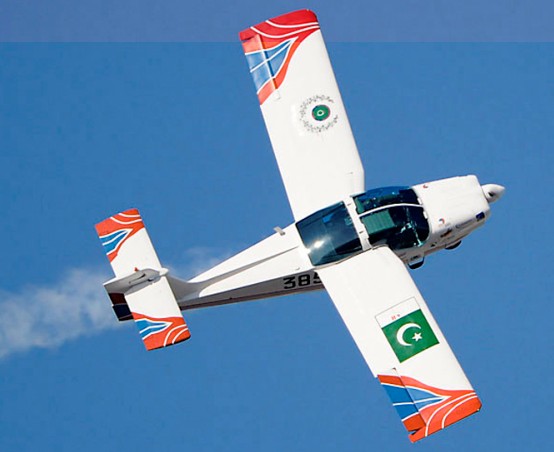
The MFI-395 Super Mushshak is a military trainer / light attack aircraft designed and manufactured by the Pakistan Aeronautical Complex (PAC) for the Pakistan Air Force (PAF) and the Royal Saudi Air Force (RSAF).
The development of the MFI-395 started in 1995. The aircraft was built by upgrading the MFI-17 with an advanced 260hp engine, electrical instruments, dual flight control systems and a Bendix RSA fuel injection system. PAC rolled out the improved version, the MFI-395 Super Mushshak aircraft in 1995.
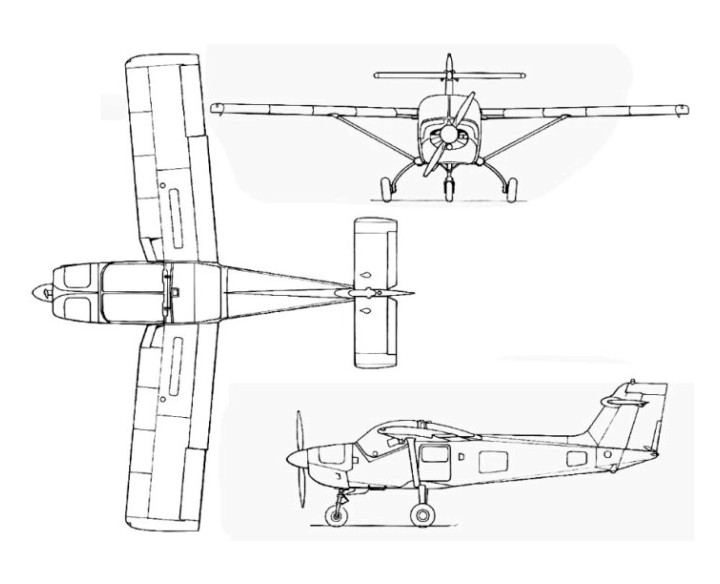
The MFI-395 features a high wing monoplane design. It boasts two integral fuel tanks which carry 47 gallons of fuel. The large baggage compartment located aft of the cockpit can be easily accessed through a door on the rear side of the fuselage.
The Super Mushshak is equipped with a blind screen, which allows the aircraft to carry out instrument flying missions.
The spacious glass cockpit of the MFI-395 accommodates two flight crew members, a student pilot and a flight instructor. It is integrated with two ejection seats adjacent to each other, with an option for third seat at the rear side. It is enclosed by an oval shaped glass canopy which opens upwards to meliorate the visibility.
The cockpit is equipped with two multifunctional displays to exhibit data related to navigation, flight instrumentation, fuel and the engine. It is also equipped with an Enviro R-134 air conditioning system to sustain constant temperature.
The avionics suite incorporated in the MFI-395 includes instrument flight rules (IFR) capable electronic flight instrumentation system (EFIS), a global positioning system, instrument landing system, voice over recorder, UHF radio, automatic direction finder, distance measuring equipment and information friend or foe transponder.
The MFI-395 is fitted with six hardpoints under the wing pylons. The inner two stressed hardpoints can carry up to 150kg each. The remaining four carry rockets, gunpods and Bofor Bantam anti-tank missiles.
The MFI-395 was designed to provide primary flight training to the pilots of the PAF Academy situated at Risalpur. It was designed to suit both military and civilian missions. The aircraft’s design is compliant with the US FAR 23 certification standards in aerobatics and utility classes.
The tricycle type undercarriage allows the aircraft to operate from unprepared airstrips and rough airfields.
The maiden flight of the Super Mushshak took place in August 1996. The production aircraft was rolled out in November 2000. It entered service in May 2001 and was certified by the Pakistan Civil Aviation Authority in 2002.
It was displayed at the Dubai Air Show held in November 2011.
Approximately 300 MFI-395s were operational at the academies of the Pakistan Armed Forces.
Customer orders for the MFI-395 included: PAF (50), RSAF (20) and Royal Air Force of Oman (five). The PAF received its first Super Mushshak in May 2001. Deliveries to the Royal Air Force of Oman were concluded in 2004.
Pakistan signed an agreement with Iraq for the supply of trainer aircraft to Iraqi Air Force, in what is billed as “major milestone” in the export of aviation products from the country.
The contract of sales of Super Mushshak Aircraft to Iraq was signed by General Anwer Hamad Ameen Ahmed, Commander Iraqi Air Force and Air Marshal Sohail Gul Khan, Chairman of the Pakistan Aeronautical Complex (PAC) Kamra.
In total two agreements were signed including the one for sale of the trainer aircraft. According to the first agreement Pakistan Air Force will provide Training, to Iraq Air Defence Force personnel, in all sphere of Modern Air Force concept pertaining to different field special Air Defence, and Air Crew.
Pakistan Aeronautical Complex was established 1978. Comprises four factories: Aircraft Manufacturing Factory constructs the Saab MF117 Safari Supporter under license as the Mushshak and Super Mushshak, and is partnered with Hongdu and AVIC of China in developing and producing the K-8 Karakorum jet trainer and light-attack aircraft. Other factories are Kamra Avionics and Radar Factory, Mirage Rebuild Factory and F-6 Rebuild Factory (the last being the oldest factory of the group), for manufacturing components and overhauling Pakistan’s Chinese-supplied combat aircraft.
The Super Sport was a single-seat homebuilt sport biplane attributed to Ivan Painter of Hollister, California, USA. The engine was reported as a 150 hp Lycoming O-320 series and year of manufacture as 1966. The sole example built was deregistered on August 10, 2012.