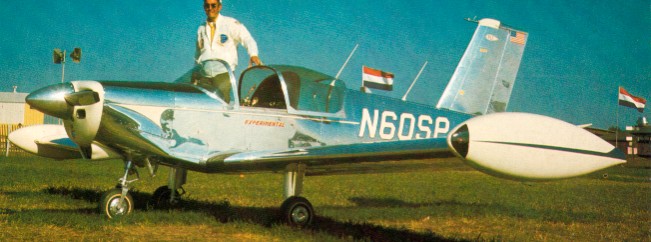
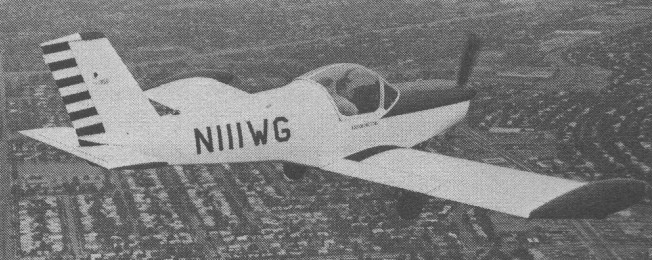
PL-1 Laminar was designed by Ladislao Pazinany. The prototype PL-1 of 1962 was stressed to nine G’s for aerobatics and featured a low-wing, tricycle-gear configuration with a sliding canopy.
Together with its advanced counterpart, the PL-2, the two Pazmany designs represent more hours flown than any other “amateur built’ aircraft design. Nearly 400 sets of plans were sold for the PL-1 before their sale was discontinued. The fuselage of the plane is all-metal with only flat or single-curvature skins. The wings are built around a single all-metal spar with a leading edge torsion box. In the cabin, seating is side-by-side with dual controls, and there is room for 40 pounds of baggage.
In 1968, a set of drawings were acquired by the Aeronautical Research Laboratory of the Chinese Nationalist Air Force in Taiwan who presented a PL-1, which they built, to Generalisimo Chiang Kai-Shek. Following construction and testing of a prototype it was decided to adopt the type as a basic trainer, and 40 aircraft designated PL-1B have been built for the Chinese Nationalist Air Force and 10 for the Nationalist Chinese Army. In the late l960’s the Nationalist Chinese Air Force acquired plans to build a version of the PL-1 to serve as a primary trainer. Their prototype flew on October 26, 1968, and an additonal 35 aircraft were started that year, and 58 were completed, overall.
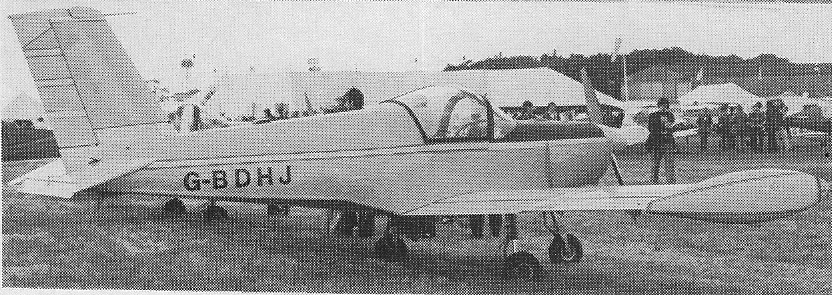
The first PL-1 flying in England was Harold Jones G-BDHJ.
Ladislao Pazmany is of Hungarian descent. His family moved to Argentina when he was three and he grew up and was educated there. After obtaining a degree in aero engineering, he worked wherever engineering jobs were available in the unstable economy that prevailed in Argentina at the time.
For nearly a decade he designed aircraft, pipelines, high tension power towers, suspenison bridges, chemical and hydroelectric plants, was an instructor at an aeronautics school.
In May of l956 Paz and his family moved to the U.S. and settled in San Diego where he went to work for Convair. The following month he attended his first EAA Chapter 14 meeting and has been involved in EAA activity ever since. At Convair, he worked on F-102, F-106 and other projects, and founded L. Pazmany & Associates at San Diego, California.
Concurrent with his full time employment he designed he PL-1, which flew for the first time on March 23, 1962, made plans available to homebuilders and wrote the book “Light Airplane Design”.
1980-95: Pazmany Aircraft, P.O. Box 80051, San Diego, CA 92138.
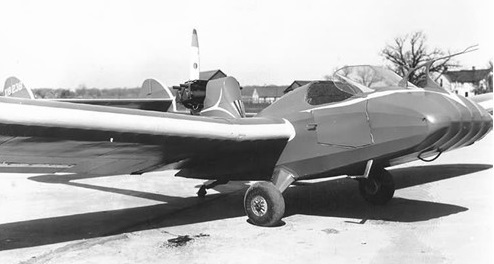
The Payne MC-7 Pusher of 1935 was a two-place open cockpit low-wing monoplane designed and built by Vernon W. Payne. A twin-boom, twin-tail experiment with a side-by-side cockpit and pod-mounted motor. Registered NX18238, it was powered by a 40hp Continental A-40 or 47hp Franklin pusher engine.
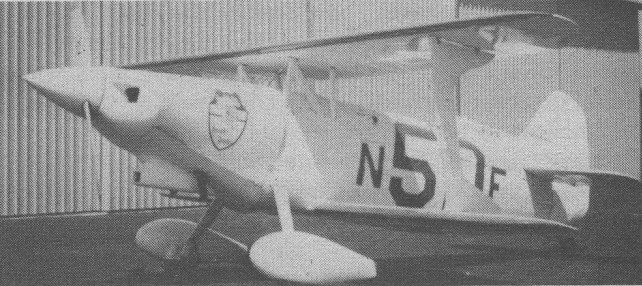
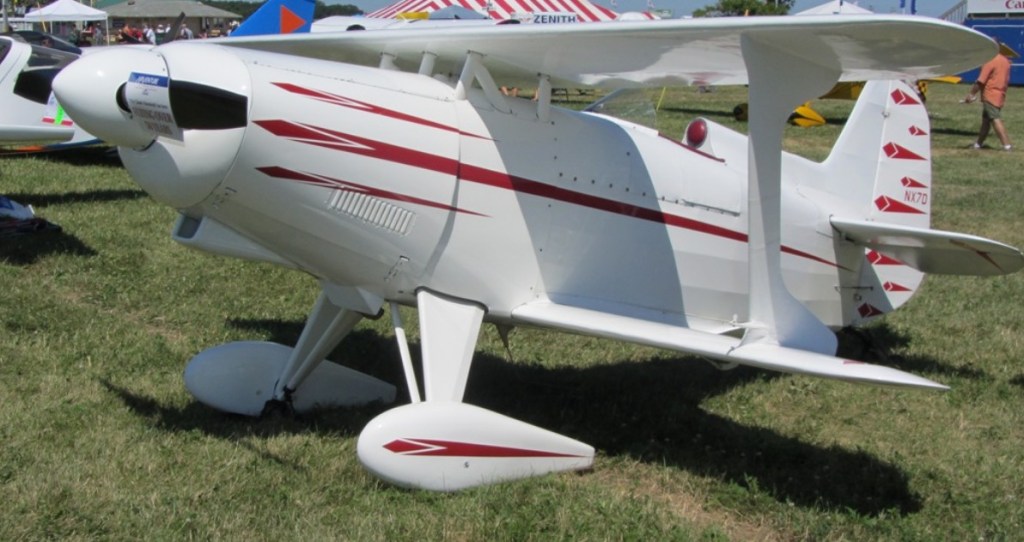
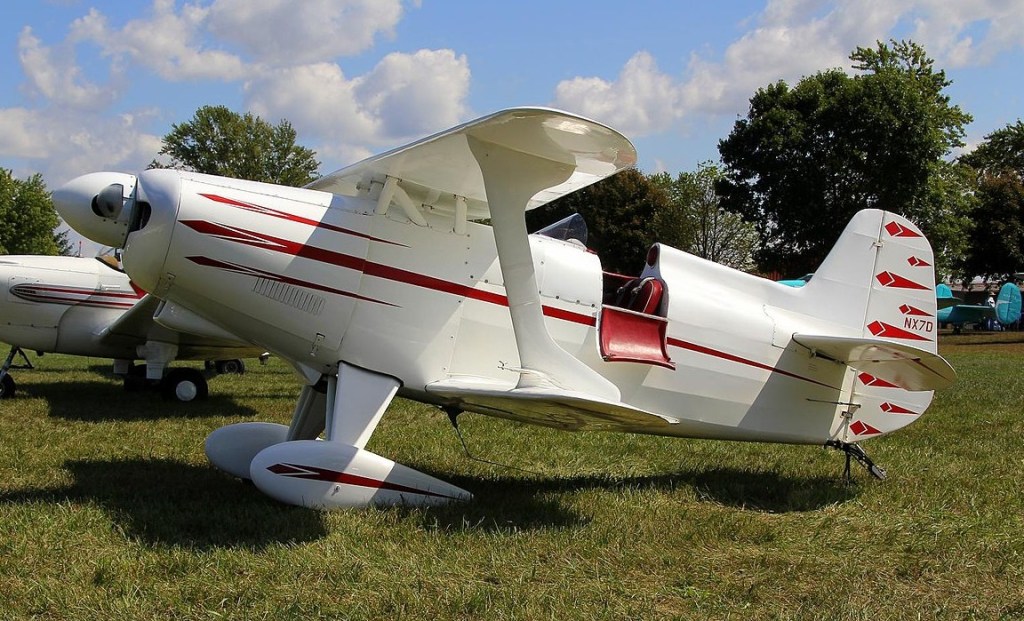
The Payne Knight Twister is a single-seat, single-engine aerobatic sport aircraft first flown by Vernon Payne Sr. in the United States in 1932 and marketed in plans form for homebuilding.
It is a conventional biplane design with slightly staggered wings of unequal span. The wings are of fully cantilever design and do not require the bracing wires commonly used on biplanes or even interplane struts; however, most builders brace the wings with I-struts and at least one pair of wires. The cockpit is open, and the undercarriage is of fixed, tailwheel type with divided main units. The wings and horizontal stabilizer are of wooden construction, skinned in plywood, while the fuselage and vertical stabilizer are of welded steel tube covered in fabric.
Payne designed the Knight Twister in 1928 while teaching aircraft design and repair at a school attached to the Aviation Service and Transport Company in Chicago. Construction of a prototype by Payne and his students commenced the following year but ended shortly thereafter when the school was forced to close as a consequence of the Great Depression. Payne began building a second prototype in 1931, which first flew in fall the following year powered by a Salmson 9Ad radial engine. This aircraft was damaged in a forced landing due to fuel exhaustion during a demonstration flight for the press, and parts of the airframe were reused to build the second Knight Twister in 1935. This machine, powered by a converted Ford Model A automobile engine, was built for an Argentine buyer who eventually declined to take delivery. After it had passed through several hands, Payne himself bought the aircraft back after World War II and his son, Richard, was killed in it during a test flight on which the engine failed shortly after take-off.
1951 D-1 Knight Twister
The Knight Twister built a reputation as a racing aircraft. In 1964, Clyde Parsons flying the “Parsons Twister”, won the Sport Biplane Championship race at Reno with a speed of 144.7 mph. In the 1970s, Don Fairbanks competed with a Knight Twister preserved initially at the Motorsports Hall of Fame of America museum in Novi, Michigan, and later in the lobby of Sporty’s Pilot Shop at Clermont County Airport, Batavia, Ohio. Fairbanks set the world record in the sport biplane class of 178 mph (284 km/h) with this aircraft.
The Knight Twister has a reputation as a “handful” to fly, but this has been vigorously denied by both its designer and by Fairbanks. Both men have attributed this reputation to the controls being lighter and more responsive than those of the light aircraft that most pilots are more familiar with.
KT-125
In the 1990s, the rights to the design were acquired by Steen Aero, who continue to offer plans for sale in 2009.
Variants KT-125 KTS-1 – first prototype with Salmson 9Ad engine (1 built) KTD-2 – second prototype with converted Ford Model A engine designated Douglas Bear (1 built), later redesignated Knight Twister Junior 75-85 KT-50 – version with 50 hp (37 kW) Continental or Franklin engine and 18-ft wingspan KT-75 Knight Twister Junior – version with 75 hp (56 kW) Continental or Lycoming engine and 17 ft 6 in-wingspan KT-80 – version with 80 hp (60 kW) Franklin engine KT-85 – standard version with Continental engine of 85 to 90 hp (63 to 67 kW) and 15-ft wingspan KT-90 – version with 90 hp (67 kW) engine and 15-ft wingspan KTT-90 – version with 90 hp (67 kW) Lycoming engine and 18-ft wingspan KT-95 – version with 95 hp (71 kW) Lambert engine KT-125 – version with 185 hp (138 kW) engine KT-140 – version with 140 hp (104 kW) engine. SKT-125 Sunday Knight Twister – version with 125 hp (93 kW) Lycoming engine and 19 ft 6 in-wingspan KT Imperial – version with engine of 135 to 150 hp (101 to 112 kW) and wing area increased (span: 17 ft 6 in) to comply with Sport Biplane class rules KT Holiday – version with 125 hp (93 kW) engine and wingspan of 19 ft 6 in KT Acro – version with wingspan of 15 ft 6 in KT Coed – version with passenger seat in tandem with pilot’s; wingspan of 22 ft 6 in. Double Twist – A two place model with an untapered 21 ft M6 airfoil. Pretty Prairie Special II model 1 – Straight leg conventionally braced based on a Knight Twister, stretched 16 inches Pretty Prairie Special III – A Menasco powered variant displayed in the EAA Airventure Museum in Oshkosh, Wisconsin until 2006, and now at the Kansas Aviation Museum.
Payne Knight Twister Span upper: 15.00 ft Span lower: 13 ft Length: 14 ft
Knight Twister Imperial Engine 140-hp Lycoming. Gross Wt. 900-1100 lb Empty Wt. 694 lb Fuel capacity 35 USG Wingspan 17 ft Length 16 ft 1 in Top speed 170 mph Cruise 120 mph Stall 50 mph Climb rate 1000 fpm Takeoff run 475 ft Landing roll 800 ft Range 680 miles
KT-85 Powerplant: 1 × Continental C90 , 90 hp (67 kW) Wingspan: 15 ft 0 in (4.57 m) Wing area: 60 sq ft (5.6 m2) Length: 14 ft 0 in (4.27 m) Height: 5 ft 3 in (1.60 m) Empty weight: 535 lb (243 kg) Gross weight: 960 lb (435 kg) Maximum speed: 160 mph (257 km/h, 140 kn) Range: 390 mi (625 km, 340 nmi) Rate of climb: 900 ft/min (4.6 m/s) Crew: One pilot
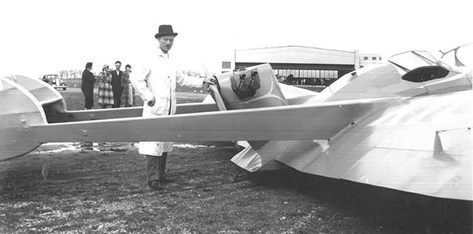
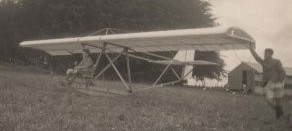
When the Imperial College Gliding Club was formed in February 1930, it had no gliders and therefore decided to build its own. This was designed by J. H. Payne and built by students, with materials donated by the Rector, Sir Henry Tizard. Parts were made in the Chemistry and Glass workshop of the college and the glider was assembled in Payne’s garden.
The I.C.1 had a straight, constant chord, thick section wing built around two spruce box spars with plywood webs. The I-section ribs were also made from spruce and ply, the leading edge from ply and the trailing edge form dural. It had outboard ailerons but neither flaps nor airbrakes. The fuselage was an open frame structure with two horizontal, parallel booms that ran rearwards from the wing spars to the tail, where two cross braces carried the tailplane. A pair of N-form struts converged below the wing onto a third boom, horizontal below the wing then angled upwards to the tail, joining the rear cross brace via a short vertical member and two angled ones. The three long booms formed a triangular section girder that did not require further wire bracing.
The pilot’s seat and control column were mounted, unenclosed, on the lower beam ahead on the wing; below him a shallow, curved member served as a keel for landing. The lower beam also provided an attachment point for lift wires, one on each side, to the forward wing spar. Above the wing two further pairs of wires ran from a central, three strut cabane to both spars. The tail surfaces were straight edged and the fin small, its leading edge formed by a sloping member that joined the forward transverse member at the front of the tailplane to the lower fuselage beam. The rudder extended to the lower fuselage.
Named The Incredible, the I.C.1 was completed during the Club’s summer camp at Gore Farm, near Shaftesbury, in September 1930.
During preparation for its first flight, the Incredible was overturned by a gust of wind and damaged. It was stored at Gore Farm and repair work was begun in the 1931 Easter vacation but never completed and the SC.1 never flew. In December 1930 the club had bought a R.F.D. Primary (Dagling), a steel framed version of the German Zogling, which they designated I.C.II and were soon flying regularly.
Wingspan: 36 ft 0 in (10.97 m) Wing area: 179 sq ft (16.6 m2) Aspect ratio: 7.2 Airfoil: Probably Bairstow Aerofoil B Length: 19 ft 5 in (5.92 m) Height: 7 ft 6 in (2.29 m) Empty weight: 190 lb (86 kg) Capacity: 1
Payen then concentrated more on delta aerofoils. After the war Payen built the single-seater jet PA-49, precursor of the “Mirage” series of the planes with delta wing, and two-seater PA-61 “Arbalète”.