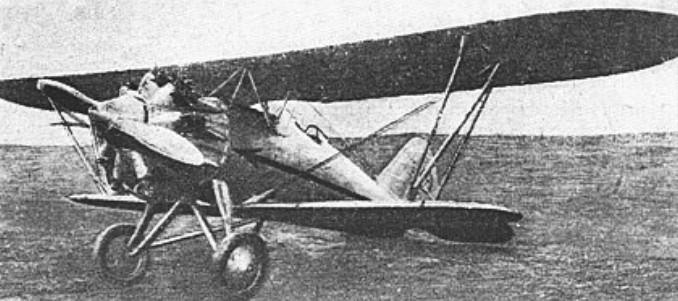
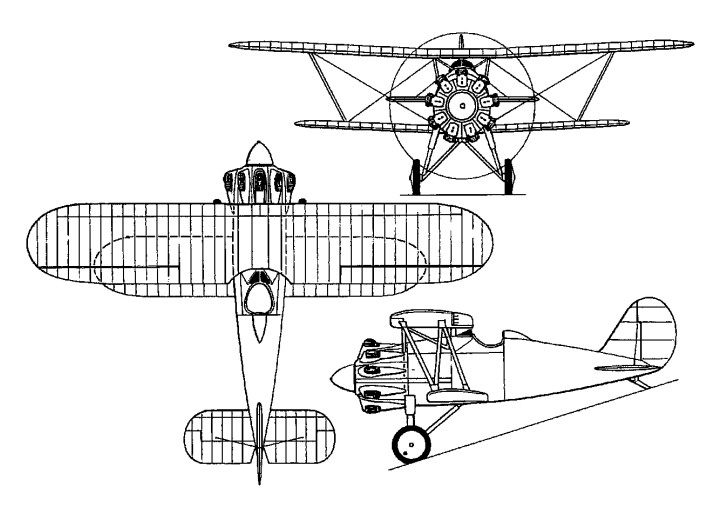
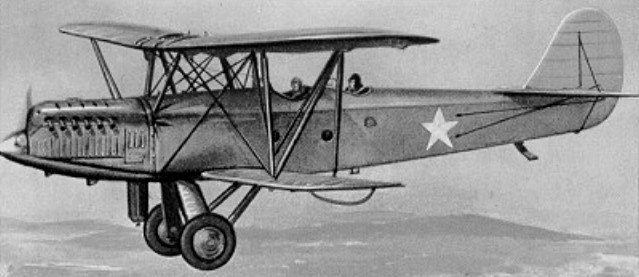
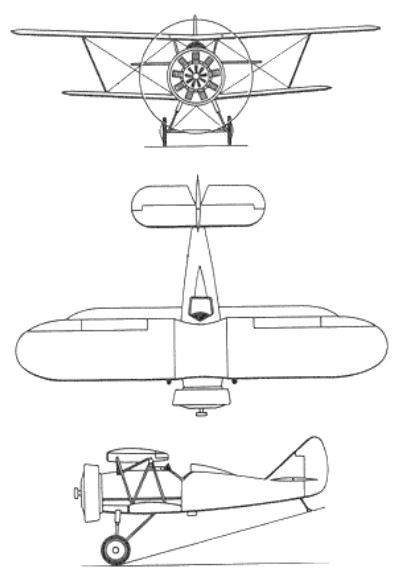
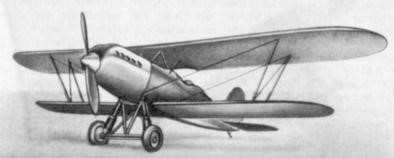
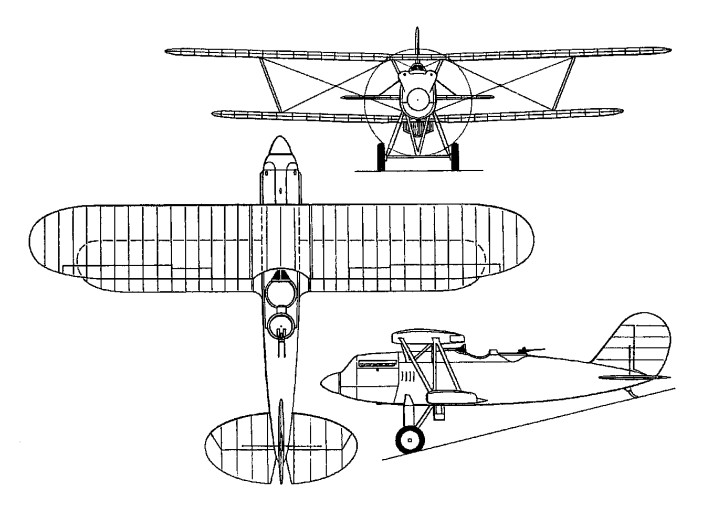
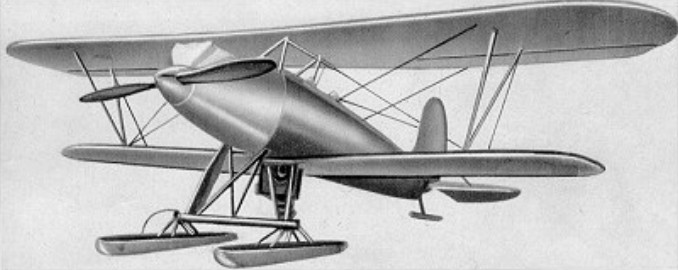
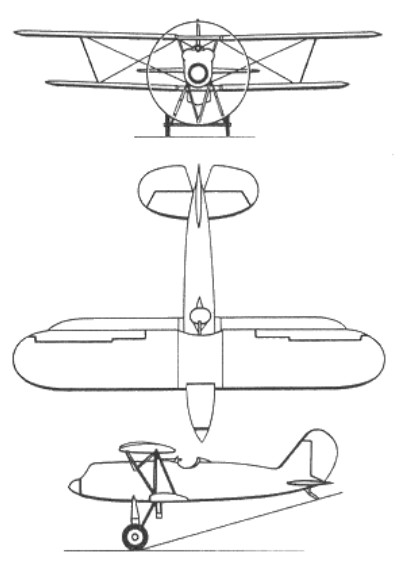
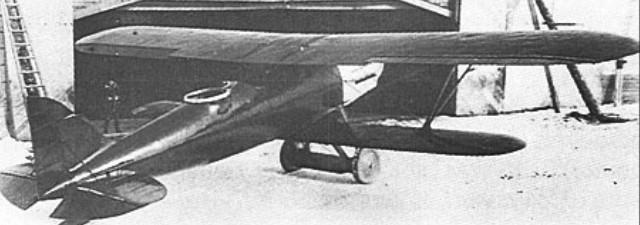
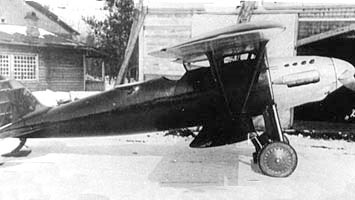
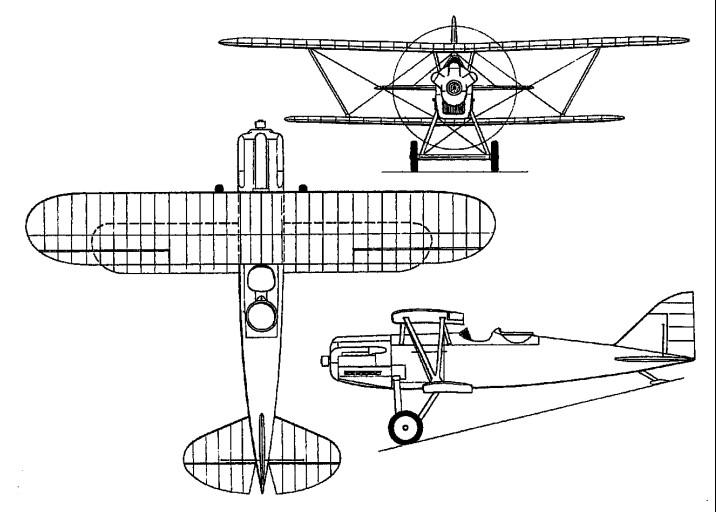
With acceptance of the I-3 for series production, Polikarpov and his team commenced work on a smaller, lighter fighter, the I-6, powered by a 450hp Gnome- Rhone Jupiter VI air-cooled radial.
A single-bay, unequal- span biplane of wooden construction with fabric skinned wings and a monocoque fuselage, the I-6 was flown on 30 March 1930, two prototypes appearing in the annual May Day fly-past over Moscow in that year. Prior to the commencement of flight testing, Polikarpov had been arrested (in September 1929), accused of “exercising insufficient energy in bringing assigned work to fruition”, and, together with Dmitri P Grigorovich, was already working whilst in detention on a further fighter (the I-5). Comparative trials were subsequently performed between the I-6 and the I-5, the latter being selected for series manufacture after prolonged evaluation. The I-6 was the faster in level flight, but offered a poorer rate of climb and was less manoeuvrable. Development was therefore discontinued in favour of the I-5.
Max take-off weight: 1280 kg / 2822 lb Empty weight: 868 kg / 1914 lb Wingspan: 9.70 m / 32 ft 10 in Length: 6.78 m / 22 ft 3 in Wing area: 20.50 sq.m / 220.66 sq ft Max. speed: 280 km/h / 174 mph Range: 700 km / 435 miles
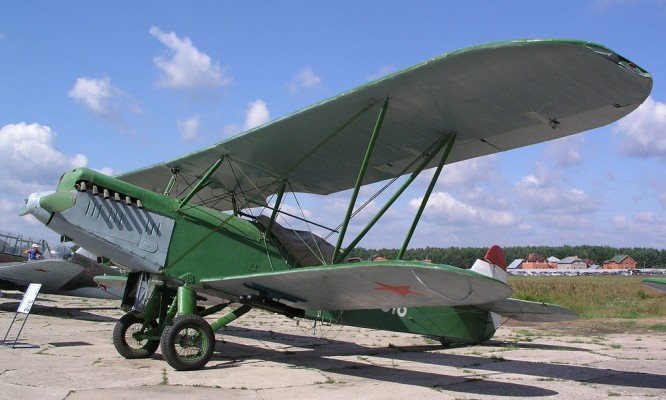
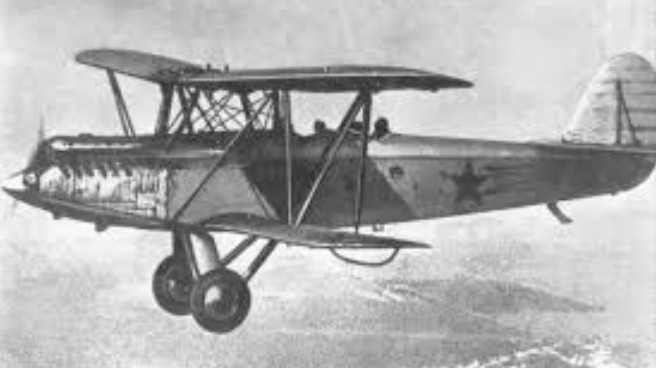
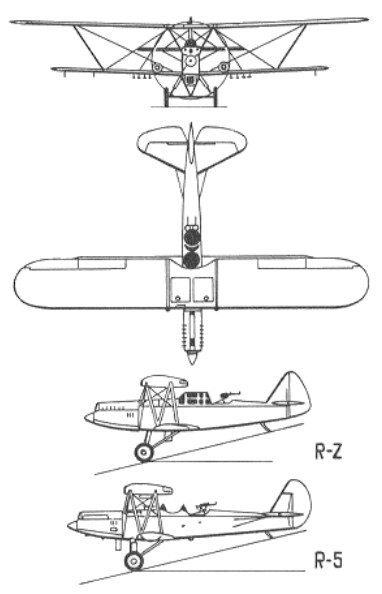
The Polikarpov R-Z or R-Zet was developed at the aircraft factory GAZ No 1 (State Aircraft Factory No 1) at Moscow as a development of, and a replacement for the Polikarpov R-5, the standard light reconnaissance bomber of the Soviet Air Force. Based on the R-5SSS, the most advanced variant of the R-5, the R-Z had a new, deeper, monocoque fuselage, with a sliding canopy for the pilot and fixed glazed fairing for the observer. Smaller than the R-5, with a more powerful engine driving a two-bladed fixed-pitch propeller. Construction however was lighter than of the R-5. The 544 kW (730 hp) M-17F engine (a licenced built copy of the BMW VI was replaced with the 611 kW (820 hp) M-34 engine. The R-Z first flew in January 1935 and was accepted for the Soviet Air Force in preference to the competing Kochyerigin LR, also an R-5 derivative. By the time production finished in spring 1937, 1,031 R-Zs had been built.
Like its predecessor the R-5, the R-Z was used in large numbers by both the Soviet Air Force and Aeroflot.
Its first use in combat was during the Spanish Civil War from 1937. 61 R-Zs were delivered to the Spanish Republican Air Force, where they were nicknamed Natacha. These were heavily used, flying in tight formations and using co-ordinated defensive fire to defend against fighter attack, while returning individually at low levels. Although many R-Zs were damaged by ground fire, complete losses were relatively low with 36 surviving to be captured by the Nationalists at the end of the war in April 1939.
R-Zs were used by the Soviet air force against Japan above Mongolia in the Battle of Khalkhin Gol in 1939, and the Winter War against Finland in the same year. By the time of the German invasion of the Soviet Union in June 1941, the R-Z was in the process of being replaced by the Ilyushin Il-2, although it remained in service with a number of light bomber regiments.
An unequal-span two-seat biplane constructed largely of wood with fabric covering, the R-5 reconnaissance light bomber flew in prototype form in 1928. Pilot and observer/gunner were seated close together in tandem open cockpits – the pilot beneath a cutout in the upper wing trailing-edge. The BMW VIb in-line engine of the prototype was replaced by the 507kW Soviet-built M-17B in production aircraft. The R-5 could operate on skis or twin-floats (the latter designated R-5A or MR-5), as well as on the more normal axle-type fixed undercarriage. Standard armament was a fixed 7.62mm PV-1 machine-gun and a DA-1 weapon of the same calibre operated by the observer. Up to 250kg of bombs could be carried on underwing racks.
Many variants of the R-5 were used in the Soviet Union. These included the single-seat R-5T torpedo bomber; the heavily armed R-5Sh ground-attack aircraft; and the SSS of 1934 with 533kW M-17F engine, spatted landing gear and new ShKAS machine-guns. Civil versions were the P-5 and P-5A, the latter with cabin accommodation for four passengers, and an enclosed pilot’s cockpit.
Some 7,000 of all versions of the R-5 were built. Military operations included the Spanish Civil War (31 R-5s serving with the Republicans), the campaigns in 1938-39 against the Japanese in the Far East, the ‘Winter War’ against Finland, and the fighting against Germany from 1941. At the time of the German invasion most R-5s had been relegated to training and liaison duties, but several hundred returned to first-line duties to equip light night-bombing ‘nuisance raid’ units alongside the Polikarpov U-2.
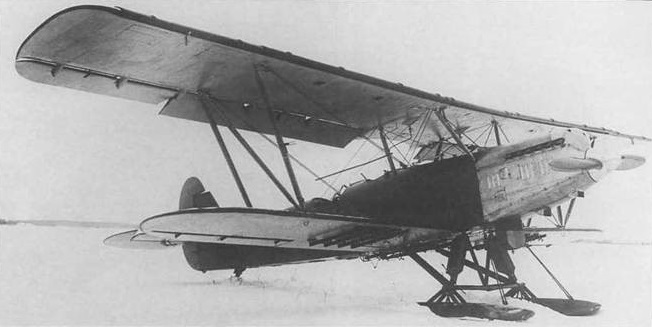
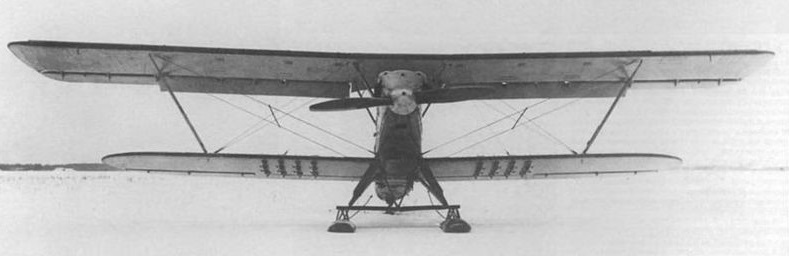
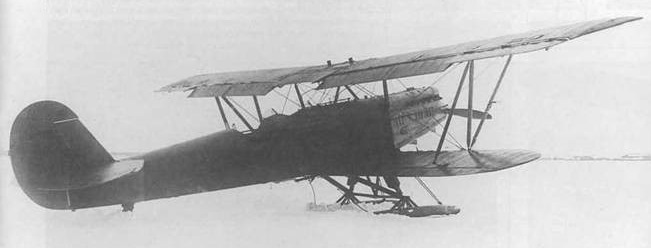
As early as 1930, the possibility of equipping the R-5 with a wing equipped with leading edge flaps and slats was considered. It was appreciated that an aircraft with this wing configuration would be much safer to perform the role of a night bomber.
R-5 # 4681 with leading edge slats and top plane flap
Originally the development of this variant was assigned to the TsKB-39 and later transferred to the TsKB. The modifications were made by a group under the leadership of LI Sutigun in S A. Kochierigin’s brigade. The upper wing received straight ends, trailing edge flaps following the ailerons, and slats on the wing leading edge. Two examples were modified in 1933 as Polikarpov R-5 with sectioned wing (Russian: Поликарпов Р-5 с разрезным крылом). The first, with serial number No.4681 was called Sectioned Wing – 1 and the second with number No.5563 Sectioned Wing – 2.
R-5 No.4681
During the tests it was possible to reduce the landing speed to 70 km / h. The ceiling increased and the maximum speed decreased slightly.
Despite the results obtained, the series production of the model was not approved as it was considered that the take-off and landing characteristics of the R-5 were not bad and the wing mechanization complicated the production process.
R-5 No.4681 on February 9, 1933 with slightly low flaps.
In 1933 R-5 No.4681 was used to test the VAP containers for chemical weapons developed by engineer Vaxmistrov.
Variation: Grokhovsky G-61 Polikarpov ARK-5
Engine: 1 x M-17, 370kW Max take-off weight: 3351 kg / 7388 lb Empty weight: 2108 kg / 4647 lb Wingspan: 15.5-12.0 m / 51 ft 10 in – 39 ft 4 in Length: 10.6 m / 35 ft 9 in Height: 3.6 m / 12 ft 10 in Wing area: 50.2 sq.m / 540.35 sq ft Max. speed: 230 km/h / 143 mph Ceiling: 6150 m / 20200 ft Range w/max.fuel: 600 km / 373 miles Armament: 3 machine-guns, 250kg of bombs Crew: 2
Kochierigin R-5 Engine: 1 M-17B 500/680 hp Wingspan upper: 15.50 m Wingspan lower: 12.0 m Length: 10.65 m Wing area: 50.84 m² Empty weight: 2085 kg Normal takeoff weight: 2985 kg Wing loading: 58.7 kg / m² Power load: 5.9kg / hp Fuel weight: 427 kg Total load capacity: 900 kg Maximum speed at sea level: 205 km / h Maximum speed at 3000 m: 189 km / h Landing speed: 70 km / h Practical range: 800 km Endurance: 4.5h Climb to 1000 m: 7.5 min Climb to 2000 m: 15.0 min Practical ceiling: 5140 m Landing run: 120 m Seats: 2 Armament: A 7.62mm PV-1 synchronized machine gun/ 2 x 7.62mm DA machine guns in rear cockpit.
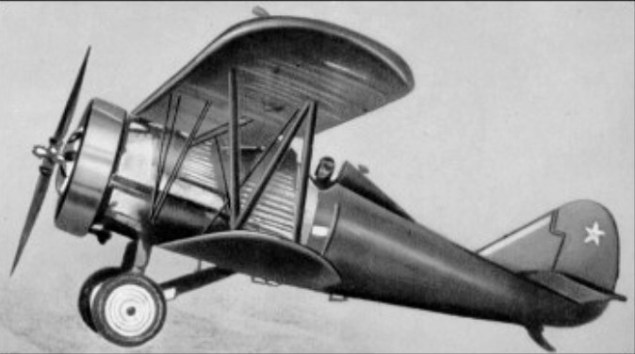
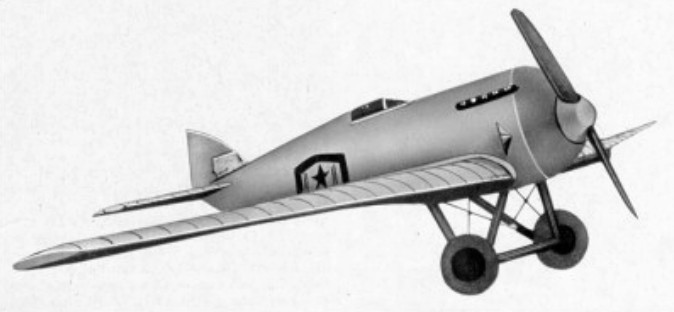
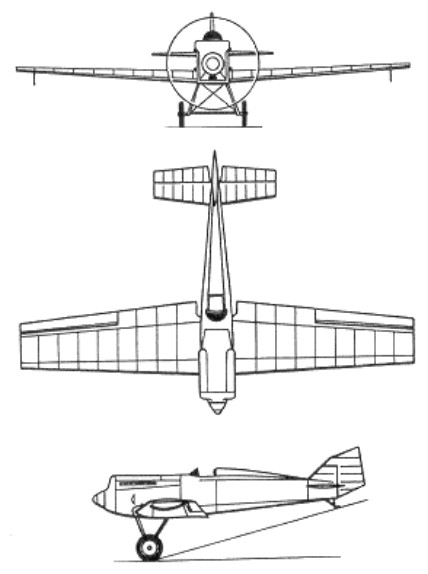
The first prototype of this diminutive single-seat unequal-span biplane flew on 29 April 1930. Power was provided by an imported Gnome-Rhone Jupiter VII radial engine with individual helmet-type fairings over each cylinder head. The second prototype was named Klim Voroshilov after the Soviet Defence-Minister. It had a Jupiter VI radial and was intended for low-level operations. The third and final prototype had a Soviet M-15 radial engine with a ring cowling. In the summer of 1930 seven evaluation aircraft were built, powered by the 358kW M-22 radial – in fact a Russian version of the Jupiter VI. Tests were successful and series production was undertaken. A total of 803 was built and the type formed the main equipment of Soviet fighter units until 1936.
Standard armament of the I-5 was two synchronised 7.62mm PV-1 machine-guns and up to 40kg of bombs could be carried on underwing racks. The circular-section fuselage had a metal tubular framework with metal sheet covering forward and fabric aft. The wooden wings were fabric covered. The axle-type undercarriage could be fitted with wheel spats.
A number of I-5s were still in use at the time of the German invasion of the Soviet Union in June 1941, when a few were pressed into service by Black Sea naval airmen for ground attack. Interestingly, I-5s had previously been used in Soviet Zveno ‘parasite’ experiments, being launched in the air from the TB-3 mother ship.
Engine: 1 x M-22, 355kW Max take-off weight: 1355 kg / 2987 lb Empty weight: 943 kg / 2079 lb Wingspan: 10.2/7.4 m / 33 ft 6 in / 24 ft 3 in Length: 6.8 m / 22 ft 4 in Wing area: 21.3 sq.m / 229.27 sq ft Max. speed: 278 km/h / 173 mph Cruise speed: 250 km/h / 155 mph Ceiling: 7300 m / 23950 ft Range w/max.fuel: 660 km / 410 miles Armament: 2 x 7.62mm machine-guns Crew: 1
Polikarpov D-2 (DI-2) two-seat fighter in its original version.
Despite the failure of the 2I-N1 fighter, the VVS was not willing to give up having a two-seat fighter. In 1927 it was decided to obtain a model from the I-3 single-seat fighter, which was successfully mass produced.
Nikolai Polikarpov considered it more important to work on the creation of the I-5 single-seat fighter with an air-cooled engine and expressed his opinion at the meeting of the Aviotrust technical committee, held on August 12, 1927. Despite his opinion, the development of the I-5 fighter with a 480 hp Gnôme-Rhöne Jupiter engine was entrusted to TsAGI and the OSS collective, under the direction of Polikarpov, received the task of creating the D-2 or DI-2 (Russian: Поликарпов Д-2 (ДИ-2)) two-seat fighter. with 500 hp BMW VI engine.
Constructively, the DI-2 two-seat fighter repeated the layout and characteristics of the I-3 single-seat fighter.
The construction was mixed. The fuselage was presented as a monocoque wooden structure. The structure was made up of 4 stringers, 4 stringers and 13 frames. The stringers were constructed from rectangular pieces of pine wood. Towards the tail section the sectional area of these spars decreased.
The construction of the fuselage at Factory No.25 was carried out in two halves. On a mold with the appropriate shape, the coating began with sheets of birch bark in several layers, fixed with the use of glue. In the bow area, 5 layers were used and only four in the tail area. Between each application of a layer, the previous one was left to dry for 6 – 7 hours. Once the gluing process was completed, the entire structure was left to dry for 10 – 12 days.
The two halves were located on the wooden structure, fixed with screws and nails. In the joining area, a 50 mm wooden strip was placed, which was glued and also fixed with screws. The fuselage, once completed, was painted with two layers of enamel and the bow area was protected by sheets of duralumin.
The engine cowling was fixed to the structure, in the same way as the upper part of the fuselage located from the machine gun position to the windshield of the pilot’s position. Behind the gunner’s position the fuselage continued with a duralumin upper fairing, which could be removed and to which the rudder control cables were attached.
The wing box was made up of planes of different spans joined by N-shaped supports made of aluminum tubes. These supports were fixed to the wing using screws, which also served to adjust the wing. The upper and lower planes had a Clark Y profile and a double wooden spar structure with plywood covering from the leading edge to the first spar. The upper plane featured ailerons constructed from a fabric-covered duralumin structure. To attach the ailerons, the upper plane had a third additional spar.
The upper center plane in its front part had two tanks intended to store water and fuel. The fuel tank, with a capacity of only 2.5 liters, was used to start the engine, reaching the engine by gravity. The second, slightly larger tank was part of the engine cooling system. This system was composed of a retractable honeycomb radiator. The retraction system was operated from the cockpit using a crank located on the left side of the cockpit.
The tail unit featured aluminum construction. The keel was made of wood and was incorporated into the structure of the plane. To facilitate flight control in different regimes, the stabilizer could vary its deployment angle. This angle could be modified by the pilot in flight using a lever located on the right side of the cockpit.
The landing gear was of the conventional type with a tail skid. The main landers featured a steel skeletal structure with duralumin fairings with a central flat piece within which the rubber shock absorbers were located. The half-axles of the wheels in the central area were joined by a common axle. To guarantee greater rigidity, support arms were used. The spoked wheels had dimensions of 800 x 150 mm. It is noteworthy that in many cases the spokes were covered by duralumin discs to improve rigidity. The tail skid was made of duralumin and had cushioning using a rubber strip. Its operation was synchronized with the position of the rudder.
In winter the wheels were replaced by ash skis similar to those used by the R-1.
The D-2 was equipped with the BMW VI liquid-cooled engine with a nominal power of 500 hp and a maximum calculated between 680 and 730 hp. This engine was considered high altitude, prepared to obtain its highest performance at altitudes of 2500 – 2700 m.
The fuel system, apart from the small tank on the upper plane, consisted of a tank located in the fuselage. The engine was powered by AM type fuel pumps that were driven by the engine itself.
The engine was started by using a 5 liter cylinder of compressed air. In case of failures, an emergency starting system was used.
The cockpit equipment was quite standard for a fighter of the time. Of note is the use of a large AP compass located under the instrument panel, between the pilot’s legs.
The D-2’s armament consisted of a pair of synchronized PV-1 machine guns firing through the propeller and one or two PV-1 machine guns in a ring mount located in the gunner’s cockpit. For aiming, the pilot used an OP-1 type collimator located in the center of the windshield. As additional support, a KP-5 annular mechanical collimator was located on the right side of the fuselage and near the windshield.
The technical task for the construction of the two-seat fighter was modified several times. In 1928 Polikarpov received the task of designing the ND-2 night fighter and the builder himself presented a version with a 480 hp Gnôme-Rhöne Jupiter radial engine. However, these “deviations” were discarded and finally the D-2 was built from the original specifications.
The BMW VI- powered D-2 prototype was built at Factory No.25 in the spring of 1929.
D-2 two-seat fighter in original version
Factory tests began on March 15 and lasted until July 1929. The plane was flown by test pilot BL Buxgolts and in his opinion the plane showed no disadvantages of any kind in relation to most fighters of the time. With the installation of more powerful weapons, this fighter could be more effective than single-seat fighters.
On the other hand, Buxgolts highlighted that the D-2 had a centering that was too late, which affected the characteristics of the plane in a spin.
After the development of the tests, the plane remained abandoned for a long time, almost a year, due to the lack of requests for the continuation of the work. By this time Polikarpov was arrested and Factory No.25 was absorbed by Factory No.39.
In the spring of 1930 work on the D-2 fighter was continued. In order to improve the behavior in spin, the tail unit was modified by adding V planes located with an inclination of 8º with respect to the horizontal. This type of tail was used for the first time in the USSR).
Other modifications included the addition of a TUR-7 turret to the rear gunner position. This new installation was simply a TUR-6 ring mount with the ring diameter reduced from 710 to 636 mm. Two paired Lewis machine guns were originally installed there, but later a single Degtiariov light machine gun for aircraft was located there.
On June 13, 1930, the first flight was made with the new V-tail unit. Kozlov was appointed as test pilot. The following days were dedicated to making certain adjustments and the aircraft was transferred to the NII VVS to begin state testing.
In the NII VVS the D-2 was flown by Buxgolts, Zhukov and Pisarienko. None of these pilots in their reports stated anything in relation to the new tail unit. Only Buxgolts describes that he failed to notice any improvement in the plane’s behavior.
The general assessment was positive, considering that the D-2 was overall a good combat aircraft. A request was made to develop a small batch in series, mainly motivated by the need for VVS in two-seat fighters.
At the end of July 1930, pilot Vladimir Ivanovich Chekariov joined the D-2 tests. By that time, a total of 6 hours and 48 minutes of flight had been reached.
On August 4, 1930, Chekariov received the task of testing the control of the D-2 at altitudes of 3000 m, but the first flight of the day, carried out together with the observer Vasily Ivanovich Blagonadiezhni, was intended to measure the maximum ceiling of the plane. Equipped with oxygen cylinders and masks, the pilots soared until they reached a height of 7,170 meters and landed happily.
After a rest they began to prepare to make the second flight. Responsible for the flights that day was the head of the first brigade of the fighter department of the NII VVS Nikolai Alexeyevich Zhemchuzhin. According to his words, the pilot Chekariov, when heading to the second flight, said: “Now I will tame him as he should. ”
The pilot was referring to pushing the plane with maximum overloads. Zhemchuzhin snapped: “Stop this nonsense, this is not the VT” (he was referring to the VT-11 or I-5, flown by Chekariov).
Among the ground observers were the renowned builder and assistant to the head of the TsKB-39 D. P. Grigorovich and the deputy head of the TsKB I.M. Artamonov. According to their statements, after executing its task the plane came out of the clouds at a height of 1,200 m and then began to descend in a spiral to about 100 m. Observers noted a strong vibration in the tail, which would soon be accompanied by the destruction of the right section of the stabilizer. This caused the destruction of the wing box and the plane hit the ground. The crew died instantly. Despite having both parachutes, it was impossible for them to leave the plane due to the low altitude.
Investigations showed that the vibration in the tail had been noticed before, but none of the testers had given it importance. It was considered that when the tail was raised, the upper wing exerted an important influence on its operation, which caused these vibrations.
It was considered that the rough handling of the plane resulted in damage to the attachment points and the vibration accelerated the process, which ended in the destruction of the tail.
With the loss of the D-2 the small batch approved for production was cancelled. The accident contributed to worsening the position of the detained Polikarpov and his specialists.
Despite the loss of the D-2 prototype, work on the development of two-seat fighters did not stop. Following VVS requirements, the development of a combat and reconnaissance version with a BMW VI engine began , whose model was presented for evaluation on October 8 , 1930 . This project would never be finished because the DI-3 would soon appear, created in the OGPU system and in which great hopes were placed.
Powerplant: 1 x 730 hp BMW VI Wingspan: 11.80 m / 39 ft 9 in Wing area: 31.80 sq.m / 342.29 sq ft Length: 8.20 m / 27 ft 11 in Height: 3.12m Max take-off weight: 2122 kg / 4678 lb Empty weight: 1557 kg / 3433 lb Fuel capacity: 210 kg Lubricant capacity: 33 kg Total load capacity: 565 kg Wing loading: 67.0 kg/m² Power load: 2.9 kg/hp Max. speed: 256 km/h / 159 mph at SL Speed at 5000 m: 243 km/h Landing speed: 100 km/h Cruising speed: 231 km/h ROC: 455 m/min Range: 510 km / 317 miles Endurance: 2 hours Service ceiling: 6,300 m Spin time: 14s Time to 1000 m: 2.2 min Time to 2000 m: 4.5 min Time to 3000 m: 7.2 min Time to 5000 m: 17.5 min Landing run: 250 m Takeoff run: 180 m Armament: 4 x 7.62 mm PV-1 machine guns Accommodation: 2
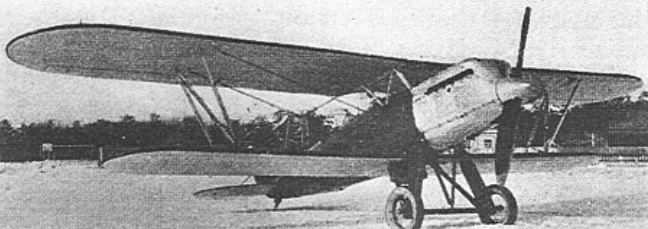
Trouble with the I-1 monoplane led Polikarpov to design a new fighter as a biplane, and in 1927 the I-3 appeared. Powered by a 447kW M-17 engine, it entered production and service, later being supplemented but not replaced on production lines by the superior I-5. Several hundred I-3s were built.
Engine: 1 x BMW-VI, 370kW Max take-off weight: 1863 kg / 4107 lb Wingspan: 34 ft 10 in / 30 ft 6 in Length: 8.1 m / 27 ft 7 in Height: 4.1 m / 13 ft 5 in Max. speed: 280 km/h / 174 mph Ceiling: 7200 m / 23600 ft Range w/max.fuel: 580 km / 360 miles Crew: 1 Armament: 2 machine-guns
The Polikarpov 2I-N1 or DI-1 (Russian: Поликарпов 2И-Н1 (ДИ-1)) aircraft was designed under the direction of NN Polikarpov as part of the experimental aeronautical construction program approved in October 1924 and conceived for three-year development.’’
Its name 2I-N1 means Dvuxmiestni Istrebitel c odnim Napirom or Two-seat fighter with a Napier engine, although it was also known as DI-1 or Dvuxmiestni Istrebitel – 1 (Two-seat fighter – 1).
The 2I-N1 was designed as a single-section sesquiplane of wooden construction. The monocoque fuselage, developed by VM Oljovski, was constructed of glued wooden sheets and plywood was used in some sections. The cross section was circular. The coating varied between 4 mm in the front section and 2 mm towards the tail.
The wings, with an area of 27.15 sq.m, had a double wooden spar structure. The upper and lower planes were covered with 1.5 mm plywood, which made it possible to obtain a very clean exterior surface and lighten the interior structure. The V-shaped interlayer supports were made of duralumin tubes with an aerodynamic section and the braces were laminated steel strips.
The tail unit and ailerons were made of fabric-covered duralumin.
The landing gear, of a conventional tailskid type, featured solid wheels joined by a central piece. Each semi-axle was made up of two support pieces with rubber cushioning.
The power plant, a 450 hp Napier Lion 12-cylinder W engine was installed, allowing a maximum speed of almost 270 km/h. Its fuel capacity an endurance of 2.5 – 3 hours.
According to the project, the 2I-N1 was to be armed with a PUL-9 synchronized machine gun firing through the propeller and a mobile machine gun located in a TUR-3 mount in the gunner’s position. This second machine gun was never installed.
The model was characterized by its clean lines and careful finishing. Unlike the reconnaissance models, the 2I-N1 had much smaller dimensions, reduced equipment and lower fuel capacity, which made it light and efficient. During its development, vibration calculations were carried out for the first time in the USSR.
The design project of the 2I-N1 was completed at the beginning of 1924, but execution was delayed for a few months due to the impossibility of having a Napier engine. Finally, on October 8, 1924, Factory No.1 “Duks” received the order to begin construction. Shortly afterwards, after several discussions on design issues, the final design of the aircraft was defined. On February 9, 1925, the Scientific Committee of the main leadership of the VVS approved the task of developing the two-seat fighter that received the designation 2I-N1. In parallel, the development of a single-seat model called 1I-N1 was approved, but this project would never be completed.
By the beginning of the summer of 1925, the construction of 2I-N1 was proceeding at a good pace. Despite this, on June 15 it was decided to accelerate the work to finish construction by November 15. In practice this proved impossible. On January 1, 1926, the plane was still 90% complete. By this time a brand new Napier Lion engine, purchased from England in December 1925, was received.
The preparation of the 2I-N1 in the factory workshops ended on February 8, 1926, and by the 9th of that month the prototype was transferred to the Moscow Central Aerodrome on the Khodynka field, where preparation for flight was completed. It was winter, so the plane was equipped with skis.
On February 25, 1926, pilot VN Filippov made two first familiarization flights. The next day this same pilot carried out the entire set of high-school piloting figures in the 2I-N1 without any difficulties being detected. The evaluation of the device was excellent. The 2I-N1 surpassed in speed all the single-seat fighters in service with the VVS, even operating with skies.
According to Shavrov, NN Polikarpov himself participated in two of the test flights as an observer, including the eighth flight, which was intended to define the ceiling of the plane.
On March 31, 1926, on the ninth flight, intended to define the maximum speed in horizontal flight, a tragic accident occurred, resulting in the death of test pilot VN Filippov and timekeeper VV Mikhailov.
The plane had already made several passes over the marked kilometer. In the next pass the plane made a descent to gain speed and level the horizontal flight at a height of about 100 meters. At that time the speed reached (according to ground timekeepers) about 300 km/h, which was exceptional for a two-seater device also equipped with skies. Suddenly on the upper right wing there was a loud crack and the upper surface covering came off, followed by the lower one. The upper right wing collapsed, causing the destruction of the lower wing and the plane, still flying about 500 meters, fell to the ground. The two crew members died as a result of the impact.
The cause of the accident was poor fixation of the plywood skin to the wing structure. In many places the coating did not stick and the fixing screws to the wing ribs, due to assembly errors, were left out. On the other hand, the ventilation windows intended to balance the pressures inside and outside the wing during flight at high altitudes were ignored in the coating. During the high-altitude flight tests on the eighth flight, the attachment of the coating to the wing had to come off due to the difference in pressures, and when the test was carried out at high speed on the ninth flight, the detachment materialized, causing the wing to break.
Another possible cause of the accident appears recorded in the official documents of the VVS management. According to this version, the catastrophe occurred when a dive was made with a sudden attempt to exit it and it is established that initially the explosion occurred in the coating of the lower wing and this resulted in the rupture of the upper wing. These documents also explain that the plane was built using outdated structural resistance standards, despite the fact that during the plane’s design process the VVS had already approved new ones. Despite these facts, the report ends with the phrase: “The causes of the catastrophe have not been clarified so far.”
On June 18, 1926, the head of the VVS RKKA PI Baranov sent a report on the causes of the accident to the president of the RVS of the USSR. In this document it was specified: “The 2I-N1 plane, calculated according to outdated standards, should never have been approved for factory tests… I propose to hand over all the materials to justice so that the culprits can answer”
The issue of the 2I-N1 accident was actually raised to the Supreme Court of the USSR, which in February 1927 requested all documentation of the development of the static tests of the aircraft. The development of the judicial process lasted all year and had a very negative influence on the work of the collective led by NN Polikarpov. Finally, the 2I-N1 accident was one of the main causes of Polikarpov ‘s arrest and his closest collaborators.
Work on the two-seat fighter was never resumed and as a direct result of its failure, resistance standards and technical control of the production process were increased, which caused an unnecessary increase in weight in future models. Also, as a consequence, a rigorous flight test program of the experimental prototypes began to be implemented.
The 2I-N1 would serve as the basis for the development of the I-3 single-seat fighter, which was produced in series, and the DI-2 two-seat fighter, both with a similar layout and construction.
2I-N1 Powerplant: 1 x 450 hp Napier Lion Wingspan: 12.00 m / 39 ft 4 in Wing area: 27.15 sq.m / 292.24 sq ft Length: 9.75 m / 32 ft 0 in Height: 3.32m Empty weight: 1153 kg / 2542 lb Max take-off weight: 1700 kg / 3748 lb Wing loading: 62.5 kg/ sq,m Power load: 3.8 kg/hp Fuel and oil capacity: 300 kg Total load capacity: 547 kg Maximum speed at sea level: 268 km/h / 167 mph Cruising speed: 243 km/h Landing speed: 92 km/h ROC: 385 m/min Practical range: 800 km Endurance: 3 hours Practical ceiling: 7100 m Time to 1000 m: 1.8 min Time to 2000 m: 3.8 min Time to 3000 m: 6.1 min Time to 5000 m: 13.0 min Landing run: 200 m Takeoff run: 100 m Armament: two 7.62 mm machine guns Accommodation: 2
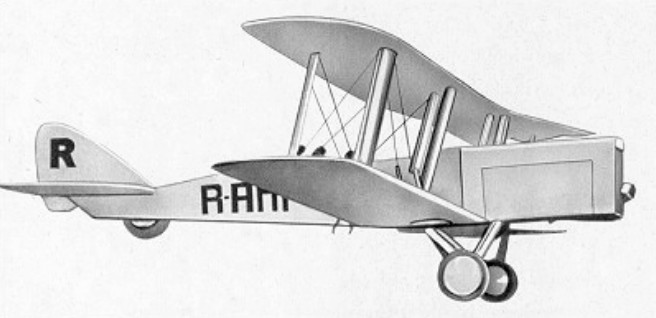
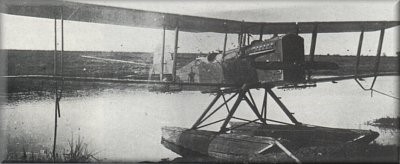
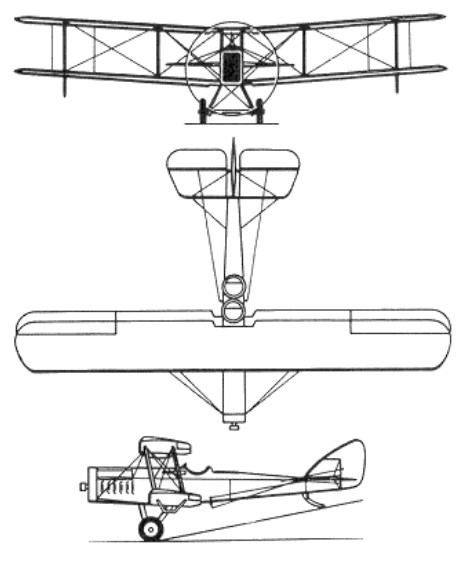
A large single engine passenger aircraft, the prototype Polikarpov PM-1 flew for the first time on 10 June 1925. It was an unequal-span biplane with the upper wing connected directly to the upper decking of the fuselage. The pilot had an open cockpit just forward of the wing leading edge and the enclosed cabin accommodated five passengers. The ‘M’ in the designation arose from the single 194kW Maybach IVa inline engine which gave a maximum speed of 170km/h. Successful flight testing brought an order for 10 aircraft to operate on the routes of the German-Soviet airline Deruluft, but as the result of a crash in Germany it is believed that most of the series aircraft were cancelled.
Engine: 1 x Maybach, 190kW Max take-off weight: 2360 kg / 5203 lb Empty weight: 1380 kg / 3042 lb Wingspan: 15.5 m / 51 ft 10 in Length: 11.0 m / 36 ft 1 in Wing area: 38.5 sq.m / 414.41 sq ft Max. speed: 180 km/h / 112 mph Ceiling: 4100 m / 13450 ft Range w/max.fuel: 1200 km / 746 miles Crew: 2 Passengers: 5
Working at the former Duks factory (GAZ 1) at Khodinka, Moscow, Nikolai N Polikarpov, assisted by I M Kostkin, designed a conceptually advanced single-seat fighter, the IL-400, which flew on 15 August i923. A cantilever low-wing monoplane of wooden construction powered by a 400hp Liberty water-cooled engine, the IL-400 proved longitudinally unstable and crashed shortly after becoming airborne on its first flight. Extensive redesign, both aerodynamic and structural, resulted in the IL-400b (also to be known as the IL-2), which, flown on 18 July 1924, retained a plywood-covered wooden fuselage mated with an entirely new, shorter span, thinner-section wing with dural ribs and corrugated dural skinning. Armament comprised two 7.62mm machine guns. Following State trials, contracts were placed for eight and then a further 25 of a modified version of the fighter which reverted to all-wood construction. Designated I-1M-5 (and also referred to as the IL-3) and powered by an M-5 engine – the licence-built version of the 400hp Liberty – this completed State tests on 16 March 1926. The series I-1M-5 suffered from low manufacturing standards, however, was seriously overweight and dangerously unstable. It was not delivered to service units.
Max take-off weight: 1530 kg / 3373 lb Empty weight: 1112 kg / 2452 lb Wingspan: 10.8 m / 35 ft 5 in Length: 7.75 m / 25 ft 5 in Wing area: 20.00 sq.m / 215.28 sq ft Max. speed: 263 km/h / 163 mph
Airco DH-4 production in Russia at the Dux factory was about to start in October 1917, but manufacturing was frozen due to the absence of the engines, though preparations did not stop. N.N.Polikarpov was steadily working on blueprints for the assembly lines. During the Civil War some of the latest DH-9 and DH-9A were captured, and modifications were included into the project.
When the Bolshevik government decided to gain airpower, one of the simplest solutions was to restart old projects. Intermediately DH-4, DH-9/R-1, DH-9/R-2 were built (1921-1923), using parts imported from the Great Britain. Production of the M-5/Liberty engine allowed the first Soviet mass production aircraft. First combat ready R-1 were built on the GAZ-1 factory under the supervision of N.N.Polikarpov in 1923. They were named “Imeni Izvestij VTsIK” and “Moskowskij Bolshevik”. Mass production started same year at GAZ-10 (Taganrog).
The first squad of 19 aircraft was designated ‘Lenin’ and presented to XIII Congress of the RKP(b) on May 23-31 1924.
It is not correct to call the R-1 a copy of DH-4/9. It was built from all domestic materials, whole construction was revised to utilize technologies available in war burnt Russia. It was heavier, carried more payload and had a substantially strengthened construction.
Group of R-1s performed a Moscow-Peking-Tokyo flight (M.M.Gromov as a leader), proving high quality and reliability of the first Soviet series aircraft.
The R-1 became the first Russian aircraft to be exported – Afghanistan purchased some 20 in 1923-1924.
One hundred and twenty-four of the MR-1 floatplane version of the R-1 with wooden floats were built.
All-metal floats for the R-1 were designed by engineer Munzel. The float skin was corrugated aluminum and the underside smooth aluminum. The floats were attached to system of struts (14 tube elements). The steel tubes had an aerodynamic cross-section.
As the PM-2 floatplane ( Polikarpov and Munzel) / MR-2 trials were performed during Fall 1927 by pilot Ya.N.Moiseev, timing by V.V.Nikitin. Performance was better than one of the MR-1 on wooden floats due to substantial weight savings.
PM-2
Only one was built and no production followed due to shortage of aluminum and light alloys.
The R-2 biplane reconnaissance aircraft was based on the R-1.
During 1924-1931 approximately 2800 were produced.
Engine: 1 x M-5, 295kW Max take-off weight: 2200 kg / 4850 lb Empty weight: 1450 kg / 3197 lb Wingspan: 14.0 m / 46 ft 11 in Length: 9.2 m / 30 ft 2 in Height: 3.3 m / 11 ft 10 in Max. speed: 200 km/h / 124 mph Cruise speed: 185 km/h / 115 mph Ceiling: 5000 m / 16400 ft Range w/max.fuel: 700 km / 435 miles Armament: 2 machine-guns, 200kg of bombs Crew: 2