Polyteknisk Flyvegruppe Polyt V

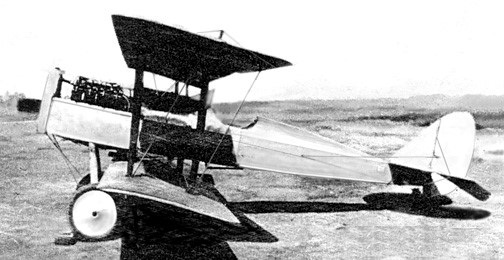
The Polyt V, sometimes written as Polyt 5, was intended from the start as a glider tug. It was designed by six graduates and student members of the Flying Group of the Technical University of Denmark, Copenhagen, (Led by Helge Petersen) a group comprising about 50 students and graduates of that University. As many as 20 other Group members built the aircraft.

It is a low wing, single-seat monoplane with a fixed tricycle undercarriage and a high T-tail, powered by a 200 hp (150 kW) Lycoming IO-360-A2B flat four engine, driving either a Polyteknisk two-blade fixed-pitch wooden propeller or a Hoffmann HO27-HM-205B-105 two-blade propeller.

For cooling the engine during low-speed flight, a 21 in (53 cm) diameter fan with 16 plastic blades is mounted in the circular air intake behind the propeller and is capable of blowing some 3,500 cu.ft (99 cu.m) of air per minute – about four times the normal cooling flow. To prevent excessive cooling the under-nose cooling flap aft of the cowling closes automatically during a dive. Fuel in two aluminum tanks in the wings, total capacity 23.24 gal (88 l). Overwing refueling point in each tank. Oil capacity 1.98 gal (7.5 l).

Its wings are built around a wooden box spar and plywood covered except for fibreglass leading edges. Wing section NACA 63-618 at root, NACA 63-218 at tip. Dihedral 4° from roots. Incidence 2°. No sweepback. They carry wide span ailerons with centrally-located trim tabs; inboard are glider style aluminium spoilers or airbrakes which can be extended to 50° to slow the aircraft after a diving release of the glider. When deployed, the spoiler surfaces extend both below and above the wing, the upper part perforated. These surfaces are carried on a shaft at 80% chord, the portion ahead of this shaft being perforated and the rear portion plain. Of aluminum construction, they have a maximum deflection of 50°; their use has no affect on lift or trim.

The tail surfaces are all wood structurally, with plywood covered fixed surfaces and a fabric covered rudder with a short trim tab. The all moving, fabric covered, constant chord tailplane carries full span anti-tabs. Trim tab in rudder.

The fuselage of the Polyt V is a plywood covered box structure, the pilot sitting over the wing under a single piece, rearward-sliding canopy. An electrically driven winch at the rear retrieves the launch cable, which exits the aircraft at the narrow extreme stern of the fuselage, at a rate of about 1 m/s.

Non-retractable tricycle type landing gear. The main wheels are mounted on a 3 m diameter semi-circular glass fibre gear legs one-third arc of a circle of 6 ft 6.5 in (2.00 m) diameter attached to the fuselage underside Cessna CFP 4097 main wheels. The nose wheel unit (leg, wheel and shock-absorber) is largely that of a Piper Colt, fitted with shimmy damper from a Cessna 172. All tires size 600 x 6, pressure 24 lb/sq.in (1.69 kg/sq.cm).

Accommodation is a single seat for pilot under fully-transparent rearward-sliding canopy. Cockpit heated and ventilated. Electrical system includes AC alternator and 12V battery for engine starting, instruments, lights and towing winch. Vacuum pump for directional gyro. Equipment includes an electrically-operated winch in the rear fuselage, which can reel in over 130 ft (ca. 40 m) of nylon tow line in 40 sec after sailplane is released. Aircraft can make seven or eight launches an hour.
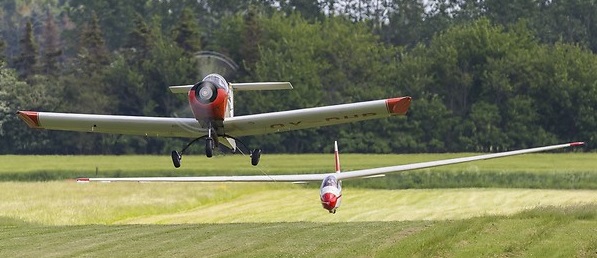
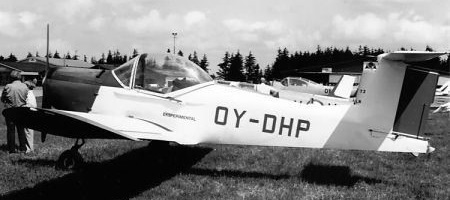
The Polyt V flew for the first time on 12 April 1970, construction having started in 1965. The Polyteknisk Flyvegruppe have used the sole Polyt V to launch their various gliders from 1970 to at least 2006. OY-DHP (c/n 12001) remained on the Danish register in 2010 and was still active as a glider tug. Some modifications have been made: the original Polyteknisk designed propeller, optimised for low speed flight has been replaced by a quieter Hoffmann one and the rudder trim tab has been extended to half rudder height.

Specifications
Engine: 1 × Lycoming IO-360-A2B, 150 kW (200 hp)
Propeller: 2-bladed Polyteknisk designed wooden fixed pitch
Prop diameter: 2.05 m (6 ft 9 in)
Length: 6.20 m (20 ft 4 in)
Wingspan: 9.60 m (31 ft 6 in)
Wing aspect ratio: 6.35
Wing chord, constant: 4 ft 11 in (1.50 m)
Height: 2.60 m (8 ft 6 in)
Wing area: 14.4 m2 (155 sq ft)
Empty weight: 615 kg (1,356 lb)
Max takeoff weight: 760 kg (1,676 lb)
Wing loading: 10.8 lb/sq.ft (52.8 kg/sq.m)
Power loading: 8.38 lb/hp (3.8 kg/hp)
Tailplane span: 9 ft 10 in (3.00 m)
Ailerons area (total) : 17.87 sq.ft (1.66 sq.m)
Air-brakes/flaps area (total): 10.98 sq.ft (1.02 sq.m)
Fin area: 12.92 sq.ft (1.20 sq.m)
Rudder area, incl. tab: 5.06 sq.ft (0.47 sq.m)
Tailplane area, incl. tab: 29.06 sq.ft (2.70 sq.m)
Wheel track: 7 ft 0.5 in (2.15 m)
Wheel base: 4 ft 9 in (1.5 m)
Propeller ground clearance: 6 in (15 m)
Maximum speed: 200 km/h (124 mph; 108 kn) at sea level
Max dive speed: 144 mph (232 kmh)
Cruising speed: 185 km/h (115 mph; 100 kn) maximum at sea level
Econ cruise speed: 103.5 mph (166 kmh) at sea level
Stall speed: 46 mph (74 kmh)
Endurance: about 2 hrs
Service ceiling: 5,500 m (18,045 ft)
Climb, solo: 1,575 ft (480 m)/min
Climb, with single-seat glider: 1,050 ft (320 m)/min
Climb, with two-seat glider: 820 ft (250 m)/min
Takeoff run, solo: 280 ft (85 m)
Takeoff run, with single-seat glider: 510 ft (155 m)
Takeoff to 50 ft (15 m), solo: 460 ft (140 m)
Takeoff to 50 ft (15 m), with single-seat glider: 900 ft (275 m)
Landing run from 50 ft (15 m): 920 ft (280 m)
Landing run: 460 ft (140 m)
Crew: 1
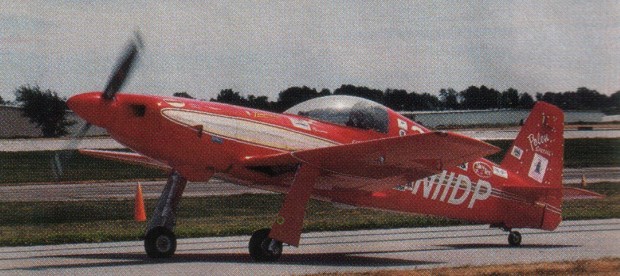
Polson Special

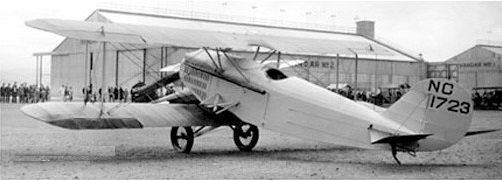
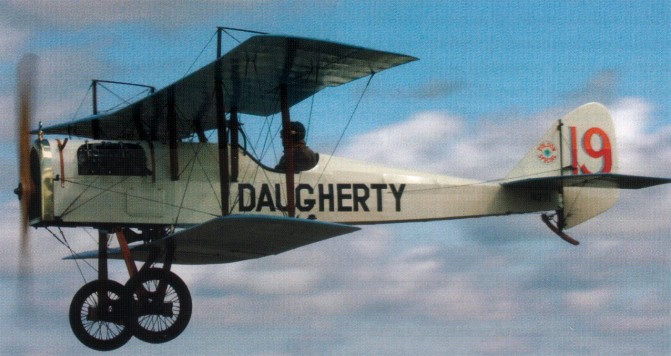
The Polson Special C/NC1723 was built between 1917 and 1925 by Thor Polson of Long Beach, California, for Earl Daugherty who was a regular participant in air shows, stunt displays and air racing post WW 1.

1922

The aircraft was restored by George Jenkins of St. Davids, PA, and flew again from Brodhead, after 83 years.

Engine: OX-5 V-8, 90 hp

1927
1927

Polliwagen Polliwagen

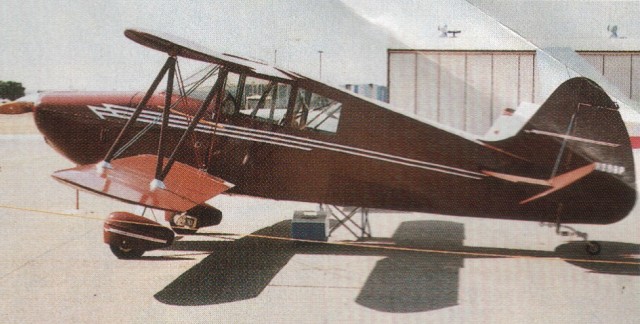
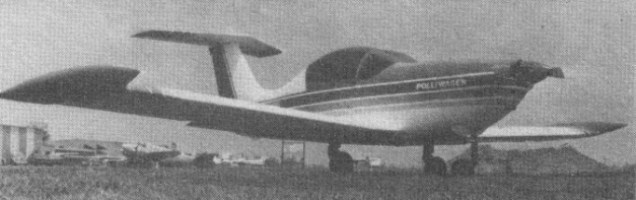
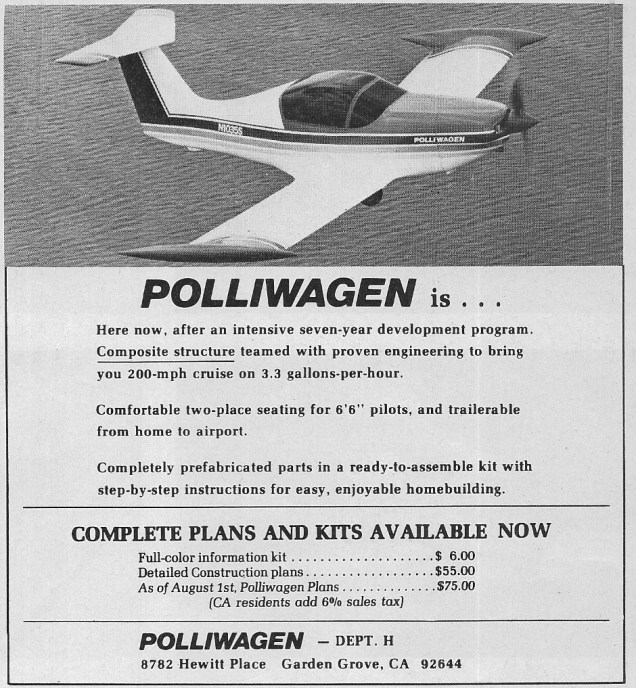
Designed by Argentine-born Joseph Alvarez in 1973, the Polliwagen derives its name from its appearance and its engine type. It is powered by a Revmaster R-2100-D turbocharged Volkswagen conversion. The Revmaster is closely cowled behind a two-position, constant-speed Maloof metal propeller of 59 inches diameter. The Polliwagen’s ex¬ceptionally clean lines give it an excellent speed-to-power ratio as well as fine aerodynamic handling characteristics. The wings are Wort¬mann FX-67-K-1 50 wing section with full-span trailing edge flaps and ailerons. Both the wings and fuselage make use of foam/epoxy com¬posite construction. Prefabricated parts are also offered in the Polliwagen kit including: molded windshield and canopy, landing gear, disc brakes, complete panels, composite structure wingtip fuel tanks, outward-breaking cabin structure, T-tail, etc.
First year built: 1978. Units delivered to June 1981: 300 kits, 65 flying. Price 1982: $5,500 (Excludes engine).

April 1982

Engine 78-hp Revmaster VW
Gross Wt. 1250 lb
Empty Wt. 650 lb
Fuel capacity 25 USG
Wingspan 26 ft
Length 16 ft
Wing area: 90 sq.ft
Top 200+ mph
Cruise 180 mph
Stall 51 mph
Climb rate 925 fpm
Range 1000 fpm
Takeoff run 500 ft
Landing roll 500 ft
Seats: 2

Polikarpov ARK-5

Mikhail Vodopyanov during the salvation of the crew of the steamship Chelyuskin used an R-5 specially prepared for Arctic operations. On these flights Molokov used the containers for people designed by Grojovski, which allowed him to save 39.

In correspondence with the polar exploration plans of the 30s the management of the Glavsievmorputi prepared for 1936 a flight from Moscow to Franz Josef Land. This flight was not intended to break any records, it was only to study the access routes for the conquest of the North Pole, the recognition of flight paths and the conditions of the ice in the Kara and Barents Seas. Pilots were also required to collect information on climate and weather changes.

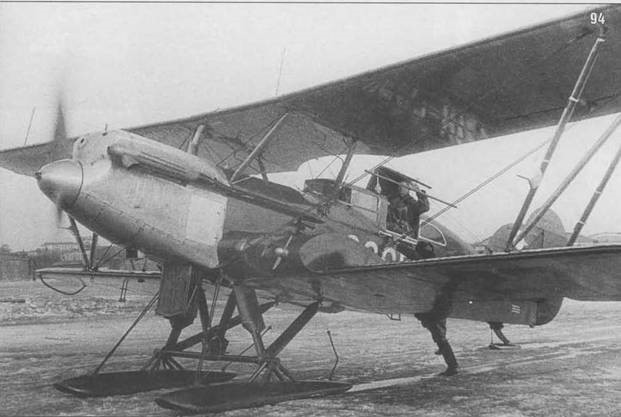
For this task two examples with closed cabins were modified. The changes in this case were very careful. This modification would be named Polikarpov ARK-5 (Russian: Поликарпов АРК-5) to highlight its Arctic use.

The crew of the ARK-5 was increased to three people. The cabin was modified and equipped with a heating system from hot air from the engine. The overboard containers, previously used on the LP-5s, were enlarged so that spare propellers, skis, tents and an inflatable boat could be stored.

All the equipment was calculated so that in case of a breakdown the crew would be able to return to the mainland by their own means, counting on food reserves for the three crew members for 45 days.

Built at Glavsievmorputi Workshops, both aircraft received registrations of the Glavsievmorputi СССР Н-127 and СССР Н-128 and were painted in intense green and red colors.

March 28, 1936

The main aircraft, with number Н-127 was equipped with radio beacon and radio compass, radio station MRK-0.04 with a rigid antenna on the upper plane. The Н-128 received lighter equipment, being equipped with a shortwave radio station for ground contacts and with the Н-127.

As commander of the expedition was appointed M. V. Vodopyanov. Its crew consisted of mechanic F. I. Bassein and radista S. A. Ivanov. The second aircraft was flown by V. M. Majotkin, with V. L. Ivashin as mechanic and V. I. Akkuratov as radio operator.

ARK-5 of M. V. Vodopyanov at Moscow airfield in March 1936.

The planes took off on March 28, 1936 and in general the route did not present problems, which demonstrated the feasibility of flights at high latitudes. This expedition allowed to gain experiences in the preparation of future expeditions and to develop the idea of landing groups at the North Pole, which would be carried out in 1937.

On May 21, only one plane, the Н-127, arrived in Moscow. The second plane was damaged on the way back, near Tijaya Bay.

At the time of the breakdown the crew was in good physical condition. The plane was abandoned and the crew picked up by an icebreaker.

In 1935, two new ARK-35s were prepared at the Repair Factory No.5 in Smolensk.

These aircraft were characterized by the structure of the cabin deck made of steel. Part of the fuselage structure was replaced by duralumin parts.

In the front cockpit was the pilot and in the rear the mechanic, the radista and two passengers. The side containers were enlarged. On the left a compressor was installed with its engine, which allowed the engine to be started from compressed air even after a long stay on land.

At the front of the containers electric current generators were installed using fans. The one on the left for the radio station and the one on the right for lighting. One of these aircraft received a radio compass.

Polikarpov 2B-R2

In March 1919 Polikarpov was selected as head of the technical department of the former Duks factory, soon to be renamed State Aviation Factory No.1 or GAZ No.1. In 1920, the first Soviet aircraft would be projected and built in GAZ No.1 and just three years later, it would already plan the construction of a multi-engine military aircraft known as 2B-L1 and powered by two 400 hp Liberty engines.

Nikolai Polikarpov’s construction activity was generally linked to fighters, but Polikarpov’s beginnings in aviation were directly linked to the Ilya Múromets bombers designed by Igor Sikorsky.

The development of this bomber began at GAZ No.1 in 1924 and the project was led by engineer L. D. Kolpakov-Miroshnichenko. Polikarpov had no relationship with the development of this project, since with the arrival of D. P. Grigorovich he would be excluded from the factory and transferred to the Glavnoavia aeronautical construction department. However, by the fall of that same year, after Grigorovich’s departure, Polikarpov would return to GAZ No.1 as head of the construction bureau. Once in this position he refused to take part in the construction of the 2B-L1 and acting as a consultant, he basically became a critic of the bomber.

The plane, however, began to be built. The VVS, foreseeing the possibility of practical use of the model, decided to replace the designation 2B-L1 with B-1, but it would soon become clear that the new bomber did not satisfy many of the requirements imposed by the military. This was the main reason why, even without finishing the B-1, it was decided to start working on a new bomber, which was called the B-2.

According to the requirements issued by the VVS management, the new bomber had to incorporate 3 to 4 Liberty engines. The B-2 should lift a weight of 1000 kg with an average speed of 170 km/h and transport it over a distance of 1000 km.

To meet this new requirement, the GAZ No.1 construction bureau developed six possible bomber variants:

  1. 4B-L3 – biplane with 4 Liberty engines and takeoff weight of 9 tons;
  2. 4B-L3 – biplane with 4 Liberty engines and takeoff weight of 10 tons;
  3. 4B-L3 – sesquiplane with 4 Liberty engines and takeoff weight of 11 tons;
  4. 3B-L3 – sesquiplane with 3 Liberty engines and takeoff weight of 9 tons;
  5. 3B-L3 – monoplane with 3 Liberty engines and takeoff weight of 8-9 tons;
  6. 4B-L3 – monoplane with 4 Liberty engines and takeoff weight of 10 tons.

Within this list were included projects by Polikarpov, Kolpakov-Miroshnichenko and Krylov.

Interest in these works remained between July and October 1925, but by this date it had already been decided to abandon the option of the Liberty engine, considering it lacking in perspective and to redesign the bombers with two 600-hp Wright Tornado North American engines.

As a basis for this new design, it was decided to use the French Farman Goliath bomber. Several of these aircraft had been acquired and arrived in Leningrad at the beginning of October.

To evaluate this foreign bomber and become familiar with its assembly, it was decided to send a group of specialists from GAZ No.1 to Leningrad. Polikarpov managed to ensure that neither Kolpakov-Miroshnichenko nor Krylov were included in this group, leaving the competition aside.

Already in the autumn of 1924 Polikarpov, head of the construction bureau and later head of the experimental department, had managed to establish a new, more effective system of work organization. The main objective of this new system was destined to gradually relegate the work of the old engineer-builders, accustomed to developing, approving and building their models based on their customs and points of view. The new structure of the OKB planned to use a system similar to the one adopted by A. N. Tupolev at the TsAGI, where a group of engineers defined the general concepts and then the different departments worked on the development of the components and systems.

The new B-2 bomber with two Wright Tornado engines, in its development stage began to be called GAZ No.1 2B-R2. The project began development in the spring of 1926.

Because the Wright Tornado engine had to be used in other types of devices, the possibility of buying a certain amount and then copying the model was valued, in the same way that this had been achieved with the Liberty.

The 2B-R2 was designed as a twin-engine biplane of mixed construction and was characterized by its bi-derived tail with double horizontal planes. The landing gear was of the conventional and fixed type.

Despite the great projection work carried out and the progress in the work, in April 1926 it was decided to cancel the VVS request for the 2B-R2 bomber. The main reason was the appearance of the all-metal Tupolev ANT-4 bomber, developed at TsAGI at the request of the Ostiexbyuró. The VVS management, pleased with the results of this new model, otherwise quite superior to the 2B-2R, decided to introduce it into service with the designation TB-1.

After a year and the appearance of some problems in the development of the TB-1 due to the lack of practice in the use of metal construction, it was decided to develop an alternative version of mixed construction. This job was assigned to Polikarpov’s collective and would be the basis for the TB-2 bomber.

2B-R2
Engines: Two 600 hp Wright Tornado
Empty weight: 5200 kg
Maximum takeoff weight: 9150 kg
Payload: 3950 kg
Maximum speed: 180 km/h
Practical ceiling: 4000 m
Bombload: 1500 kg
Accommodation: 5

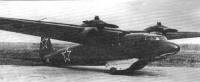
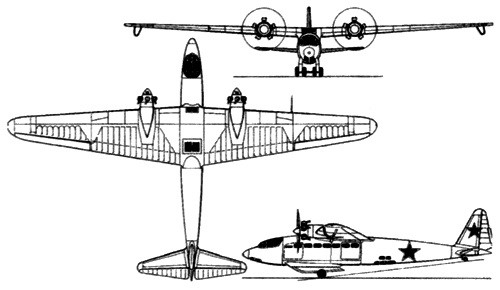
Polikarpov MP

The excellent results obtained during Aeroflot’s experimental use of the BDP-2 prototype as cargo transport made Polikarpov think about the possibility of developing a motorized model, especially that there was talk of the possibility of producing a small series.

To achieve this goal, two cowled 145 hp M-11F engines were installed on the wing leading edge. The new model was called MP (Russian: Поликарпов М П), short for Motoplanior (motor glider).

In the MP operation, the autonomous take-off variant was envisaged, but with the full load capacity the low power of the engines was unable to guarantee take-off. Generally, the MP had to take off and even arrive at the site of operations dragged by a tow plane, but after dropping its load, unlike conventional gliders, it could return to its airfield using the installed motive power.

As a small capacity transport aircraft, the MP could carry 12 equipped soldiers or a similar weight capacity.

The MP motor glider generally maintained the constructive characteristics of the BDP glider. It was designed as a monoplane with a high wing of 20 meters of wingspan and a fuselage with an aerodynamic design. The entire construction was made of wood.

The fuselage was entirely made of wood and featured monocoque construction.

The exit of personnel and cargo was carried out through two doors of 860 x 900 and 850 x 950 mm, one located in the front region on the right and the other in the rear on the left. In the lower part of the fuselage, behind the cargo area, a hatch was prepared to leave the parachute glider.

The pilot had an emergency cover with a structure also in wood. To improve visibility during landing, the lower area of the cabin was glazed. People sat on benches located on the sides of the glider, attached to the fuselage frame. Between the two benches there was a 600 mm wide corridor.

The wing of the BDP was made of wood and featured a double-spar centre and single-spar consoles. The coating of the leading edge and the force points was done with plywood. The rest of the wing was covered with fabric. The wing profile used was the NACA 230. In order to reduce the landing speed in the section between the ailerons and the fuselage, Shrenk-type flaps were installed.

The tail was monoplane and cantilever, constructed of wood covered with plywood and fabric.

The landing gear on this model was modified with the addition of wheels to the basic glider ski gear. These wheels were installed in two rows under the fuselage and featured rubber cushioning.

The powerplant consisted of two 145-hp M-111M-11F engines located on the wing leading edge and cowled, moving 2.35-meter propellers from Polikarpov U-2 training aircraft. The fuel capacity allowed for 7 hours.

The glider did not have its own weapons, but did have attachment points for seven DP-type infantry machine guns. Two machine guns could be installed in special hatches located in the area of the leading and exit edges of the wing to defend the upper hemisphere. To defend the tail a section of the upper rear fuselage could be raised and become a firing point for the gunner. Two other positions were located to the sides.

Inside the fuselage were 12 5.5 mm armored plates of 480 x 550 mm. The pilot had armor on the back of the seat. All this armor added 127 kg to the weight of the glider.

The motor glider was built ay the Novosibirsk Factory No.51 in the summer of 1943. The acceptance tests were carried out at the Moscow Central Airfield with flights to the Air Landing Forces (VDV) airfield at Medvied Lake and to the LII airfield in Ramenskoye. These flights were developed by the chief of flights and test pilot of the OIAE VDV Captain SA Anojin.

Between July 12 and September 10 of 1943 70 flights with a total duration of 40 hours and 10 min were performed. In flights towed by an SB bomber, heights of 4500 meters and speeds of 270 km / h were reached.

As a conclusion of the tests the pilots VN Yuganov, VL Rastorguyev, GM Shiyanov, AN Grinchik, PF Fedrova, PM Stefanovski, VV Shevchenko, AK Dolgov, PG Savtsov, Gavrilov, Romanov and Borodin wrote that the MP had good stability, it was simple in the piloting, accessible to pilots of low qualification. With a single engine and a flight weight of 3000 kg the aircraft was easily controllable, keeping its flight horizontal and responding to turns.

Between September 10 and 13, 1943 the MP was tested by the VDVs. Load tests were carried out with 4000 kg in different variants:
11 armed infantry soldiers with light weapons;
A group of anti-tank artillery made up of 6 soldiers with a 45 mm piece and two shell boxes (40 units). Assembly of the barrel to its operational state took 8-10 minutes;
A DShK antiaircraft battery with its 5 servers and ammunition;
A light anti-tank group with 10 soldiers and three anti-tank weapons;
Two or three motorcycles (3 of the Velosiet type or 2 Indiana).

The excellent layout of the motor glider for these configurations was highlighted and its use was recommended for VDV units and transport aviation. Series production of the model was also proposed.

Despite these results, the MP was never produced. By that time the Red Army had liberated a large part of the territory occupied by the Germans and the supply needs of the guerrilla groups had diminished.

Only the prototype was produced.

Polikarpov MP
Engines: Two 145 hp M-11F
Wingspan: 20.00 m
Wing area: 44.72 m²
Length: 13.60 m
Height: 3.20 m
Empty weight: 2420 kg
Normal loaded weight: 3500 kg
Payload capacity: 1280 kg
Wing loading: 78.5 kg / m²
Maximum speed at sea level: 185 km / h
Maximum speed at 1000 m: 179 km / h
Range: 390 – 700 km
Endurance: 7 h
Time to 1000 m: 12.5 min
Service ceiling: 2,700 m
Take-off run with 3500 kg: 480 m
Crew: 1

Polikarpov BDP

The 23 of January of 1940 the Commissariat of Aviation Industry created the Directorate for creating landing gliders. In the autumn of that year, in an extraordinary meeting, with the presence of Stalin, the decision was made to launch a competition for the development of airplanes of this type and their series production. The best would be mass-produced and used successfully in operations during the Great Patriotic War.

Nikolai Polikarpov had no experience in glider design, so he did not participate in the competition. Despite this, at the beginning of June 1941 its construction bureau, unexpectedly for many, presented a project for a landing glider. The production of gliders was carried out not in aviation factories, but in carpentry and furniture factories.

The Polikarpov glider was designed as an aircraft to support penetration units. After analyzing the losses of the Germans during the landing operations, the Soviet aircraft manufacturer came to the conclusion that it was possible to reduce them by using well-protected and armed means of landing. To achieve this objective, he designed a glider from which the landing troops, before launching themselves, could direct fire against enemy positions, using their light weapons. The protection of the device was obtained through the use of removable armoured plates, which once landed the glider allowed to create a defensive barrier for the soldiers.

The new glider was named BDP (Russian: Поликарпов БДП), after Boyevoi Disantni Planior or Military Landing Glider.

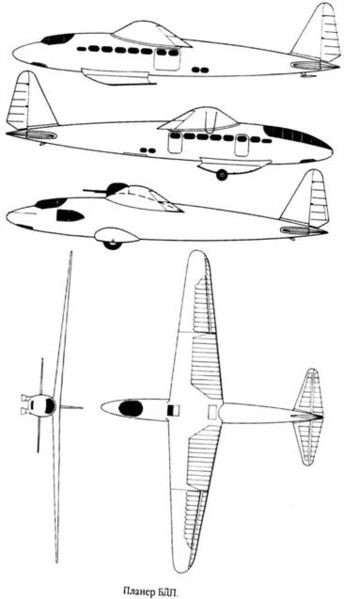
The BDP landing glider was desiigned as a high-wing monoplane with a 20-meter wingspan and an aerodynamically designed fuselage. The entire construction was made of wood.

Designers put special emphasis on making an airplane cheap and easy to produce. Due to its dimensions, the BDP was capable of transporting 16 soldiers with their equipment and its towing had to be carried out by Túpolev SB or Ilyushin DB-3 bombers. The fuselage was entirely made of wood. The pilot had an emergency cover with a structure also in wood. To improve visibility during landing, the lower part of the cab was glazed.

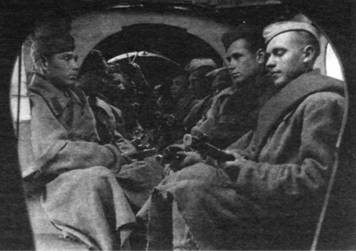
The landing troops sat on benches located on the sides of the fuselage, forming part of the structure. Between the two rows of benches there was a 600mm corridor. The exit of personnel and cargo was carried out through two 900 x 950 mm doors, one located in the front region on the right and the other in the rear on the left. In the first BDP copy there were two small doors on the right and two on the left.

In the lower part of the fuselage, behind the cargo area, a hatch was prepared to parachute from the glider.

The wing of the BDP was made of wood and had a single spar. The coating of the leading edge and the force points was done with plywood. The rest of the wing was covered with fabric. The wing profile used was the NACA 230. In order to reduce the landing speed in the section between the ailerons and the fuselage, Shrenk-type flaps were installed.

In the area of the leading and trailing edges of the wing, special hatches were located to allow firing with light weapons, covering the upper hemisphere. To defend the tail a section of the upper rear fuselage could be raised and become a firing point for the gunner.

The tail was monoplane and cantilever, constructed of wood covered with plywood and fabric.

The landing gear consisted of two ash skis placed on leaf springs to absorb the impact. The junction of the skis and the fuselage was covered by fabric covered fairings. For landing the BDP used a 400 x 150 mm four-wheel detachable wheelbarrow.

The glider did not have its own weapons, but did have attachment points for seven DP-type infantry machine guns. Two machine guns could be installed to defend the upper hemisphere, one in the lower hatch and two on the sides.

Inside the fuselage were 12 5.5 mm armored plates with dimensions of 480 x 550 mm. The pilot had armor on the back of the seat. All this protection added 127 kg to the weight of the glider.

The development of the BDP project was carried out by Polikarpov and his collective during the month of June 1941.

The project was approved by the NKAP management and it was decided to carry out the construction of the prototype at Factory No.51.

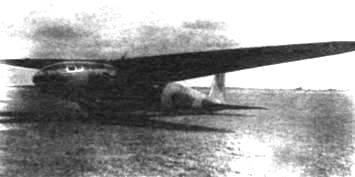
By the end of the summer of 1941 the glider was finished and ready for flight tests. The first flights were carried out in September and took place from the LII airfield in the Moscow suburbs. As a tug, an SB bomber with M-103 engines was used. The glider was piloted by VP Fyodorov.

Only 14 flights were made, which were interrupted on October 14 due to the advance of the Germans and the beginning of the evacuation.

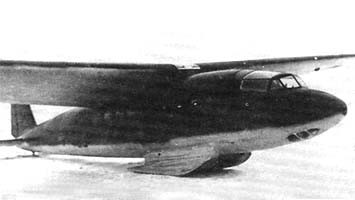
First BDP copy during tests near Moscow in September 1941.

As a result of the tests, defined as inconclusive, it was concluded that the BDP was stable in flight and that it could be maintained with free controls. The effectiveness of the rudders was acceptable, both during flight and on landing. The piloting technique was simple and did not demand a great qualification from its pilot, which ensured its control by pilots who had flown training gliders.

The negative aspects were the lack of structural strength at various points on the wing and fuselage. This caused that during the tests the flight weight was limited to only 2200 kg and the speed up to 220 km / h (the glider having been calculated for 3200 kg and 320 km / h respectively). The pilot pointed out that the curved glass in the windshield distorted the vision and proposed to replace it with a normal one made of straight pieces. When the aerodynamic brakes were extended, there was creaking in the tail area.

It was recommended to work on solving these problems and then present the model for series production. In relation to this process, there were no difficulties, since the construction could be carried out in carpentry with basic equipment. TsAGI specialists warned that the production cost of the Polikarpov model exceeded that of other similar gliders.

This first specimen was evacuated by air in October 1941 to the west. Curiously, during the flight of this unknown aircraft towed by an SB bomber, a group of fighters from Moscow’s anti-aircraft forces (PVO) went out to intercept, forcing the glider to land near Kashira. The glider was looted by the local inhabitants and in that condition it was returned to Moscow shortly thereafter.

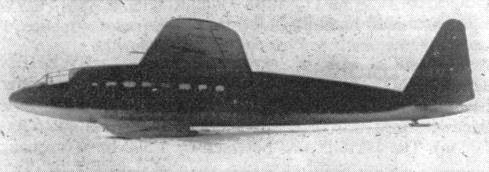
The second specimen, called BDP-2, was built in Novosibirsk, where Factory No. 51 in Moscow and the KB in Polikarpov were evacuated.

The glider was delivered for testing to the LII affiliate on February 6, 1942 and flown by II Shelest.

The BDP-2 presented a reinforced construction in relation to the original model, which brought with it a certain increase in weight. Externally it was also something different. The pilot’s windshield featured flat glass pieces and various elements were simplified. The trailing edge of the height and steering rudders was made by means of a steel cable as was the style in the first Soviet aircraft.

The tests of the BDP-2 with ski landing gear lasted until March 14, 1942. During this time several attempts were made to lessen the problem of tail creaking. The results improved after drilling a series of holes in the aerodynamic brakes, thus reducing the turbulence of the airflow.

Second BDP-2 prototype tested in Novosibirsk in the winter of 1941 – 1942.

The test conclusions again emphasized the simplicity of the piloting, the high payload capacity, good manoeuvrability and stability in different centering regimes. Serial production of the model was recommended.

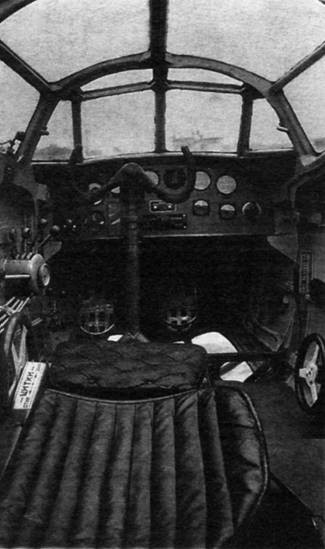
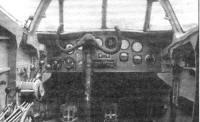
Interior layout in the cabin of the BDP-2 glider.

Almost in parallel with the flight tests, the search began for a possible production base to develop series production. After reviewing various factories and companies in the region near Novosibirsk, it was decided to select the Siberian Military Region Workshops. These facilities had previously functioned as auxiliary production capacity for Factory No.153, dedicated to the manufacture of skis.

The first figures showed a number of 100 gliders with a unit cost of 41,125 rubles.

While negotiations were taking place, a new production site was defined. It was the Stalingrad Factory No. 490. In the middle of the summer of 1942 the plans and all the technical documentation were transferred there from Novosibirsk. Soon the military situation changed and the arrival of the Germans in Stalingrad thwarted production plans.

Along with the inability to produce in Stalingrad the opinion of the VVS was a lack of need to produce the BDP. The course of the war had shown little chance of success and there were already produced successful models A-7 of Antonov and G-11 of Gribovski.

In July 1942 the BDP-2 was destined to serve as a transport in the direction of the Moscow – Irkutsk air force. Several flights were carried out towed by a PS-40 (postal Ant-40) on the Novosibirsk – Omsk – Sverdlovsk route and vice versa. This route was also covered by several Antonov A-7s . The results of these experimental flights were impressive and it was proposed to build several examples of transport gliders for civil use with Aeroflot.

In 1943, at Factory No.51, the assembly of 10 copies of the BDP began. It is known that until the end of the year only two copies had been delivered. A third and fourth specimens were 98% complete, the fifth at 80%, the sixth at 28%, and the seventh only at 10%. No evidence has been found after that date.

Polikarpov, in an attempt to achieve full autonomy for the BDP, decided to develop a motorized model that was named MP. A prototype was successfully built and flown, but it was not mass-produced either.

Polikarpov BDP
Wingspan: 20.00 m
Length: 13.60 m
Wing area: 44.72 m²
Empty weight: 1470 kg
Normal weight: 3408 kg
Crew: 1
Payload Capacity: 16 Soldiers Equipped

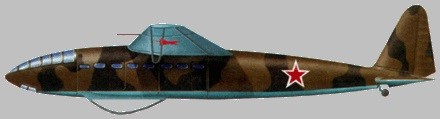
Color scheme of the first BDP prototype without the ski train fairings.
Color scheme of the second BDP-2 prototype.