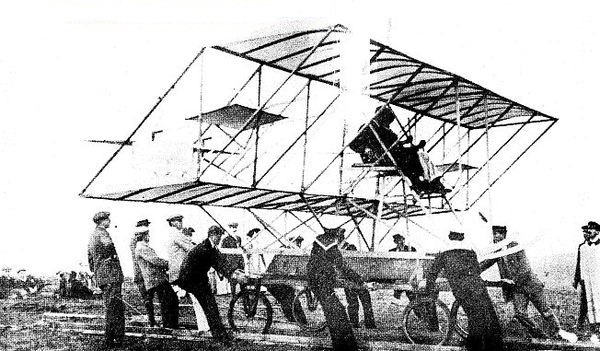
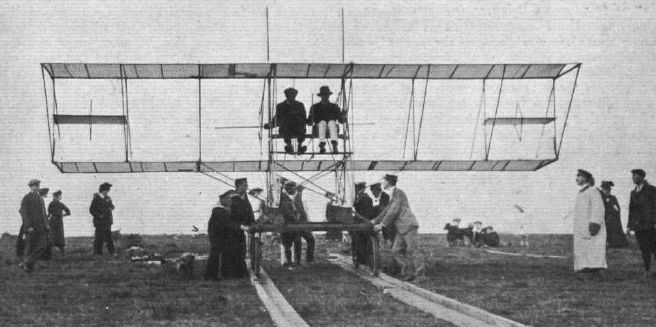
Porte & Pirie 1909 Glider

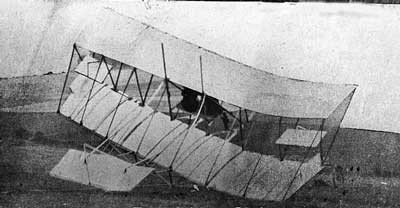
Porte and Pirie were both lieutenants in the Royal Navy when they designed and built this biplane. It was taken to Portsdown Hills, Portsmouth for a trial on 17th September 1909.

To quote “Flight” magazine for 25th September 1909; “With both officers seated in it the machine was mounted on a trolley and run along a temporary track, but it failed to rise, and eventually pitched forward and collapsed, both officers being thrown out, but escaping unhurt.” One of the designers, John Cyril Porte, who went on to have a successful career within aviation, was closely involved with the Curtiss biplane “America” intended to have made a pre-war trans-Atlantic flight.

Porte Super-Baby / Felixstowe Fury

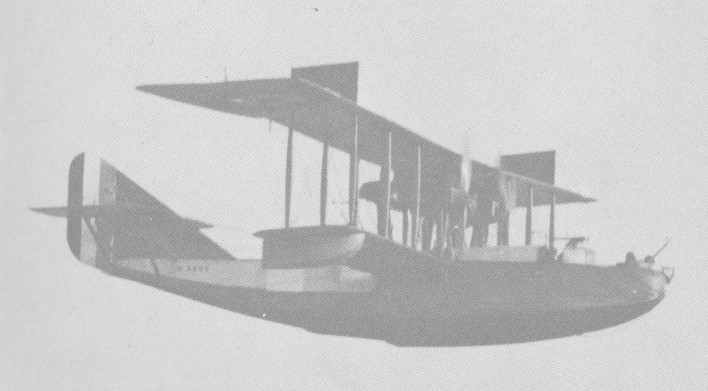
Porte’s ultimate design was a triplane flying boat, unofficially nicknamed the ‘Porte Super Baby’, but officially designated Felixstowe Fury. With wings spanning 37.5 m (123 ft), the Fury was powered by five 360hp Rolls Royce Eagle engines, two as tractors and three as pushers. Flying controls, initially, were power assisted by servomotors. After successful flying trials, the Fury was in the last stages of preparation for a projected flight to South Africa on August 11, 1919, when it was wrecked in Harwich harbour. All work on a second Fury was then stopped and the Fury programme cancelled. In October 1919, John Cyril Porte, the man whose inventive genius had conceived the F series of flying boats, died in Brighton of tuberculosis.

Engines: 5 x 334 hp Rolls-Royce Eagle VII
Span: 37.5 m (123 ft)
Length: 19.2 m (63 ft 2 in)
Height: 8.4 m (27 ft 6 in)
Maximum speed: 156 km/h (97 mph) at 609.5 m (2000 ft)

Porte F.2A America

The Admiralty placed orders for Curtiss H.4 and H.12 flying-boats in 1924-15 on the recommendation of Squadron Commander John Porte. When they arrived, Porte fitted some with much improved hulls of his own design, built at the Naval Air Station of Felixstowe and by private manufacturers.

The engines were also replaced by Rolls-Royce Eagles in the H.12’s, which were redesignated F.2A.

They featured three-bay biplane wings with two spar wood construction and fabric covering. The hull was wood with plywood covering. Conventional controls with ailerons on the top wings only. Stabilising floats were under each lower wing tip.

Normal defensive armament was four Lewis machine guns: one in the nose cockpit, one in the rear cockpit aft of the wings and one on each side of the fuselage. Sometimes the nose and rear positions were each fitted with two guns, and an additional gun could be mounted above the pilots’ canopy. Racks for two 230-lb bombs were under the wings.

Best known was the F.2A, which, in the last year of the war, formed the backbone of RNAS/RAF ocean activ¬ity. Carrying up to seven Lewis guns and two 220 lb bombs, it had a maximum weight of 11,000 lb, its two 345 hp Rolls¬Royce Eagles gave it a top speed of 95 mph and it could reach 2,000ft in 3.5min and 10,000ft in 39.5min. Despite its 120ft wingspan it was surprisingly agile. Gradually F.2s replaced H12s.

The F2A was basically a Porte II hull married to the wings and tail unit of the Curtiss H.12. Utilised by Britain during WW 1 and credited with shooting down Zeppelins L.22, L.43 and L.62.

F.2A
Engines: 2 x Rolls-Royce Eagle VIII, 345 hp
Propeller: 4 blade
Wingspan: 95 ft 7.5 in
Wing area: 1133 sq,ft
Length: 46 ft 3 in
Height: 17 ft 6 in
Empty weight: 7549 lb
MTOW: 10,978 lb
Max speed: 95 mph at 2000 ft
Service ceiling: 9600 ft
Endurance: 6 hr
Armament: 4-7 Lewis machine guns
Bombload: 2 x 230 lb
Porte II / Felixstowe F.2

By July 1916 first examples of a larger Curtiss flying boat design began arriving in England. Designated H.8, these were quickly modified to accept more powerful twin 250 hp Rolls Royce engines, and redesignated Curtiss H.12s, or ‘Large Americas’ as the RNAS crews usually referred to them. The Curtiss H.12 hull soon proved to be inadequate for its tasks, so Porte designed a new hull (the Porte II), resulting in all round improvement in performance. With a new tail unit added, the modified craft was designated Felixstowe F.2, and its general structure became a prototype for succeeding F boats.

Large scale production of the F.2 was ordered, and the type began to equip RNAS units in late 1917. Carrying a crew of four, and a bombload of approximately 272 kg (600 lb), the F.2a (its production designation) could achieve a maximum speed of some 145 km/h (90 mph), with an endurance of perhaps six hours. It was cumbersome to handle and slow in manoeuvre, yet gave formidable operational service for the rest of the war. With at least four machine guns in nose, tail, and flank locations, it also gave a good account of itself when engaged by German seaplanes. The F.2a’s main duty was antisubmarine hunting; an air deterrent which undoubtedly proved successful in the protection of Britain’s vital mercantile shipping.

Span: 29 m (95 ft 7.5 in) (upper), 20.8 m (68 ft 5 in) (lower)
Length: 14.1 m (46 ft 3in)
Height: 5.3 m (17 ft 6 in)
Maximum speed: 153.7 km/h (95.5 mph) at 609.5 m (2000 ft)

Porte Baby

On the outbreak of the First World War, among the Admiralty’s chief responsibilities was the aerial defence of Britain, as well as the more traditional role as guardian of the island’s surrounding sea¬ways. At that time the Royal Naval Air Service was almost wholly equipped with floatplanes of limited range and unreliable performance. The obvious need for a sea¬going aircraft of long range led Captain Murray Sueter, Director of the Naval Air Department, to purchase two Curtiss flying boats.

After some operational use of these initial Curtiss flying boats, Commander John C Porte set out to improve some of the more obvious weaknesses in the design.

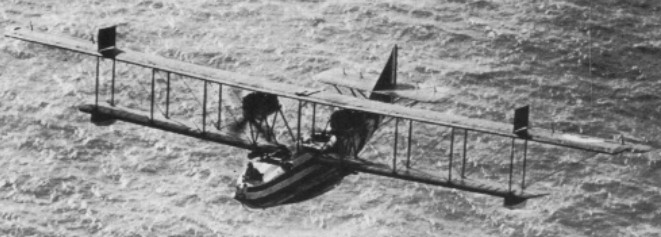
In September 1915, Porte was appointed in command of RNAS Felixstowe and while there finally produced his own design of flying boat. It was a large, three engined aircraft, and was allocated the serial number 9800. Quite unofficially, it was titled the ‘Porte Baby’. The largest flying boat design of its day, the ‘Baby’ was put into limited production some 20 machines and most of these saw operational service in 1916 17.

It had three Rolls Royce Eagle engines, two installed as tractors and one as a pusher. One successfully launched a Bristol Scout from its top wing while airborne over Felixstow.

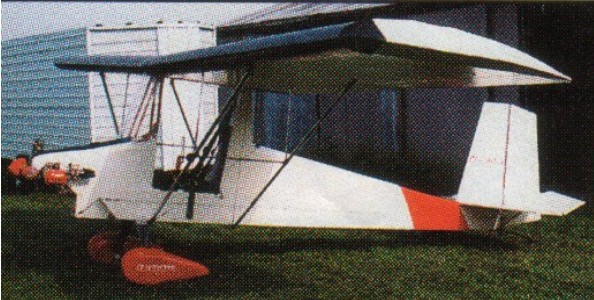
Pop’s Props Zing

First flown in 1996, optional engines are the ½ VW or Rotax.

Engine: Kawasaki 340 LC, 35 hp
HP range: 28-40
Wing span: 25.5 ft / 7.77 m
Wing area: 118.8 sq.ft / 11.05 sq.m
Length: 17 ft
Height: 5.9 ft
MAUW: 500 lb / 226 kg
Empty weight: 249 lb / 112 kg
Fuel capacity: 3.5USG / 19 lt
Max speed: 70 mph / 112 kph
Cruise speed: 55 mph / 90 kph
Stall: 26 mph / 45 kph
Rate of climb: 675 fpm / 3.25 m/s
Range: 75 sm
Takeoff dist: 100 ft
Landing dist: 250 ft
Service ceiling: 6000 ft
Seats: 1
Landing gear: tailwheel
Plan price (1998): US$60

Pop’s Props Pinocchio

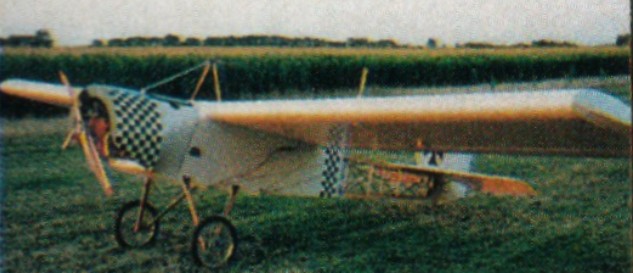
First flown in 1994, the prototype is powered by a twin-carburetted, two cylinder VW, with plans that will include optional motor mount illustrations for Kawasaki installation. The aircraft boasts three-axis controls and large tail surfaces. Wings carry full-span ailerons and can be detached for trailering. Its wire-bracing, spoked wheels and radial cowling gives the craft a very nostalgic look.

All wood construction. Estimated hp of the 2 cylinder VW is 40-45 hp. Construction. The fuselage is all wood incorporating 3mm plywood skin from firewall to seat back and aft of the seat on the centre section. From there, full length gussets all the way to the tail of all four corners.

Laminated bows help round out the fin and rudder and scallops accent the elevator and rudder trailing edges. The stabiliser leading edge is .8mm ply wrapped around wood formers to create a rigid D box and wire bracing tops off the lightweight but strong tail package.

The 16% Clark Y airfoil and 54” chord were chosen for the wings because of its superior stall speed characteristics and high lift capabilities. 30 dihedral was added for stability and 20 of incidence. Teleflex push-pull cables operate the full span ailerons safely and precisely. Leading edge is .8mm plywood wrapped around 3/4” foam nose ribs with 1/8” ply formers at each end and on all butt joints. Wire bracing not only makes for quick and easy wing removal but adds to the look of early aviation. Fuel is pulled from a 4.8 USG plastic tank tucked neatly above the pilot’s shins and filler is recessed into the rounded aluminium cover. Laminated foam cowl cheeks taper the round cowling into the fuselage which makes for a smooth flowing transition.

“Pinocchio’s” airframe requires no welding, no fibreglass work and the prototype was designed and constructed in approximately 500 hrs.

Speed max: 70 mph
Cruise: 60 mph
Range: 150 sm
Stall: 27 mph
ROC: 450 fpm
Take-off dist: 250 ft
Landing dist: 350 ft
Service ceiling: 2,000 ft
Engine: ½ VW, 45 hp
HP range: 35-50
Fuel cap: 4.8 USG
Weight empty: 254 lb
Gross: 500 lb
Height: 5.5 ft
Length: 16.5 ft
Wing span: 25.75 ft
Wing area: 115.8 sq.ft
Seats: 1
Landing gear: tail wheel
Tail span: 7’ without tips
Cockpit length: 46 1/2”
Cockpit width: 21 3/4”
Gear span: 46 1/2”
Payload: 230 lbs
Kit: Yes
Construction materials: Wood/fabric
Plans: Yes
Options: 2 cycle firewall forward capable.

Engine: Rotax 447, 40 hp
Wing span: 8 m
Wing area: 10.76 sq.m
MAUW: 226 kg
Empty weight: 115 kg
Fuel capacity: 19 lt
Max speed: 130 kph
Cruise speed: 100 kph
Minimum speed: 45 kph
Climb rate: 2.5 m/s
Fuel consumption: 2.5 lt/hr
Seats: 1
Plan price (1998): US$120
Kit price (1998): US$3995

Pop’s Props Cloudster

The Cloudster is a parasol winged monoplane built in wood and covered in Dacron. The pilot sits astride the fuselage.

Engine: ½ VW, 35 hp
HP range: 28-45
Wing span: 30 ft / 9.20 m
Wing area: 138 sq.ft / 12.8 sq.m
Length: 16 ft
Height: 7.6 ft
MAUW: 500 lb / 226 kg
Empty weight: 250 lb / 112 kg
Fuel capacity: 2.5 USG / 10 lt
Speed max: 96 kph / 50 mph
Cruise: 80 kph / 40 mph
Minimum speed: 38 kph
Range: 60 sm
Stall: 26 mph
Service ceiling: 2,000 ft
ROC: 3 m/s / 500 fpm
Take-off dist: 175 ft
Landing dist: 200 ft
Seats: 1
Landing gear: tail wheel
Fuel consumption: 7 lt/hr
Plan price (1998): $65
Kit price (1998): $3225