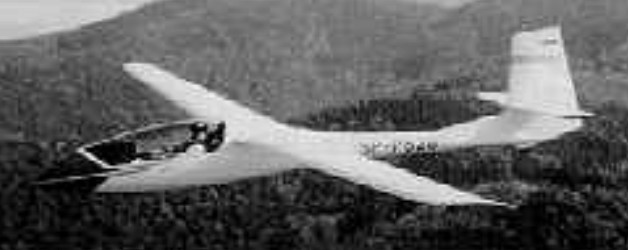
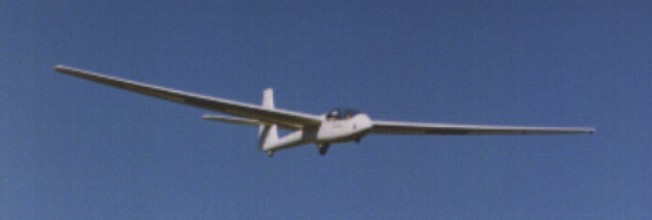
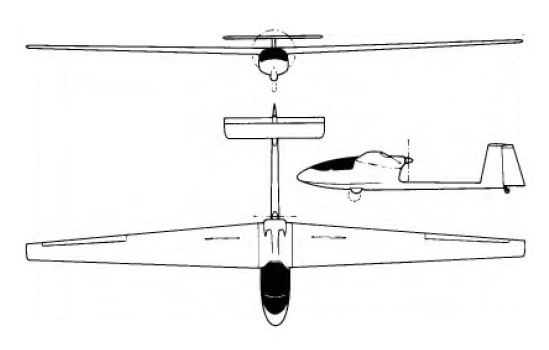
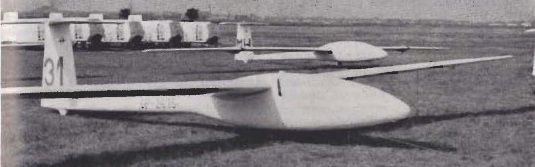
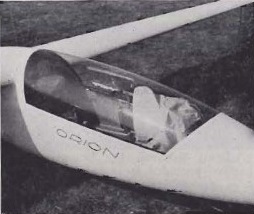
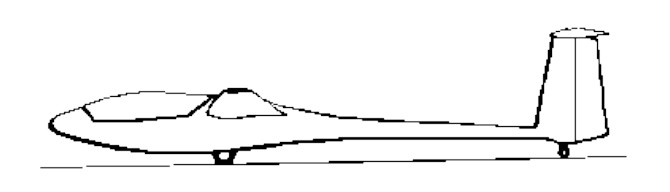
The tandem two place metal framed sailplane was designed by Jerzy Krawczyk and Eugeniusz Pelczar as a basic training glider and first flew in 1985. It has an oleo pneumatic sprung fixed main wheel, a tail wheel and a rubber sprung nose skid. Approach control is by top and bottom surface Schempp-Hirth type airbrakes.
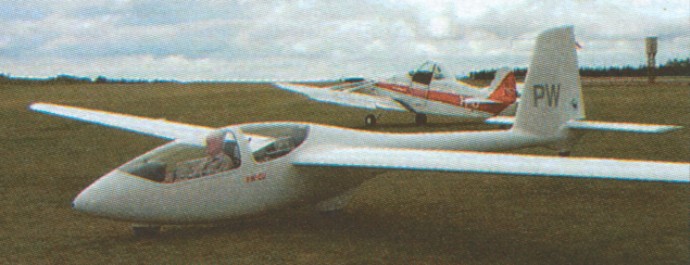
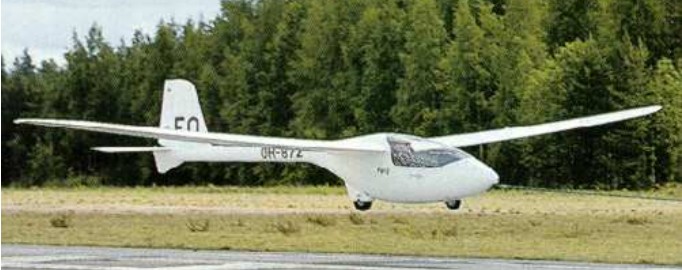
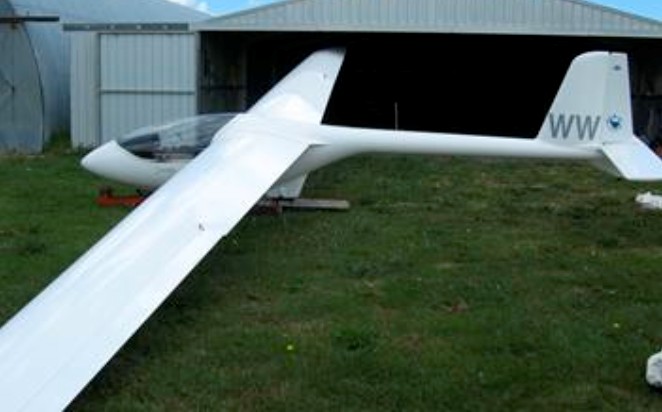
The PW-5 was the winning entry in the IGC/ OSTIV World Class design contest. The Polytechnika Warszawska design was available for license contruction both by manufacturers and homebuilders. PZL Swidnik is the first manufacturing licensee to reach production. It is flapless, has upper surface Schempp-Hirth airbrakes for approach control, and a fixed main wheel. PZL has announced that PW-5 production will be transferred to PZL Bielsko by the end of 1997. The structure is GFRP, with a fabric covered rudder.
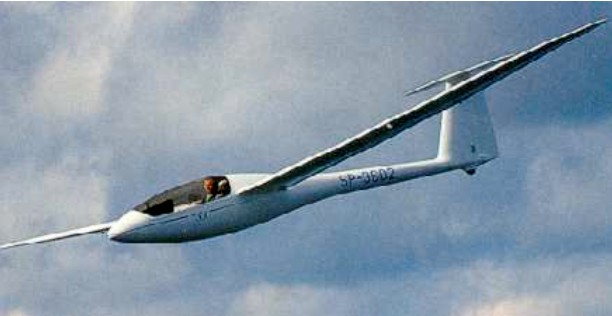
The SZD-59 was designed both as a contest aerobatic sailplane (+7/ -5 g) and, with wingtip extensions, as a 15 m. Standard Class sailplane. It has top and bottom surface Schempp-Hirth type airbrakes, retractable main wheel and provision for water ballast. The 15 m tip extensions come with optional winglets. Control connections are fully automatic.
Wing span: 13.2 m / 43.9 ft Wing area: 9.8 sq.m / 105.49 sq.ft Aspect ratio: 17.79 Airfoil: NN 8 Empty Weight: 265 kg / 584 lb Payload: 115 kg / 235 lb Gross Weight: 380 kg / 838 lb Wing Load: 38.82 kg/sq.m / 7.96 lb/sq.ft L/DMax: 36 115 kph / 62 kt / 71 mph MinSink: 0.77 m/s / 2.53 fps / 1.50 kt Seats: 1
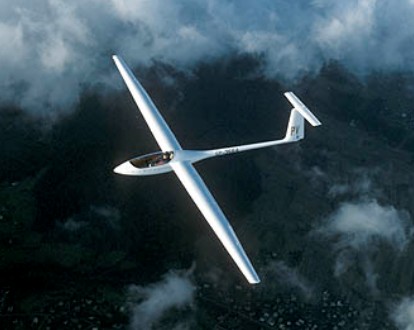
The Diana sailplane, designed by Borgumil Beres, is a flapped single place high-performance sailplane 15-meter with a mid- height wing and a “T”-tail arrangement. It uses carbon and aramide fibers exclusively to achieve an impressively low weight for a competitive sailplane of this type. The unique “sparless” wings can hold 160 litres (42.25 gallons) of water ballast, with a scant 46 kg (101.4 lb) weight for each wing panel. The structure of the Diana is exceeds the strength requirements of the JAR-22 Utility Category. The control stick is mounted on the right hand side of the cockpit rather than in the more customary center position. This arrangement brings the instrument panel closer to pilot. The adjustable backrest and headrest combine with the in-flight adjustable pedals for pilot comfort. The Diana has the capacity to carry up to 5.8 liters (1.5 gallons) of tail ballast to correct C.G. location. The ballast tanks are fitted with relief valves to relieve the pressure caused by ballast in a spin. Glidepath control is provided by top-surface air brakes. Roll rate (45 degrees to 45 degrees) is approximately 3 sec.
Wing span: 15 m / 49.21 ft Wing area: 8.16 sq.m / 87.84 sq.ft Aspect ratio: 27.5 Airfoil: NN-27-13 Empty Weight: 175 kg / 385.8 lb Payload: 115 kg / 253.5 lb Gross Weight: 410 kg / 904 lb Wing Load: 50.3 kg/sq.m / 10.3 lb/sq.ft Water Ballast: 160 kg / 353 lb L/DMax: 48:1 MinSink: 0.46 m/s / 1.51 ft/s / 0.89 kt Seats: 1
Designed by Tadeusz Labuc, this Standard Class sailplane first flew in 1988. Built from GFRP, epoxy and composites, the wing planform is of the Discus type. It has upper surface double segment Schempp-Hirth type airbrakes for approach control and a 9 kg./ 20 lb. Fin ballast tank in addition to wing tank. An SZD-55 placed second in the Standard Class at the 1991 World Championships at Uvalde TX, and another placed third at the 1993 Worlds at Borlange, Sweden.
Wing span: 15 m / 49.2 ft Wing area: 9.6 sq.m / 103.33 sq.ft Aspect ratio: 23.44 Airfoil: NN 27 Empty Weight: 210 kg / 463 lb Payload: 290 kg / 639 lb Gross Weight: 500 kg / 1102 lb Wing Load: 52 kg/sq.m / 10.65 lb/sq.ft Water Ballast: 220 kg / 441 lb L/DMax: 43 85 kph / 46 kt / 53 mph MinSink: 0.63 m/s / 1.6 fps / 1.17 kt Seats: 1
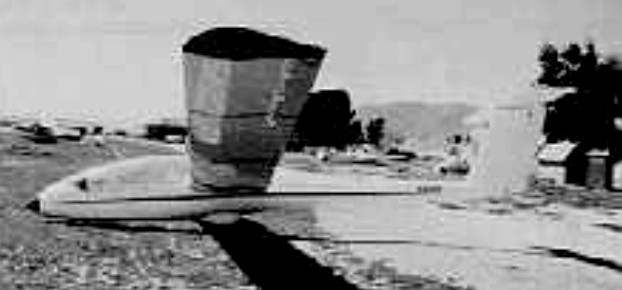
Designed by Stanislaw Zientek, this simple early solo/ club glider first flew in 1980. It has a fixed main wheel and top surface Schempp-Hirth type airbrakes. A simplified model 51-2 was a runner up in the IGC World Class design contest. The structure is GFRP, epoxy, and steel tube.
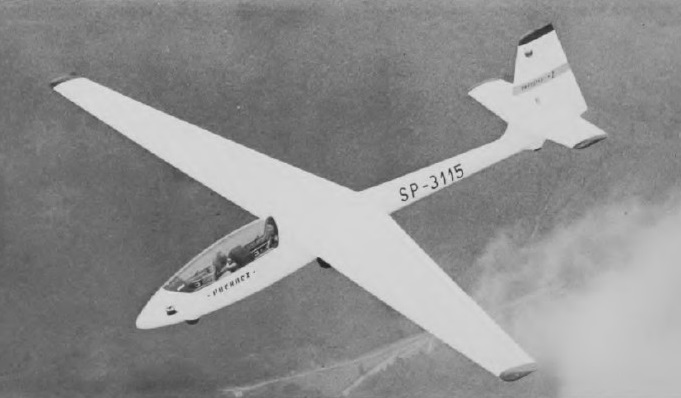
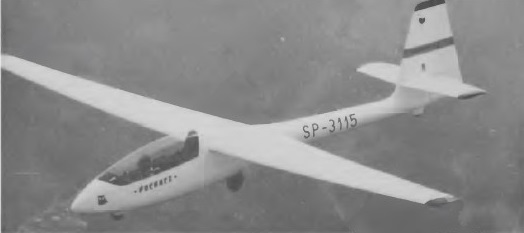
Designed by Dipl-lng Adam Meus, this high performance tandem two-seater is intended to succeed the popular SZD-9 Bocian for training and performance flying, and resembles the SZD-42 Jantar 2 and 2B but with a shorter span and the addition of the second seat. The Puchacz (or Eagle Owl) has been modified and developed from a prototype known as the SZD-50-1 Dromader which first flew on 21 December 1976; the Puchacz first flew a year later.
The first production aircraft flew on 13 April 1979 and nine had been built by the beginning of 1980. It is mainly of glassfibre sandwich construction, and has cantilever mid-set wings with slight forward sweep, plain ailerons and air bakes in the upper and lower surfaces. The glassfibre fuselage is supported in the central portion by two wooden frames, to which the wings and undercarriage are attached, and the landing gear consists of a non-retractable semi-recessed nose wheel, a sprung monowheel mounted behind the cg with a disc brake, and a tailskid which can be replaced by a tail wheel. There are two towing hooks, one in the nose for aero tows and the other mounted on the eg for winch launching. The tail unit is of glassfibre sandwich, the rudder being fabric-covered. The two pilots sit under a flush-fitting one-piece cockpit canopy that opens sideways, and have dual controls; the instrumentation for the front seat is easily visible from the rear seat.
SZD-50-3 Puchacz
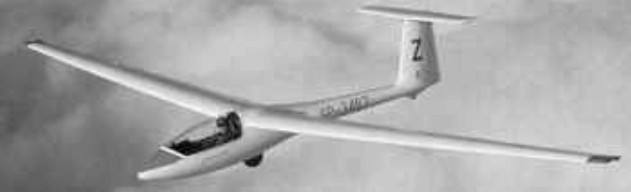
The improved 50- 3 is the major production model with larger horizontal tailplane situated part of the way up the fin and enlarged rudder. It has a fixed main wheel, top and bottom surface Schempp-Hirth type airbrakes, and is stressed for erect and inverted aerobatic maneuvers. It has been used widely throughout the soaring world both as an initial and intermediate training sailplane, and as an aerobatic instructional platform and entry level aerobatic contest ship.
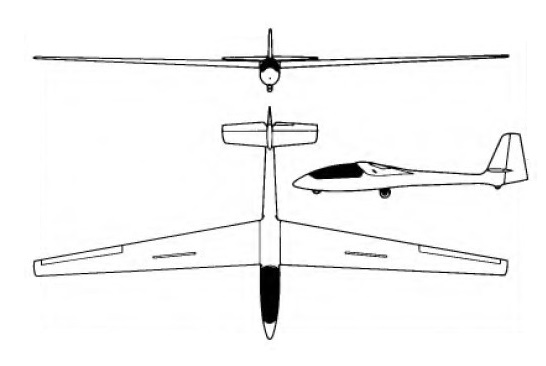
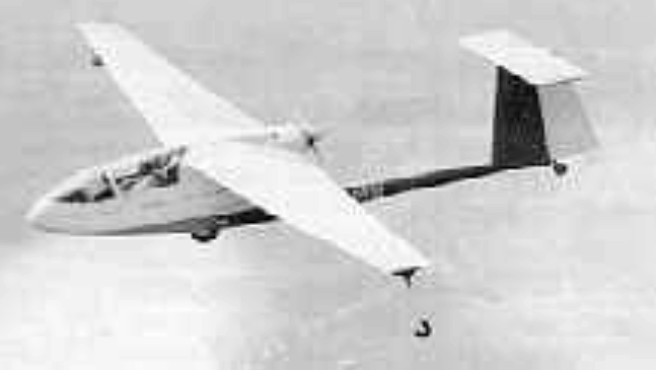
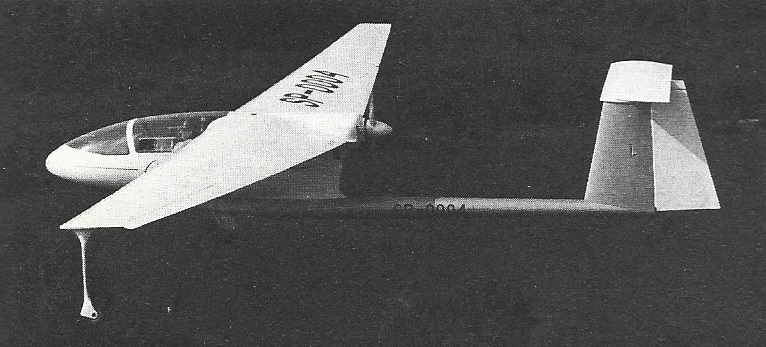
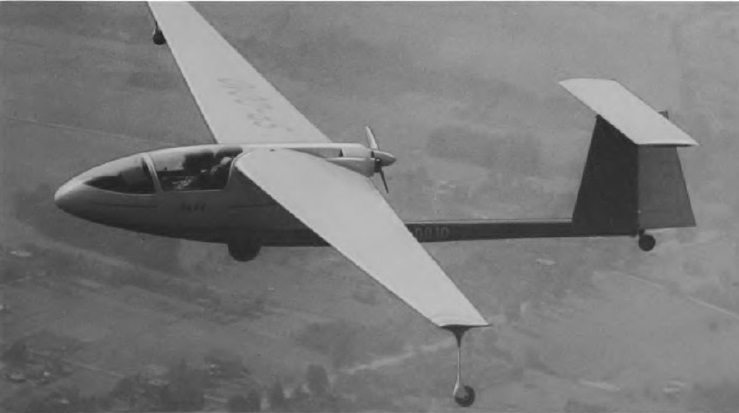
The Ogar (or Greyhound) two-seater motor glider designed by Dipl-lng Tadeusz Labuc is SZD’s first self-launching to go into production and was intended for training from ab initio to advanced stages, and for cross-country flying.
Of mixed glassfibre and wooden construction, the Ogar’s single-spar cantilever shoulder-mounted wooden wings have a moulded plywood stressed skin covered with glassfibre, and slotless ailerons of glassfibre sandwich construction; there are air brakes above and below each wing. The Ogar features sailplane rigging. The main nacelle of the pod and boom fuselage is a glassfibre/epoxy resin shell built on two wooden frames which carry the wings, engine mounting and fuel tank (up to 48.5lb of fuel can be carried) and also the tail boom. The two pilots sit staggered side-by-side with dual controls as standard under a two-piece flush-fitting canopy, the rear portion of which opens upwards for exit and entry. The fin is integral with the tail boom and there is a fully-castoring tailwheel under the rudder plus a semi-retractable monowheel with shock absorbers and a disc brake; for flying school use outrigger legs and wheels are mounted under the wing tips.
It first flew in prototype form on 29 May 1973 with a 45hp Stamo engine mounted behind the cabin and driving a two bladed Hoffmann pusher propeller; the T-tail unit is carried on a tubular duralumin boom that passes under the airscrew disc. Because the German Stamo engine was no longer in production a 68hp Sportavia-Limbach four-cylinder horizontally-opposed engine was later fitted to the prototype which was also later fitted with wing tip winglets, first flying with these on 10 September 1979. This modificatiion was devised by MrW. Blazewicz of Warsaw Technical University.
The production SZD-45A is powered by a 68hp Limbach SL 1700EC powerplant driving a two-blade Hoffman pusher propeller. In 1978 a version of the Ogar was proposed powered by a 60hp PZL-Franklin 2A-120C (later 2A-120CP) ‘flat twin’engine, which was to become the standard engine for production aircraft. The Franklin-engined SZD-45-2 Ogar-F first flew on 13 March 1979. A total of 65 Ogars had been built by the beginning of 1980, and the type had been exported to both East and West Germany, Sweden, the UK and the USA. The U.S. import is powered with the dual ignition, turbocharged, Revmaster engine. Production has now ended.
PZL Bielsko / SZD SZD 45 a Ogar Engine: 51 kW/ 68 bhp Limbach SL 1700 Wing span: 17.53 m / 57 ft 6.25 in Wing area: 19.1 sq.m / 205.6 sq.ft Length: 26 ft 1 in / 7.95 m Aspect ratio: 16.25 Airfoil: Wortmann FX 61-168/ FX 60-1261 Height: 1.72 m / 5 ft 7.75 in Empty Weight: 470 kg / 1036 lb Payload: 230 kg / 507 lb Gross Weight: 700 kg / 1543 lb Water ballast: None Wing Load: 36.6 kg/sq.m / 7.49 lb/sq.ft L/DMax: 22.6:1 at 97 kph / 52 kt / 60 mph MinSink: 0.96 m/s / 3.15 fps / 1.87 kt at 50 mph / 39 kt / 72 km/h Max. speed: 121 kts / 225 km/h / 112 mph at sea level Stalling speed: 37 kt / 68 km/h Landing speed: 42 kts / 78 km/h Cruising speed: 51 kts / 95 km/h Max rate of climb at S/L: 168 m/min / 551 ft/min Take-off run: 200 m / 656 ft Range with max fuel: 341 miles / 550 km / 296 nm Seats: 2