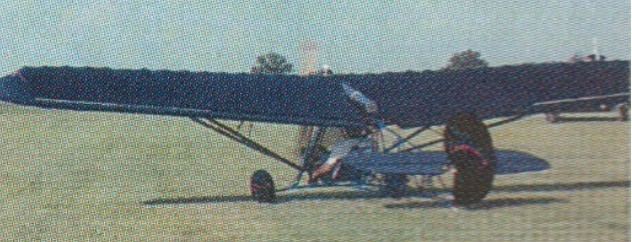
Raceair Skylite

Ed Fishers “Skylite” Ultralight gained a lot of attention, winning Grand Champion Ultralight at Oshkosh in 1991. Under the name of Raceair, plans and components were developed and marketed for the Skylite. Green Sky Adventures, Inc added some Raceair items to its product line shortly thereafter.

Speed max: 60 mph. Cruise: 47 mph. Range: 90 sm. Stall: 27 mph. ROC: 400 fpm. Take-off dist: 400 ft. Landing dist: 600 ft. Service ceiling: 9,000 ft. Engine: Rotax 277, 28 hp. HP range: 28-50. Fuel cap: 5 USG. Weight empty: 240 lbs. Gross: 520 lbs. Height: 6.83 ft. Length: 17.5 ft. Wing span: 29.16 ft. Wing area: 117 sq.ft. Seats: 1. Landing gear: nose wheel.

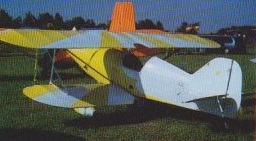
Raceair Micro Mong

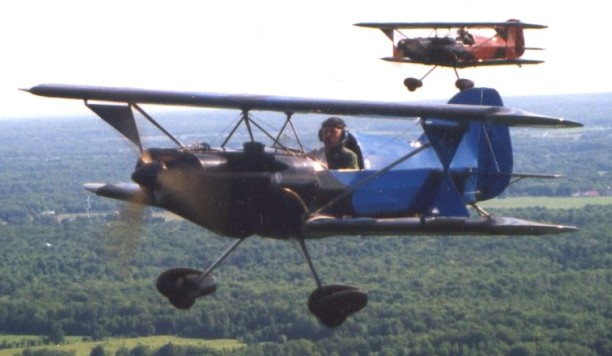
For Oshkosh 93, Ed Fisher was back with another new design, the Micro Mong. Inspired by the legendary Mong Sport, and its designer Ralph Mong, Ed had set out to replicate the timeless elegance of that Midget Biplane but to do it in such a way as to conform to FAA part 103 regulation. That was no small task! Usually, replica airplanes are smaller than what they are replicating. With the Micro Mong “Ultralight”, the opposite was true. Primarily, there was no way to get within the calculations for part 103 with less wing area than the Mong Sport. Some other “calculated” factors that allowed the racy little plane to conform were partially exposed engine, engine HP/propeller combination, and permanently deployed full span flaps (the ailerons were drooped about 3 degrees).

Ed worked diligently, after Oshkosh, and within a few months, his Raceair Company began selling plans and components for the Micro Mong. Just as with the Skylite, Green Sky added the new Raceair items to its product line. Plans were made to have the Micro Mong at Green Sky’s Sun n Fun booth in April 1994.

Green Sky Adventures, Inc. president, Gerald Olenik, was so impressed with the Micro Mong, that within three months, he and his brother formed Pyma Lake Aircraft Corp, purchased the Micro Mong design, and arranged exclusive marketing through Green Sky Adventures, Inc. Pla Corp. built the proof of plans aircraft, then built steel jigs and fixtures and organized many details for kit production. A plan to move the operation to Florida prior to establishing a dedicated production team commenced late in 1996. The following year, Green Sky Adventures, Inc., acquired the assets of Pla Corp. and the exodus to Florida began.

Green Sky management believes “biplane nostalgia” helps make the Micro Mongs popularity timeless. Though single place / open cockpit, undoubtedly limits that popularity, pilots drawn to such configurations share a passion barely comprehensible to others.

The slow process of relocation from Ohio to Florida has kept the LSA Micro Mong kit production in limbo. Plans sales have continued, and quite a few builders have completed their aircraft. Much of the promotional material and information describing details of the kit has been updated. However the Micro Mong design remains pretty much frozen. Differences between Kit and Plans versions are so few, that an original plans set is still supplied with the Micro Mong kit as the primary “Bible” for assembly.

HKS-700e 4 stroke power is perhaps the most exciting improvement to this great little plane. It’s as if the engine was designed specifically for Micro Mong application. Green Sky Adventures, Inc. has been flying, testing, and marketing this outstanding powerplant for a few years. The power, reliability, economy, and longevity of this lightweight 4 stroke add a dimension to light sport flying that does not otherwise exist. Such an improvement plus the infancy of Sport Pilot, and renewed interests in the Micro Mong should certainly be worthy of a suffix. Extra power, extra range, extra reliability and 2 times the strokes is easily 2 times the fun. Micro Mong 2XF.

Raceair Micro Mong
Engine: Rotax 377, 28 hp
Wing span: 6 m
Wing area: 10.2 sq.m
MAUW: 240 kg
Empty weight: 112 kg
Fuel capacity: 19 lt
Max speed: 105 kph
Cruise speed: 80 kph
Minimum speed: 45 kph
Climb rate: 1.5 m/s
Fuel consumption: 7 lt/hr
Seats: 1
Plan price (1998): US$125

Green Sky Micro Mong
Engine: Rotax 503, 52 hp
HP range: 30-60
Height: 6 ft
Length: 14 ft
Wing span: 19.5 ft
Wing area: 110 sq.ft
Fuel cap: 10 USG
Weight empty: 320 lb
Gross: 650 lb
Speed max: 110 mph
Cruise: 85 mph
Range: 200 sm
Stall: 35 mph
ROC: 1000 fpm
Take-off dist: 200 ft
Landing dist: 400 ft
Service ceiling: 15,000 ft
Seats: 1
Landing gear: tail wheel
Cockpit width: 21.75 in
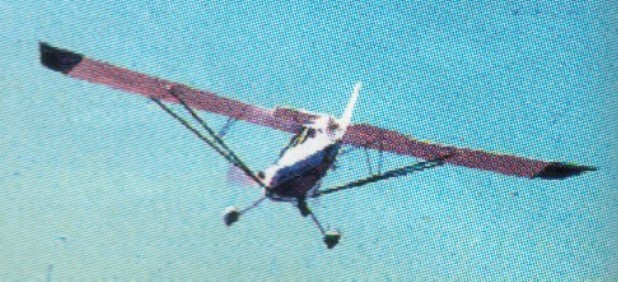
Raceair Flitplane

Designed by Ed Fisher.

Engine: Rotax 277, 28 hp
HP range: 25-40
Height: 5 ft
Length: 15.75 ft
Wing span: 27 ft
Wing area: 145 sq.ft
Weight empty: 235 lb
Gross: 500 lb
Fuel cap: 5 USG
Speed max: 50 mph
Cruise: 40 mph
Range: 120 sm
Stall: 27 mph
ROC: 500 fpm
Take-off dist: 300 ft
Landing dist: 300 ft
Service ceiling: 8,000 ft
Seats: 1
Landing gear: tail wheel

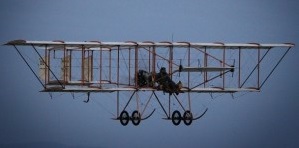
RAAF Museum Bristol Boxkite

The brainchild of Group Captain (retd) Ron Gretton and Wing Commander (retd) Geoff Matthews, the Boxkite replica was built at the RAAF Museum at Point Cook, Australia, and will eventually be a showcase display for the public.

With Air Vice-Marshal (retd) Mark Skidmore at the controls, the Boxkite flew successfully on Wednesday 11 September 2013 at RAAF Base Williams. The aircraft flew about 1000 metres and reached a speed of 42 mph.

“It was an exhilarating and humbling experience, I am honoured and proud to follow those aviators who pioneered military aviation in this country,” said AVM Skidmore, a former F-111 and ARDU test pilot.

“I now also have the honour of being the only RAAF pilot who has flown both the fastest and slowest aircraft in the Air Force. The Bristol Boxkite has a rich history in the evolution of military aviation in Australia, it was the first official military aircraft built in this country and used to train our first military pilots.”

The Boxkite has a rich history in the evolution of military aviation in Australia and was the first official military aircraft built in Australia that was used to train Australia’s military aviators.

A Bristol Boxkite was flown in Australia for the first time on 1 March 1914, when Lieutenant Eric Harrison took one into the air at Point Cook. The airfield was then the home of the Australian Flying Corps (AFC).

Harrison’s flight is recognised as the starting point of military flying in Australia. In recognition of this historical significance, RAAF Base Point Cook will play host to the Centenary of Military Aviation in Australia event on 1 to 2 March 2014 with the Bristol Boxkite replica as a major draw card.

RAAF Experimental Aircraft Station

Lawrence J. Wackett (later Sir Lawrence) started his career in the Australian Flying Corps in the First World War and saw service in Egypt; when the R.A.A.F. was formed in 1921 Wackett decided to move into aircraft design and development and, after a short professional training period, persuaded the then Defence Minister, R. K. Bowden, to set up a R.A.A.F. Experimental Aircraft Station at Randwick, in order to develop aircraft suitable for Australian conditions.
The first design was the Widgeon 1, a flying boat, followed by a much larger amphibian, the Widgeon 11, powered by a 440 hp A.S. Jaguar engine. In 1927, the Widgeon 11 undertook a 9,000 mile flight around Australia.
Two other aircraft were developed at Randwick to the prototype stage: Warrigal I (a trainer) and Warrigal II a single seat fighter. As a result of a government-sponsored report, the Randwick Station was closed in 1931: Wackett resigned from the R.A.A.F. and transferred, with some personnel and equipment to Cockatoo Dockyard.