Reynard Gliders R.4 Primary

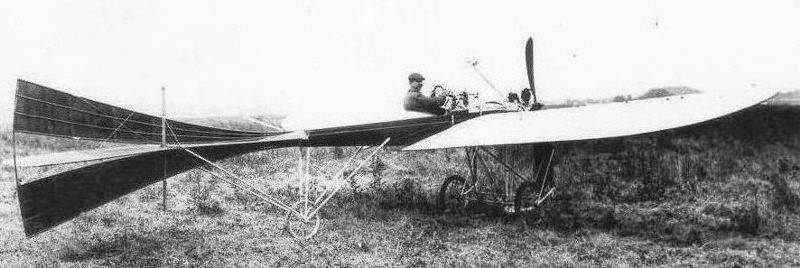
The Reynard R.4 Primary was an open seat primary glider with an open girder fuselage and a high, wire braced wing.

The wing was rectangular in plan, with ailerons at the tips but no flaps or airbrakes. N-form struts from the wing supported a girder about 8.5 ft (2.6 m) long and curved on the underside to form a landing skid. The pilot’s seat and controls were placed, exposed, on its upper surface just ahead of the wing. Lift wires ran from this girder to the underside of the wing beyond mid-span and a pair of landing wires on each side were fixed to the apex of a two strut, triangular central cabane or kingpost above the wing.

Behind the wing trailing edge and the end of the lower girder the rear fuselage was a tapering, vertically orientated, two bay Warren truss, ending at a vertical cross member which supported the rudder. The triangular tailplane and fin were mounted on the horizontal upper fuselage beam and the straight edged rudder extended down through a cut-out between the elevators to the lower beam.

It was designed and at least five built in the UK in 1930 by Reynard Gliders, Leicester. Some Reynards were built with a hinged nacelle to give the pilot better protection from the weather, though still in an open cockpit. To compensate for the extra side area the rear two bays of the fuselage were fabric covered.

It has been suggested that at least two R.4s were built with steel tubed rather than wooden rear fuselages, under the name Reynolds R.4 after the contemporary bicycle tube frame manufacturer.

The Reynard could be bought complete for £45 or built from plans costing 21/- (1 guinea or £1.05) and was regularly advertised in 1930-1. Several were built and active in the early 1930s with UK gliding clubs. One was demonstrated to the Leeds club in October 1930 and they received the first of two the following month. The Bradford, Halifax, Leicester and Ulster Gliding Clubs also had Reynards.

The two Reynards that received BGA certificates of airworthiness, BGA 166 and 167 had serial number R.4/5 and R.4/6 respectively BGA 166 was used by the Leeds and later Bradford Gliding Clubs. BGA 167 was used by the Ulster Gliding Club from 1931, they fitted a nacelle when they rebuilt it aircraft in 1933. This glider went to the Dublin Gliding Club in 1934 and was still active the following year.

Wingspan: 34 ft 2 in (10.41 m)
Aspect ratio: 6.6
Length: 18 ft 3 in (5.56 m)
Height: 7 ft 2 in (2.18 m)
Crew: 1
Rey R-1

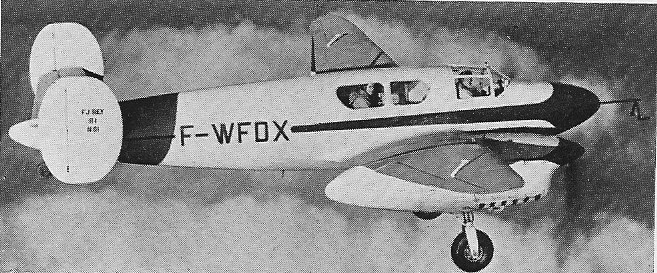
The R-1 was an experimental twin-engine monoplane with variable- incidence wings, first flown with normal wings on 16 December 1949, and with articulated wings in 1951.

Original patents taken out in 1938 and an aircraft built in 1940, but was destroyed during the war. Two prototypes were built, of wooden construction, powered by two Renault 6R engines.

The outer wing panels are articulated on an oblique hinge-line and these orientate automatically in turbulent air, the varying incidence absorbing the loads imposed.

Engines: two Renault 6R, 216 hp
Wingspan: 43 ft 2.5 in
Length: 30 ft 2 in
Height: 11 ft 11 in
Empty weight: 4950 lb
Loaded weight: 6490 lb
Max speed: 202 mph
Time to 3280 ft: 4 min 10 sec
Ceiling: 19,025 ft

Rex Smith Aeroplane Co 1910 biplane

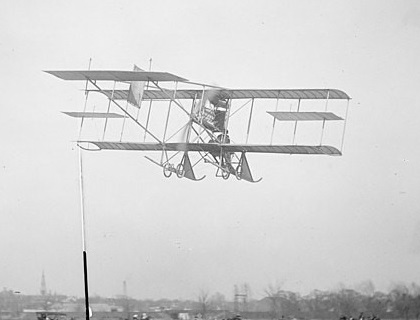
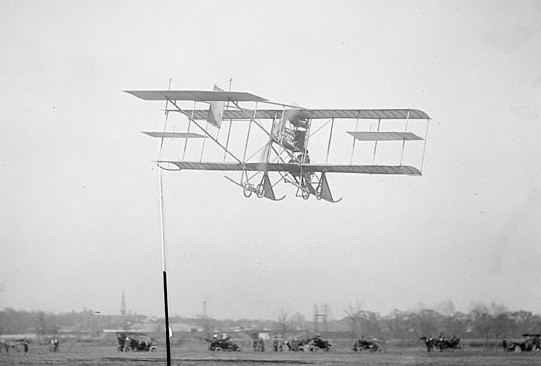
Designed by Rex Smith and Frederick Fox, the Rex Smith Biplane Curtiss-type first flew on 5 November 1910, piloted by R Smith. It was built and demonstrated at College Park, Maryland, at the same airfield that the Wright Brothers trained pilots using their aircraft for the U.S. Army Signal Corps just north of Washington, D.C.

This followed the initial demonstration at Fort Myer, Virginia, in 1908 and 1909, when the U.S. Army Signal Corps accepted the Wright Flyer in July 1909. Both the Wright Brothers and Curtiss continued to demonstrate their aircraft at the College Park Airport.

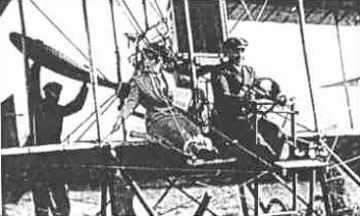
A two-place biplane powered by an Emerson marine engine pusher, it was used in Signal Corps experiments with wireless radio-telegraphy in April 1911, piloted by Antony Jannus.

Rex Smith Tony Jannus piloting

At a 1911 display in Washington, D.C., of the Smith biplane, a large crowd gathered to watch the motor started indoors, kicking dust throughout the building. On April 13, the biplane demonstrated wireless air-to-ground communications at College Park. On April 15, test pilot Tony Jannus attempted a take-off from the Potomac River with new pontoons attached to the landing skids. The plane plowed into the water, nearly drowning Jannus. By the end of the year, the aircraft had demonstrated 137 flights, including takeoffs and landings during snowstorms.

An aircraft was developed with an airfoil that tapered from four feet thick to nearly flat at the wingtips. The aircraft used wing warping tips rather than ailerons. It was tested with a Hall-Scott engine by test pilot Paul Peck. A Berliner Rotary was also considered for the design.

Rex Smith Biplane
Powerplant: 1 × Emerson 2 cycle, six cylinder, 100 hp (75 kW)
Propeller: 2-bladed Paragon, 9 ft (2.7 m) diameter
Wingspan: 40 ft (12 m) span later reduced to 32 feet for speed
Empty weight: 875 lb (397 kg)
Capacity: 1-3

Rex Smith Aeroplane Co

The founder of Rex Smith Aeroplane Company, Rex Smith (1862–1923), was an inventor and a patent attorney. He placed his offices in Washington D.C., and operations at College Park Airport, Maryland. The company was capitalized with $500,000 in 1910 with Victor J Evans as president and Rex Smith as Vice president.

(Rexford) Rex Smith Aeroplane Co,
College Park MD.
USA

In 1911, Rex Smith moved his hangar to line up with the Army Aviation School, and hired Frank Kastory from Anzani, and Abraham Whalomie Raygorodsky from Russia. He test flew Smith aircraft alongside Fox engine powered Curtiss aircraft. Rex also hired Tony Jannus, and Paul Peck as test pilots. In a stroke of coincidence, flying at the same airport at the same time was another military aviator, Paul W. Beck.

Rex Smith plane in flight

Two Rex Smith Biplane were built and used in the successful April 3, 1911 U.S. Army Signal Corps experiments in wireless communications. Potomac river pontoon experiments on April 5, were not as successful, with the aircraft plowing into the water headfirst nearly drowning the test pilot Jannus. Just two days later the machine was ready again. Janus took up actor Nat M. Wills, and later two female passengers at the same time. Marking the first time an aircraft flew with more than one passenger.

The Signal Corps did not buy any Smith Biplanes, they did however use them from time to time to train pilots to fly the Curtiss aircraft at the same field.

Operations continued until 1916 in building several other Curtiss-type biplanes.

Rex Composites / Moniot

Philippe Moniot having previously designed for Wassmer, formed Avions Philippe Moniot.

In 1986 the joint stock company Rex Composites was created by Philippe Moniot with 300m² of workshop space.

In 1999 was the certification of the APM Lionceau, the first “all carbon” aircraft in the world.

2011 was the creation of the REXIAA Group and launch of a new strategic development project.
Commercialization of the APM 40, an “all carbon” 4-seater plane, designed and produced by all the companies in the REXIAA Group.

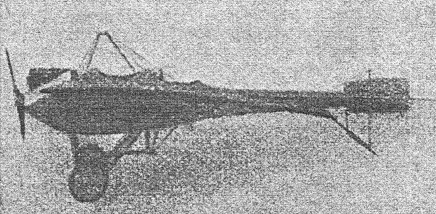
Requillard 1910 monoplane

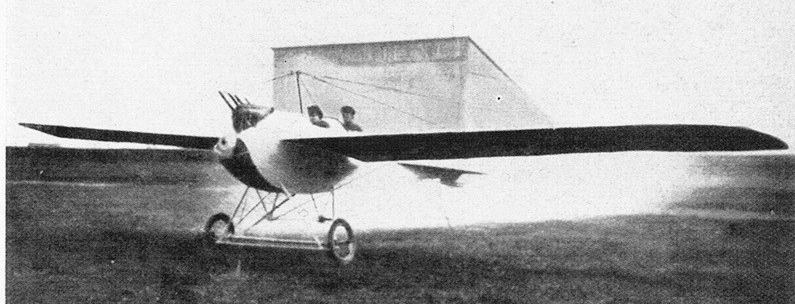
Requillard’s monoplane made its official appearance at Juvisy, France, in June 1910, flown by Marc Pourpe. The machine was very slender and streamlined, with long and triangular fixed tail surfaces, the rudder in two parts connected at the trailing edges to allow the elevator to move up and down between them. It was powered by a 50 hp Gnome. It was reported to have flipped onto its back on its first tests.

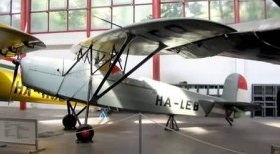
Repülögpégyàr Levente II

Training and liaison aircraft, Hungary, first flown in October 1940

Engine: Hirth HM 504 A2, 104 hp
Wingspan: 31.004 ft / 9.45 m
Wing area: 145.314 sq.ft / 13.5 sq.m
Length: 19.948 ft / 6.08 m
Height: 8.301 ft / 2.53 m
Max take off weight: 1653.8 lb / 750.0 kg
Weight empty: 1036.4 lb / 470.0 kg
Max speed: 97 kts / 180 km/h
Cruising speed: 86 kts / 160 km/h
Service ceiling: 14764 ft / 4500 m
Wing loading: 11.48 lb/sq.ft / 56.0 kg/sq.m
Range: 351 nm / 650 km
Armament: None
Crew: 1