
The 1911 Radley gullwing monoplane was designed and built by James Radley in the UK
The 1911 Radley gullwing monoplane was designed and built by James Radley in the UK
In 1929 William P Ames, Albany NY, built a Parasol, registered N22W.
Albany NY.
USA
Built a parasol aircraft in 1929
In 1908 Ames, a congressman at the time, used his office to acquire USS Bagley as for 11 days as a testing platform for his Drum-wing experimental aircraft in an experiment with the Magnus Theory, trying to create lift from rotating barrel-forms; powered by a 40hp Curtiss V-8. It failed to produce any exciting results.
Butler Ames Wasington DC.
USA
Experimented with drum-wings in 1908.
Morris Kamar, Pincus Cashman, Minnie Israel
New York NY.
USA
Operated circa 1929
The Queen-Martin 1911 biplane was designed by James Martin and built by Queen Aeroplane Co in the USA
Span: 30′
Length: 29′
Weight: 950 lb gross
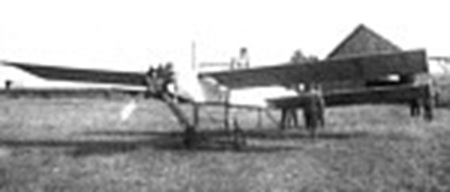
The 1908 Astra-Kapferer tandem plane was designed and built by ASTRA in France
The 1926 American Eagle Aircraft Corp Trimotor “Taloga” was a four-place open cockpit biplane conversion of A-1, ordered by Wichita oilman H H Patton, but never finished. Power was to be three 125hp Quick engines.
The 1931 American Eagle Aircraft Corp Eaglet B-31 (ATC 450) was a two-place open cockpit, high wing monoplane. Powered by a 45hp Szekely SR-3, it was also available with 40hp Salmson AD-9. The price was $1,575. A modernized American Eagle Eaglet B-31 and ATC from American Eaglet A-31 as the 1946 Eaglet A-31-B (ATC 2-583). Two were built; NC17686 and N80567.
The Eaglet B-32 had minor control modifications and range of 215 mi.
Thirteen were built; NX531Y, NC550Y, NC589Y, NC595Y, N599Y, NC12522, NC12559, NC14420, NC17007, and NC17686.
A 1948 version had a basic enclosed cabin and 65hp Continental.
Production rights went to American Eaglecraft Co after WW2 as American Eaglecraft Eaglet.
Eaglet B-31
Engine: 45hp Szekely SR-3
Wingspan: 34’4″
Length: 21’7″
Useful load: 413 lb
Max speed: 90 mph
Cruise: 75 mph
Stall: 30 mi
Range: 240 mi
Seats: 2
 All Aero