Roberts Cygnet

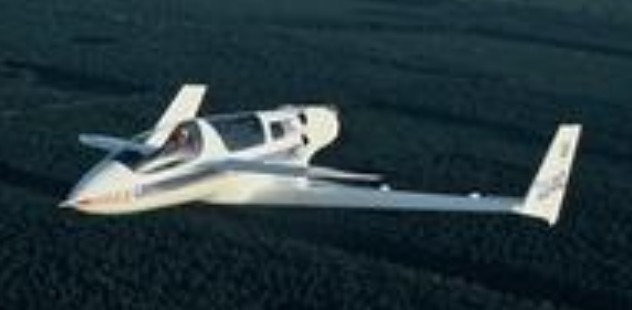
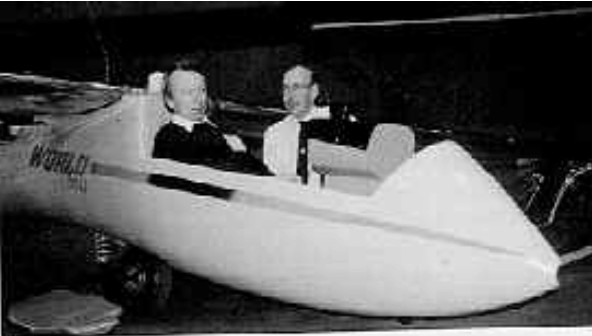
Designed by Donald Roberts, the Cygnet, which first flew in 1992, was the only U.S. entrant in the IGC/ OSTIC World Class sailplane design contest (won by the Polish designed PW-5). It has balanced DFS type airbrakes for approach control, and is fitted with a ballistic parachute emergency recovery system. The structure is steel tube and aluminum with GFRP fairings.

Wing span: 13 m / 42.65 ft
Wing area: 9.57 sq.m / 103 sq.ft
Aspect ratio: 18
Empty Weight: 165 kg / 364 lb
Payload: 110 kg / 242 lb
Gross Weight: 275 kg / 606 lb
Wing Load: 28.7 kg/sq.m / 5.88 lb/sq.ft
Water Ballast: 0 kg
Seats: 1
No. Built: 1
Roberts Zero

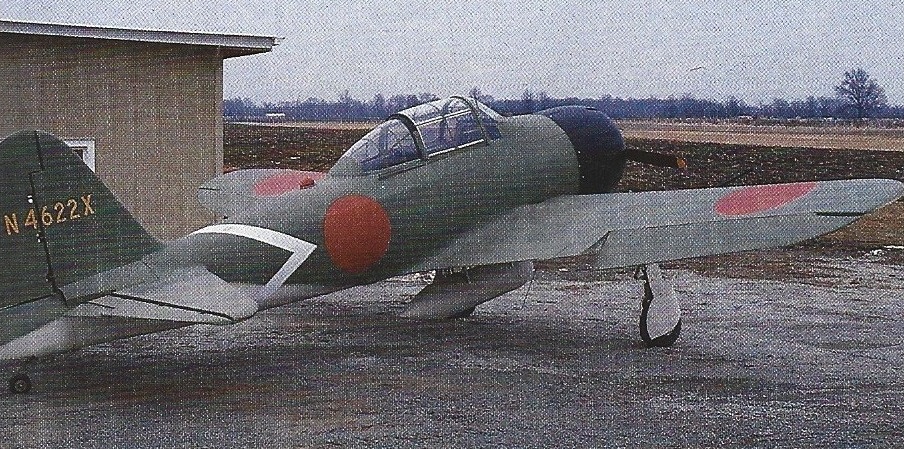
A May 1987 article “Tora, Tora, Tora over Indiana” describes another one of Mr. Don Roberts’ class projects, a 5/8 scale Zero. It was mostly of wood construction, using the wing from the Cavalier and a fuselage made from a wood box covered with foam and fiberglass, similar to the WAR replicas. It was powered by an O-290-D2 from a Tri-Pacer. (Overhauled to “zero time,” it says.)

Roberts Zero Article

Roberts Douglas Dauntless

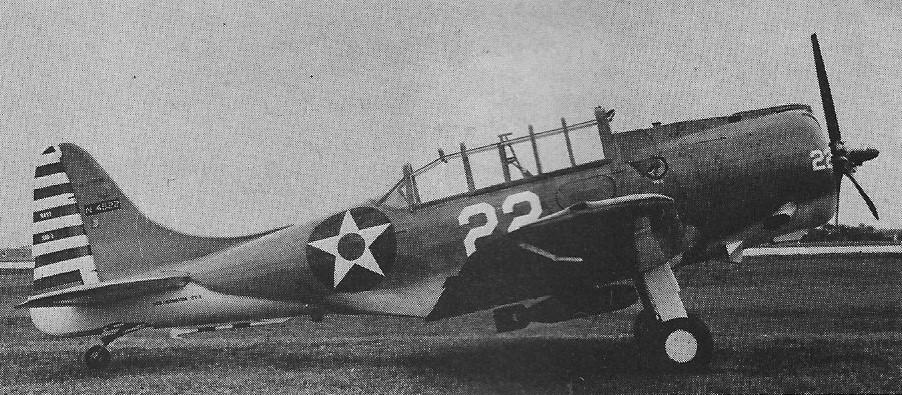
A 2/3 scale Douglas Dauntless dive bomber was built by a group of high school students in Project Schoolflight.

The project was lead by a Mr. Don Roberts of Noblesville High School, Noblesville, Indiana. Construction began in the fall of 1972 and was completed in May of 1977 at a cost of $15,000.

They supposedly used the plans from a Guillow’s Balsa Wood kit and scaled. The aircraft was powered by a Lycoming O-435. The wing was aluminum; the fuselage was steel tube with aluminum formers and skins.

It first flew on 25 May 1977.

The aircraft was supposedly sold after it was completed.

The Dauntless went to the San Diego Air Museum.

Jan 19, 2021
I was a student of Don Roberts 76-79 and remember this aircraft well! I remember the smell of the polyester resin through half of the school building from the cowl construction. Mains were from a Ryan Navion if I remember correctly. The “bomb” was donated by the Navy recruiter and we all got copies of Naval Aviation News which had an article of the plane.

Roberts, Don

Don Roberts of Noblesville High School, Noblesville, Indiana.

Mr. Roberts built or rebuilt 10+ aircraft in the high school program he led, involving hundreds of boys in the process.

Mr. Don Roberts was a Navy man, serving on the aircraft carrier USS Essex as an aircraft maintenance technician.

He describes his ring-side seat at the Bay of Pigs invasion.

I was at Noblesville High School from 1972 to 1976 and worked on this plane. Mr. Roberts approached the school board several years before I became a high school student and convinced the board to allow him to put together an aviation program. The Dauntlas was the third plane the school built. Don was able to scratch together funds to allow us to build this plane and it was one of the greatest experiences I had. The program he put together was three years, the first was a ground school, the second you learned how to work on airplanes, (welding, riveting and general maintenance), and in the third year two students were selected to supervise the rest that worked on this plane. He took a group of us to Oshkosh two years in a row.

RMT Aviation Bateleur

The configuration of the Bateleur brings numerous advantages compared to the conventional high or low winged aircraft. Its flight and handling characteristics remaining standard allows any pilot instant conversion.

The tandem seating for 2 people gives both pilot and passenger full view to both sides. The concept has proven to be stable in severe turbulence, comparable only to aircraft many times its weight making it very suitable as an aerial photographic or observation platform. The endurance and range in excess of 7 hours / 1000 km can be extended with auxiliary tanks by another 50%. As an Ultralight, the MTOW is 450 kg.

Bateleur 115 T
Stall: 35 kt / 40 mph / 65 kmh
Cruise: 149 kt / 171 mph / 276 kmh
VNE: 173 kt / 199 mph / 320 kmh
Empty Weight: 259 kg / 570 lbs
MTOW Weight: 599 kg / 1320 lbs
Climb Ratio: 1700 ft/min / 9 m/s
Glide Ratio: 18
Take-off distance (50ft obstacle): 500 ft / 152 m
Landing distance (50ft obstacle): 400 ft / 122 m
2009 Price: 92800 EURO

Bateleur 912 S
Stall: 35 kt / 40 mph / 65 kmh
Cruise: 140 kt / 162 mph / 260 kmh
VNE: 173 kt / 199 mph / 320 kmh
Empty Weight: 250 kg / 551 lbs
MTOW Weight: 600 kg / 1323 lbs
Climb Ratio: 1400 ft/min / 7.1 m/s
Glide Ratio: 18
Take-off distance (50ft obstacle): 720 ft / 220 m
Landing distance (50ft obstacle): 490 ft / 150 m
2009 Price: 78800 EURO

RMI RMI-9 M/G

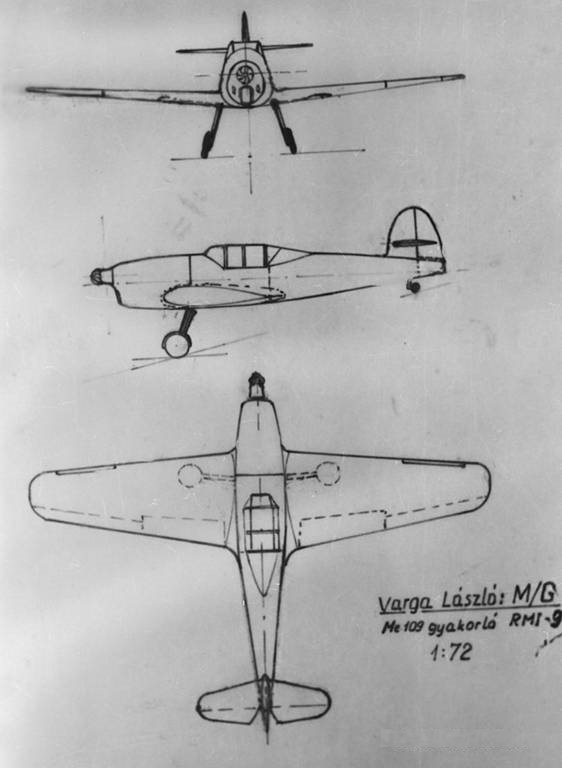
From 1943 the Air Force was gradually getting the Bf-109 advanced jet fighters (F and G versions), but it was not easy to get used to the tight and narrow track undercarriage. The Aero Technical Institute created the RMI-9 M/G specifically for the Messerschmitt pilots in training. The machine was designed with slats, so as to better mimic the Bf-109 flight characteristics.

Designed by Varga László, the RMI-9 M/G [or Me/G] Bf-109 pilot trainer was built but destroyed by US bombing in 1944 in the Ferihegy experimental hangar.

Engine: Argus As-411, 480 hp
Wing span: 9.5m
Length: 7.2m
Height: 2.3m
Empty weight: 1,100 kg
T/O weight: 1,480 kg
Maximum speed: 350 km/h
Range: 700 km
Ceiling 9,200 m

RMI RMI-8 X/V / Marton X/V

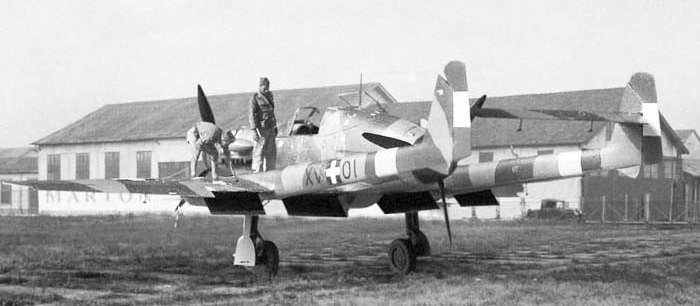
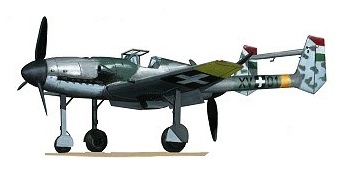
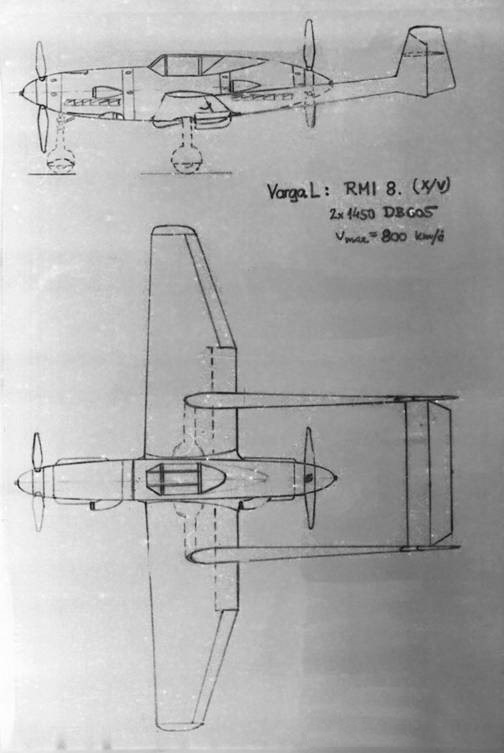
The RMI-8 X/V twin-boom, twin DB605 fighter was designed by Vilmos and Dezso Marton (assisted by László Varga), was also called the Marton X/V after the designers.

The two wings joined to the tail section, which is designed to incorporate the connection points of the high-powered MK-108 (30mm) deck gun.

The prototype (X/V-01) was said to have been destroyed by bombing while the airframe was still incomplete in April 1944.

Engines: 2 x DB-605, 1475 hp
Wing span: 11.8m
Length: 10.2m
Height: 3.5m
Empty weight: 2,850 kg
T/O weight: 3,800 kg
Maximum speed: 800 km/h
Range: 1,000 km
Ceiling: 11,500 m
Armaments: 2 x 8 mm machine guns, 2 x 30mm MK-108 machine guns.