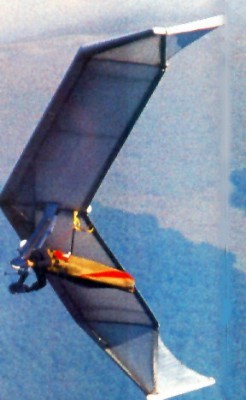
The Flair was a design developed by Günter Rochelt in 1987. Featured on the cover of ‘Drachenflieger’ magazine in November 1987. It was first conceived in 1984, but took some time to develop, with work on the fiberglass – Carbon – Kevlar airframe begun in Spring 1987. After a few test flights, in which the performance was confirmed but the rudders were found to be somewhat ineffectual, Günter decided not to put the Flair into production, concluding that he could improve performance further with some changes to the design (which led to the Flair 30, whose design goal was to reach a 30:1 glide ratio in a foot-launched aircraft.)
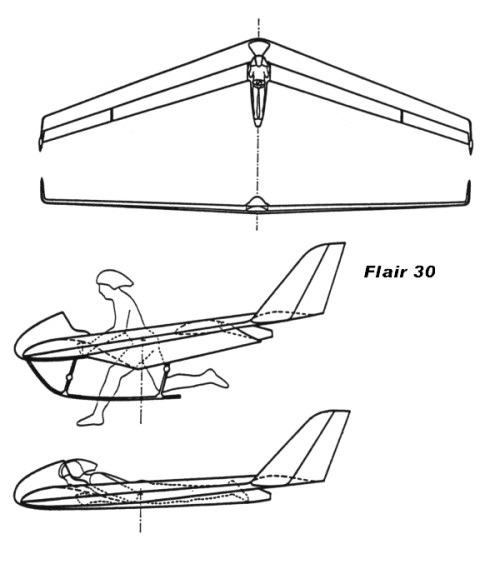
The Flair 30 was a follow-up to the Flair design and first flew in 1990. The pilot could launch by foot, then lay prone in a special harness, and finally land on a skid. After extensive test flights, including more than 50 hours logged by test pilot Knut Von Hentig, the prototype was destroyed in a crash at a sailplane club, when the sailplane pilot flying it dove into the ground at high speed from less than 100 m. Control reversal was suspected but unproved.
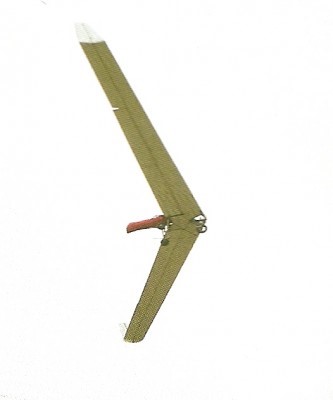
The test pilot felt the glide ratio and sink rate was quite poor, worse actually than modern flex wings
Flair
Wing area: 14.5 m²
Wing span: 11.47 m
Aspect ratio: 9
Maximum pilot weight: 165 kg
Max glide ratio (L/H): 17
Max glide ratio speed: 45 km/h
Minimum sink rate: 0.65 m/s
Nose angle: 147°
Flair 30
Wing area: 11 m²
Wing span: 12 m
Aspect ratio: 14
Profile: CM-140-K47
Hang glider weight: 33 kg
Maximum pilot weight: 90 kg
Minimum speed: 30 km/h
Maximum speed: 150 km/h
Max glide ratio (L/H): 30
Max glide ratio speed: 65 km/h
Minimum sink rate: 0.72 m/s
Packed length: 6.6 m
Nose angle: 160°